Search Engine Optimization Basics Every Founder Must Know
Learn search engine optimization basics for founders: how to get found by Google and AI engines like ChatGPT, Perplexity, and Gemini without an agency.

Search engine optimization basics for founders means making your business easy for both traditional search engines and AI engines like ChatGPT, Perplexity, and Gemini to find, understand, and recommend, without hiring an agency. In practice this means structuring your website content clearly, adding structured data that spells out what your business does, publishing genuinely useful pages, and tracking whether AI tools and Google are actually surfacing you. SMBs can now automate most of this with affordable software instead of paying agencies thousands per month.
Search Engine Optimization Basics: What Changes When AI Search Is Involved?
Google ranks pages by crawling and indexing links; AI engines skip the list entirely and synthesize a single answer, naming or omitting your business in the process. That difference is the whole reason search engine optimization basics look different in 2025 than they did five years ago.
Why Are AI Search Engines Different From Google?
Google's model is built around sending users to a webpage, it crawls your site, indexes the content, and ranks it against competitors based largely on links and relevance signals. ChatGPT, Perplexity, and Gemini work differently: they pull from multiple sources at once, compress that into one answer, and either cite your business by name or leave it out entirely [1].
That shift matters because the AI model skips the click. A customer asking Perplexity "best project management tool for a 10-person team" never sees ten blue links, they see one answer, often with two or three brands mentioned. If your business isn't one of them, you lose the customer before your website ever comes into play [2].
This is also why a business can rank on page one of Google and still be invisible in AI search. Google rewards a page built around keywords and backlinks. AI engines reward content that answers a question directly, in language the model can lift and attribute cleanly. A founder can have strong Google rankings and zero ChatGPT mentions at the same time, and because more buying journeys now start with an AI query, that gap directly costs new customer discovery [1].
How Does Strategy Change When Targeting AI Recommendations Instead of Rankings?
Old-school link building doesn't translate well to this environment. AI engines weigh clarity, structured data, and directly-answerable content more heavily than raw backlink volume, a page that states plainly what your business does, who it serves, and what makes it different will out-perform a page stuffed with keywords and inbound links but no clear answer [1][3].
This is also where third-party mentions start to matter more than they did for classic SEO. LLMs tend to surface what other sites and reviewers say about a business, not just what the business says about itself [3]. That means technical fixes alone, schema markup, clean headings, fast load times, aren't enough; the content and the surrounding signals both need attention.
The practical implication for founders: you can't run two separate playbooks, one for Google and one for AI engines, without the costs doubling and the signals conflicting. You need one approach that satisfies both at once, structured enough for AI engines to parse and cite, substantive enough for Google to rank. Moonrank was built around that overlap, running daily content publishing alongside schema markup and llms.txt configuration so the same site output serves both systems instead of splitting the work across two efforts.
How Do You Get Your Business Discovered by ChatGPT and Perplexity?
Getting recommended by ChatGPT or Perplexity means fixing how AI engines read your site technically, then giving them direct, consistent facts to quote.
Google SEO basics still matter, backlinks, page speed, keyword targeting. But AI search engines like Perplexity and ChatGPT work differently: they retrieve, summarize, and cite information in real time, often skipping the click entirely. Zero-click results already make up close to 60% of searches [1], which means the old goal of "rank in the top 10 blue links" is being replaced by a new one: get pulled into the answer itself. That requires a parallel set of search engine optimization basics on top of the traditional ones.
What Steps Get Your Website Indexed and Recommended by AI Search Engines?
Start with schema markup, structured data tags that label exactly what your business sells, where it operates, and who it serves, written in a format machines parse instantly rather than infer from paragraphs. A hotel using schema can specify room types, price tier, and neighborhood directly in the code, so an AI engine doesn't have to guess from marketing copy. Without that labeling, an AI system has to interpret loose prose, and ambiguity is exactly what keeps a business out of a generated answer.
Next, add an llms.txt file, a plain-text file, similar in spirit to robots.txt, that tells AI crawlers which pages matter most and what the site is fundamentally about. It will not guarantee a citation, but it removes guesswork for crawlers that increasingly shape which businesses get mentioned [1]. This is one of the clearest areas where AI search diverges from classic Google ranking factors: Google has decades of signals to infer intent, while AI crawlers lean harder on explicit, structured cues.
This is also where a platform like Moonrank fits in, it handles schema markup, llms.txt configuration, and citation building automatically, so a shop owner doesn't need to touch code to be AI-readable.
Taken together, the core search engine optimization basics for AI discoverability come down to a short list:
- Add schema markup that states plainly what your business sells, where, and for whom.
- Publish an llms.txt file so AI crawlers know which pages matter most.
- Keep business details identical across your website, directories, and review sites.
- Write pages that answer one specific question clearly instead of general marketing copy.
- Earn third-party mentions, reviews, and press that AI engines can pull from directly.
What Content and Technical Signals Do AI Search Engines Actually Look For?
AI engines pull from content that answers questions directly, not from copy built to sound persuasive. A page titled "Do you ship to Canada?" with a one-paragraph answer gets quoted more often than a vague "About Us" page, because the engine can lift the answer cleanly [2]. FAQ pages, specific service descriptions, and plainly stated pricing tiers all function as citable units. Consistency matters just as much as clarity. If your directory listings, reviews, and website describe your business differently, one says "boutique hotel," another says "budget inn", AI engines lose confidence in which version is true and tend to cite the competitor with the cleaner, matching story across the web [3].

What Technical and Content Changes Do SMBs Need to Rank?
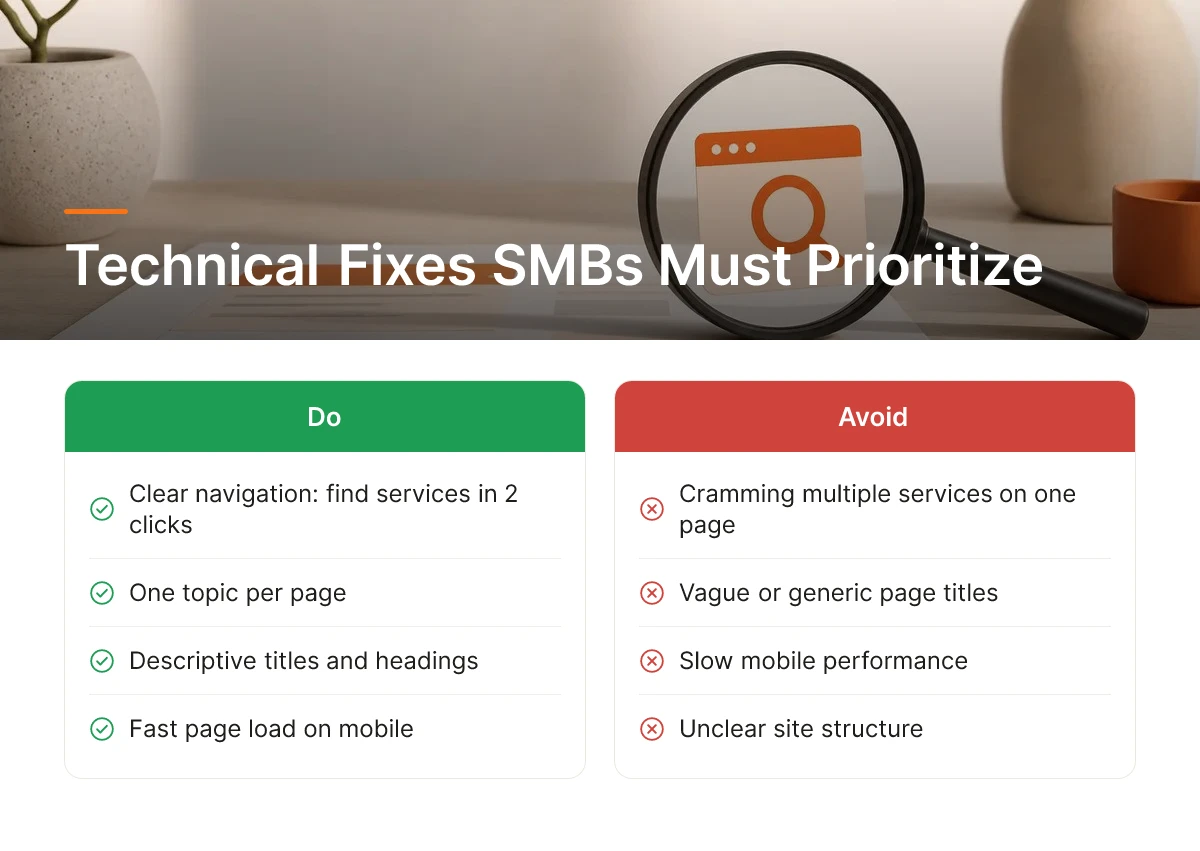
The technical fixes that matter most are unglamorous: clear navigation, one topic per page, descriptive titles, and pages that load fast on a phone. These four items cover most of what separates a site Google and AI engines can parse from one they skip over.
Clear navigation means a visitor, or a crawler, can find your services, pricing tier, and contact details in two clicks or fewer. One clear topic per page means you don't cram "web design," "logo design," and "SEO services" onto a single page hoping it ranks for all three; split them. Descriptive titles and headings should state plainly what the page covers, "Shopify Migration Services for Furniture Retailers" beats "Our Services" every time. And page speed still matters: a bloated homepage that takes six seconds to load on mobile loses visitors before they read a word, and search engines notice the same bounce.
What Are the Most Common SEO Mistakes Beginners Make?
Most beginner mistakes come from optimizing for a machine that no longer exists rather than the customer actually reading the page. Among founders just learning the search engine optimization basics, a few mistakes show up again and again:
- Keyword-stuffed copy that repeats a phrase like "best cybersecurity software for small business" several times in a paragraph, which reads as spam to both readers and modern ranking systems.
- Duplicate or thin pages, such as a hotel chain publishing near-identical pages for each location with no unique content, giving search engines nothing to differentiate.
- Missing structured data, meaning the schema markup that tells search engines and AI tools exactly what your business sells, where it's located, and what it costs is simply absent.
- Inconsistent business information, a different phone number or address on your website versus your Google listing versus a directory, which erodes the trust signals AI engines use to decide who to recommend [3].
- Ignoring page speed, which remains a quiet killer of otherwise solid content.
How Do You Organize a Website So Both AI and Traditional Search Can Find It?
Group related content into topic clusters, a core service page supported by FAQs and in-depth guides on the same subject, so both crawlers and AI engines see a business with real depth, not a single thin page guessing at everything. A cybersecurity SaaS company, for example, benefits from a core "endpoint protection" page linked to an FAQ on compliance requirements and a guide comparing deployment options. That structure signals authority the way a single generic "solutions" page never can [2]. The content itself should answer the specific question a customer or an AI engine would ask, not repeat brand slogans. "What does SOC 2 compliance cost for a 50-person company?" earns a citation; "We're the industry leader in security solutions" does not [3]. These structural habits are the search engine optimization basics that hold up regardless of which engine, Google, ChatGPT, or Perplexity, is doing the reading. Moonrank handles this organizing work directly, building the site structure, schema markup, and topic clusters automatically rather than leaving a founder to sort it out page by page.
How Long Does SEO Take to Work, and What Should You Measure?
Technical fixes can show results in weeks, but content authority and ranking growth take months, expect progress in tiers, not a single deadline.
Founders who skip this step tend to quit right when traction is about to start. Understanding the realistic pace of each layer of search engine optimization basics keeps expectations grounded and prevents premature abandonment of work that's compounding in the background.
What Timeline Should SMBs Expect Before Seeing Results From AI Search?
Technical changes, fixing crawl errors, adding schema markup, submitting an updated sitemap, can get pages indexed and parsed correctly within two to four weeks. These are mechanical fixes: once a search engine or AI crawler can read the page properly, that part of the job is done.
Content authority is slower. Building the kind of experience-driven, well-cited content that AI systems trust enough to reference takes sustained publishing over months, not a single blog post [1]. Google rankings and AI search visibility also don't move on the same clock. Google's ranking system relies heavily on established factors like backlinks and crawl history, built over years in some cases, while AI platforms like ChatGPT and Perplexity can surface a newer page faster if it directly answers a conversational query with clear structure and credible sourcing [1][2]. Judging AI visibility by Google's historical timeline, or vice versa, leads to false conclusions about what's working.
This is part of why automated, consistent publishing matters more than occasional bursts of content. Moonrank's daily content generation and technical optimization are built around this tiered reality: schema markup and llms.txt configuration can improve AI readability almost immediately, while the compounding content archive builds authority over the following months.
How Do You Track Whether SEO Efforts Are Actually Working?
Four metrics matter more than any single ranking number. Organic traffic trend over 90-day windows shows whether visibility is actually growing. Indexed page count confirms search engines and AI crawlers can find and parse your content at all. Whether your business shows up in AI-generated answers for relevant queries, tested by actually asking ChatGPT or Perplexity the questions your customers would ask, is a direct visibility signal [2]. Conversion from organic visitors confirms the traffic that does arrive is the right traffic.
Raw keyword rankings alone are a vanity metric; a page one ranking for a term nobody searches, or that doesn't convert, means little [3]. Track actual brand mentions and citations by AI tools instead, that's the signal that maps to real customer discovery in 2026's search environment.
What Tools Can Replace an Expensive SEO Agency?
Three categories of software now handle what agencies used to bill for: technical audits, content publishing, and AI visibility tracking. Understanding this split is one of the search engine optimization basics founders need before they decide whether to hire out or automate.
A traditional retainer typically bundles a technical audit, a content calendar, and a monthly reporting call. A small business SEO consultant put it plainly: most owners show up to an agency relationship already burned, paying for "monthly reports full of graphs" without a clear sense of what changed or why [3]. The work itself, crawling a site for errors, writing posts, compiling data into a dashboard, is repetitive enough that software can now do it on a schedule, without a strategist re-deriving the plan each month.
What Tools Should Beginners Use Instead of Hiring an Agency?
Beginners need exactly three tool categories, not a stack of ten. The first handles technical and structured data audits, checking schema markup, site speed, and crawlability, the kind of technical groundwork one Forbes Council contributor called a "great place to start" for any business's SEO [5]. The second handles content publishing, since consistent, experience-driven writing is what AI engines look for when deciding who to cite as authoritative [1]. The third tracks visibility specifically inside AI answers, ChatGPT, Gemini, Claude, Perplexity, because standard rank trackers were never built to measure whether a chatbot mentions your brand at all.
How Can SMBs Automate SEO to Stay Competitive Without Manual Effort?
Automation removes the two bottlenecks that made agencies necessary: someone has to update structured data every time a site changes, and someone has to write and publish new content on a predictable cadence. Solopreneurs managing SEO on two to five hours a month already lean on this logic, since the strategy only works long-term if it does not depend on burning out one person's time every week [2]. When software handles schema updates and daily publishing automatically, the manual labor an agency used to charge for simply stops being manual.
Moonrank was built around this exact gap. It runs daily automated content generation and auto-publishing, implements schema markup and llms.txt configuration for technical AI-readability, and tracks how a business appears across ChatGPT, Gemini, Claude, and Perplexity, all three categories beginners need, in one subscription at a budget-friendly monthly rate instead of the premium retainers agencies typically charge. For e-commerce stores, B2B SaaS companies, and other SMBs that want AI search optimization and traditional SEO handled together without hiring a team, visit www.moonrank.ai to get started.

Frequently Asked Questions
Do I need separate strategies for Google SEO and AI search optimization?
No, the fundamentals overlap heavily, so one strategy covers both if you build it around trust signals rather than keyword tricks. Clean site structure, structured data, and content that demonstrates real expertise help Google rank you and help ChatGPT, Gemini, Claude, and Perplexity decide you're a credible source to cite [1]. The main addition for AI search is machine-readable formatting like schema markup and llms.txt files, which signal context those systems can parse directly.
Is SEO worth it for a small business compared to paid ads?
Yes, for most small businesses SEO delivers better long-term value because a well-optimized page keeps generating traffic for months or years after publication, unlike an ad that stops the moment you stop paying [2]. SEO is also a low-cost, evergreen way to build brand awareness and attract customers without a recurring media spend [5]. That said, paid ads still work faster for immediate demand, many businesses run both, using ads for short-term volume while SEO compounds in the background.
Can I do SEO myself without any technical background?
Yes, the core work is writing clear, useful content and fixing basic technical issues, neither of which requires a computer science degree [2]. Boosting site speed, organizing pages logically, and publishing content consistently cover most of what moves the needle [5]. Tools like Moonrank handle the harder technical layer, schema markup, llms.txt, structured data, automatically, so you don't have to learn to edit code yourself.
How do I know if ChatGPT or Perplexity is already recommending my business?
Ask the AI engines directly, type the kinds of questions a customer would ask, like "best [your category] near me," into ChatGPT, Gemini, Claude, and Perplexity and see who gets named. Since these platforms pull from third-party mentions rather than your own marketing copy [3], check if review sites, directories, or press coverage about your business even exist for them to cite. Moonrank's visibility tracking automates this check across all four engines so you're not guessing manually.
Where should a complete beginner start with search engine optimization basics?
Start by auditing what already exists: check whether your pages load quickly, whether each page covers one clear topic, and whether your business details match across your website, Google listing, and directories. From there, add schema markup, publish an llms.txt file, and write a handful of pages that directly answer the questions your customers actually ask. These first few fixes cover most of the search engine optimization basics that influence both Google rankings and AI citations.
Conclusion
SEO fundamentals haven't changed as much as the channels they serve. Clear, expertise-driven content, solid technical structure, and third-party signals that prove your business is real still decide who gets found, whether that's Google's crawler or an AI engine deciding who to cite [1][3]. The shift is that AI search engines now sit alongside Google as a discovery channel your business needs to earn visibility in, not just optimize for after the fact.
Start small: ask ChatGPT and Perplexity what they say about your business today, then fix the biggest gap you find. If daily content and technical upkeep aren't realistic on your own schedule, Moonrank runs that process automatically at www.moonrank.ai.
Sources & References
- AI Search Is Reshaping SEO: How SMBs Can Win in the Zero-Click Era
- SEO for Solopreneurs: 2026 Guide to Search & AI Visibility
- Small Business SEO: Building Authority That Outlasts the Algorithm | Jeremy Rivera
- SEO Basics Every Entrepreneur Can Master
Recommended Articles
Explore more from our content library: