8 Reasons Your Small Business Stays Invisible Online
Small businesses stay invisible to AI search tools like ChatGPT, Gemini, Perplexity, and Claude because these systems recommend based on structured...

Understanding why small business invisible online is essential. Small businesses stay invisible to AI search tools like ChatGPT, Gemini, Perplexity, and Claude because these systems recommend based on structured, consistent, well-explained information, not keyword rankings. Traditional SEO signals (backlinks, meta tags, page one rankings) carry little weight with AI engines, which instead pull from structured data, consistent business details across the web, and content that directly answers specific questions. The 8 reasons below cover the specific gaps, from missing schema markup to inconsistent listings, that keep AI systems from finding and recommending a business, plus how to fix each one.
1. Why Small Business Invisible Online Starts With Missing Structured Data
Missing schema markup is the top reason why small business invisible online problems persist, AI engines cannot extract what unstructured web pages only imply.
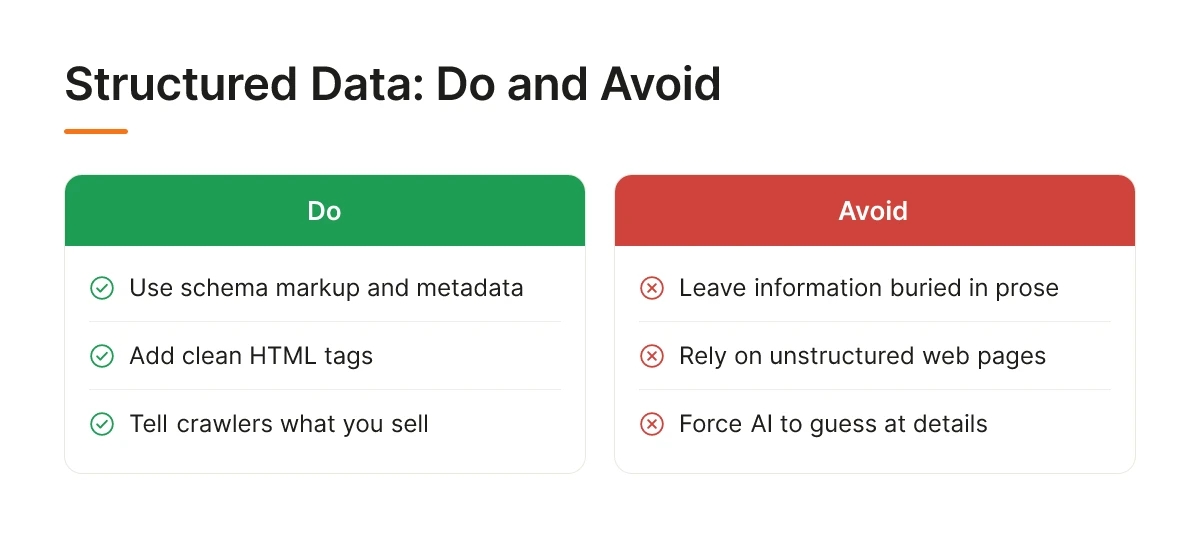
AI search engines parse structured signals far more reliably than flowing prose. Schema markup, organized metadata, and clean HTML tags tell a crawler exactly what a business sells, where it operates, and what it costs, instead of leaving that information buried in sentences a language model has to interpret.
What Structured Data and Metadata Do AI Engines Need to Find and Recommend You?
Without schema, an AI crawler has to guess at services, location, and offerings the way a distracted reader might, and guessing produces wrong or incomplete answers. A hotel that lists room types and amenities only in paragraph form ("Our rooms include a king bed, ocean view, and complimentary breakfast") forces the AI to infer structure. The same hotel marking up room type, occupancy, price, and amenities as discrete structured fields gives the AI exact data it can quote with confidence.
This matters specifically for AI engines, not just Google's rich snippets, ChatGPT, Gemini, Claude, and Perplexity build answers from structured facts they trust, not from skimming marketing copy [2]. This is why Moonrank's technical audit implements schema markup, llms.txt configuration, and structured data as a baseline step, not an afterthought.
Best for: ecommerce stores and SaaS companies with detailed product or feature catalogs, where every unmarked specification is a missed citation opportunity.
2. Inconsistent Business Information Across the Web
Contradictory details about a business across different sites lower an AI engine's confidence score and push it toward a more consistent competitor.
How Does Inconsistent Business Information Hurt AI Discoverability?
AI engines cross-reference multiple sources before recommending a business, they check whether a claim on the company website matches what appears on review platforms, directories, and third-party listings. When the facts disagree, the system has no reliable way to decide which version is true, so it often drops the business from consideration entirely.
Consider a SaaS company that lists one set of pricing tiers on its own site and a different, outdated set on a review platform like G2 or Capterra. Or a hotel whose amenity list on its own booking page says "free parking and pool access" while three different booking sites list neither. Each contradiction chips away at the AI's trust in every other claim the business makes.
This hits AI synthesis harder than it hits Google. Google tolerates minor inconsistency because it ranks pages individually; AI engines synthesize one answer from several sources, so contradictory inputs get treated as unreliable and are more likely to be excluded [2].
Best for: multi-location businesses and hotels, whose listings are scattered across dozens of directories and booking platforms where small discrepancies accumulate fast.
3. Thin or Generic Content That Doesn't Answer Real Questions
Generic marketing copy written for keywords instead of real questions is largely why small business invisible online outcomes happen even with a well-designed site.
Why Does Thin or Low-Quality Content Make Small Businesses Invisible to AI?
AI engines favor content that directly and specifically answers a query over content optimized to rank for a keyword phrase. A vague "About Us" page or a service page padded with adjectives doesn't give an AI model anything concrete to extract and cite.
Compare a generic "Our Software Integrates With Your Tools" line to a page structured around the actual question a B2B SaaS buyer types into ChatGPT: "Does this platform integrate with Salesforce and Okta without custom API work?" The second version gives a direct, checkable answer; the first gives nothing an AI summarization model can confidently repeat.
The mechanism is straightforward, AI summarization extracts clear, self-contained answers and skips promotional filler, since vague language carries no verifiable claim to surface [1]. Pages written to satisfy a keyword rather than answer a specific question get passed over in favor of competitors who answered the real question directly.
Best for: B2B SaaS and cybersecurity companies, whose buyers research highly specific technical questions, compliance scope, integration depth, data residency, before ever contacting sales.
4. No Clear Content Strategy Built Around Buyer Questions
Without a content plan mapped to real buyer questions, AI engines fill those gaps with answers pulled from competitors instead.
AI engines assemble answers from whichever source most directly and completely addresses a sub-question. Every buyer question a business never addresses in writing becomes a visibility gap that a competitor's content quietly fills.
An ecommerce brand that never publishes anything about sizing guidance, return policy specifics, or how its product compares to alternatives loses every one of those moments, even if its core product pages are strong. A shopper asking an AI assistant "does this brand run small" or "is this returnable after 30 days" gets routed to whichever retailer actually answered that question in writing.
The difference is writing for rankings versus writing to be the most complete answer to one specific question. A keyword-driven page tries to cover a broad topic shallowly; a question-mapped page answers one query thoroughly enough that an AI model can lift it directly.
This only works as an ongoing practice, a one-time content audit maps today's gaps, but buyer questions shift constantly, which is why Moonrank runs daily automated content generation tied to a business's specific niche rather than a single static keyword list.

5. Weak Entity Signals and Lack of Topical Authority
AI engines trust a business as a credible source only after seeing consistent, repeated coverage of a topic, not from a single strong page.
Do AI Search Engines Favor Established Brands Over Small Businesses?
AI systems build confidence in a business as a reliable source through repeated, consistent topical coverage over time, not isolated keyword wins. One excellent blog post rarely moves the needle; a pattern of coverage on the same subject does.
Compare a cybersecurity firm with a single generic blog post titled "Why Security Matters" against one that consistently publishes on a specific niche, compliance requirements for mid-size financial firms, say, month after month. The second firm becomes the entity an AI engine associates with that exact question; the first remains undifferentiated from thousands of similar posts.
Small businesses usually lose this contest not from lack of expertise but from inconsistent publishing and scattered topics, one month on ransomware, the next on unrelated general IT advice, with no throughline an AI model can learn to associate with the brand.
Best for: cybersecurity and B2B SaaS companies competing against larger, better-funded brands on authority rather than budget. Moonrank's competitive landscape analysis is built around this exact problem, surfacing where competitors have built topical authority and where gaps remain open. Businesses ready to close those gaps without hiring a content team can start at www.moonrank.ai.
6. Overlooking Where AI Engines Actually Pull Answers From
AI engines treat third-party mentions, reviews, forums, comparison sites, as independent proof a business is real and trustworthy, not just what the business says about itself.
A hotel can have a polished website and still get skipped by Perplexity or ChatGPT if it's absent from travel forums and review aggregators where guests actually discuss their stay. An ecommerce brand with a fast, well-built store can lose out to a competitor who simply shows up more often on comparison sites and review platforms. The AI engine isn't reading the business's own claims as fact, it's looking for corroboration elsewhere first.
What SEO Tactics That Work for Google Don't Work for AI Search Engines?
Google's ranking math rewards backlinks as a signal of authority and relevance, regardless of whether the linking page is agreeing with the business or just referencing it. AI engines instead look for corroborating evidence across independent sources before recommending a business, which means a page full of backlinks but no third-party validation can rank on Google and still get ignored by an AI assistant [2]. This is one of the clearer answers to why small business invisible online patterns persist even after a site technically "ranks."
This gap matters most for hotels and ecommerce brands, where review volume and third-party trust signals carry outsized weight in purchase decisions.
7. No Way to Measure or Track AI Visibility
Most small businesses have zero insight into whether ChatGPT, Gemini, Perplexity, or Claude ever mention them, so the problem stays hidden until a competitor gets cited instead.
Google Analytics and traditional rank trackers report organic traffic and keyword positions, neither captures whether an AI assistant recommended a business by name in a chat response. That activity happens outside any dashboard a typical shop owner or SaaS founder already checks daily.
What Metrics and Tools Should Small Businesses Use to Track AI Search Visibility?
The most direct method is manual: run the actual prompts a customer would type, "best project management tool for small teams" or "boutique hotel in [city] with rooftop bar", across all four major engines and log whether the business appears, how it's described, and which competitors show up instead. This creates a baseline where none existed before.
How Often Should You Audit AI Search Performance?
A single check only captures one moment in a system that keeps changing. AI models update frequently, and answers shift as training data, citation sources, and ranking logic evolve, so a business cited today can disappear next month without any site change on its end. Treating this as a recurring monitoring habit, checked on a consistent schedule rather than once, is what separates businesses that catch a drop early from those that find out only after losing customers to a competitor.
8. Treating AI Search and Google SEO as the Same Problem
Good technical SEO helps AI engines crawl a site but doesn't automatically make its content citable, which is why AI visibility needs separate attention.
A fast-loading, cleanly structured site makes it easier for any crawler, including the ones feeding AI models, to access content in the first place. But crawlability isn't the same as recommendability. An AI engine still needs clearly structured answers, consistent facts, and corroborating sources before it cites a business by name.
Does Fixing AI Search Visibility Also Improve Your Google Rankings?
Rarely does fixing AI visibility hurt Google rankings, and it often helps them, since clearer page structure and better-answered questions tend to satisfy both systems at once [1]. The two aren't opposing goals, they overlap more than most small business owners assume.
Should Small Businesses Treat AI Search and Google SEO as Separate Strategies?
The inputs differ even where the outcomes overlap. Google's ranking math still rewards keyword density and backlink volume; AI recommendation logic weighs clarity, structure, and consistency across sources more heavily [1]. Businesses currently investing only in traditional SEO and wondering if a separate push is needed should treat AI visibility as an added layer, not a replacement.
How to Choose the Right Approach to Fix AI Search Invisibility
Start with structured data and listing consistency, then layer in content production and ongoing measurement based on budget and business type.
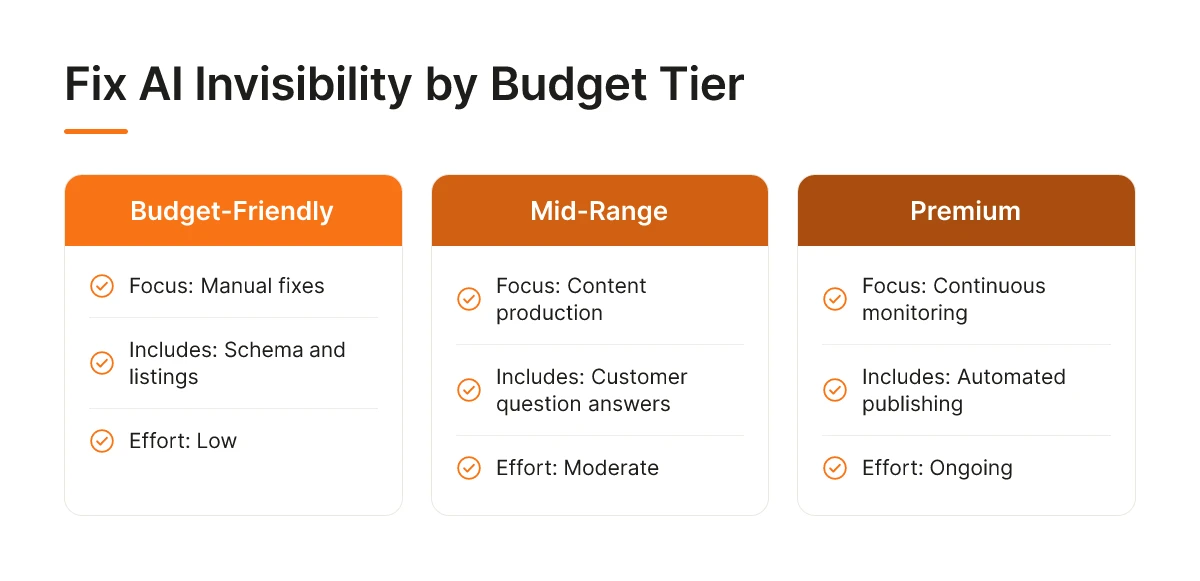
Schema markup and consistent business details across listings are foundational and low-effort, fix these first regardless of industry. From there, priorities split by budget tier: budget-friendly approaches focus on manual fixes like schema and listing consistency; mid-range adds regular content production targeting the questions customers actually ask AI engines; premium adds continuous monitoring and automated publishing so visibility doesn't quietly decay between checks.
Can Small Businesses Afford AI Search Optimization Without Hiring an Agency?
Agencies built for this work typically charge $3,000 or more a month, a cost that puts continuous AI optimization out of reach for most solo founders and small teams. For businesses with limited time, prioritization should follow what's already at stake: hotels and ecommerce brands should prioritize review and listing consistency first, B2B SaaS companies should prioritize clear, structured answers to comparison and "best tool for X" queries, and cybersecurity companies should prioritize citation-worthy technical content that establishes authority.
Manual fixes don't scale to daily publishing or constant monitoring, that's where automation does the work a single owner can't sustain alone. Moonrank runs daily content generation, technical optimization, and AI visibility tracking across ChatGPT, Gemini, Claude, and Perplexity on autopilot, built specifically to solve why small business invisible online without requiring an agency retainer or a content calendar. Visit www.moonrank.ai to see where a business currently stands.
Frequently Asked Questions
What data do AI search engines actually use to recommend businesses?
AI engines pull from structured data, business listings, reviews, citations across the web, and content that directly answers customer questions. They favor pages with clear schema markup, consistent business details across directories, and third-party mentions that confirm what a business claims about itself. Classic ranking signals like backlink volume matter less than trust signals like consistency and citation [2].
Can automation help small businesses scale AI visibility without manual work?
Yes, automated tools can handle daily content publishing and technical optimization without requiring an owner to write anything. Moonrank, for example, runs keyword research, content generation, and schema/llms.txt setup on autopilot for a fraction of agency cost, which matters since 67% of small businesses already use AI for content or SEO [1].
Which AI search engines should small businesses prioritize first?
Start with ChatGPT and Perplexity, since both actively cite sources and drive direct referral traffic to businesses. Perplexity alone handles over 100 million weekly queries, and its answer format rewards businesses with clear, well-structured content. Gemini and Claude matter too, but build citation-worthy content first and visibility across engines tends to follow [2].
What advantages do small businesses have in AI search that they don't have in Google?
AI search engines weigh content depth and topical authority more heavily than domain age or backlink count, which levels the field for newer or smaller sites. A specialty hotel or niche SaaS tool with narrow, specific expertise can get cited over a larger generalist competitor if its content answers the exact question better. This rewards focus over scale [1][2].
Will optimizing for AI search engines accidentally hurt your Google SEO?
No, not if done correctly, the two overlap more than they conflict. Google's own AI Overviews pull from well-structured, credible pages, so schema markup, clear answers, and strong citations help both systems simultaneously [1]. The risk only appears when businesses mass-produce thin AI content, which Google's scaled content abuse policy actively penalizes [1].
Conclusion
Small business invisibility in AI search comes down to three fixable gaps: missing structured data, inconsistent citations across the web, and content too thin to get quoted by ChatGPT or Perplexity. Fixing structured data and publishing consistently matters more than chasing backlinks the way old SEO demanded. Businesses that treat this as a daily, ongoing process, not a one-time fix, pull ahead of competitors still waiting on traditional rankings.
Start by running a free AI visibility check on your own business name plus your top three keywords in ChatGPT and Perplexity this week, if competitors show up and you don't, that's your starting point. Tools like Moonrank automate the fix from there.
Sources & References
- How AI Can Help Small Businesses with SEO (2026 guide)
- AI Search Is Changing Everything: Why Your Business Needs to Be Found by ChatGPT, Gemini, Claude and Perplexity - GBX Digital
Recommended Articles
Explore more from our content library: