7 Competitor Analysis Tools for SEO Teams in Cyber Security
The best competitor analysis tools for SEO in cyber security let you track what rival firms rank for, which content earns backlinks, and how they show up...

Understanding competitor analysis tools seo is essential. The best competitor analysis tools for SEO in cyber security let you track what rival firms rank for, which content earns backlinks, and how they show up in AI answers from ChatGPT, Gemini, and Perplexity, without hiring an agency. For SMB cyber security teams, the priority is a tool that covers both traditional Google rankings and AI search visibility, since prospects now ask AI assistants to recommend security vendors directly. Look for budget-friendly or mid-range tools with automated tracking, so a small marketing team can monitor competitors continuously instead of running manual audits every quarter.
Why Cyber Security SMBs Need Competitor Analysis Tools for SEO
Security buyers now ask ChatGPT or Perplexity to shortlist vendors before they ever open a browser tab, so a competitor named in that answer wins the deal before your demo gets booked. This is why competitor analysis tools seo teams rely on for Google rankings alone no longer cover the full risk.
How Competitor SEO Analysis Helps You Rank Better in Traditional Search
Rival vendors who publish threat research and compliance guides earn backlinks from security directories, audit firms, and industry blogs. Those citations compound: AI engines pull from the same well-linked, well-cited pages when generating answers, so a competitor's content advantage in Google search extends directly into AI recommendations. This is particularly relevant for competitor analysis tools seo.
Why Tracking AI Search Visibility Differs From Tracking Google Rankings
Traditional tracking checks keyword position and SERP features, where you rank on a results page. AI visibility tracking asks a different question: does the AI assistant name your brand at all in its generated answer, regardless of any ranking position. A security vendor can rank page one for a term and still be invisible in every AI-generated shortlist.
Small security teams rarely have the headcount to run manual competitor checks across four AI engines plus Google every week. That gap is exactly where tool-driven monitoring replaces spreadsheets and ad hoc searches.
1. Moonrank
Moonrank tracks where your brand and competitors appear in AI-generated answers across ChatGPT, Gemini, Claude, and Perplexity, alongside standard SEO signals.
It identifies competitive gaps and then closes them automatically, publishing optimized content daily and applying technical fixes like schema markup, llms.txt configuration, and citation building, so a finding doesn't sit in a report waiting for someone to act on it. This matters for SMB cybersecurity vendors, B2B SaaS companies, ecommerce stores, and hotels that need continuous monitoring but have no dedicated SEO analyst on staff.
Most competitor analysis tools seo teams use today stop at reporting: they'll tell you a rival ranks for "SOC 2 compliance checklist" and leave the rest to you. Moonrank's differentiator is the follow-through, it turns a competitor content gap into a published, structured page without manual intervention, at $99/month versus agency retainers that commonly run $3,000 or more per month.
2. A Backlink and Content Gap Analyzer
A backlink and content gap analyzer crawls competitor domains to show which specific pages attract the most referring domains and social shares.
The output is a prioritized list of content topics and link sources a lean security marketing team could realistically replicate, rather than a vague sense that "competitors have more links." For a compliance-focused vendor, this might surface that a rival's SOC 2 audit checklist earned links from three industry directories and a law firm blog, concrete targets, not guesswork.
These tools work best for teams with some in-house writing capacity who want direction, not raw data dumps. For security and compliance niches specifically, look for a tool that distinguishes link sources relevant to the industry, audit firms, compliance directories, ISO/SOC certification bodies, from generic guest-post networks that pad backlink counts without building topical trust.
3. A Keyword Gap and Ranking Tracker
A keyword gap tracker compares your ranking keyword list against a competitor's to surface terms they rank for and you don't.
How Do You Identify Which Keywords Your Competitors Are Winning With?
Run a side-by-side comparison of your domain against two or three direct competitors and filter for keywords where they rank in the top 10 and you don't appear at all. This shortens the research phase of a content calendar considerably, instead of guessing what to write next, the tool hands you topics with proven demand, since a competitor is already capturing traffic on them.
This category suits lean marketing teams that need a short, prioritized list over a spreadsheet of raw search volume. For security vendors, the differentiator worth prioritizing is branded versus non-branded keyword separation. Buyers searching "SOC 2 compliance tool" or "vendor risk management software" are evaluating the category, not a specific brand, so non-branded gaps usually matter more than keywords built around a competitor's company name. When considering competitor analysis tools seo, this point stands out.

4. A Free or Low-Cost Manual Research Method
Manual research methods, sitemap reviews, Google "site:" searches, and viewing page source for schema markup, can substitute for paid competitor analysis tools seo platforms in the earliest stage of monitoring.
What Free or Low-Cost Methods Can Replace Paid Competitor Analysis Tools?
Pulling a competitor's XML sitemap shows which pages they've added recently and how often they publish. A Google "site:competitor.com" search filtered by date reveals their newest content without any subscription. Viewing page source on a competitor's key pages shows whether they've implemented schema markup, a signal of how seriously they're optimizing for both Google and AI engines.
Free plans on paid tools are worth testing too, but check the limits before relying on one: most free tiers cap the number of tracked competitor domains or limit historical data to a few weeks, which breaks down fast if you need ongoing monitoring rather than a one-time snapshot.
One free method often overlooked: ask ChatGPT or Perplexity directly which sources it cites for a topic in your niche. The answer reveals exactly which competitor pages are already feeding AI-generated recommendations, a direct, no-cost read on who's winning AI search visibility right now. This approach suits very early-stage teams validating whether a budget-friendly or mid-range paid tier is worth the investment before committing. For teams ready to move past manual checks, Moonrank automates this tracking and acts on the gaps it finds, starting with a 3-day free trial.
5. An AI Search Visibility Tracker
An AI search visibility tracker runs test prompts across ChatGPT, Gemini, Claude, and Perplexity to log which brands get named in the answers.
Instead of crawling the web like a traditional rank tracker, this category queries the models directly, asking "best EDR software" or "top SOC 2 automation tools" the way a real buyer would, and records who shows up, how often, and in what context. For a B2B SaaS or cybersecurity team, this is the fastest way to see that a competitor dominates the AI conversation on a category term even while your Google rankings look fine.
How Do You See Where AI Platforms Are Positioning Your Competitors vs Your Brand?
Run the same set of buyer-intent prompts weekly and compare which vendors get recommended, in what order, and with what justification. This matters most for teams that already have traditional SEO covered through an agency or an in-house analyst but have zero insight into AI-driven research, a growing share of enterprise software buying, since over 100 million weekly queries now flow through Perplexity alone [1].
Update frequency is the differentiator here. AI answers shift week to week as models retrain or re-crawl source material, so a snapshot from two months ago can point a team at a competitor gap that no longer exists [1]. Among competitor analysis tools seo teams adopt for this purpose, the ones worth paying for refresh citation data frequently enough to catch those swings before a strategy decision is based on stale information.
6. A Technical SEO and Schema Auditor
A technical SEO and schema auditor scans a competitor's pages for structured data, page speed, and crawlability gaps that explain visibility differences.
The output typically flags what schema types are present, FAQ, Organization, Product, Review, along with load-time issues and indexing blocks. Structured data is often what lets AI engines parse a page correctly and cite it with confidence, so seeing which schema a competitor has implemented explains a real chunk of why they get recommended and you don't.
This tool matters most for teams that already match or beat competitors on content quality but still lose visibility. If the writing is comparable and the keyword coverage is similar, the gap is usually technical: missing schema, slow page speed, or crawl errors blocking AI crawlers from reading the page at all. Moonrank's technical audit covers this exact layer, schema markup, llms.txt configuration, and structured data, specifically so AI systems can parse and trust a business's pages, not just so Google can index them.
The differentiator to look for: generic auditors check ecommerce-style schema (Product, Offer, AggregateRating) by default. For B2B SaaS, cybersecurity, or hotel sites, prioritize a tool that specifically flags FAQ, Organization, and Product schema relevant to how those buyers actually search. For those exploring competitor analysis tools seo, this matters.
7. A Social Listening and Mention Tracker
A social listening and mention tracker monitors forums, review sites, and social platforms for competitor mentions, including unlinked brand references.
This is a lighter category than a full backlink audit, but it surfaces something backlink tools miss: earned-media conversations happening outside a competitor's own domain. A mention on a practitioner forum or a review site often never turns into a tracked backlink, yet it still shapes what AI engines treat as a trust signal when they decide who to cite.
It's best suited for teams trying to spot PR angles or partnership moves a competitor already made, a product mention in a community thread, a quoted founder in an industry roundup, a review site comparison where they outrank you. Those are repeatable plays once you see them.
The differentiator for security and B2B SaaS buyers specifically: peer discussion carries more weight than vendor content. A recommendation on a practitioner forum where security engineers debate EDR tools outweighs a polished landing page, which means mention-tracking in those communities deserves more attention than its traffic numbers alone would suggest.
How to Choose the Right Competitor Analysis Tools for SEO
Pick tools based on team size, budget tier, and whether your bigger visibility gap is traditional Google rankings or AI search recommendations.
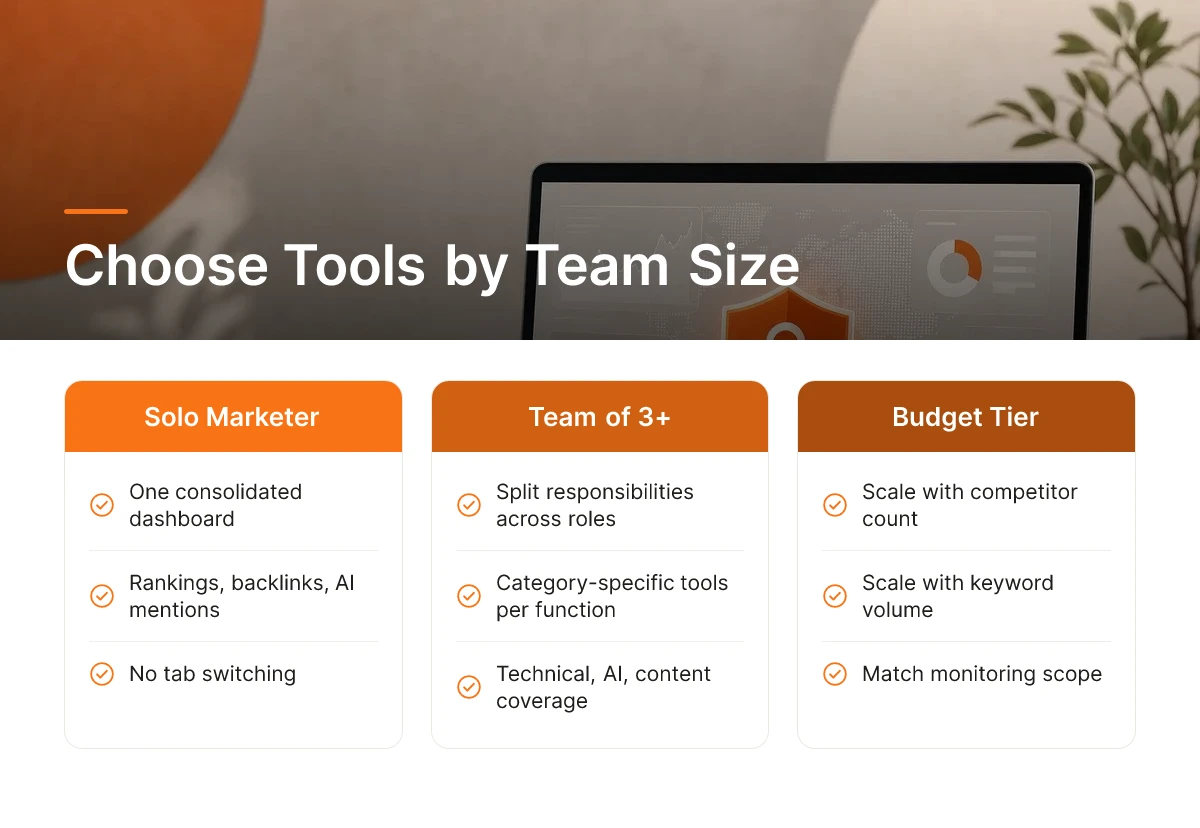
A solo marketer needs one consolidated dashboard that covers rankings, backlinks, and AI mentions without switching tabs all day. A team of three or more can split responsibilities, one person owning technical/schema audits, another owning AI visibility tracking, a third on content and backlinks, and afford category-specific tools for each.
Budget tier should scale with how many competitors and keywords actually need tracking. A business watching three direct competitors across a narrow keyword set doesn't need the same tier as one tracking a dozen rivals across hundreds of terms, budget-friendly tools handle the former fine, while mid-range or premium/enterprise tiers earn their cost only at higher competitor and keyword volume [2].
Learning curve matters as much as feature count. Some platforms dump raw data and expect a trained analyst to interpret it; others, including Moonrank, surface plain-English findings and handle the optimization automatically, which fits a business owner with no SEO background better than a tool built for agency analysts.
Decide which gap is bigger before buying anything: if Google rankings are solid but your brand never comes up when someone asks ChatGPT or Perplexity for a recommendation, weight your tool selection toward AI visibility first.
How Often Should You Update Your Competitor SEO Analysis?
Check AI search visibility monthly, since model updates and re-crawls can shift which brands get recommended within weeks [1]. Backlink and content-gap analysis moves slower and holds up fine on a quarterly cadence. This directly impacts competitor analysis tools seo outcomes.
Can You Automate Competitor Tracking to Save Time and Resources?
Yes, automated tracking removes the manual prompt-testing and spreadsheet work that makes competitor analysis tools seo teams often skip until it's too late. Moonrank builds this into its ongoing visibility monitoring, running the analysis in the background so a business owner sees the findings without running the checks themselves. Visit moonrank.ai to see how it tracks your brand against competitors across ChatGPT, Gemini, Claude, and Perplexity for $99/month.
Frequently Asked Questions
What role do backlinks and content play in competitor SEO analysis?
Backlinks and content still matter, but they cover a shrinking slice of how customers find a business. Traditional SEO tools track which pages and links earn rankings in Google, which still accounts for a meaningful share of search traffic [1]. But AI search engines like ChatGPT and Perplexity weigh citations, structured data, and content freshness differently, so a backlink-heavy strategy alone leaves a business blind to how it gets cited, or ignored, inside AI-generated answers.
Do you need separate tools for social listening, tech stack monitoring, and SEO?
Not always, it depends on team size and budget, not on whether the categories are "different enough" to require separate tools. Larger teams often run distinct platforms for social listening, technical monitoring, and SEO [3]. Smaller teams and solo founders get more value from a smaller stack that covers SEO and AI visibility together, rather than three subscriptions tracking overlapping signals.
How do you avoid copying competitors and instead find your own SEO advantage?
Treat competitor data as a map of gaps, not a script to copy. Competitor analysis shows where rivals rank, get cited by AI engines, or earn backlinks, the value is spotting keywords and topics they've missed, not mirroring their published content. Moonrank's competitive landscape analysis, for example, is built to surface where competitors appear across ChatGPT, Gemini, Claude, and Perplexity so a business can target the openings, not the overlaps.
What workflows should in-house teams follow when acting on competitor data?
Review competitor data on a fixed schedule, then route findings directly into content and technical fixes rather than letting reports sit unused. A monthly cadence works for most SMBs: check rival keyword gains, AI citation share, and backlink shifts, then update underperforming pages or publish new content targeting the gap before a competitor locks it in.
Conclusion
Competitor analysis only pays off when it changes what gets published. Pick one tool that tracks traditional SEO signals and one that tracks AI citation share [1], running both gives a fuller picture than either alone. Then build a habit: review gaps monthly, not quarterly, since AI search engines update their citations faster than Google refreshes rankings.
For a business with no time to run that review manually, Moonrank handles the competitive landscape analysis, daily content publishing, and technical optimization together for $99 a month. Start the 3-day free trial at moonrank.ai and see where your business currently stands against competitors in ChatGPT, Gemini, Claude, and Perplexity.
Sources & References
- 10 Best Competitor Analysis Tools for AI Search & SEO (2026): Ranked by Citation Share
- Best Competitor Analysis Tools (2026): An Honest Comparison - Competely
- Top Competitive Intelligence Tools and Platforms | Built In
Recommended Articles
Explore more from our content library: