The 9 Best SEO Tools for Ecommerce Catalogs with 1,000+ SKUs
Discover the best SEO tools for ecommerce catalogs with 1,000+ SKUs, covering technical audits, feed optimization, and AI search visibility tracking.

The best SEO tools for ecommerce catalogs with 1,000+ SKUs combine bulk technical auditing, automated product feed optimization, and AI search visibility tracking, without requiring agency-level budgets or staff. At that scale, manual SEO breaks down: duplicate content across variants, thin category pages, and inconsistent schema markup multiply faster than a small team can fix by hand. The right tool stack automates crawling, flags duplicate-content risks across product variants, and shows how your catalog appears not just in Google but in ChatGPT, Gemini, Claude, and Perplexity results.
Before diving into each tool category, it helps to see the full list of what qualifies as the best seo tools for ecommerce operations at scale:
- Moonrank, for combined technical SEO and AI visibility tracking
- Technical audit platforms, for bulk crawling and duplicate-content detection
- Product feed optimization tools, for shopping and AI recommendation visibility
- Platform-native integration tools, for Shopify, WooCommerce, and BigCommerce
- Rank tracking tools, for product and category-level keyword monitoring
- Competitor gap analysis tools, for identifying content and structure gaps
- On-page content optimization tools, for product description quality at scale
- Site speed and Core Web Vitals tools, for catalog-wide performance diagnostics
- AI search visibility monitoring tools, for tracking mentions in AI-generated answers
1. Moonrank
Moonrank keeps large product catalogs visible across Google and AI engines by publishing content daily and tracking recommendations automatically, with no per-SKU manual work required.
Most ecommerce stores with 1,000+ SKUs can't update metadata, write category descriptions, and fix technical gaps for every product line fast enough to keep pace with inventory changes. Moonrank's daily automated content generation and publishing process runs in the background, keeping product and category pages fresh without a content team producing copy by hand. The same system handles schema markup, llms.txt configuration, and citation building, the technical signals AI engines use to parse what a store actually sells.
What separates Moonrank from a standard rank tracker is the visibility layer: it monitors how a brand appears in recommendations across ChatGPT, Gemini, Claude, and Perplexity alongside traditional Google rankings, in one dashboard. Most tools treat AI visibility as an add-on report bolted onto legacy SEO metrics; Moonrank built the tracking and the technical optimization as a single process from the start.
This fits ecommerce teams without a dedicated in-house SEO hire, owner-operators running a Shopify store who need a system that works without becoming a part-time job. At $99/month with a 3-day free trial, it's built as the budget-conscious alternative to agencies charging $3,000 or more per month for comparable scope.

2. Best SEO Tools for Ecommerce: Technical Audit Platforms
Technical audit platforms crawl thousands of product and category pages at once to catch duplicate content and canonical errors that quietly waste crawl budget.
Catalogs with color, size, and material variants generate near-identical pages by default, a problem no single store owner catches by browsing manually. This category of the best seo tools for ecommerce addresses that scale problem directly: bulk crawlers compare page content, titles, and structured data across variant URLs to flag duplication before search engines start deprioritizing entire sections of a site.
How Do Tools Prevent Duplicate Content Across Product Variants?
Bulk crawlers scan variant and near-identical category pages in batches, comparing content blocks and metadata to surface clusters of pages competing against each other. Instead of a human reviewing page 1 and page 4,000 side by side, the crawler groups similar pages automatically and ranks them by duplication severity.
What's the Best Approach to Canonical Tags at Scale?
Canonical tag auditing checks that every variant page points to one authoritative version, rather than leaving search engines to guess which page should rank. Done manually across a large catalog, this is close to impossible; audited at scale, it's the mechanism that stops a red-shirt page and a blue-shirt page from splitting ranking signal.
These platforms suit teams with catalogs large enough that page-by-page review isn't realistic, and the better ones add site architecture visualization showing exactly where crawl budget gets spent across SKU-heavy sections.
3. Product Feed Optimization Tools
Product feed tools clean up titles, attributes, and category fields so listings surface correctly in both shopping results and AI-generated product recommendations.
A feed with missing size data, vague titles, or inconsistent categorization doesn't just rank poorly in Google Shopping, it gets skipped entirely by AI shopping assistants. When an AI engine can't confirm a product's attributes from the feed, it tends to omit that product from its answer rather than guess, which means incomplete data directly costs visibility rather than just ranking position.
Feed optimization tools fix this by standardizing fields across the catalog: consistent naming conventions, complete attribute sets, and categorization that matches how shoppers actually search. This matters most for catalogs with frequent inventory turnover or seasonal SKU changes, where new products enter the feed weekly and stale or incomplete listings pile up fast.
The differentiator worth checking for is automatic syncing, feed changes should propagate the moment inventory updates, not require a manual re-export every time a product goes in or out of stock. Tools that still depend on scheduled exports introduce lag that shows up as outdated or missing listings during high-turnover periods.
4. Platform-Native Integration Tools (Shopify, WooCommerce, BigCommerce)
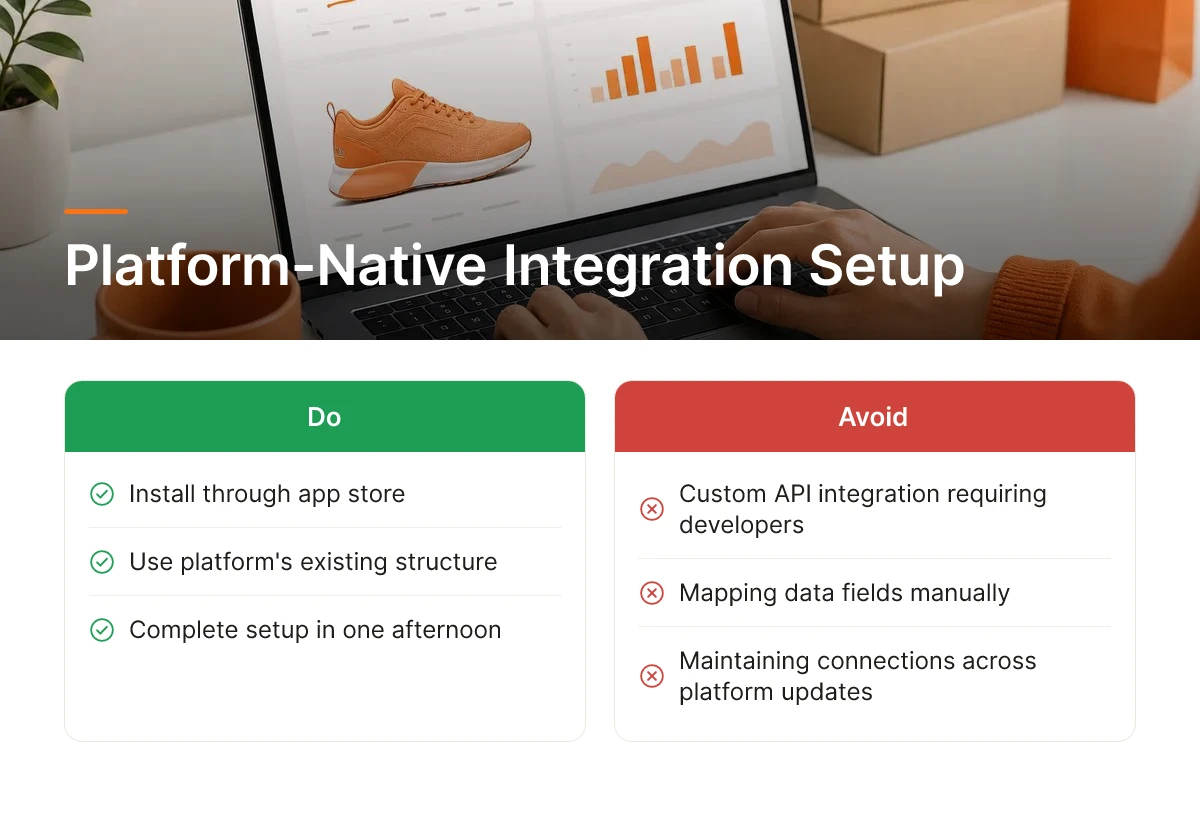
Platform-native tools install directly through the Shopify, WooCommerce, or BigCommerce app store, cutting setup from weeks of development to a single afternoon.
Do SEO Tools Require Custom Development to Work with Your Stack?
Tools requiring custom API integration typically need a developer to map data fields, handle authentication, and maintain the connection as the platform updates, work that stalls out for stores without engineering staff on retainer. Native integrations skip that step entirely, reading product data, collections, and metafields through the platform's existing structure.
Compatibility varies by platform. Shopify's app ecosystem is the deepest, with the most SEO-specific apps built directly for its theme and metafield structure [1]. WooCommerce, running on WordPress, tends to work well with plugins built for the broader WordPress SEO ecosystem rather than ecommerce-specific ones. BigCommerce sits between the two, with platform documentation noting that control over metadata and custom fields is a must-have feature when evaluating any platform for SEO [3].
This category suits lean teams without developer resources on standby, most ecommerce operators fall into this group. The differentiator to look for is bulk editing inside the platform admin itself: changing titles, meta descriptions, or alt text across an entire collection in one pass, rather than exporting data to a separate dashboard and re-uploading it.
5. Rank Tracking Tools for Product and Category Keywords
Rank tracking tools built for ecommerce group keywords by product category, turning thousands of individual rankings into a manageable set of trend lines.
Can Rank Tracking Tools Monitor Performance Across Product Categories?
Tracking every keyword variation for a 1,000-SKU catalog individually produces a spreadsheet no one reads. Grouped tracking by category, "women's running shoes" as a cluster rather than fifty separate long-tail variants, keeps the data usable and shows which sections of the catalog are gaining or losing visibility.
Rank movement alerts matter more than raw position data for ecommerce specifically. A sudden drop on a high-revenue product page often signals an indexing issue or a technical error, and catching it within a day rather than discovering it in a monthly report can prevent weeks of lost organic traffic.
These tools work best for teams that want prioritized alerts rather than another data dump to sort through manually. The differentiator that matters most for ecommerce specifically: segmenting tracked keywords by revenue contribution, not just search volume, so a page driving significant sales gets flagged before a high-traffic but low-converting page does.

6. Competitor Gap Analysis Tools
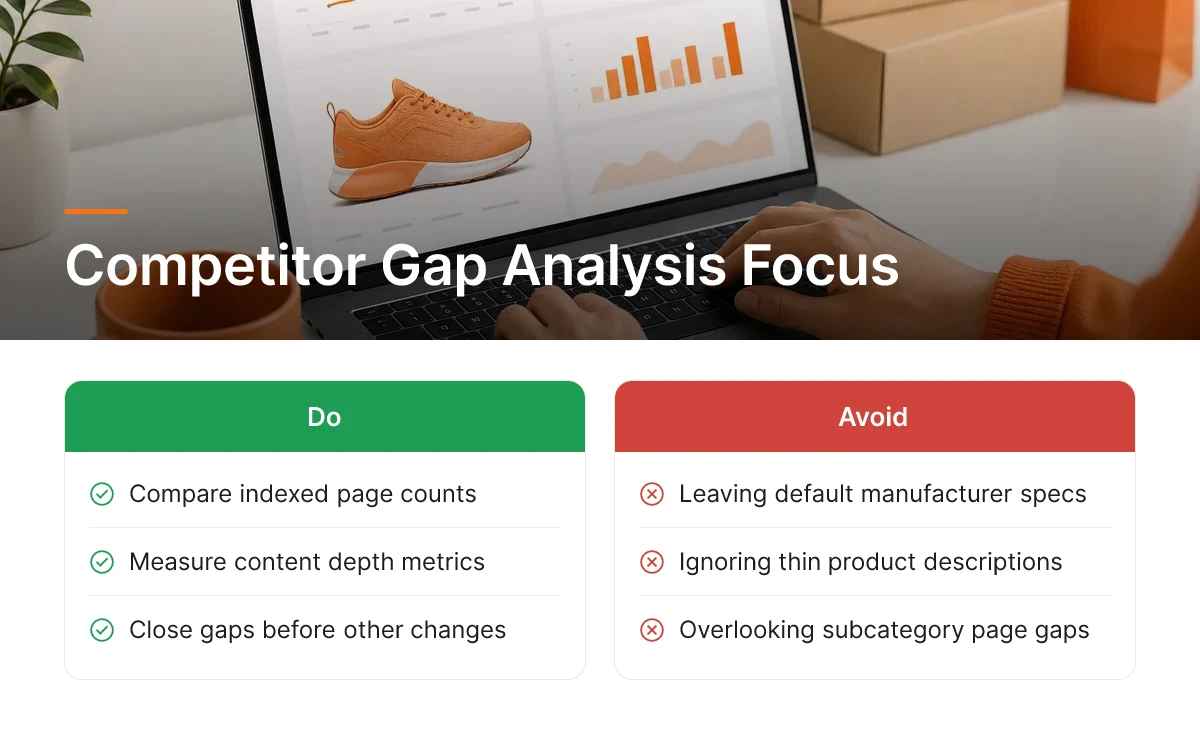
Competitor gap analysis tools compare your indexed pages against rival catalogs to show exactly which category and product terms you're losing on and why.
The comparison works by crawling both sites and measuring content depth, word count, structured attributes, image detail, and internal linking, on matching category and product pages. If a competitor has 40 indexed subcategory pages for "men's running shoes" and you have six, that's a gap worth closing before you touch anything else.
These tools also catch thin product descriptions. A competitor who's rewritten every manufacturer spec sheet into unique copy will often outrank a catalog that left the default text untouched, even with a stronger domain. One of the clearer findings across ecommerce SEO guides is that tool roundups often skip the step of mapping content gaps before recommending fixes [2], which leaves teams optimizing pages that were never the problem.
This category suits teams entering a competitive niche who need a prioritized list, not a general audit. The differentiator worth watching for: tools that flag gaps specific to AI search answers, where a competitor's product gets cited and yours doesn't, rather than only traditional ranking position.
7. On-Page Content Optimization Tools for Product Descriptions
Content optimization tools rewrite and score product and category copy against what buyers actually search for, separate from tools that only fix crawl errors.
Technical SEO tools and content tools solve different problems. A technical tool tells you a page is crawlable and fast; a content tool tells you whether the words on that page answer what a shopper typed before clicking "buy." Among the best seo tools for ecommerce, this distinction matters most for catalogs where every page is technically sound but still converts poorly from organic search.
How Do Content Tools Help Match Product Pages to Search Intent?
They apply templated optimization, structured prompts covering material, use case, sizing, and comparison points, across thousands of listings at once, so a 500-SKU apparel catalog keeps one brand voice instead of 500 slightly different ones. This matters for stores whose descriptions were copied straight from manufacturer feeds, a common issue flagged in ecommerce SEO audits where duplicate content suppresses rankings [2].
Teams with thin, duplicated, or inconsistent product copy get the most value here. The differentiator: intent matching tuned specifically for transactional product pages, purchase-stage language, specs, and comparison cues, rather than generic blog-style content scoring.
8. Site Speed and Core Web Vitals Tools for Large Catalogs
Speed tools built for large catalogs diagnose image bloat and script overload across thousands of product pages, not just a homepage test.
Image-heavy product galleries, zoom functions, and third-party scripts for reviews, chat, and upsells load on every single product page, multiplying their performance cost across a 5,000-SKU catalog in a way a five-page brochure site never experiences. A single unoptimized hero image repeated across every variant page compounds fast.
Which Tool Type Should You Prioritize for Crawl Errors and Site Speed?
Prioritize tools that run bulk image compression and lazy-loading diagnostics across the full catalog rather than spot-checking individual URLs, since manual review doesn't scale past a few hundred pages. This category fits stores with high-resolution photography across every SKU and color variant, where image weight is usually the single biggest drag on load time.
The differentiator: tools that rank fixes by page traffic and revenue contribution rather than a flat technical severity score, so a slow but high-converting category page gets fixed before a rarely visited archive page with the same error count.
9. AI Search Visibility Monitoring Tools
AI visibility monitoring tracks whether your products get mentioned inside AI-generated answers, a different metric than where you rank on a results page.
Traditional rank tracking checks position on a search engine results page. AI visibility monitoring checks something else entirely: whether ChatGPT, Gemini, Claude, or Perplexity mention your product at all when a shopper asks for a recommendation, and whether the details cited are accurate. A product can rank on page one of Google and never get referenced in a generated answer.
Which Tools Are Designed to Improve Visibility in ChatGPT, Gemini, Claude, and Perplexity?
Structured data and clear product attributes, price, availability, materials, specs, directly affect whether an AI engine can parse and cite a product correctly, since these systems pull from schema markup and well-organized text rather than inferring meaning from a page design. Moonrank builds this into its technical layer, implementing schema markup, llms.txt configuration, and citation building alongside daily automated content publishing, so a store's catalog becomes something AI engines can actually read and trust.
This category fits teams who've already handled core technical SEO and are ready to expand into AI-driven discovery. The differentiator: tracking visibility by product category, not just by brand name, so a team can see that their running shoes get cited in AI answers while their hiking boots never appear.
How to Choose the Best SEO Tools for Ecommerce Catalogs
Match tool choice to three variables, SKU count, how often the catalog changes, and in-house technical skill, before comparing feature lists.
A 200-SKU store updated quarterly needs less automation than a 10,000-SKU catalog adding new variants weekly. Start with a checklist: how many products need ongoing optimization, how often pages change, and whether anyone on the team can edit schema markup or troubleshoot a crawl error without help.
- SKU count and catalog growth rate, since a fast-growing catalog needs more automation sooner
- Update frequency, since seasonal or weekly inventory changes demand automatic syncing over manual exports
- In-house technical skill, since teams without a developer need native platform integrations
- Budget tier, choosing between budget-friendly, mid-range, and premium options based on hours saved, not sticker price alone
- AI visibility coverage, since traditional rank tracking alone no longer reflects how shoppers discover products
Where Do Ecommerce Businesses Still Need Human Expertise Alongside Tools?
Tools handle repetitive, catalog-wide work well, bulk content generation, schema implementation, speed diagnostics. Judgment calls still need a person: deciding brand positioning, resolving legal or compliance language in product claims, and interpreting why a specific category underperforms despite clean technical signals. Automated tools are sufficient for maintenance and scale; human review stays necessary for strategy and edge cases.
What Metrics Tie Tool Performance to Revenue?
Weigh budget tier, budget-friendly, mid-range, or premium, against hours saved rather than the sticker price alone. A mid-range tool that eliminates 15 hours of manual content work each week often pays for itself faster than a cheaper tool requiring constant manual oversight. Track organic revenue per category, not just traffic or impressions, since traffic without conversion tells you nothing about tool effectiveness.
Start with one technical tool and one AI-visibility tool rather than adopting a full stack at once. Moonrank covers both sides for a single monthly cost, daily automated content, technical optimization, and AI search visibility tracking across ChatGPT, Gemini, Claude, and Perplexity, built for teams that want results without hiring an agency. Visit moonrank.ai to see how it fits an ecommerce catalog's specific SKU count and update cadence.

Frequently Asked Questions
What's the difference between general SEO tools and ecommerce-specific solutions?
General SEO tools track keywords and backlinks across any site type; ecommerce-specific tools handle bulk product data, faceted navigation, and schema at catalog scale. A store with 5,000 SKUs needs bulk meta-tag editing, duplicate-content detection across variants, and structured data for pricing and availability, tasks a generic rank tracker was never built to manage [2].
Can AI-powered SEO tools fully replace hiring an agency for ecommerce optimization?
For most SMB catalogs, yes for execution, no for original strategy. Automated tools now handle technical audits, schema markup, and daily content publishing without manual input, which covers the bulk of what agencies bill for [5]. Moonrank, for example, runs this on autopilot for $99/month, positioned against agencies charging $3,000 or more monthly for comparable output.
What's the learning curve for using enterprise-grade SEO tools versus beginner-friendly ones?
Enterprise platforms take weeks to configure properly; beginner tools can run useful audits within a day [1]. Enterprise suites like seoClarity are built for teams with dedicated SEO staff managing complex workflows [1], while simplified tools trade some depth for faster setup, a tradeoff most solo ecommerce owners should take.
How do you build a case for an SEO tool's ROI using before-and-after results?
Compare organic traffic, AI citation frequency, and conversion rate for 60 to 90 days before and after adoption. Track whether technical fixes, schema, broken links, page speed, correlate with ranking or visibility shifts, and tie at least one metric to revenue, not just traffic volume, since tools that can't show revenue impact rarely justify renewal [2].
How many of the best SEO tools for ecommerce does a small catalog actually need?
Most small catalogs under 1,000 SKUs do fine with two tools: one covering technical audits and schema, and one tracking AI and traditional search visibility. Adding more tools before fixing core technical issues, duplicate content, broken canonical tags, incomplete feeds, usually wastes budget rather than improving rankings. Expand the stack only once those fundamentals are stable.
Conclusion
Catalog size changes the math on SEO tooling. Tools built for 50-page brochure sites buckle under 1,000+ SKUs, broken variant URLs, and thin category pages, so prioritize bulk schema, automated technical audits, and AI visibility tracking over generic keyword dashboards. Google's shrinking click share [1] and the rise of AI answer engines mean your product pages now compete for citations inside ChatGPT and Perplexity, not just Google's results page.
Start by auditing whether your current stack tracks AI search visibility at all, most don't. If it doesn't, test Moonrank's 3-day free trial and see where your store currently stands in AI recommendations before competitors lock in the answer.
Sources & References
- The 11 Best SEO Tools in 2026 | Zapier
- Best eCommerce SEO Tools That Work
- How to Choose the Best Ecommerce Platform for SEO
- Best Ecommerce SEO Tools (2026): 14 Tools Tested
Recommended Articles
Explore more from our content library: