What Is Search Engine Optimization and How Does It Work
Search engine optimization now means making your business easy for AI engines like ChatGPT, Perplexity, and Claude to find, understand, and recommend — not...

Understanding what is search engine optimization is essential. Search engine optimization now means making your business easy for AI engines like ChatGPT, Perplexity, and Claude to find, understand, and recommend, not just ranking on Google. It works by giving AI systems clear, structured signals about what your business does: consistent facts across the web, structured data markup, and content written in direct question-and-answer form. For SMBs, this means AI engines can accurately cite and recommend your business when customers ask for suggestions, often without them ever visiting a traditional search results page first.
What Is Search Engine Optimization for AI Search Engines?
The question "what is search engine optimization" now has two answers: ranking on Google, and getting named inside an AI-generated answer before the reader ever sees a results page. AI engines like ChatGPT and Perplexity don't hand back ten blue links, they read dozens of sources, synthesize a single answer, and decide which businesses to mention by name [3]. If your business isn't in that synthesized answer, you don't exist for that customer, no matter how well your site ranks on page one of Google.
How Is Optimizing for AI Search Engines Different From Traditional Google SEO?
Traditional SEO chases a position on a results page; AI search optimization chases a mention inside the answer itself. Google SEO rewards a page for matching a query closely enough to earn a click [4]. AI search works differently, a chatbot or AI assistant condenses information from across the web into one response, and only the sources it trusts enough to cite get surfaced to the user [1]. That shift matters most for the zero-click reality already underway: searches increasingly end without a single click to any website, yet brand mentions and citations inside AI answers still drive awareness and purchase decisions [1].
What Are the Core Principles of Getting Recommended by ChatGPT, Perplexity, and Claude?
AI models build recommendations from structured, unambiguous facts about a business, what it sells, who it serves, and where it operates, pulled from many pages and sources, not one optimized landing page [2]. A Shopify store selling outdoor gear needs its product categories, service area, and differentiators stated plainly across its site, its Google Business Profile, and relevant directories, not buried in marketing copy a crawler has to interpret.
Consistency carries real weight here. AI models cross-reference your website against directories, review platforms, and third-party mentions to build confidence before naming you in an answer [2]. If your hours, service area, or product lineup contradict each other across those sources, the model has less reason to trust any single one, and will often cite a competitor with cleaner, matching signals instead.
This practice goes by a couple of names: generative engine optimization (GEO) and answer engine optimization (AEO), both simply meaning the work of making your business easy for an AI model to find, verify, and recommend [3]. Moonrank builds its product around exactly this mechanism, running technical fixes like schema markup and llms.txt configuration, plus daily content publishing, so AI engines have consistent, structured facts to pull from when a customer asks for a recommendation.
How Can SMBs Implement SEO With Limited Resources and Budget?
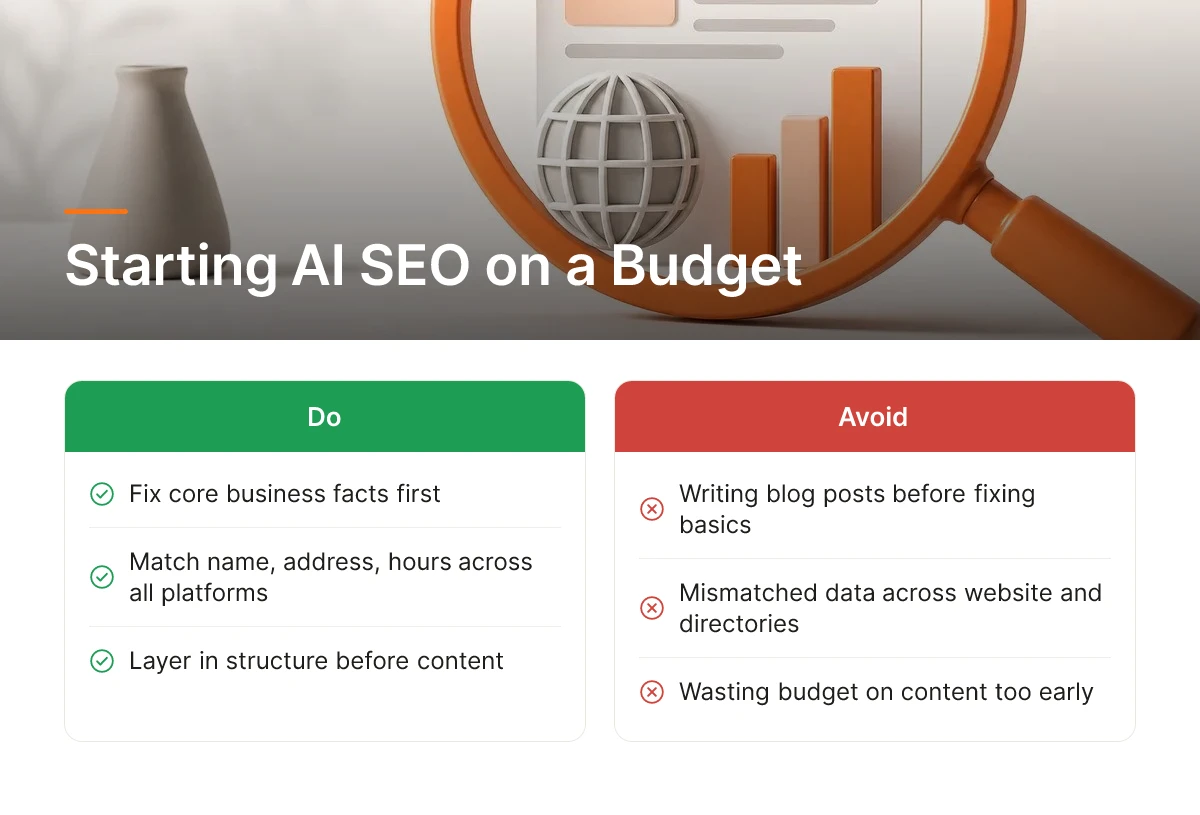
Start with the facts AI engines check first, then layer in structure, then invest in content, in that order, not reverse. Most SMBs waste budget writing blog posts before fixing the basics that make a business legible to an AI system in the first place.
What's the Most Cost-Effective Way to Start AI Search Engine Optimization Without Hiring an Agency?
Fix your core business facts before touching anything else. That means your name, address, hours, pricing structure, product specs, and service categories need to match exactly across your website, Google Business Profile, and any directory listing, AI engines cross-reference these to decide whether your business is trustworthy enough to recommend [2]. Once those facts are consistent, add structured data (schema markup) so engines can parse what you actually sell rather than guessing from unstructured paragraphs [3].
The fix looks different depending on the business:
- Hotels: correct amenity lists (pool, parking, pet policy) and precise location data, these are the details AI assistants pull when someone asks "hotels near [venue] with free parking."
- Ecommerce stores: clean product attribute data, size, material, compatibility, since incomplete product feeds get skipped by AI shopping summaries.
- B2B SaaS companies: a clear category statement and named use cases, so an AI engine can place you in the right comparison set instead of lumping you into a vague "software" bucket.
- Cyber security firms: explicit coverage of which threats and industries you serve, "ransomware protection for healthcare providers" ranks far better in AI answers than generic "cybersecurity solutions" copy.
Only after facts and structure are solid does deeper content, comparison pages, FAQs, case studies, start paying off.
How Does Automated SEO Compare to Manual Optimization for Small Businesses?
Manual optimization works but demands continuous technical attention: someone has to monitor AI search visibility, update schema, and publish content on a schedule, which is what is search engine optimization has always required at the operational level, consistent upkeep, not a one-time project [4]. For a solo founder or hotel owner without a marketing hire, that ongoing demand is usually the real barrier, not knowledge.
Three tiers exist in practice. A budget-friendly DIY approach means the owner handles schema and content updates themselves, which is workable but slow and easy to neglect. A mid-range, tool-assisted approach uses a dedicated AI visibility tool, like Moonrank, which runs daily content publishing and technical optimization (schema markup, llms.txt, citation building) on autopilot for $99 a month, to handle monitoring and publishing continuously without a dedicated hire. A premium, agency-led approach brings in a freelance SEO consultant or full-service agency, often costing far more than an SMB budget can justify for the volume of work needed. For most of the audiences above, hiring a full agency is disproportionate: the fixed overhead rarely matches the scope of fixes a smaller business actually needs.
What Are the Key Technical and Content Steps to Get Discovered by AI Search Engines?
Getting discovered by AI search engines comes down to five concrete moves: structured data, a crawler-readable priority file, question-led content, consistent business facts, and a clear audit order. None of these require a developer on staff, they just require knowing what is search engine optimization means for AI engines rather than for Google's old ranking factors alone.
What Specific Optimizations Do AI Search Engines Prioritize?
AI engines prioritize structured data that removes ambiguity about what a business sells, where it operates, and whether its claims are verifiable. Large language models don't "browse" a page the way a human does, they parse signals, and the clearest signal is schema markup, the structured data that tells AI engines exactly what a business does in a format machines can read without guessing.
- Organization schema, confirms the legal business name, logo, and official site.
- Product schema, lists what's for sale, pricing tier, and availability, which matters directly for e-commerce catalogs.
- FAQ schema, flags question-and-answer content as citable, a format AI Overviews and chat-based engines pull from heavily [2].
- LocalBusiness schema, ties a hotel, restaurant, or storefront to a specific address and service area.
A second, newer layer is the llms.txt file, a simple text file placed at the root of a site that tells AI crawlers which pages matter most and which to skip, similar in spirit to a robots.txt file but aimed at language models instead of search bots. Most SMB sites don't have one, which means AI crawlers are left guessing at priority. Moonrank builds this file automatically as part of its technical audit, alongside citation building and structured data, so a business doesn't need to hand-edit configuration files to get read correctly.
How Should SMBs Structure Their Content to Rank in AI Search Results?
AI engines favor content that answers a question in the first sentence, in plain factual language, rather than copy that builds up to a point through marketing flourish. Industry guidance increasingly points to E-E-A-T signals, experience, expertise, authority, trust, as a determining factor in whether generative engines treat a page as citable [1]. In practice, that means:
- Headings written as the actual question a customer would type into ChatGPT or Perplexity.
- A direct answer in the first one to two sentences beneath each heading.
- Specific facts, square footage, price tier, service area, return policy, instead of vague claims like "industry-leading" or "best-in-class."
Consistency matters just as much as structure. If a restaurant's hours or phone number differ across its website, Google Business Profile, and a directory listing, AI models have no way to resolve which version is correct, so they either hedge the answer or drop the business from the response entirely.
The practical order is: audit existing pages for clarity and factual density, add structured data across key pages, rewrite top pages in question-and-answer form, then confirm NAP (name, address, phone) consistency across every third-party listing. Moonrank runs this sequence daily and automatically, generating question-led content, applying schema, and flagging inconsistencies, which is the kind of ongoing maintenance a $3,000-a-month agency retainer would otherwise be needed to sustain.
How Long Does It Take to See Results From AI Search Engine Optimization?
Technical fixes can show up in AI answers within weeks, but content-driven authority gains typically take two to three months or longer to compound.
The gap comes down to how AI engines work. ChatGPT, Gemini, Claude, and Perplexity don't update instantly, they re-crawl the web and re-synthesize answers on their own schedules, which vary by platform and query volume [3]. A fix to your schema markup or llms.txt file can get picked up the next time an engine re-indexes your site. Building the kind of topical authority that makes an AI engine trust and cite your business takes longer, because it depends on accumulating consistent, well-structured content and credible references over time, the same E-E-A-T signals that influence how AI Overviews decide what's trustworthy enough to include [1].
What Realistic Metrics Should SMBs Track to Measure AI Search Visibility Success?
Anyone asking what is search engine optimization in the AI search era needs a new scoreboard, because the old one, keyword rankings on Google, doesn't measure what's actually happening inside a chatbot's answer. Three metrics matter more:
- Brand mentions inside AI-generated answers. Does ChatGPT or Perplexity name your business when a customer asks for a recommendation in your category?
- Referral traffic from AI platforms. Check your analytics for sessions originating from chatgpt.com, perplexity.ai, or Gemini, this traffic behaves differently than organic search clicks but it's trackable.
- Accuracy of AI-generated descriptions. Ask each engine directly what your business does. If the answer is outdated, incomplete, or wrong, that's a visibility and trust gap worth fixing.
Moonrank's visibility tracking layer monitors these signals, mentions, referral patterns, and description accuracy across ChatGPT, Gemini, Claude, and Perplexity, so a business owner isn't left guessing whether their content is actually landing in AI answers.
What's the Typical Timeline for Getting Recommended by AI Search Engines?
Think in two phases rather than one countdown clock. First, technical fixes, structured data, llms.txt configuration, citation cleanup, tend to surface in AI answers within the first few weeks, since they remove barriers that were already blocking an engine from reading the site correctly. Second, content and authority-building effects stack up over a longer stretch, often several months, as an AI engine accumulates more signals that a business is a credible answer to a given query. Traditional rank trackers won't show this progress at all, because keyword position on Google and inclusion in an AI-generated answer are measured on entirely different systems.
What Common SEO Mistakes Should SMBs Avoid When Optimizing for AI Search?
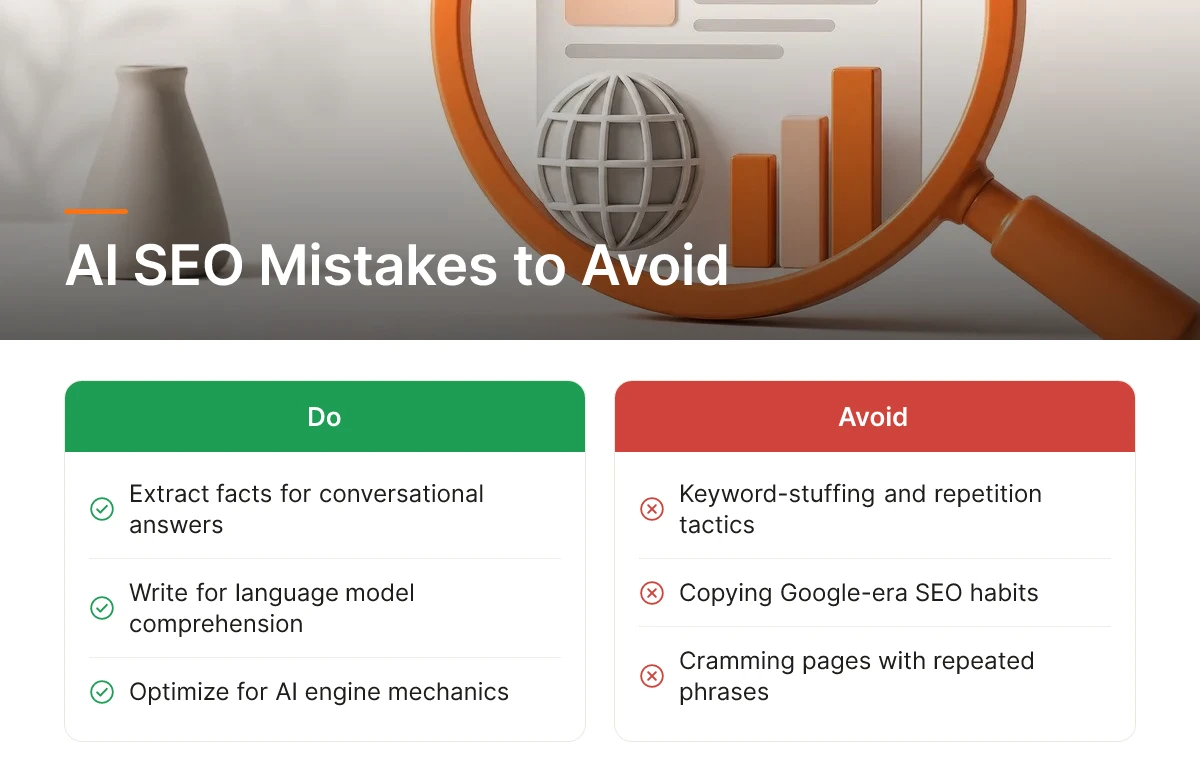
The biggest mistakes come from copying Google-era habits into AI search without asking whether the AI engine actually works the same way Google does.
Why Do Traditional Google SEO Tactics Sometimes Fail for AI Search Engine Optimization?
Keyword-stuffing worked on Google because older ranking systems rewarded repetition and density. AI engines don't rank keywords, they extract facts and summarize them in a conversational answer [3]. A page crammed with the same phrase ten times doesn't look more relevant to a language model; it looks harder to parse, and a confusing page is a page the model skips in favor of a competitor with a cleaner answer.
The same goes for backlink-heavy strategies and thin, duplicated location pages built purely to rank for "[service] + [city]." Google's crawler rewarded volume. AI engines reward clarity, structure, and consistency [1]. Time spent building a hundred low-value backlinks is time not spent making your core service pages machine-readable, a worse trade now than it was five years ago.
Inconsistent business information is the other silent killer. If your website says you offer four services, your Google Business Profile lists three, and a directory listing has outdated hours, an AI model has no way to know which version to trust [2]. That ambiguity often means it cites a competitor's listing instead, not because the competitor is better, but because their information agrees across every source the model checks.
How Should SMBs Adapt Their SEO Strategy as AI Search Engines Evolve?
Treating this as a one-time project is the mistake that undoes everything else. AI engines continuously re-crawl and re-index sources, so a business that optimizes once and walks away gradually loses ground to competitors publishing fresh, structured content every week [1]. Understanding what is search engine optimization for AI engines means understanding it as a maintenance habit, not a launch checklist.
Revisit your approach periodically, audit your schema markup, confirm your listings still match, and check whether your content still answers the questions customers are actually asking. This is also where automation earns its keep: Moonrank handles this cycle by publishing optimized content daily and re-checking technical signals like schema markup and llms.txt on an ongoing basis, so SMBs without a marketing team aren't stuck re-doing manual audits every quarter.
Frequently Asked Questions
Do I still need traditional Google SEO if I optimize for AI search engines?
Yes, AI search optimization builds on top of Google SEO, it doesn't replace it. Large language models still pull heavily from indexed, well-structured web content, and strong fundamentals like fast load times, clear site architecture, and quality backlinks remain the foundation both Google and AI engines rely on to trust your business [3].
Can a small business realistically compete with larger brands in AI search results?
Yes, because AI engines weigh relevance and trust signals over brand size or ad budget. A boutique hotel with detailed, specific content about its neighborhood can outrank a national chain if its pages answer customer questions more directly [2]. Consistency and technical clarity matter more than marketing spend here.
Which AI search engines matter most for SMBs to optimize for right now?
ChatGPT, Perplexity, and Google's AI Overviews currently drive the most referral traffic for SMBs. Perplexity alone handles a large volume of weekly queries [3], and Google's AI Overviews already appear across a majority of search results, making both priorities for visibility work.
Does having a blog help with AI search engine optimization?
Yes, a regularly updated blog gives AI engines fresh, citable content to pull from when answering customer questions. Posts built around real expertise and specific details perform better than generic articles, since AI systems favor experience-driven, human-authored content as a trust signal [1].
Conclusion
AI search optimization now runs alongside, not instead of, traditional SEO, the two share a foundation of structured data, credible content, and technical clarity. The businesses winning visibility in ChatGPT and Perplexity today are the ones publishing consistently and fixing the technical gaps that keep AI engines from understanding their sites. Most SMB owners don't have time to do both manually.
Start by auditing whether your site has basic schema markup and an llms.txt file in place. If that sounds like one more technical project you don't have time for, Moonrank automates it, daily content, technical fixes, and visibility tracking across ChatGPT, Gemini, Claude, and Perplexity, starting at www.moonrank.ai.
Sources & References
- AI Search Is Reshaping SEO: How SMBs Can Win in the Zero-Click Era
- How to Rank in AI Overviews: 11 Tips for Small Businesses
- A Marketer's Guide to AI-Powered Search | Perrill
- What Is SEO and How Does it Work? | Digital Marketing Institute
Recommended Articles
Explore more from our content library: