Entity SEO for AI and Why Engines Must Know Your Brand
Entity SEO for AI means structuring your brand's information so engines like ChatGPT, Perplexity, Claude, and Gemini can identify and recommend you.

Entity SEO for AI means structuring your brand's information so AI engines like ChatGPT, Perplexity, Claude, and Gemini can clearly identify who you are, what you do, and why you're credible enough to recommend. It works by making your brand a well-defined "entity", a recognized thing with consistent facts, across structured data, your website, and third-party sources, rather than just a collection of keyword-matched pages. AI systems cross-check these signals before citing or recommending a business, so the stronger and more consistent your entity footprint, the more likely you are to show up in an AI answer.
What Is Entity SEO for AI, and How Does It Differ from Traditional SEO?
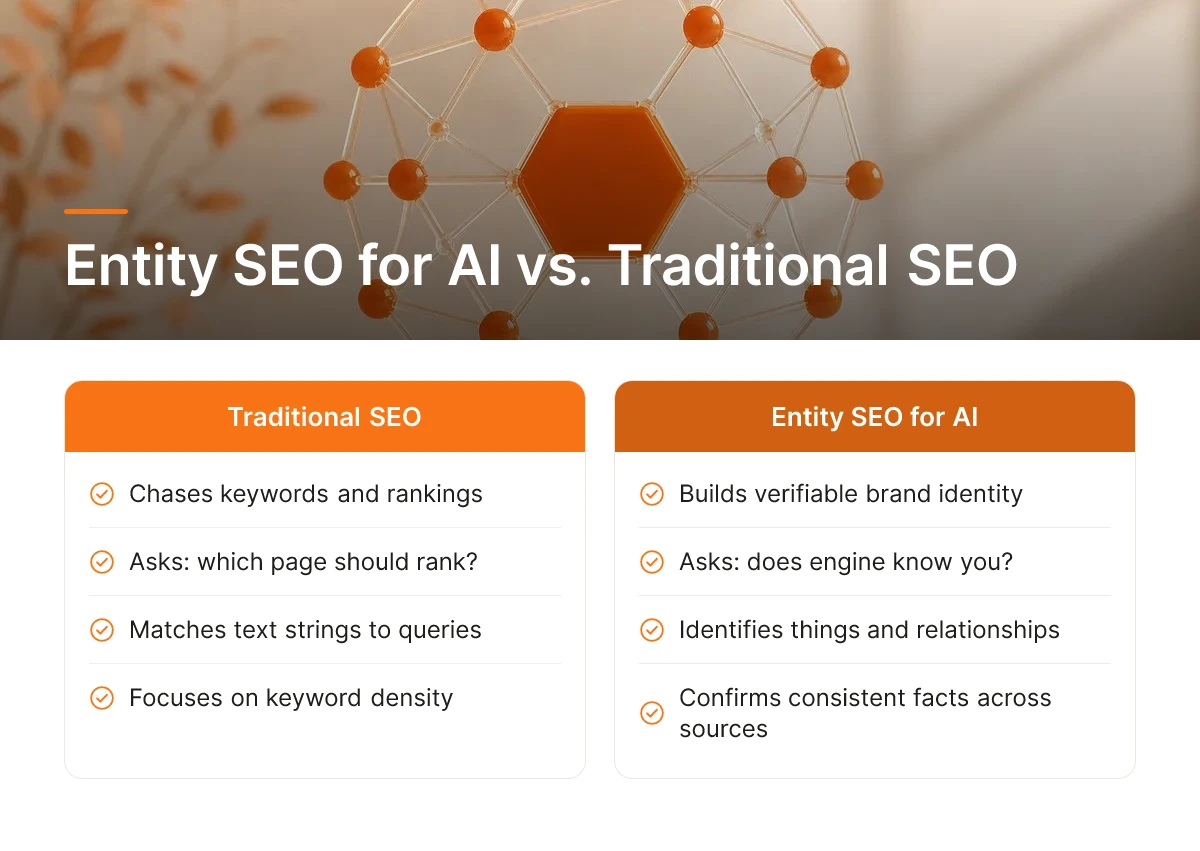
Traditional SEO chases keywords and rankings on a results page; entity SEO for AI builds a verifiable identity that AI systems can confirm, trust, and cite directly.
The two disciplines solve different problems. Classic SEO asks: which page should rank for this search term? Entity SEO asks a more basic question first: does the engine actually know who you are? Google itself has moved past matching strings of text toward identifying things, people, organizations, places, and the relationships between them [3]. An AI engine answering "best project management software for remote teams" isn't scanning for keyword density. It's trying to recall a brand it already has a confident, corroborated model of.
Is SEO Going Away with AI, or Do You Need Both Strategies?
SEO isn't disappearing, AI engines still depend on crawled, indexed web content to build their answers, so technical SEO and entity work function as two layers of the same system rather than competitors.
An AI model has to find your pages before it can form an opinion about your entity. That means site structure, crawlability, and indexable content remain the foundation. Entity signals sit on top of that foundation, telling the engine which facts to trust once it has found you. A SaaS company with clean technical SEO but a scattered, contradictory web presence will get crawled and still get misidentified or ignored in the answer itself.
How Does Entity-Based SEO Help You Rank in AI Answers Versus Google Search Results?
Entity signals, consistent facts, structured data, and third-party corroboration, tell an AI engine your brand is real and reliable enough to recommend, not just indexable.
A traditional Google result rewards a page matched to a query string, ranked among ten blue links. An AI answer is generated, not listed, and it pulls from a smaller set of brands the model already trusts enough to name. Research based on roughly 75,000 brands found that web mentions, not backlinks or domain rating, were the strongest predictor of AI Overview visibility [2], which points to corroboration across the web mattering more than raw authority metrics. For an e-commerce store or a B2B SaaS vendor, that means organization schema, a clear canonical "About" page, and consistent facts across review sites and directories carry weight an AI engine can actually use.
This also changes what "visibility" means. AI answers frequently skip the click entirely, so a brand can be recognized, cited, and recommended without a single referral visit ever showing up in analytics, which is exactly why entity clarity now matters independent of ranking position.
How Do AI Search Engines Like ChatGPT and Perplexity Decide Which Businesses to Recommend?
AI systems recommend businesses whose facts agree across many independent sources, not businesses that rank highest on a page of links. There is no algorithmic leaderboard to climb. Instead, there is a confidence check: does the web agree on who you are?
Traditional SEO asks a page to match a query. Entity SEO for AI asks a different question: can the model resolve your brand to one stable identity, with consistent name, category, location, and offerings, across sources it doesn't control? A restaurant's own website can claim it's the best seafood spot in Charleston. That claim means little until a review site, a local directory, and a news mention say roughly the same thing about the same business. This is corroboration, and it's the mechanism underneath most AI citation behavior [2]. When schema markup on the brand's site, a Yelp listing, an industry directory, and a press mention all describe the same entity with matching details, the model's confidence in that entity goes up. When those sources conflict, different addresses, inconsistent category labels, a name that overlaps with an unrelated company, the model has less reason to recommend it.
What Role Does Your Knowledge Graph Presence Play in AI Recommendations?
A Knowledge Graph entry works as a trust shortcut, signaling to AI systems that a brand is already verified as a distinct, well-documented entity.
Google's Knowledge Graph stores entities as nodes with corroborated facts attached, not as ranked pages [3]. Google's own documentation is explicit that there's no special markup that guarantees a Knowledge Graph entry or an AI Overview appearance, panels are generated automatically, not requested [1]. That doesn't make the underlying entity work pointless. A business with an established Knowledge Graph presence has already cleared the disambiguation bar that AI systems care about, which makes it a safer citation.
How Do sameAs Links and Corroboration Across the Web Influence AI Citations?
sameAs links connect a brand's website to its verified social profiles, Wikipedia or Wikidata entries, and industry directories, telling AI systems these all refer to one entity.
This matters most when a brand name is ambiguous or shared with another company. sameAs markup, paired with consistent facts across a verified "About" page and third-party listings, gives the model a path to the correct entity rather than a near-miss [3]. One analysis of roughly 75,000 brands found web mentions were the strongest single correlate of AI Overview visibility, ahead of backlinks and domain rating [2], a sign that recognition across the web, not link volume, drives citation.

What Structured Data and Schema Do You Need to Get Recognized by AI Systems?
Organization schema is the foundational markup: a block of structured data declaring your business name, logo, description, and sameAs links to every profile that corroborates you exist.
This is the part of entity SEO for AI that most guides reduce to a checklist, and it is worth doing properly, but it is not magic. Google's own documentation says there is no special structured data that guarantees entry into AI Overviews or a Knowledge Graph panel [1]. What Organization schema does is remove ambiguity. It tells a crawler, in a format it can parse without guessing, what your brand is called, what it does, and which other pages on the web belong to the same entity. The sameAs property, links to your LinkedIn page, Crunchbase profile, Wikipedia entry if you have one, and other verified accounts, is what lets an AI engine connect those scattered profiles into one node instead of treating them as unrelated mentions [3].
A solid Organization schema foundation typically includes:
- Business name: the exact, consistent legal or brand name used everywhere else online
- Logo and description: a clear, factual summary of what the business does
- sameAs links: URLs pointing to verified LinkedIn, Crunchbase, Wikipedia, or Wikidata profiles
- Address and contact details: matching NAP (name, address, phone) data used on directories and review sites
- Category and industry classification: a consistent descriptor of what kind of business this is
How Do You Define Your Canonical Facts and Entity Home for AI Systems?
Pick one URL, usually your homepage or a dedicated About page, as the single authoritative source for every fact about your brand, then reference it everywhere else.
Call this your entity home. It is where your business name, category, founding date, locations, and leadership are declared once, in both the visible page copy and the matching schema markup. Every other mention of your brand, your Google Business Profile, your Crunchbase listing, your directory entries, should point back to or match this source rather than introducing a slightly different version of the same facts. A clear About page combined with consistent schema is the baseline most entity SEO frameworks converge on [2].
What's the Difference Between Entity SEO for Major Brands Versus Niche or Long-Tail Businesses?
Major brands refine an entity AI systems already recognize; niche businesses have to build that recognition from zero through deliberate corroboration.
A national retailer or well-known SaaS company likely already has a Knowledge Graph presence, press coverage, and a Wikipedia page doing passive corroboration work. For that brand, entity SEO for AI is a tuning exercise, fixing inconsistencies, consolidating duplicate listings, tightening schema. A regional hotel, a specialty e-commerce store, or an early-stage security startup starts with no such head start. AI engines have no existing model to correct, so the work is additive: getting listed consistently across directories, earning mentions on sites the engine already trusts, and publishing enough entity-rich content that a pattern emerges. An Ahrefs analysis of roughly 75,000 brands found web mentions were the strongest correlate of AI Overview visibility, ahead of backlinks or domain rating [2], a signal that favors sustained, consistent publishing over one-time schema fixes. This is where Moonrank's daily content automation and technical audit work together: new entity-rich pages publish automatically while schema markup and citation building run in the background, so a business starting from zero accumulates corroboration instead of waiting on it.
How Do You Measure Whether Your Entity SEO Is Actually Working Across AI Platforms?
Measure it by prompting AI engines directly with brand and category questions, tracking AI-referral traffic, and checking whether citations stay consistent across platforms over time.
There is no single dashboard that shows "entity strength" as one score. Instead, you are watching several signals move together, and you are watching them over weeks, not after one lucky mention.
How Do You Track Entity Strength and AI Citations Across ChatGPT, Perplexity, Claude, and Gemini?
Start with direct prompting. Ask each engine questions a real customer would ask: "best [your category] in [your city]," "what does [your brand] do," "who are the top competitors to [your brand]." Run the same prompts across ChatGPT, Perplexity, Claude, and Gemini, and note whether your business appears at all, how it's described, and whether the facts match what's on your site.
This matters because AI answers come from a model the engine already holds, built well before your prompt, not a live crawl of your homepage [3]. If that stored model is thin or confused with a similarly named competitor, no amount of on-page keyword tuning will fix what shows up in the chat window. Repeating this prompt test monthly and logging the results in a simple spreadsheet turns a vague feeling of "are we visible" into a trend line you can actually act on.
What Metrics Show That Your Entity SEO Efforts Are Driving AI-Sourced Traffic?
A useful tracking routine covers a few recurring checks:
- AI-referral sessions: segment analytics traffic from chatgpt.com, perplexity.ai, and similar domains to see if citations are turning into visits
- Citation consistency: confirm you're named the same way, with the same facts, across every engine tested
- Direct prompt results: compare how your brand is described month over month across ChatGPT, Gemini, Claude, and Perplexity
- Fact accuracy: check whether address, category, and leadership details match your canonical source
The second metric worth watching is citation consistency: are you named the same way, with the same facts, across every engine you test, or does one platform cite you while the others ignore you or get details wrong? Consistent naming and facts across multiple AI platforms suggest a strengthening entity; a single engine citing you once looks more like coincidence than progress [3].
Entity SEO for AI compounds slowly, corroborating signals need to accumulate across the web before engines treat your brand as settled fact, so judge progress by direction over two or three months rather than any single week's snapshot. Moonrank's AI search visibility tracking is built around this reality, checking how your business appears across ChatGPT, Gemini, Claude, and Perplexity on an ongoing basis so the trend is visible instead of guessed at.
What's the Step-by-Step Process to Audit and Improve Your Entity Signals for AI Search?
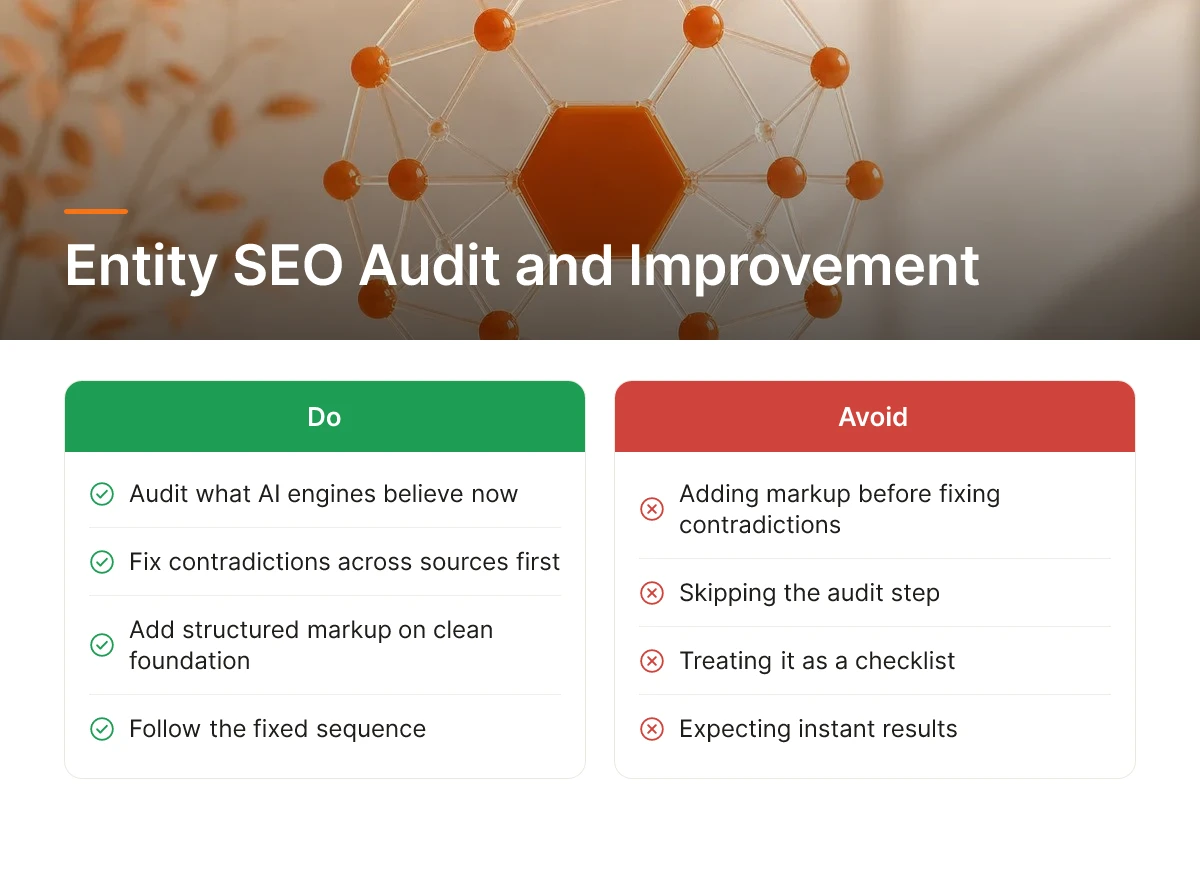
Entity SEO for AI follows a fixed sequence: audit what AI engines already believe about your brand, fix contradictions across your existing sources, then add structured markup and corroboration on top of a clean foundation.
How Do You Audit How AI Search Engines Currently See Your Brand and Entity Signals?
Start by asking ChatGPT, Perplexity, Gemini, and Claude directly what your business does, where it's located, and who its main competitors are. Each answer is pulled from a stored model of your brand, not a live read of your homepage [3], so whatever comes back reveals exactly which facts the engine has already attached to your entity, correct or not.
Write down every discrepancy: wrong address, outdated founder name, a competitor's product described as yours, or a category mismatch (listed as a "software company" when you sell hardware). These gaps are your priority list, not the schema you haven't added yet.
How Do You Reconcile and Strengthen Entity Signals Before Adding New Markup?
Before publishing anything new, reconcile your canonical facts, business name, address, founding year, leadership, product categories, across your own website, your existing schema, and third-party listings like Google Business Profile, Crunchbase, or industry directories. Inconsistent facts across these sources are what create a tangled or thin entity model in the first place [3], and new markup layered on top of unresolved contradictions just adds noise.
Once your facts agree everywhere, publish or update Organization schema with accurate sameAs links pointing to your verified social profiles, Wikidata entry (if one exists), and key directory listings. Web mentions, not backlinks, were the strongest correlate of AI Overview visibility in an Ahrefs analysis of roughly 75,000 brands [2], so follow the schema update with active corroboration: get listed in relevant directories, earn mentions in industry roundups, and keep review platforms current.
How Does Entity SEO Work Differently for Multi-Location Businesses or Franchise Models?
A hotel group or multi-location retailer cannot rely on one blended entity, each location needs its own LocalBusiness schema, nested under a parent Organization entity that holds the brand-level facts. Blending everything into a single identity confuses disambiguation rather than helping it, since an AI engine trying to answer "best hotel near [city]" needs to resolve a specific address and phone number, not a corporate headquarters three states away.
Manual spot-checks catch a snapshot, but AI engines update their models continuously, and a new location, rebrand, or leadership change can silently break entity recognition for weeks before anyone notices. Moonrank's AI search visibility tracking monitors how ChatGPT, Gemini, Claude, and Perplexity describe your business on an ongoing basis, and its technical optimization layer handles the schema markup, sameAs links, and citation building that keep each location's entity distinct and current, the kind of upkeep an agency typically bills a premium monthly retainer for, built into a budget-friendly subscription instead.
Frequently Asked Questions
Do I need a Wikipedia page to show up in AI search results?
No, a Wikipedia page is not required to appear in AI search results. Google itself documents that there is no special markup or single asset that guarantees a Knowledge Graph entry or an AI citation [1]. What helps more is consistent facts about your business across your own site, directories, and review platforms, corroboration matters more than any one credential.
Can a small or local business build a strong entity without a big existing Knowledge Graph presence?
Yes, entity strength comes from consistency and corroboration, not company size. A clear "About" page, matching NAP (name, address, phone) details across directories, and schema markup on your own site do more work than chasing a knowledge panel [2]. Local businesses with tight, accurate facts often outperform larger brands with scattered or conflicting ones.
How long does it take for entity SEO changes to show up in AI answers?
Most businesses see changes over weeks to a few months, not days. AI systems rely on models built from crawled and corroborated data rather than a live read of your homepage [3], so updates need time to get re-crawled, cross-checked, and absorbed into the underlying entity model.
Does entity SEO help with Google's AI Overviews as well as chat-based engines?
Yes, the same entity signals support both Google's AI Overviews and chat-based engines like ChatGPT or Perplexity. An Ahrefs analysis of roughly 75,000 brands found web mentions were the strongest correlate of AI Overview visibility, ahead of backlinks and domain rating [2]. Clear, corroborated facts feed every AI surface that draws on the same underlying web signals.
What's the first thing I should fix if AI engines are getting my business facts wrong?
Start by auditing what search engines currently say about your brand, then publish one canonical source of truth. Check how your name, services, and location appear across your site and major directories, and correct any mismatches first [3], disambiguation problems usually trace back to conflicting facts, not missing ones.
Conclusion
Entity SEO for AI comes down to three habits: keep your brand facts consistent everywhere they appear, back up your own claims with corroborating mentions across the web, and check regularly how ChatGPT, Gemini, and Perplexity actually describe your business. None of this requires a Wikipedia page or a large marketing team, it requires discipline most SMBs don't have time to maintain by hand.
That's the gap Moonrank fills: it runs the technical audit, schema markup, and daily content work in the background while tracking how your business shows up across AI engines. Start a 3-day free trial at moonrank.ai and see what AI search engines currently say about your business.
Sources & References
- Entity SEO for AI: Why Your Brand Has to Be a Thing
- Entity SEO: Build the Brand Entity Google & AI Trust
- Entity SEO & the Knowledge Graph: How AI Engines Understand Your Brand
Recommended Articles
Explore more from our content library: