The #1 Enterprise AEO Platform + Enterprise SEO Platform
SMBs need both AEO (answer engine optimization) and SEO because Google and AI engines like ChatGPT, Gemini, Claude, and Perplexity now run on different rules...

Understanding The #1 Enterprise AEO Platform + Enterprise SEO Platform is essential. SMBs need both AEO (answer engine optimization) and SEO because Google and AI engines like ChatGPT, Gemini, Claude, and Perplexity now run on different rules, one ranks pages, the other recommends businesses by name. A platform that handles both automatically lets you get recommended by AI search engines and rank in Google without hiring an agency or managing separate tools. Moonrank combines AEO and SEO into one automated system built for small and mid-size businesses, covering technical signals, structured data, and content publishing on autopilot.
What's the Difference Between AEO and SEO, and Why Do SMBs Need Both?
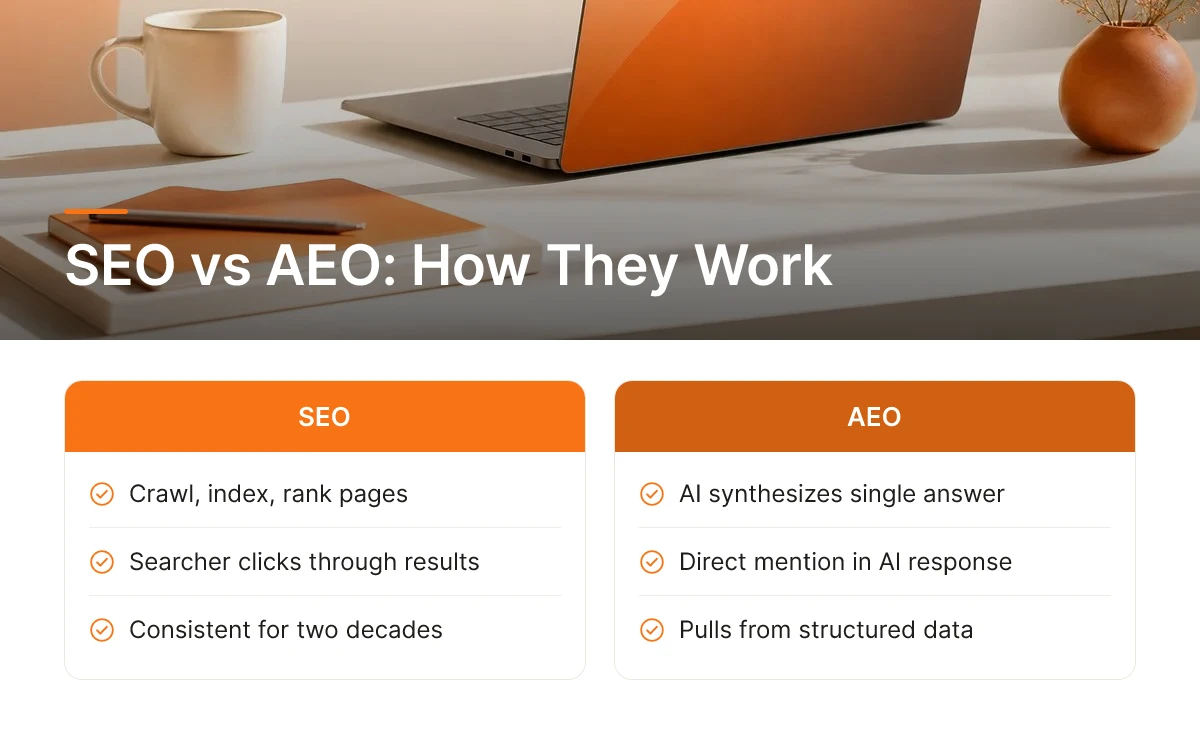
SEO wins you a ranked spot in Google's blue links; AEO wins you a direct mention when an AI engine answers a customer's question for them. Both matter, but they run on different mechanics, and treating them as the same project is how small businesses quietly lose customers to competitors they outrank on paper.
Google's system has stayed consistent for two decades: crawl pages, index them, rank them by relevance and authority, then show a results page the searcher still has to click through. AEO works differently. ChatGPT, Gemini, Claude, and Perplexity synthesize a single answer by pulling from structured data, customer reviews, third-party citations, and content signals scattered across the web, then they name one or two businesses directly, no page of ten links to compare, no click required. Enterprise teams are already describing SEO and AEO as sequential layers of the same discoverability infrastructure, where SEO builds the technical and authority foundation that AEO needs to perform [2]. That framing holds for a five-person Shopify store just as much as it does for a Fortune 500 brand, the difference is budget, not need.
Which Search Channels Matter Most for SMBs Right Now, Google, AI Engines, or Both?
Google still sends the majority of organic traffic to most small businesses today, but AI engine referrals are climbing fast enough that ignoring them means ceding ground to whoever shows up first. Industry analysis of the enterprise SEO market now treats the shift toward AI-powered search as a permanent change in how platforms are built, not a passing trend, noting that traditional SEO tools built for Google's SERP framework increasingly need to account for LLM visibility as a separate requirement [3]. For an e-commerce brand or a B2B SaaS company, that means the customer evaluating your product might never see your website in Google at all, they might only see your name inside a Claude or Perplexity answer.
What Happens If You Optimize for Google but Ignore AI Search Engines?
A competitor who ranks below you in Google can still beat you to the customer if their structured data, schema markup, and llms.txt file are set up correctly and yours aren't. AI engines don't care about your position on page one, they care whether your content is formatted in a way they can parse, trust, and cite by name. That's the practical risk: you can win the traditional ranking battle and still lose the recommendation.
Customer research now starts in both places at once, which is why no serious platform can afford to specialize in only one. This is the real test behind calling any tool the #1 Enterprise AEO Platform + Enterprise SEO Platform, it has to perform in Google's ranking logic and in the AI engines' recommendation logic simultaneously. Moonrank was built around that exact requirement for SMBs, running daily content publishing, technical AI audits, and Google-facing SEO work from one automated system instead of two separate subscriptions.
How Does an AEO Platform Get Your Business Recommended by AI Search Engines?
An AEO platform gets a business recommended by feeding AI engines machine-readable facts, publishing fresh answer-shaped content, and tracking citations instead of rankings. These are concrete, testable mechanisms, not guesswork.
Enterprise teams researching The #1 Enterprise AEO Platform + Enterprise SEO Platform tend to assume AI visibility works like Google visibility with a new label. It doesn't. Google's crawlers rank pages; AI engines like ChatGPT, Claude, Gemini, and Perplexity synthesize answers from whatever sources they trust enough to cite. Getting named inside those answers requires different inputs entirely.
What Technical and Content Changes Get You Into AI Search Results?
Three mechanisms do most of the work. First, schema markup, structured data embedded in a site's code, tells AI engines exactly what a business sells, where it operates, and who it serves, removing the guesswork a language model would otherwise do by scraping unstructured text. Second, an llms.txt file acts as a direct channel to AI crawlers: a plain-language summary of business facts, placed exactly where these systems expect to find it, similar in spirit to how robots.txt works for traditional search bots.
Third, and most overlooked, is publishing cadence. Static "About Us" pages rarely get cited because AI engines favor content that reads like a direct answer to a direct question, specific, current, and narrowly scoped. A page updated once in 2022 loses to a competitor publishing fresh, question-shaped content every day. This is the mechanism Moonrank is built around: daily automated content generation paired with technical fixes, schema markup, llms.txt configuration, citation building, so a business doesn't need an in-house developer to implement any of it [2].
How Do You Measure Whether an AEO Platform Is Actually Working?
Keyword rank tells you almost nothing about AEO performance. The metric that matters is whether a business gets named, and how often, inside actual AI-generated responses across ChatGPT, Gemini, Claude, and Perplexity over time, what the industry increasingly frames as AI search visibility tracking rather than rank tracking [3]. Enterprise platforms built for this build dashboards around citation frequency and competitive share of voice inside AI answers, not SERP position [1].
This is a deliberate break from legacy SEO tactics, backlink acquisition, meta tag optimization, keyword density, which were built for crawler-based ranking systems, not generative synthesis [2]. Some practitioners now call it LLM SEO [3]. Whatever the label, the underlying work, structured data, machine-readable facts, and citation tracking, is what separates businesses that get recommended from businesses that remain invisible to the engines customers now ask first.
Can One Platform Handle Both AEO and SEO, or Do You Need Separate Tools?
One platform can handle both, and for most ecommerce and B2B SaaS teams, it should, because AEO and SEO draw on the same underlying content and structured data. For more information, see Platform.
Enterprise research backs this up at the strategic level: AEO and SEO function as sequential layers of the same discoverability infrastructure, with SEO building the technical and authority foundation that AEO then builds on [2]. That's true whether you're running a 500-person marketing org or a five-person Shopify team. The difference is what happens when you try to manage those layers with two disconnected tools instead of one system that understands the relationship between them.
What Are the Trade-Offs Between an All-in-One Platform and Buying Separate Tools?
Running separate tools for AEO and SEO means entering the same business information twice, reconciling two keyword lists that don't agree, and checking two dashboards to answer one question: are customers finding us? A rank tracker might say your blog post is climbing Google's results while an AI visibility checker shows ChatGPT has never once recommended your brand. Neither tool tells you which fix actually matters, and nobody on a five-person team has time to referee that argument every week.
A combined platform skips the duplication entirely. The same page that earns a Google ranking, clear structure, factual claims, schema markup that tells search engines what your business actually does, is the page large language models pull from when answering a customer's question. Write it once, optimize it once, and let it work across both channels instead of paying twice to produce two versions of the same signal.
Do Combined AEO + SEO Platforms Sacrifice Depth in Either Channel?
A single-purpose tool built only for technical SEO crawling, or only for AI citation tracking, will likely go deeper on that one narrow job than a combined platform does. That's a fair trade-off to name honestly. But depth on one channel is worthless to a business owner who can't afford two subscriptions, two logins, and two learning curves on top of running the actual business.
What a resource-constrained team needs isn't the deepest report, it's one dashboard with one clear next step. That's the gap Moonrank is built to close: automated daily content, technical AI-readability fixes, and visibility tracking across ChatGPT, Gemini, Claude, and Perplexity, running on autopilot for $99/month instead of stacking tools or hiring an agency. For SMBs, that combination, not raw depth in either direction, is what makes the #1 Enterprise AEO Platform + Enterprise SEO Platform conversation actually relevant to a shop owner instead of just a CMO.
What Should SMBs Look for in the #1 Enterprise AEO Platform + Enterprise SEO Platform?
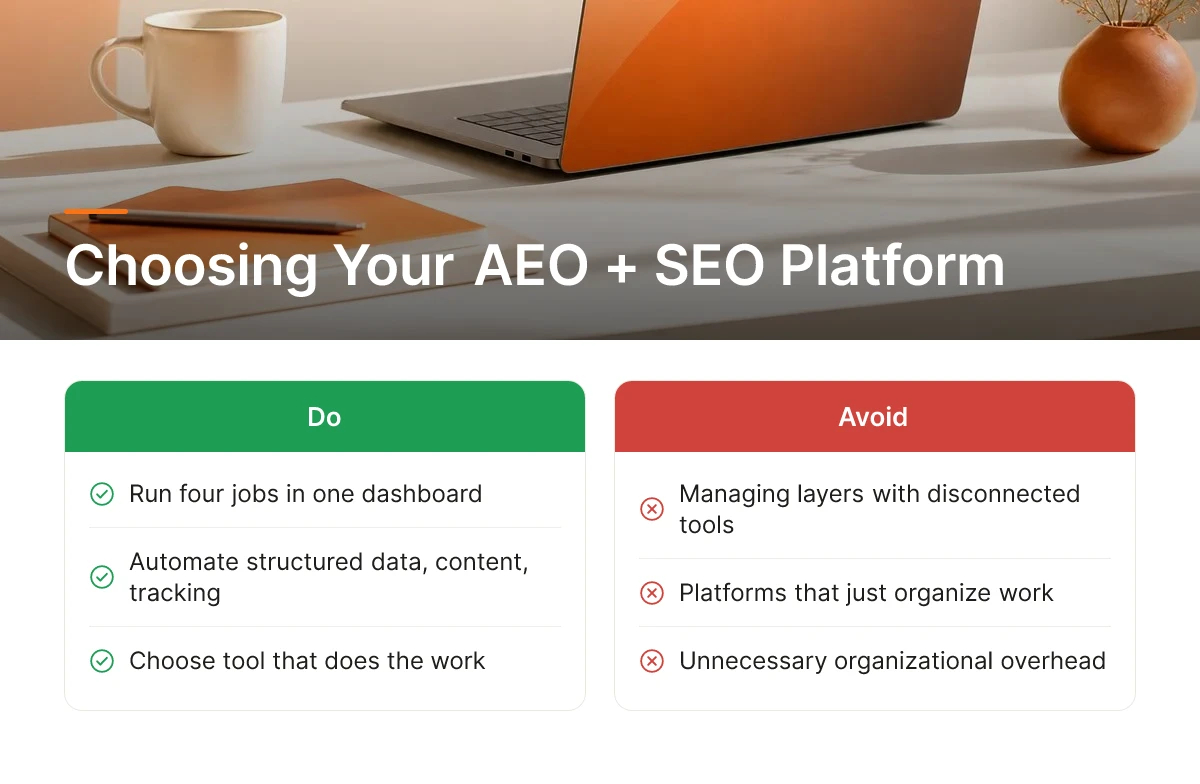
The right platform runs four jobs in one dashboard, structured data, content publishing, AI citation tracking, and Google rank tracking, without you managing any of them by hand.
Enterprise buyers evaluating a platform like Conductor get a long checklist covering governance, access controls, and cross-domain reporting [1]. An SMB doesn't need that level of organizational overhead, but the underlying question is the same one enterprise teams ask: does this tool actually do the work, or does it just organize work for a person to do? For a solo founder or e-commerce owner, that distinction decides whether the tool replaces an agency or just becomes another task on the to-do list.
How Much Hands-On Work Is Required for the Platform to Run on Autopilot?
True autopilot means the platform handles technical maintenance and content output continuously, while still giving you a review step before anything ships. That's different from a tool that drops a to-do list in your inbox every Monday. Ask a vendor directly: does the system publish new pages and refresh schema markup on its own schedule, or does it hand you a report and wait for you to act? Moonrank, for example, runs daily content generation and auto-publishing alongside ongoing structured data and llms.txt maintenance, so the business owner's job shifts from "doing SEO" to occasionally checking what already went live.
What Integration Requirements Should You Check Before Committing to a Platform?
A platform worth paying for should connect to your existing CMS, analytics, and site infrastructure without a developer on standby. Enterprise-grade platforms market themselves on avoiding "IT lift" for large organizations [1], for an SMB, the equivalent test is simpler: can it plug into Shopify, WordPress, or whatever you already run, today, without a custom build? If a sales call starts mentioning engineering resources or implementation timelines, that's a signal the tool was built for a bigger company's budget and headcount, not yours.
The checklist also has to match your business type. An e-commerce store needs product-level structured data so AI engines can describe specific SKUs accurately. A B2B SaaS company needs feature and comparison content that answers the buyer questions prospects type into ChatGPT or Perplexity. A cybersecurity vendor needs trust signals, certifications, case-study-style proof points, built into its content and schema. A hotel needs location and availability signals surfaced consistently across every AI engine a traveler might ask. Enterprise AEO guidance frames this as unifying technical foundation with answer-ready content [2]; the SMB version of that same idea is just making sure the platform's defaults fit your category, not a generic template.
What Does an Enterprise-Grade AEO and SEO Platform Cost Compared to an Agency?
A budget-friendly automated AEO and SEO platform runs on a fixed monthly subscription, while agency retainers typically demand long contracts and separate line items for strategy, content, and technical work [3].
Enterprise SEO agencies and consultancies price around headcount: a strategist to set direction, writers to produce content, and a technical specialist to handle schema markup and site audits. Each of those roles bills separately, and most retainers lock businesses into multi-month or multi-year contracts regardless of results. Automated platforms collapse that into one subscription that covers tracking, content, and technical optimization together [4]. That's the structural bet behind calling something The #1 Enterprise AEO Platform + Enterprise SEO Platform, it only earns the label if it replaces headcount, not just adds a dashboard on top of it.
What's the Real ROI from Switching to an Automated Platform Versus Hiring an Agency?
The ROI comes from removing the ongoing labor cost of manual content production and technical audits that agencies bill for hourly or monthly.
An agency charges for the hours a strategist spends researching keywords, a writer spends drafting posts, and a technical lead spends auditing llms.txt files and structured data. Automation platforms replace those billable hours with software that runs daily, without a retainer attached to each task. Moonrank, for example, handles daily content generation, schema markup, and AI search visibility tracking as one $99/month subscription, a fraction of what agencies charge for the same combination of services, which commonly runs $3,000 or more per month. For an ecommerce brand or B2B SaaS company managing multiple product lines, the savings compound fast because the platform doesn't bill more as content volume scales the way an agency's hours would.
Are There Hidden Costs That Change the Total Cost of Ownership?
Some platforms charge extra for onboarding, integrations, or content volume beyond a base tier, and total cost of ownership should include setup time, not just the listed subscription price.
Enterprise SEO suites often require a services team to configure integrations across regions, brands, or content management systems before the platform does useful work [3]. That setup period, sometimes weeks long, is a real cost even if it doesn't show up on the invoice. The honest comparison weighs the subscription price against the time and dependency required to get the platform running, not just the sticker price. A platform built for SMBs and growing teams should get a business live without a drawn-out implementation phase, that's part of what separates a genuinely automated tool from an enterprise suite with automation features bolted on [4].
Replacing agency work with an automated platform changes the cost structure entirely: instead of variable, billable-hours pricing that grows with scope, a business pays one fixed, predictable subscription. That shift alone is why more SMBs and growing brands are moving away from retainers. If your business is ready to make that switch, start with www.moonrank.ai and see what a fixed-cost alternative to an agency retainer looks like in practice.

Frequently Asked Questions
Do I still need an SEO agency if I use an automated AEO + SEO platform?
No, that's the point of automation. An agency charges $3,000+ a month for strategy, content, and technical fixes that a platform like Moonrank handles on autopilot for $99/month, covering keyword research, daily content publishing, and schema markup without requiring you to manage a retainer or approve every deliverable.
How long does it take to see results from an AEO and SEO platform?
Most businesses notice technical fixes within days and AI search visibility improvements within a few weeks. Google SEO rankings typically take longer to shift because of crawl and authority timelines, but daily content publishing and structured data changes tend to influence AI engine recommendations faster than traditional search rankings [2].
Can a small business realistically compete with larger brands in AI search results?
Yes, AI engines reward clear, well-structured, frequently updated content over brand size alone. A boutique hotel or Shopify store with accurate schema markup and consistent publishing can outrank a larger competitor that hasn't optimized for how ChatGPT, Gemini, or Perplexity actually parse and cite sources [2].
What industries benefit most from combined AEO and SEO optimization?
E-commerce, B2B SaaS, cybersecurity, and hospitality see the clearest gains because their buyers frequently ask AI engines for direct product or vendor recommendations. These industries also have competitors already investing in visibility, so businesses that skip AEO risk being left out of the exact comparison queries where customers make decisions [3].
Conclusion
Enterprise platforms like Conductor prove that AEO and SEO are no longer separate projects, they're one discoverability system that needs daily upkeep [1][2]. For SMBs, the takeaway is practical: you don't need enterprise budgets to apply the same logic, just a tool that handles technical optimization, content publishing, and visibility tracking without manual effort.
Start by checking how your business currently appears when customers ask ChatGPT, Gemini, or Perplexity for recommendations in your category. Then visit www.moonrank.ai and start your 3-day free trial to see what's fixable in under a week.
Sources & References
- The #1 Enterprise AEO Platform + Enterprise SEO Platform
- AEO vs. SEO: What enterprise teams need to understand about AEO
- Enterprise SEO Platforms and Software: 10 Compared (2026)
- Best Enterprise SEO Platforms, Software and Tools 2026: 14 Compared
Recommended Articles
Explore more from our content library: