How Perplexity Shopping Chooses Which Products to Recommend
Perplexity shopping recommendations favor structured, accurate product data over paid placement. Learn what it takes to get your store surfaced and recommended.

Understanding Perplexity shopping recommendations is essential. Perplexity recommends products based on structured, accurate, and current product data, not paid placement. To show up, your store needs clean product feeds (title, price, availability, specs), accurate schema markup, real customer reviews, and content that directly answers buyer questions. Perplexity's AI pulls from indexed web content and shopping data partners to match a user's query, so the more clearly your product information is structured and the more trustworthy your site appears, the more likely your products get surfaced through Perplexity shopping recommendations.
How Can SMBs Get Their Products Recommended by Perplexity's AI Shopping Feature?
Your product has to exist cleanly in the index first: Perplexity pulls from crawled web content and shopping data partners, not from an ad auction, so a well-structured product page beats a paid placement every time [2].
That mechanic changes the entire game plan. Instead of bidding on keywords, you're feeding a system that's trying to match a shopper's question, "best noise-canceling headphones under $150", against your actual inventory data. Perplexity ranks products on a weighted mix of signals: how complete your structured data is, how deep your reviews run, how accurate your real-time pricing is, how well your attributes match the query, and whether third parties cite your brand as authoritative [3]. None of those five factors involve a media budget, which is exactly why earning Perplexity shopping recommendations requires a data strategy rather than a bidding strategy.
This is why keyword stuffing does nothing here. An AI system matching intent to inventory needs machine-readable facts, price, availability, variant options, dimensions, materials, compatible devices, not repeated phrases. A product page that states "Available: 42 in stock, Size: M/L/XL, Material: 100% cotton" in structured schema gives the model something to match against a query. A page full of marketing copy with no attribute data gives it nothing to work with, no matter how often you've repeated your category keyword.
Which Product Categories and Store Types See the Most Perplexity Recommendation Traffic?
Categories with naturally structured, comparison-friendly data, electronics, home goods, and B2B SaaS tools with clear spec sheets, tend to surface more often because their attributes are already quantifiable. A laptop has RAM, screen size, and battery life. A SaaS product has seat counts, integrations, and tiered feature lists. Those are the exact data points an AI shopping assistant needs to compare options and justify a recommendation, which puts well-documented catalogs at a structural advantage over categories that rely on subjective description, like apparel or home décor, where attributes are harder to standardize.
How Do Inventory Status and Real-Time Pricing Affect Whether Perplexity Recommends Your Products?
Stale listings get filtered out, and inaccurate pricing erodes the trust Perplexity's system is built to protect for the shopper. Real-time price accuracy is one of the core ranking signals Perplexity weighs when deciding what to surface [3], so a feed that still lists a sold-out item as available, or shows a price that doesn't match checkout, works against you. Keeping inventory and pricing data synced isn't a back-office chore here, it's a visibility requirement for earning a spot in Perplexity shopping recommendations.
The same logic extends past physical products. Hotels and service businesses with bookable inventory, room types, nightly rates, availability windows, can apply identical structured-data discipline to their booking engines, since an AI assistant matching "pet-friendly hotel under $200 near downtown" works off the same accuracy and completeness signals as a shopper comparing headphones.
What's the Difference Between Optimizing for Perplexity Shopping vs. Traditional Google Shopping?
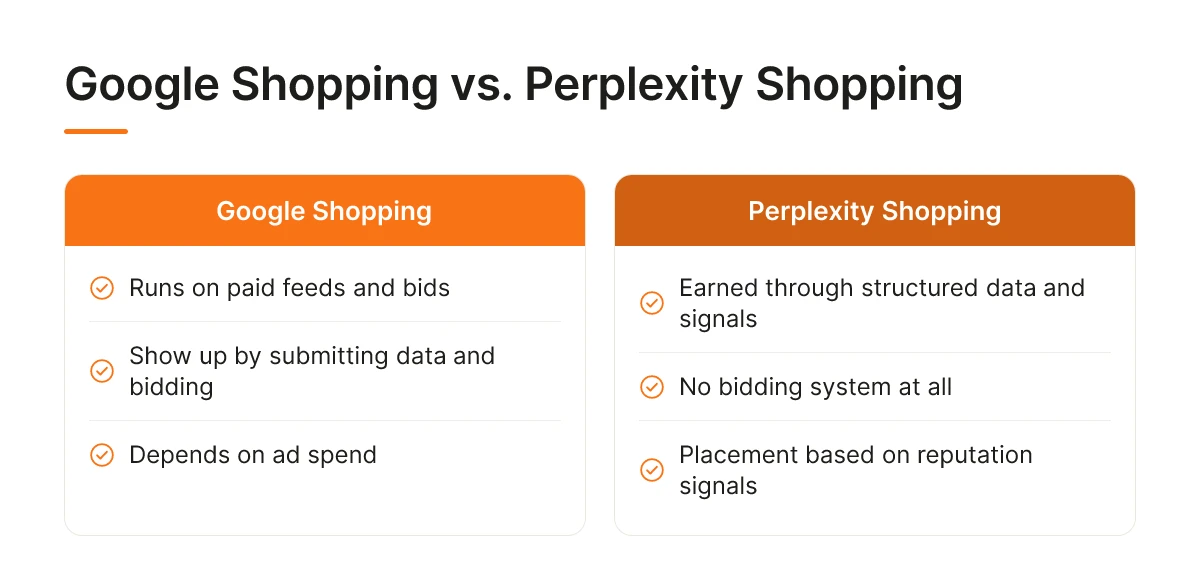
Google Shopping runs on paid feeds and bids, while Perplexity shopping recommendations are earned through structured data, organic content, and reputation signals with no auction involved.
That's the mechanical difference, and it changes almost everything about how a store should spend its time.
Paid Feeds vs. Earned Signals
Google Shopping depends on a Merchant Center feed and ad spend, show up by submitting product data correctly and bidding competitively, full stop. Perplexity has no bidding system at all; placement is earned through structured data completeness, review depth, pricing accuracy, and third-party citation authority [3]. A store with thin product data and no reviews can't buy its way into a Perplexity recommendation the way it can buy a Google Shopping placement. That's a real mindset shift for teams used to treating visibility as a media-buying problem rather than a data and content problem.
Short Queries vs. Conversational Comparisons
Google Shopping typically answers short, transactional searches like "men's running shoes size 10." Perplexity responds to conversational, comparison-style questions, "what's the best running shoe for flat feet under $150", where the AI has to understand attributes, match them to a query, and justify a recommendation [2]. Optimizing for the second kind of query means writing content that answers comparison questions directly, not just stuffing a product title with keywords.
How Do Conversion Rates and Customer Quality Differ Between Perplexity Recommendations and Google Shopping Traffic?
Perplexity sends fewer visitors than Google Shopping, but those visitors tend to convert better because an AI has already filtered and compared options before the click happens. One analysis of 310 brands found Perplexity's average order value running higher than ChatGPT's, $129 versus $71, even though Perplexity accounts for a small slice of total LLM referral traffic, around 2.6% [3]. That pattern lines up with what you'd expect: a shopper who asked a conversational question, read a synthesized comparison, and then clicked through has effectively pre-qualified themselves. They're not browsing, they're closing.
Complementary Channels, Not Competing Ones
Nothing about optimizing for Perplexity shopping recommendations requires turning off Google Shopping ads. A store can keep running paid feeds for immediate volume while separately building the structured data, schema markup, and content depth that earns organic placement in AI shopping surfaces. Moonrank handles that second track specifically, it builds the schema markup, citations, and structured data that help AI systems trust and recommend a store's products, while running as automated daily content in the background rather than a manual project.
What Product Data and Technical Factors Does Perplexity Use to Surface Recommendations?
Perplexity ranks products on five weighted signals: structured data completeness, review depth, real-time price accuracy, attribute-to-query matching, and third-party citation authority [3]. Get those five right and Perplexity shopping recommendations become a realistic traffic channel instead of a guessing game.
Schema Markup Tells the AI What You're Actually Selling
Product, Offer, and Review schema give Perplexity machine-readable facts it doesn't have to infer from page copy, current price, stock status, and star ratings pulled straight from code rather than scraped from a layout that might change next week. Perplexity's algorithm favors structured data completeness above everything else [3], which means a product page with full schema markup can outrank a bigger competitor whose data is thin or missing [3]. There's no bidding system to buy your way around this, placement is earned through data quality, not ad spend [3].
Product Descriptions Need to Answer the Comparison Question Directly
Specific descriptions that name materials, dimensions, and use cases let the AI match a product to a shopper's exact question instead of guessing from vague marketing copy. "Durable and stylish" tells the model nothing; "14-inch waterproof canvas tote, machine washable, fits a 15-inch laptop" answers three comparison questions at once. Perplexity's matching layer weighs attribute-to-query fit directly [3], so a listing that spells out the attributes a shopper is likely to search for has a real edge over one that relies on brand voice alone.
How Should You Structure Product Descriptions, Pricing, and Metadata Specifically for Perplexity's AI to Pick Them Up?
Keep titles, prices, and availability status identical and current across your site, product feeds, and any marketplace listings, since inconsistent data erodes the trust an AI model places in a source. Perplexity's shopping layer blends conversational search with real-time product data [2], so a price that's stale by even a day can knock a listing out of contention. Treat this the same way you'd treat NAP consistency for local SEO, one accurate, synchronized version of the truth everywhere the AI might look.
Reviews and Third-Party Mentions Work as Trust Signals
Genuine customer reviews and independent citations let Perplexity cross-reference your claims against outside sources instead of taking your product page at its word. Review depth and third-party citation authority both sit among the five ranking signals [3], meaning a product with a handful of detailed, verified reviews often beats one with none, regardless of brand size.
A Short Structuring Checklist
- Specific, attribute-rich product titles (not generic brand names)
- Structured, accurate pricing in both on-page copy and schema
- Complete Product, Offer, and Review schema markup
- Clearly visible, real-time stock and availability status
- A steady stream of genuine review content
Most SMBs can audit titles and descriptions manually, but schema markup and feed-level consistency are harder to maintain without ongoing attention, which is the technical gap Moonrank's AI audit and optimization layer is built to close, implementing structured data and keeping it current without requiring the store owner to touch a line of code.
How Do You Measure ROI and Track Visibility When Perplexity Recommends Your Products?
Track Perplexity referral traffic in your analytics platform and pair it with manual, repeated checks of how your products appear in Perplexity's answers, there is no ad dashboard to do this for you.
Unlike Google Shopping, Perplexity does not give merchants a native reporting console that shows impressions, clicks, or conversions tied to specific product listings [2]. That gap means SMBs have to assemble their own measurement approach from two sources: web analytics and direct observation.
Finding Perplexity in Your Analytics
Start with referral source data in Google Analytics or whatever platform runs your store. Perplexity traffic typically shows up as a referrer domain in your traffic acquisition reports, separate from organic search and direct visits.
Where possible, add UTM parameters to any links you control that might feed Perplexity's citations, your product pages, press mentions, and listings on review sites it pulls from. This lets you distinguish a visit that originated from a Perplexity shopping recommendation from one that came through a different AI engine or a standard web search.
What Metrics Matter Most for Proving Sales Impact from Perplexity Recommendation Traffic?
Look at referral sessions, conversion rate from that specific referral source, and assisted conversions, not just last-click sales.
Last-click attribution undercounts AI-driven discovery because a shopper might see your product in a Perplexity answer, open a new tab to compare prices, then complete the purchase later through a direct visit or a Google search. Assisted conversion reporting, available in most analytics platforms, credits Perplexity for its role in that path even when it isn't the final touchpoint. Reported average order values for Perplexity-driven purchases have come in around $129, compared to $71 from ChatGPT [3], which makes the case for tracking this channel's contribution even when it rarely closes the sale on the first visit.
Checking Visibility Directly
Analytics only tells you what already happened. To see whether you're positioned to show up at all, ask Perplexity the kinds of questions a shopper would type, "best waterproof hiking boots under $150," "top organic skincare brands for sensitive skin", and check whether your store appears in the results.
Run this check across several query variations, not just one phrase, and repeat it over weeks rather than relying on a single snapshot. Perplexity's answers shift as your product data, reviews, and third-party citations update [3], so a brand absent from recommendations in January can appear by March after fixing structured data gaps.
Doing this by hand across dozens of queries and competitors gets tedious fast, which is where a dedicated visibility-tracking tool earns its keep. Moonrank monitors how your business appears across ChatGPT, Gemini, Claude, and Perplexity on an ongoing basis, removing the need to manually re-run the same shopping-style questions every week to catch when your Perplexity shopping recommendations visibility changes.
What's the Fastest Way to Optimize Your Store for Perplexity Shopping Recommendations?
Fix product schema first, tighten descriptions second, build review content third, then monitor results, in that order, because each step compounds on the last.
This sequence matters because Perplexity ranks products on structured data completeness, review depth, pricing accuracy, attribute-to-query matching, and citation authority, roughly in that weighted order [3]. Schema fixes change what the model can read today. Review campaigns take weeks to show up. Start with the thing that pays off fastest.
Step 1: Fix Product Schema
Add or correct Product schema markup on every active listing, price, availability, SKU, brand, and review ratings all need to be present and accurate. A small brand with complete schema can outrank a household name that has left its structured data thin or outdated [3]. This is the single highest-use fix available to a small store, because it requires no new content, just cleanup.
Step 2: Tighten Product Descriptions
Rewrite descriptions so they answer the specific questions a shopper would type into Perplexity, not just list features for a human skimming a product page. Attribute-to-query matching is one of the five ranking signals Perplexity weighs [3], so descriptions that use the language customers actually search for tend to surface more often.
Step 3: Build Review Content
Collect and display reviews on-site and through third-party sources, since review depth factors directly into which products get shown [3]. This step takes longer than schema or copy fixes, which is why it comes third, not first.
Step 4: Monitor Results
Check regularly for pricing that failed to sync, stock status that went stale, or schema that silently broke after a platform update. Real-time price accuracy is one of the ranking signals Perplexity checks [3], so a listing that shows an old price can quietly lose its slot even if nothing else changed.
Can Automation Tools Replace Manual Optimization for Perplexity Visibility?
Automation can handle the repetitive technical upkeep, but accurate product knowledge still needs a human behind it.
Keeping schema consistent across hundreds of SKUs, watching for ranking drift, and re-checking structured data after every platform update is tedious, repeatable work, exactly what automation is good at. But knowing which product attributes matter to your specific customers, or which review angles build real trust, still takes someone who understands the business.
Moonrank handles the technical side of this for store owners who don't have time to audit schema weekly: it runs technical AI audits, builds structured data and llms.txt configuration, and tracks how a store shows up across ChatGPT, Gemini, Claude, and Perplexity shopping recommendations, all on autopilot. Visit www.moonrank.ai to see where your store stands today.

Frequently Asked Questions
Does Perplexity Shopping charge for product placement like Google Shopping ads?
No. Perplexity's Merchant Program carries no listing fees, commissions, or transaction fees, and there is no bidding system for placement [3]. Products rank based on structured data quality, review depth, pricing accuracy, and citation authority rather than ad spend [3]. That makes product data quality the real lever, not a media budget.
Can a small store compete with large retailers for Perplexity shopping recommendations?
Yes, placement is earned through data quality, not brand size or advertising budget [3]. A smaller brand with complete Product schema markup, accurate pricing, and strong reviews can outrank a larger retailer with thin or outdated product data [3]. This levels the playing field in a way traditional paid shopping placements never did, since there's no "escape hatch" through higher bids [3].
How often does Perplexity update its product recommendations?
Perplexity weighs real-time price accuracy as one of its core ranking signals, so recommendations shift as product feeds change [3]. Stores with frequently updated pricing, stock status, and attributes stay competitive, while stale feeds lose visibility over time. Treat your product data as a live feed, not a one-time setup task.
Do B2B SaaS and service businesses benefit from Perplexity shopping optimization, or just ecommerce?
Perplexity's shopping agent is built for physical product discovery, so its direct impact is strongest for ecommerce [2][4]. B2B SaaS and service businesses still benefit from the same underlying principles, structured data, citation authority, and AI-readable content, through Perplexity's broader answer engine, just not through the Shop feature itself.
How long does it typically take to see results from optimizing for Perplexity shopping recommendations?
Schema fixes can influence how your products are read within days, since they change what the model can parse immediately. Review depth and citation authority build more slowly, often over several weeks, because genuine review volume and third-party mentions accumulate over time. Most stores see meaningful movement in Perplexity shopping recommendations within a month of fixing structured data and pricing accuracy consistently.
Conclusion
Perplexity's shopping recommendations run on a different set of rules than paid search: structured data, review depth, pricing accuracy, and citation authority decide who gets picked, not ad spend [3]. That means your next move isn't a bigger budget, it's cleaner Product schema, current pricing feeds, and content that establishes trust signals AI systems can parse. Small stores with disciplined data can outrank bigger names with messy feeds. Start by auditing your product pages for complete schema markup this week, then check how Moonrank's technical AI audit and daily content automation at www.moonrank.ai can keep that data current without manual upkeep.
Sources & References
- Perplexity Shopping Is Changing the Way We Shop Online
- How Perplexity Picks Top 3 Product Recommendations
- What is Perplexity Shop like a Pro and ways to gain visibility
Recommended Articles
Explore more from our content library: