Get Recommended When Buyers Use AI Search for Manufacturers
AI assistants like ChatGPT and Perplexity recommend manufacturers whose online presence gives them clear, verifiable facts to cite — specific capabilities...

Understanding AI search for manufacturers is essential. AI assistants like ChatGPT and Perplexity recommend manufacturers whose online presence gives them clear, verifiable facts to cite, specific capabilities, certifications, materials, and third-party proof like reviews or industry directories. Unlike Google, these tools don't rank pages; they synthesize an answer from whichever sources state your capabilities plainly and consistently across your site and the web. Manufacturers get recommended by making those facts easy to find, structured, and corroborated elsewhere online.
Prerequisites: What Your Manufacturing Site Needs Before Optimizing for AI Search
Four things need to be in place before AI search for manufacturers can work at all: crawlable text content, specific capability pages, some third-party corroboration, and someone who can edit your site's code. Skip these and later steps have nothing to build on.
1. Crawlable, text-based content
AI crawlers need to read your pages as text. If your product specs live only in a JavaScript-rendered catalog or a PDF spec sheet with no HTML equivalent, most AI systems never see them [1]. A manufacturer with a visually polished site full of image-based infographics and download-only datasheets can be invisible to an AI assistant even while ranking fine on Google.
2. Specific capability pages
AI tools cite facts, not impressions, so vague "About Us" copy does not get quoted. You need dedicated pages stating materials handled, tolerance ranges, certifications held, minimum order quantities, and typical lead times [1]. A procurement engineer's prompt is often this specific, "food-grade conveyor systems" with named certifications [4], and an AI assistant can only answer with your name if that detail already exists on your site in plain language.
3. Some third-party presence
AI assistants cross-reference claims rather than trusting a single source, so your own website saying "ISO 9001 certified" carries less weight without outside confirmation [2]. Industry directories, customer reviews, case studies, and press mentions give the AI a second and third place to confirm what you claim about yourself. If none of this exists yet, plan for it, it does not need to be extensive, but it cannot be absent [3].
4. Access to edit code or CMS templates
Structured data, schema markup, and llms.txt configuration, steps covered later, require someone who can touch your site's templates or raw HTML, not just a page-builder's text fields [5]. If your current setup runs through a locked-down CMS or an outside agency with slow turnaround, resolve that access question before moving further.
Audit How AI Search Assistants Currently Evaluate Your Manufacturing Company
Run buyer-style prompts through ChatGPT and Perplexity yourself before changing anything on your site, the results show you exactly where you stand today.
Open ChatGPT, Perplexity, and Gemini in separate tabs and type the questions a procurement engineer would actually ask: "who makes injection-molded enclosures for medical devices," "best sanitary conveyor suppliers for food processing," or "top CNC machining shops for aerospace tolerances." Note whether your company appears, what's said about you, and which competitors show up instead. Run each prompt three or four times, AI answers vary between sessions, and a single query tells you little. This manual audit is the starting point for any work on AI search for manufacturers, because you can't fix a visibility gap you haven't measured.
What Role Do Trust Signals and Third-Party Citations Play?
AI assistants trust what other sources say about you far more than what you say about yourself, because independent mentions act as corroborating evidence rather than self-reported marketing claims.
A case study on your own site stating "ISO 9001 certified, 30 years of experience" carries less weight than that same fact appearing on an industry directory, a trade association page, or a distributor's supplier list. Research on B2B buying behavior shows AI tools pull supplier recommendations from a mix of your website, review platforms, industry publications, and third-party data sources, not your homepage alone [4]. If your certifications, capabilities, and case studies only exist in your own marketing copy, an AI assistant has no way to corroborate them.
How Do AI Engines Judge Credibility Differently Than Google?
Google ranks pages by backlinks and keyword density; AI engines judge credibility by whether facts about you stay consistent and specific across independent sources.
Traditional SEO rewarded volume, more pages, more keywords, more inbound links. AI models instead look for agreement: does your certification list on your site match what a distributor's catalog says, does a trade publication describe the same capabilities you claim, does your specialty show up the same way everywhere it's mentioned? Specificity matters more than scale here. A 12-person shop that precisely documents "FDA Class II device enclosures, cleanroom-rated, domestic tooling" can outrank a thousand-employee competitor whose site only says "custom plastics manufacturing", because the model can match a narrow buyer query to a narrow, well-corroborated claim [3]. That gap between niche precision and generic size is where smaller manufacturers have a real opening in AI recommendations today.

Optimize Content and Technical Signals for AI Search for Manufacturers
Winning at AI search for manufacturers means rewriting pages so a language model can lift a fact and quote it, then fixing the technical plumbing so crawlers can reach that fact in the first place.
Why Does Writing for AI Citation Differ From Writing to Rank on Google?
Content built to rank on Google uses keyword-rich headings, long introductions, and broad topical coverage designed to signal relevance to a crawler counting keyword density. Content built to get cited by an AI assistant does the opposite: it leads with a direct factual statement, a specific number, or a named capability that can be lifted whole into a chat answer.
Compare two sentences. "We offer many precision machining solutions for various industries" ranks fine but gives an AI nothing to quote. "We CNC-machine aluminum and titanium parts to ±0.0005-inch tolerance for aerospace and medical device customers" gives the model a fact, a material, a number, and a buyer type it can cite directly in a shortlist answer. Manufacturing sites optimizing for AI search need to say exactly what they sell, to whom, and why a buyer would choose them, on pages a crawler can actually reach [1]. That shift matters because B2B buyers now paste AI-generated shortlists straight into messages to their buying committee, and if your page never produced a quotable fact, you were never in the running [2].
What Technical Foundations Do AI Engines Need to Find and Understand You?
AI crawlers need structured data and clean HTML before they need good writing, because a well-written page an AI can't parse never gets cited. Schema markup is structured data that states your organization type, product lines, and certifications in a machine-readable format, rather than burying them in a PDF or an image-based spec sheet. Clean, text-based site structure, logical URLs, real headings, no critical content locked behind JavaScript, lets crawlers extract and verify information instead of guessing at it [3].
An llms.txt file is a plain text file placed at your site root that tells AI crawlers which pages matter most and where to find authoritative information fast. It is worth adding once your core capability, certification, and case study pages are solid, adding it before the content exists just points crawlers at thin pages.
Publish these content types, each on its own page:
- Capability pages per process or material (injection molding, sheet metal fabrication, food-grade stainless)
- Certification pages (ISO 9001, AS9100, ITAR) stating scope and audit dates
- Named case studies with specific, quantified outcomes
- A "who we serve" page naming the industries you serve by name, not by category
Keyword stuffing and aggressive backlink building tend to backfire here. Models read inconsistent, promotional phrasing as a trust signal in the wrong direction, it looks like marketing copy trying to game a system, not a factual answer to a procurement question [4]. Moonrank's technical audit handles the schema markup, llms.txt configuration, and citation building automatically, so manufacturers don't have to hand-edit structured data to fix these gaps.
Verify Your Visibility and Measure AI Search Results Over Time
Confirm progress by running the same buyer-intent prompts across ChatGPT, Perplexity, and other assistants on a set schedule, then logging exactly what each one says about your company.
Treat this as a recurring audit, not a one-time check. Pick 10-15 prompts that mirror how a procurement lead or engineer would actually search, "best sanitary conveyor suppliers in North America," "top injection molding vendors for medical devices", and run them monthly against the same assistants. Record whether your company appears, where it ranks in the list, and whether the description is accurate. This is the only reliable way to track AI search for manufacturers over time, since there's no dashboard equivalent to Google Search Console for assistant-generated answers yet.
Can Manufacturers Rely on B2B Directories Alone, or Is a Separate Strategy Needed?
No, directories and AI assistants serve different buyer moments and neither replaces the other.
A listing on Alibaba or Global Sources functions as a transactional marketplace entry: a buyer who already knows roughly what they want searches a catalog and compares listed suppliers side by side. An AI assistant answers a conversational, specific question, "who are the best suppliers of food-grade conveyor systems, and what should I evaluate them on?", and synthesizes a shortlist with reasoning attached, often before the buyer ever opens a directory or search engine [4]. A growing share of buyers now reach that shortlist stage without a single click on any supplier's website [2]. Directory presence and AI visibility need to run in parallel, not as substitutes for each other.
What Metrics Prove ROI From AI Search Visibility?
Track four things: how often you're mentioned across your test prompts, whether what's said about you is accurate, referral traffic from assistant citations, and the quality of inquiries tied back to AI discovery.
- Mention frequency: the share of your test prompts where your company appears at all, tracked month over month.
- Accuracy of description: whether the assistant correctly states your certifications, capabilities, and location, since AI summaries sometimes carry outdated or wrong details.
- Referral patterns: site traffic originating from AI assistant citations, even if volume is still small relative to organic search.
- Inquiry quality: whether leads who mention an AI assistant convert at a different rate than directory or cold-outreach leads.
Validate the last metric directly. Add a "How did you hear about us?" field to intake forms, and have sales reps ask the same question on discovery calls. Without that direct confirmation, it's easy to mistake coincidence for causation when a lead happens to mention ChatGPT in passing. Because AI-generated answers shift as models update and new content gets indexed, schedule this whole review quarterly at minimum, what ranked well in January can disappear by April without any change on your end.
Moonrank builds this verification into its core workflow, tracking how a business appears across ChatGPT, Gemini, Claude, and Perplexity on an ongoing basis rather than leaving manufacturers to run manual prompt checks by hand.
Common Mistakes to Avoid When Optimizing for AI Search as a Manufacturer
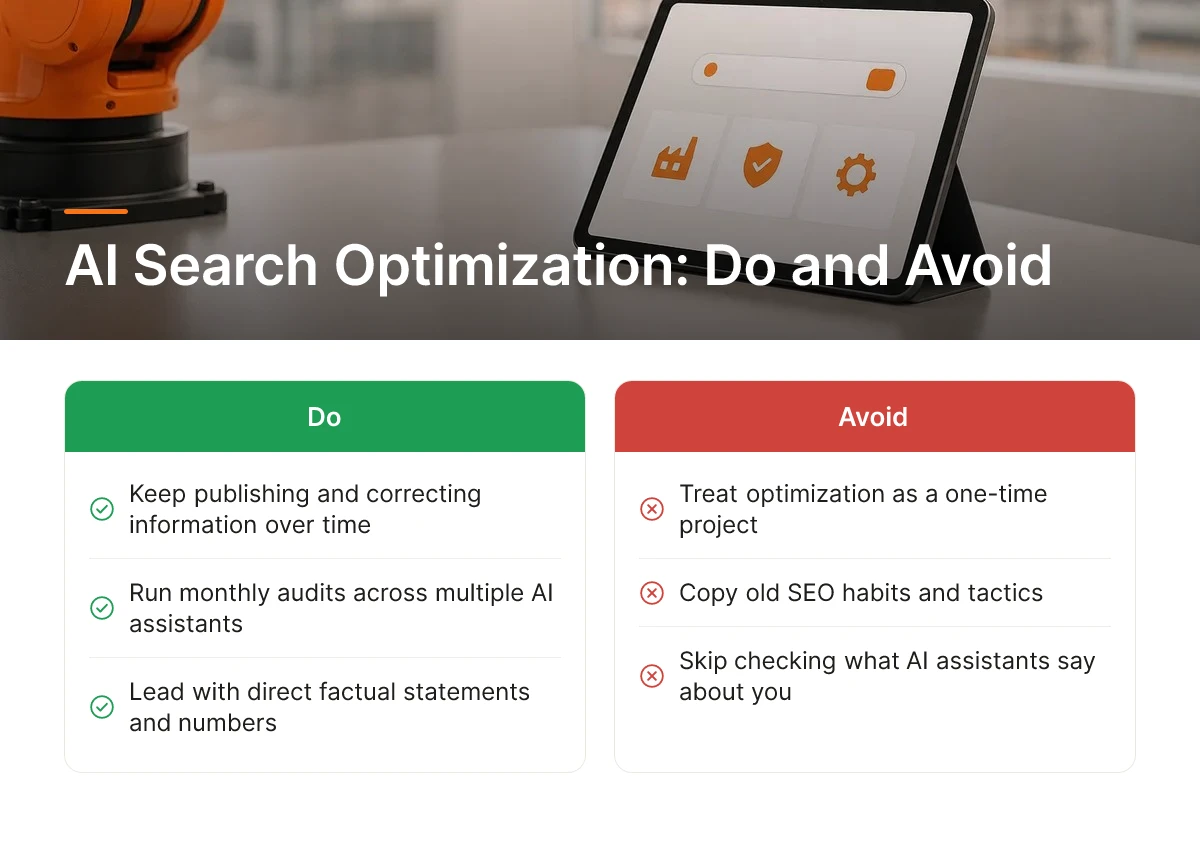
Most manufacturers lose ground in AI search by treating it as a one-time fix, copying old SEO habits, or never checking what AI assistants actually say about them.
These errors show up again and again across the manufacturing sites we've reviewed. Use this list as a troubleshooting checklist before you assume your content strategy is working.
Mistake 1: Treating it as a project with an end date
A website audit and a content sprint feel like a finish line, but AI search for manufacturers rewards companies that keep publishing and correcting information over time. Large language models re-crawl and re-weight sources continuously, so a site that goes quiet for six months loses the freshness signal it built up [1]. Budget for ongoing maintenance, not a single rebuild.
Mistake 2: Porting Google SEO tactics directly
Keyword-stuffed pages and a thin variant for every possible search term made sense for Google's old ranking logic, but AI models are matching intent to direct, factual statements, not keyword density [1]. A procurement engineer's prompt gets answered with whichever page states plainly what you make, who it's for, and what certifications back it up, not the page with the most repeated phrases.
Mistake 3: Polishing only your own website
AI assistants cross-check claims against independent sources before recommending a vendor, so a flawless website with no outside corroboration still gets passed over [2]. Industry directories, distributor listings, review sites, and trade publications all feed the models that build shortlists [4]. If your only mention of your own capabilities lives on your domain, there's nothing for the model to verify it against.
Mistake 4: Never checking what AI already says about you
Outdated plant locations, discontinued product lines, or wrong certifications can sit uncorrected in AI-generated answers for months because no one at the company asked the question. Run regular checks across ChatGPT, Gemini, Claude, and Perplexity to catch and correct inaccurate claims before they cost you an RFQ.
This is the gap Moonrank is built for. It tracks how your business appears across ChatGPT, Gemini, Claude, and Perplexity, and automatically publishes the schema markup, structured data, and optimized content manufacturers need to stay accurate and visible, without adding another task to your team's plate. Visit www.moonrank.ai to start the 3-day free trial.
Frequently Asked Questions
How often should manufacturers update their content to stay visible to AI search engines?
Treat content as a living asset and review product, spec, and application pages at least quarterly. AI models favor pages that stay accurate and current, and stale pricing, discontinued SKUs, or outdated certifications give the model a reason to cite a competitor instead [1]. Manufacturers running daily or weekly publishing cycles tend to earn more frequent re-crawls than those that update once a year.
How do AI search recommendations change the buyer journey compared to traditional supplier discovery?
AI compresses the funnel: buyers now build a shortlist inside a chat window before ever visiting a supplier's website [3]. A G2 survey of more than 1,000 B2B decision-makers found 51% of buyers start research in an AI chatbot more often than Google, and 69% end up choosing a vendor they hadn't originally planned to consider [3]. That means the AI's shortlist, not your homepage, is often the first impression.
Which SEO tactics that work for Google can actually hurt AI search recommendations?
Keyword-stuffed pages built purely to rank, thin category pages, and vague "solutions" language without specifics can work against AI citation [1]. AI models extract and quote facts, so pages optimized for keyword density rather than clear answers about what you sell and who it's for tend to get skipped in favor of competitors with plainer, more specific copy [1].
Can a small manufacturer compete with larger suppliers in AI search recommendations?
Yes, AI models weigh clarity and relevance more than brand size or ad budget. A smaller manufacturer with precise technical content, clean structured data, and clear certifications can out-cite a larger competitor whose site buries specs in PDFs or vague marketing pages [5].
Conclusion
AI search is already shaping which manufacturers get named before an RFQ ever lands in your inbox [4]. Winning a spot on that shortlist depends on specifics: clear product and audience pages, structured data AI crawlers can parse, and content that stays current enough to earn repeated citation. None of this requires a bigger marketing team, it requires consistency most manufacturers don't have time to maintain manually.
Start by auditing one high-value product page this week: check whether it states plainly what you sell, to whom, and why a buyer would choose you over the next name on the list. Tools like Moonrank can automate that ongoing work, daily content, technical fixes, and visibility tracking across ChatGPT, Gemini, and Perplexity, for less than a single agency invoice.
Sources & References
- How to Optimize a Manufacturing Website for AI Search (2026)
- How B2B Buyers Use AI to Choose Vendors | Grey Matter
- AI Search for Manufacturers: What Your Website Needs to Be Findable
- How Industrial Buyers Use AI to Find Suppliers in 2026
- Can AI Agents Find Your Products? AI Discovery for B2B Manufacturers & Distributors | B2BEA News
Recommended Articles
Explore more from our content library: