How Google AI Overviews Choose Which Websites to Cite
Google AI Overviews tend to cite websites that combine clear topical authority with content structured for easy extraction — think direct answers near the...

Understanding How Google AI Overviews Choose Which Websites to Cite is essential. Google AI Overviews tend to cite websites that combine clear topical authority with content structured for easy extraction, think direct answers near the top, scannable lists or tables, and well-organized headings. Domain trust signals (backlinks, consistent expertise, and author credibility) also matter, since AI Overviews pull from sources Google already trusts in traditional search. For SMBs, this means the same content that earns citations also tends to rank well organically: clear, well-structured, genuinely useful pages beat thin or keyword-stuffed ones every time.
What Signals Help SMBs Get Their Websites Cited in Google AI Overviews?
The signals that matter most are the ones Google already trusts in organic search: topical authority, clear answers, and a backlink profile that signals credibility to crawlers and summarization models alike.
Understanding How Google AI Overviews Choose Which Websites to Cite starts with a simple correction: there is no separate citation database. AI Overviews select from the same index Google uses for regular search results.
Where Does Google AI Overview Actually Pull Its Source Information From?
AI Overviews are generated using pages that already rank well in traditional organic search, not a parallel or hidden dataset [3]. Google's own documentation describes the feature as surfacing a generative snapshot "with key information and links to dig deeper," built from systems that determine when a summarized answer helps the searcher more than a standard list of links [3].
That matters for how you think about strategy. If a page never earns a spot on page one for its target query, it has little chance of being pulled into a summary above the results [1]. The practical implication: ranking and citation are linked, even though ranking first doesn't guarantee a citation [2].
How Do Backlink Profile and Domain Age Influence Whether Your Site Gets Cited?
Backlinks remain one of the strongest trust signals Google uses to judge whether a domain deserves to be quoted [4]. A site with links from recognized publications or industry authorities tells Google's systems that other credible sources already vouch for the content, which raises the odds of being pulled as a source rather than just ranked.
Domain age, by contrast, is often overstated as a factor. A newer domain with a consistent publishing history and real topical depth can out-cite an older domain that posts sporadically and covers topics shallowly. What AI Overviews appear to reward is sustained focus on a subject, not simply how long a domain has existed.
This is good news for small businesses. An e-commerce brand or a B2B SaaS company does not need a decade-old domain to compete, it needs a backlink profile built on genuine topical trust and a track record of covering its niche consistently.
Content structure plays its own role here. Pages that state a direct answer early, then back it up with scannable detail, make the summarization process easier because there's less ambiguity about what to extract [2][5]. For SMBs without a large in-house content team, this is where tools like Moonrank fit, its daily automated publishing and technical optimization layer (schema markup, structured data, citation building) are built to keep content clear, consistent, and trust-signaling without demanding a full-time writer.
None of this is about outspending bigger competitors. It's about matching the clarity and consistency Google already rewards, which is a fight SMBs can win on merit, not budget.
How Does Content Structure and Format Affect Citation Likelihood in AI Overviews?
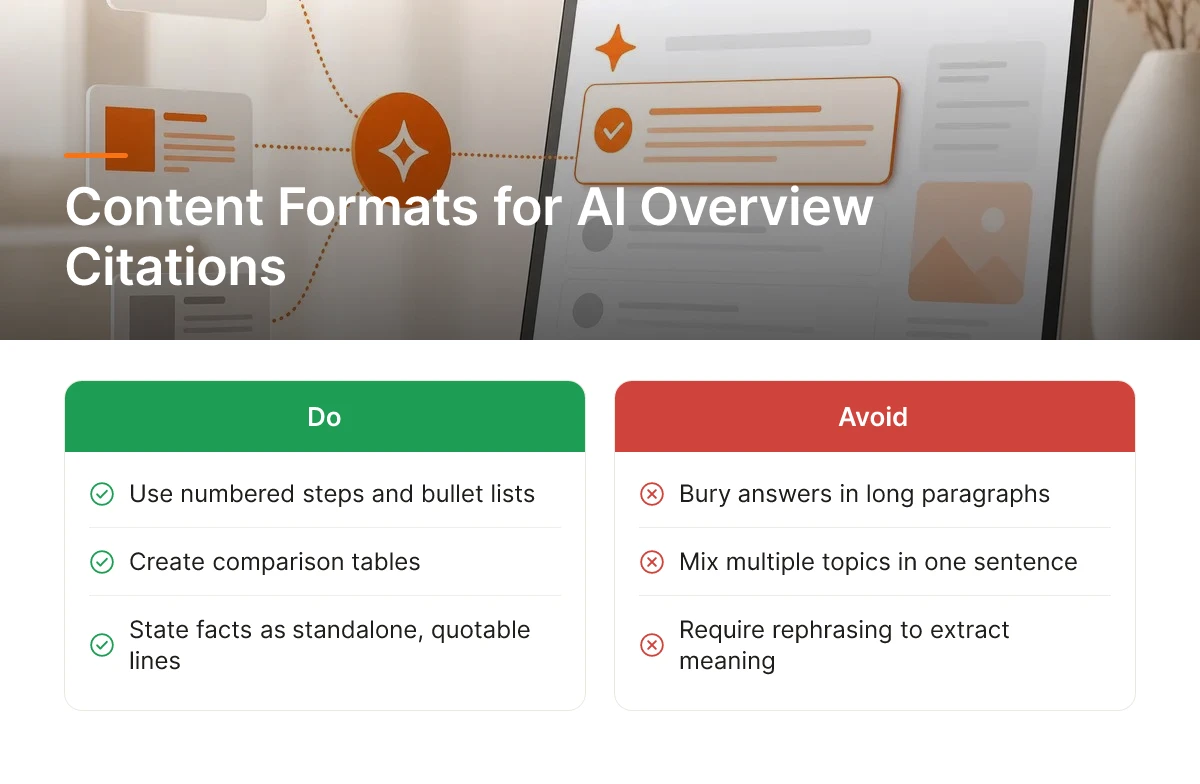
Scannable formats get cited more because Google's system can lift a complete answer in one pass, without stitching together sentences from scattered paragraphs.
Numbered steps, bullet lists, and comparison tables work because they isolate a single fact or instruction from everything around it. A long paragraph might contain a correct answer buried in the middle of a sentence about something else, the AI Overview has to extract and rephrase, which adds a failure point. A bullet point that states "Returns accepted within 30 days, original packaging required" needs no rephrasing at all; it's already a quotable unit [2].
FAQ-style sections map onto this even more directly. When a heading asks a specific question and the text underneath answers it in one or two sentences, that pairing resembles the query-and-answer shape AI Overviews are built to generate [5]. This is part of what people are asking when they search for guidance on how Google AI Overviews choose which websites to cite, they want to know what shape of content gets selected, not just what topic.
Which Content Formats Perform Best for AI Overview Citations Across Different Industries?
The right format depends on the kind of question your industry gets asked. An ecommerce store comparing materials, sizes, or shipping speeds across products should use a table, it's the format that most cleanly answers "which one is better for X." A B2B SaaS company explaining a technical concept like API rate limits benefits more from FAQ blocks, since buyers tend to search in direct questions. A boutique hotel listing cancellation policies, pet rules, or amenities should favor bulleted lists, since those are inherently discrete facts rather than a narrative. For more information, see Google Castle Experiment.
How Should You Structure Content Differently for AI Overviews Versus Traditional Search Rankings?
Traditional rankings reward comprehensive pages that cover a topic from every angle, rewarding depth and length. AI Overviews instead reward the single clearest passage that answers the exact query [4], regardless of how long the rest of the page is. That means the old habit of building up to an answer through three paragraphs of context no longer serves the goal, the direct answer belongs in the first sentence of a section, with supporting detail after it.
Moonrank's daily content generation builds this structure in by default, producing posts with schema markup and clear question-led sections, rather than requiring a business owner to learn these formatting rules manually.
What Role Do E-E-A-T and Domain Authority Play in AI Overview Citations?
E-E-A-T, experience, expertise, authoritativeness, and trust, functions as a risk filter: the more a wrong answer could hurt a reader, the more Google leans on trust signals before citing a source [1].
Google's own guidance confirms that AI Overviews only appear when its systems judge a generative summary as genuinely useful [3], and usefulness is inseparable from accuracy once the topic touches money, safety, or health. That's the core logic behind how Google AI Overviews choose which websites to cite: it's a bet on which domain is least likely to embarrass the search engine if a user acts on what they read.
How Are E-E-A-T Signals Weighted Differently for Medical, Tech, and Lifestyle Content in AI Overviews?
A page about cyber security incident response or a SaaS tool's data-handling claims gets scrutinized far more heavily than a blog post about weekend hiking trails. For cybersecurity vendors and B2B SaaS companies, this means unverified claims, vague authorship, or missing business information can quietly disqualify a page from citation even if it ranks well in traditional search. Visible author expertise, named credentials, and transparent sourcing all lower the perceived risk of quoting a page [4]. A hotel site listing amenities faces less scrutiny than a health-adjacent app making efficacy claims, and Silktide's analysis of cited pages found that AI Overviews favor discrete, directly attributable facts over vague assertions, regardless of how authoritative the domain looks on paper [2].
When Multiple Sources Conflict, How Does Google Decide Which Website to Cite?
Google doesn't default to the newest or first-published source when websites disagree. Instead, it tends to favor the domain with stronger overall trust combined with corroboration across multiple independent sites [4]. If three unrelated sources state the same figure and one outlier contradicts them, the corroborated claim, and the site best associated with it, wins the citation. This matters for e-commerce brands publishing product specs or SaaS companies publishing benchmark data: inconsistent numbers across your own pages can work against you even when each page is individually accurate.
For SMBs, the practical path is consistency, not scale. Publishing verifiable expertise, case studies with real outcomes, clear named authorship, transparent "who we are" information, builds the trust layer AI Overviews depend on over time [5]. Domain authority accumulates slowly, so a small site is better served going deep on a narrow niche than spreading thin across unrelated topics. This is precisely the gap Moonrank's technical audit addresses: it implements structured data and citation-friendly formatting while its daily content engine builds topical depth in one niche, rather than scattering effort across broad, unfocused keywords.
How Can SMBs Optimize Their Sites for AI Search Engine Visibility?
SMBs improve their odds by combining clean technical structure, direct-answer content, and a consistent publishing habit, no single fix works alone.
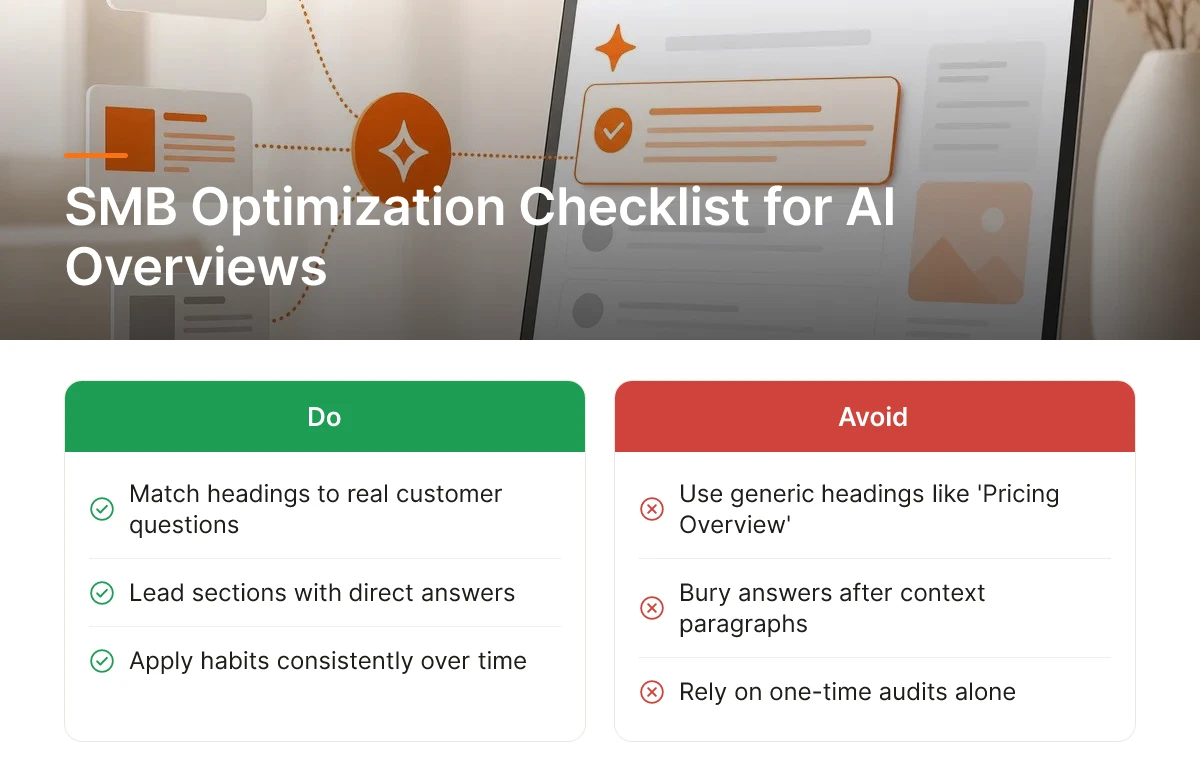
Once you understand how Google AI Overviews choose which websites to cite, the action plan is less mysterious than it sounds. It comes down to a short list of habits applied consistently, not a one-time audit.
The practical checklist
- Match headings to real questions. Write H2s and H3s the way a customer would actually ask them, "How much does X cost" beats "Pricing Overview."
- Lead with the answer. Open each section with a direct, quotable sentence before adding context, the same structure that gets lifted into AI summaries [2].
- Add structured data. Schema markup tells search engines and AI crawlers exactly what your page covers, reducing the guesswork that keeps you out of citations [4].
- Publish on a steady cadence. Fresh, regularly updated content signals an active, maintained site rather than an abandoned one.
What's the Difference Between Optimizing for Google AI Overviews Versus ChatGPT, Gemini, Claude, and Perplexity?
Google AI Overviews draw heavily on existing organic ranking signals, while ChatGPT, Gemini, Claude, and Perplexity each weigh training data, crawlable content, and real-time retrieval differently.
Google's system pulls from the same index that powers classic search results, so ranking fundamentals still matter even if ranking first isn't required to get cited [1]. ChatGPT and Claude lean more on what was absorbed during training plus live browsing when it's enabled, while Perplexity runs closer to a real-time retrieval model that resembles traditional search. Gemini sits closer to Google's own index. The overlap is real, clear structure and factual precision help everywhere, but the weighting of each signal shifts engine by engine, so a strategy built only around classic Google ranking will under-serve the others.
How Do You Build Citation Authority Across Multiple AI Search Engines at Once?
Depth on one niche builds citation authority that transfers across engines, while spreading thin across unrelated topics builds authority nowhere.
A cybersecurity SaaS site that publishes consistently on a narrow set of threat categories, ransomware response, endpoint detection, compliance frameworks, builds the kind of topical depth that multiple AI systems recognize as a trustworthy reference on that subject. A hotel site that structures its cancellation policy, amenity pages, and local guides the same way across every property page builds the same kind of pattern recognition. This consistency is why Moonrank focuses on personalized keyword research and competitive landscape analysis built around one business's actual niche, rather than generic keyword lists that dilute topical focus.
Structured data and clean site architecture support this across every engine simultaneously, they're not a Google-only tactic. Moonrank's technical optimization layer handles schema markup, llms.txt configuration, and citation building in the background, so a site stays legible to Google, ChatGPT, Gemini, Claude, and Perplexity at once without the business owner touching code.
What Tools and Metrics Help You Track and Improve AI Overview Citation Performance?
You measure AI Overview citation performance by manually tracking target queries over time, since standard analytics tools don't log these citations the way they log organic clicks.
How Do You Measure Whether Your Optimization Efforts Are Increasing AI Overview Citations?
Here's the core problem: when Google cites your page inside an AI Overview, that impression doesn't always generate a click, and even when it does, it often doesn't arrive tagged in a way that separates it cleanly from regular organic traffic. Google Search Console won't hand you a "cited in AI Overview" filter. That means tracking this requires deliberate, ongoing observation rather than a single dashboard check.
Three qualitative methods work for most ecommerce and B2B SaaS teams without dedicated tooling:
- Manual query checks. Pick the 15-20 queries that matter most to your business and search them yourself on a regular schedule, noting whether an AI Overview appears, whether you're cited, and where in the summary your citation lands.
- Referral pattern monitoring. Watch for new or shifting referral sources in your analytics, along with sessions that show unusual engagement patterns, short time-to-first-action, direct navigation to a specific product or pricing page, which often indicate a visitor arrived already informed by an AI summary [1].
- Brand mention tracking. Periodically ask the queries your prospects would ask and check whether your brand name, product, or specific data points from your site show up in the generated answer, even without a visible link.
Meaningful improvement looks specific, not vague. It shows up as more of your target queries triggering a citation at all, your citation moving higher in the summary rather than buried in a secondary reference, and citations spreading across multiple pages on your site instead of resting on one lucky article [4]. That last shift matters most, it signals Google sees your domain as a reliable source across a topic, not just the owner of one well-optimized page.
Dedicated AI visibility tracking platforms have emerged specifically to automate this kind of monitoring across ChatGPT, Gemini, Claude, and Perplexity, checking target queries on a schedule so you're not doing it by hand. Moonrank builds this tracking in as a standing layer, running alongside its daily content publishing and technical optimization so you can see whether new pages are actually earning citations rather than guessing. Understanding how Google AI Overviews choose which websites to cite only pays off if you can confirm the changes are working, and that confirmation depends on consistent content structure and a steady publishing cadence, the same two levers that drove citation eligibility in the first place.

Frequently Asked Questions
What before-and-after signs show a site's AI Overview visibility is improving?
Watch for a jump in impressions on queries you don't rank #1 for, plus referral traffic from Google with no matching keyword in your analytics. Tools that track AI search visibility, including Moonrank's monitoring layer across ChatGPT, Gemini, Claude, and Perplexity, can flag citation events directly. You'll also notice branded searches rising as people see your name in a summary and search for you by it afterward.
Does having an FAQ section guarantee a citation in AI Overviews?
No, an FAQ section alone never guarantees a citation. It helps because it packages answers into the discrete, extractable format AI systems favor [2], but Google still weighs topical depth, clarity, and trust signals before pulling from any page, FAQ or not.
Can a small or new website ever outrank a large competitor for an AI Overview citation?
Yes, a smaller site can get cited over a bigger competitor if its content answers the query more precisely. AI Overviews don't require the #1 organic ranking to pull a citation [4], so a focused page with original data or a clearer explanation can beat a broader, less specific page from a larger domain, even one with far more backlinks.
How often should SMBs update content to maintain AI Overview visibility?
Review and refresh key pages at least monthly, since stale facts and outdated examples lose citation priority over time. Publishing fresh, well-structured content on a steady schedule, the core of what Moonrank automates daily, keeps your site in the pool of pages AI systems consider current enough to quote.
Conclusion
Getting cited in Google's AI Overviews comes down to three things: structuring content so facts are easy to extract [2], covering a topic with enough depth and entity detail that Google trusts your page over a higher-ranked rival [4], and keeping that content current. Ranking well still matters, but it's no longer sufficient on its own [4].
The practical next step: audit one high-intent page on your site this week, rewrite its key facts as standalone sentences, and add schema markup so AI crawlers can parse it cleanly. If you'd rather automate that process across your whole site, see how Moonrank handles it at moonrank.ai.
Sources & References
- How do Google AI Overviews affect SEO (and how to adapt)?
- The Content That Survives Google's AI Overview Filter - Silktide
- Find information in faster & easier ways with AI Overviews in Google Search - Android phone & tablet - Google Search Help
- How Do Google’s AI Overviews Choose Which Sources to Cite? - Blue Tree Digital
- How to Get Cited in Google AI Overview
Recommended Articles
Explore more from our content library: