How to Get Cited by AI: 5 Strategies to Optimize for LLMs
AI search engines like ChatGPT, Perplexity, Gemini, and Claude cite your content when it clearly answers a specific question, is structured so the answer can...

Understanding How to Get Cited by AI is essential. AI search engines like ChatGPT, Perplexity, Gemini, and Claude cite your content when it clearly answers a specific question, is structured so the answer can be lifted in context, and comes from a page the AI's underlying search layer already trusts enough to surface. Citation depends less on traditional keyword ranking and more on how directly your content maps to a question, how well it's labeled with clear headings and structured data, and whether other credible sources already reference your business. For SMBs, this matters because AI answers are increasingly where buyers form their first impression, before a single click to your website.
What Does It Mean to Get Cited by AI, and Why Does It Matter for SMBs in 2026?
A citation happens when an AI engine names or links to your business while answering a question, not when your page simply appears somewhere on a results page.
That distinction is the whole game. A search ranking is a position in a list of blue links; an AI citation is an editorial choice made mid-answer. ChatGPT, Perplexity, Gemini, and Claude don't rank ten options and let the user pick, they synthesize one answer and decide which sources earn a mention inside it. Figuring out how to get cited by AI starts with understanding that this is a different competition entirely, judged on different terms.
What Are LLM Citations and How Do They Differ from Search Rankings?
LLM citations come from retrieved passages, not from a page's overall authority, so a single strong paragraph can outperform an entire well-optimized site. AI engines break a query into sub-questions, pull specific passages that answer each one, and attribute the ones they use. Surfer's analysis of 10,000 keywords found that 67.82% of pages cited in Google's AI Overviews did not rank in the top 10 for the query or any of its related searches [3], proof that passage-level relevance, not page-level rank, decides citation. There's no fixed position either. Multiple sources can appear side by side in the same answer, and earning a citation still doesn't guarantee a click, Surfer's research draws a clear line between being retrieved and actually being cited [3]. A business can be pulled into the AI's context window and still lose the attribution to a competitor with a cleaner, more quotable sentence.
Why Is AI Citation Becoming Critical for SMB Visibility?
SMBs are exposed here in a way large brands aren't, because the questions AI tools answer best, "best [product] for small teams," "top-rated [service] near me", are exactly the comparison and recommendation queries that used to send traffic straight to small business websites. B2B SaaS buyers now research vendors inside ChatGPT and Claude before opening a browser tab, and brand visibility in that first conversation increasingly decides who makes the shortlist [4]. The quieter risk is being summarized without being named, an AI engine describing your category, your product, or your city's best options using information that originated on your site, without ever crediting you. That's visibility with no attribution, and no path back to your business. It's why treating AI citation as a 2027 problem is a mistake Moonrank's customers, e-commerce stores, B2B SaaS teams, and hotels among them, can't afford to make in 2026.
How Do AI Search Engines Decide Which Sources to Cite?
AI search engines pull candidate passages from an index first, then generate an answer that references whichever passages matched best, a process called retrieval-augmented generation.
That sequence matters. The AI isn't "writing from memory" the way a chatbot might answer a trivia question. It runs your query (and several reworded variations of it) against an index of web content, pulls back the passages that match closest, and builds its answer around them. Ranking well in Google doesn't guarantee retrieval here, Surfer's analysis of 10,000 keywords found that 67.82% of pages cited in Google's AI Overviews didn't rank in the top 10 for the query or any of its variations [3]. Retrieval and ranking are related, but they're not the same contest.
What Signals Do AI Engines Prioritize When Choosing Sources?
Four signals show up consistently across how these systems behave: tight question-to-answer matching, topical depth, freshness, and factual consistency across the web.
- Question-to-answer matching: the system looks for passages that answer a specific query directly, not pages that mention the topic in passing.
- Topical depth: pages and sites that cover a subject thoroughly get retrieved more often than pages that touch on many subjects shallowly.
- Freshness: recently updated or published content signals that the information is current, which matters for anything involving prices, availability, or rankings.
- Cross-web consistency: the same facts about a business, what it does, who it serves, what it costs, need to show up the same way across multiple independent sources.
Understanding how to get cited by AI starts with accepting that these systems reward retrievability and consistency over keyword density or link volume.
How Do Structure, Authority, and Topical Depth Influence Citation?
Structure determines whether a passage can be retrieved cleanly; authority here is judged by factual consistency across sources, not backlinks; and depth beats breadth.
On structure: pages that answer the core question in the first sentence or two of a section, use descriptive subheadings instead of vague ones, and write paragraphs that make sense pulled out of context get retrieved more reliably. An AI system is lifting a chunk of text, not reading the whole page in order, so each section needs to stand on its own [2].
On authority: classic SEO treats backlinks as the main trust signal. AI citation works differently. These systems cross-check facts about a business, its pricing tier, its service area, its founding date, against multiple independent mentions. If your "About" page, your directory listings, and your press coverage all describe your business the same way, that consistency reads as credibility. Contradictions do the opposite, even if your domain has strong backlinks [5].
On depth: a page that fully answers "what does this tool do and who is it for" will outperform a page that briefly covers ten related topics. Virayo's research on B2B SaaS citation behavior points to the same pattern, narrow, complete answers get pulled into AI responses more often than broad overviews [4]. For a B2B SaaS or ecommerce brand, that means one well-built page beating a thin FAQ every time.
What Content and Technical Changes Actually Improve Your Odds of Getting Cited by AI?
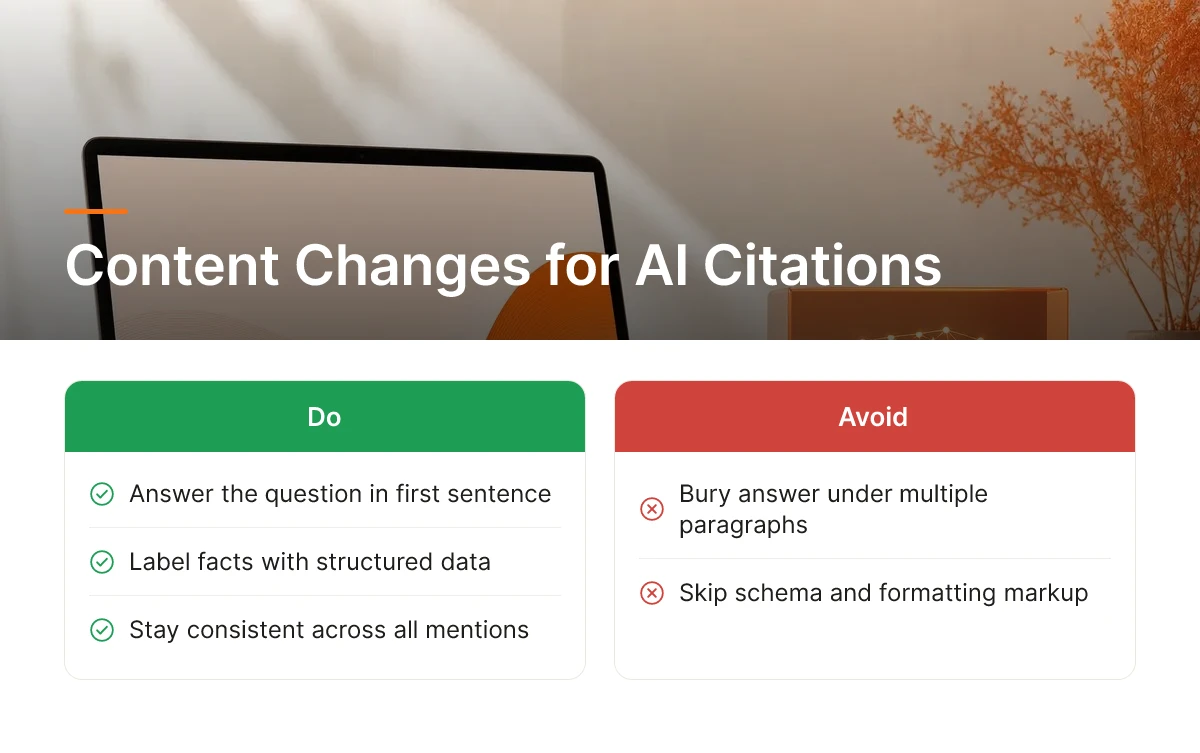
The pages that get quoted answer the question in the first sentence, label their facts with structured data, and stay consistent everywhere the business is mentioned online. Nothing on this list is exotic, most of it is achievable without a developer.
What Schema and Formatting Changes Help AI Identify Citation-Worthy Content?
Start every section with a direct answer, then back it up. AI engines pull passages, not pages, and a section that opens with a clear claim can be lifted and quoted on its own, bury the answer under three paragraphs of throat-clearing and the model has to guess what you're actually saying, so it often skips you. This is the single highest-use habit in any approach to how to get cited by AI.
Schema markup is the structured data that tells AI systems what a page is about without making them infer it. FAQ schema flags question-and-answer pairs, Organization schema confirms your business name and address, Product schema states price and availability. These tags remove ambiguity, which matters because AI engines favor content they can attribute facts to with confidence [3].
Formatting choices matter as much as the words themselves:
- Write H2s and H3s as the actual questions customers type into ChatGPT or Perplexity
- Keep paragraphs to two or three sentences so each one stands alone as a quotable unit
- Define technical or industry terms the first time they appear
- Use comparison tables for pricing tiers, feature sets, or product specs, tables are easy for models to parse and quote accurately
Retrieval research backs this up: in a study of 10,000 keywords, 67.82% of pages cited in Google's AI Overviews didn't rank in the top 10 for the query or any of its related searches [3], meaning structure and clarity at the passage level often matter more than overall ranking position.
How Should You Optimize for AI Citation Versus Traditional SEO?
Traditional SEO rewards aggregate authority, backlinks, domain age, overall page ranking. AI citation rewards something narrower: whether one self-contained section answers one question clearly enough to extract. A page can rank poorly in Google and still get cited by an AI engine if a single section is unusually clear and factual [3].
That shift also raises the cost of inconsistency. If your pricing tier, service area, or hours are listed one way on your site and differently on a directory or review platform, AI systems have no reliable source to trust and may cite a competitor instead, or cite you with wrong information. Keep core facts about the business identical across your website, Google Business Profile, and review sites. This is the kind of unglamorous technical hygiene that Moonrank automates for SMBs, applying schema markup and structured data consistently across a site so AI engines have one clear version of the facts to cite.
How Does AI Citation Behavior Differ Across ChatGPT, Google AI Overviews, Perplexity, and Claude?
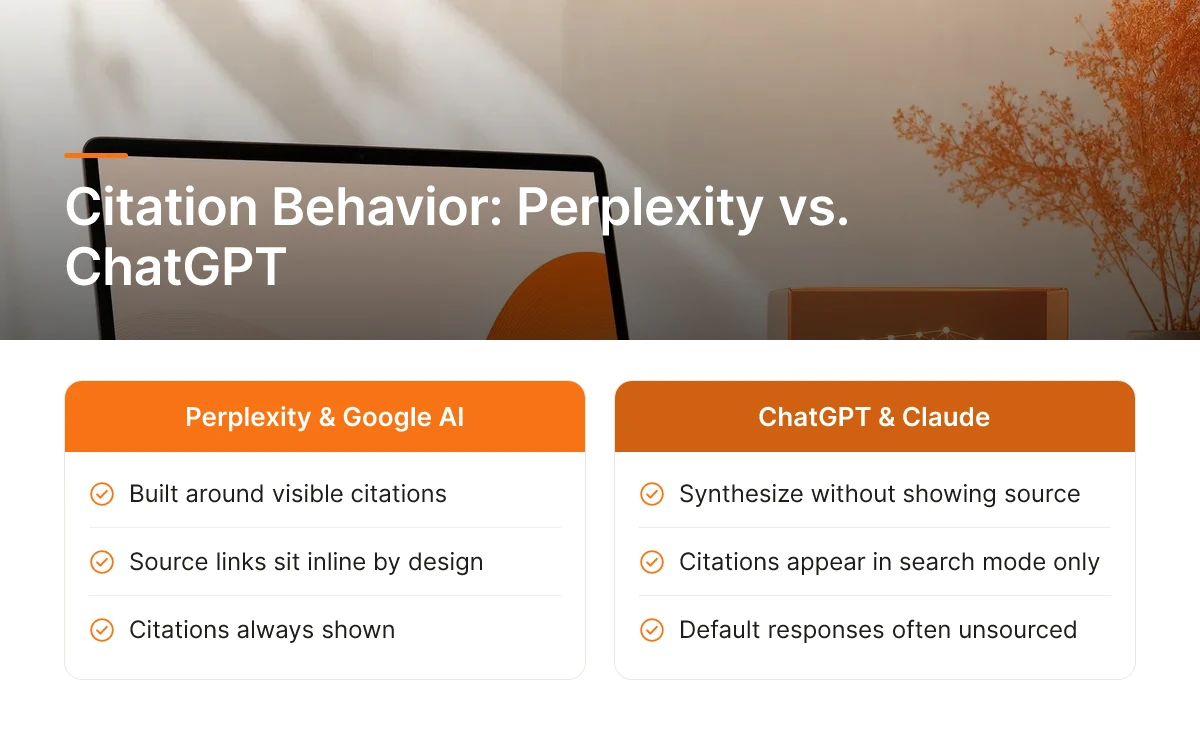
Each platform shows and sources citations differently, so how to get cited by AI depends partly on which engine your buyers actually use.
Perplexity and Google AI Overviews are built around visible, inline citations, the source links sit right next to the claim they support, by design [3]. ChatGPT and Claude behave differently by default. Their standard chat responses often synthesize an answer from trained knowledge without showing a source at all, and citations only appear reliably when the user triggers a browsing or search-enabled mode [5]. That means a brand can influence what ChatGPT "knows" about it without ever getting a clickable citation in a given conversation.
The deeper difference is where each platform pulls its information from. Perplexity and AI Overviews lean heavily on live web retrieval, so content freshness and current structured data matter more [3]. ChatGPT and Claude blend retrieval with knowledge baked in during training, which means older, well-established content and third-party mentions can carry weight even without a live crawl [5]. This is why a page can rank well in Google yet still miss AI citations, or vice versa, the two systems aren't asking the same question of the same index.
Which AI Platforms Should SMBs Prioritize Based on Industry and Audience?
Match the platform to where your buyers already research, rather than treating all four engines as equally important.
- Ecommerce and hotel brands: Prioritize platforms with strong shopping and local retrieval behavior, since Perplexity and AI Overviews are more likely to surface product pages, availability, and location-specific content inline.
- B2B SaaS and cybersecurity brands: Focus on where comparison, "best of," and review-style queries get asked, these categories tend to surface in ChatGPT and Claude conversations where buyers are weighing vendors, even without a visible citation on every answer.
- Everyone else: Check server logs or analytics for referral traffic from each engine before committing budget to one over another.
Chasing every platform equally wastes effort an SMB doesn't have to spare. Moonrank's AI search visibility tracking shows which of ChatGPT, Gemini, Claude, and Perplexity already mention a business, so owners can see where to concentrate content and technical fixes instead of guessing across all four at once.
How Do You Track and Measure Whether Your AI Citation Strategy Is Working?
Track citations by manually sampling AI platforms with buyer-style questions, watching referral traffic from AI domains, and tying both back to conversions over time.
Any plan for how to get cited by AI falls apart without measurement. Content and technical fixes are only half the job, you need a repeatable way to know whether ChatGPT, Gemini, Claude, and Perplexity are actually mentioning your business, and whether that mention leads anywhere.
What KPIs and Tools Help You Monitor Citations Across AI Engines?
The simplest starting point is manual monitoring. Ask each platform the exact questions your buyers would ask, "best project management tool for a 20-person team," "boutique hotels near [location]," "top endpoint security vendors for small business", and record what comes back. Do this on a fixed schedule, not once.
Three KPIs matter more than a single yes/no check:
- Frequency of mention, how often your business appears across a sampled set of relevant queries, not just one lucky result.
- Accuracy, whether the AI describes your product, pricing tier, or services correctly, since a citation with wrong information can cost more than no citation at all.
- Link presence versus name-only mention, a cited link drives traffic you can measure; a name dropped with no link builds awareness but leaves no trail back to your site.
Manual sampling works for a handful of queries a week. It breaks down once you're tracking dozens of keyword variants across four platforms. This is the gap a dedicated AI visibility tracking platform closes, Moonrank runs this sampling automatically and reports citation frequency, accuracy, and link presence across ChatGPT, Gemini, Claude, and Perplexity without anyone on your team running the same ten prompts every Monday morning.
How Do You Connect AI Citations to Traffic and Revenue?
Citations only matter if they move the business, so the next step is connecting them to analytics. Most analytics platforms can isolate sessions originating from AI referral domains, chat.openai.com, perplexity.ai, gemini.google.com, giving you a proxy signal for citation-driven visits even when a user doesn't click a direct link [4].
Tag those sessions and follow them through your funnel the same way you'd follow paid or organic traffic. Watch for form fills, trial signups, or purchases attributed to AI-referred visitors, not just the raw count of times you were mentioned. A business might be cited often with low accuracy and see little revenue impact, while a business cited less often but accurately, with a link, converts at a meaningfully higher rate.

Frequently Asked Questions
Can a small business realistically get cited by AI without a large content team?
Yes, AI citation depends more on clear, well-structured answers than on content volume. A single page that directly answers a specific question, backed by accurate schema markup and structured data, can outperform a large blog with vague, generic posts. Tools that automate daily publishing and technical optimization, like Moonrank, close the gap for owners without a writer on staff.
Does getting cited by AI replace the need for traditional SEO?
No, AI citation builds on the same foundation as traditional SEO, it doesn't replace it. AI engines still rely on crawlable, indexable, well-structured sites, and many citations go to pages that also rank well in Google [3]. Think of AI visibility as an added layer on top of solid SEO fundamentals, not a swap.
How long does it take to start seeing AI citations after optimizing content?
Most businesses see initial movement within a few weeks, with meaningful citation growth building over two to three months. AI engines need to recrawl, reprocess, and re-rank content, and citation patterns shift as competitors publish too. Consistent daily publishing and periodic technical audits tend to compound results rather than produce one-time spikes.
Do AI citations send real traffic, or just brand visibility?
AI citations send both, and the traffic they send tends to convert better than typical organic search clicks. ChatGPT referral traffic converts at roughly 15.9% compared to 1.76% for Google organic, a roughly 9x gap [4]. Even when a citation doesn't generate an immediate click, appearing in the AI's shortlist still builds the brand trust that influences a later purchase decision.
Conclusion
Getting cited by AI comes down to three things: structure your content so engines can extract a direct answer, back it up with technical signals like schema markup and llms.txt, and publish consistently enough that AI systems keep finding fresh evidence you're the authority. Ranking in Google alone won't guarantee a citation [3], and with 88% of B2B SaaS brands still invisible in AI search results [4], the businesses that act now build a lead competitors will struggle to close.
Start by auditing one high-intent page on your site this week and checking whether it answers its core question in the first two sentences. If you'd rather automate that process entirely, daily content, technical fixes, and visibility tracking across ChatGPT, Gemini, Claude, and Perplexity, see how Moonrank handles it at www.moonrank.ai.
Sources & References
- Mastering AI Citations: The Ultimate GEO Playbook | Frase
- How to Get Cited by AI: 9 Ways to Earn LLM Citations in 2026
- LLM SEO: The B2B Guide to Getting Cited in AI Search
- LLM Optimization: How To Get AI To Cite Your Brand
Recommended Articles
Explore more from our content library: