What Are AI Citations & How Do I Get Them?
An AI citation happens when ChatGPT, Gemini, Claude, or Perplexity mentions your business, links to your content, or recommends you directly in response to a...

Understanding What Are AI Citations & How Do I Get Them? is essential. An AI citation happens when ChatGPT, Gemini, Claude, or Perplexity mentions your business, links to your content, or recommends you directly in response to a user's question. Unlike a traditional search ranking, there's no list of ten blue links, the AI picks a small number of sources it trusts enough to reference or summarize. You get cited by publishing clear, well-structured, fact-based content that directly answers specific questions, backed by technical signals like structured data and consistent information across the web.
What Does It Mean When an AI Search Engine Cites Your Content?
A citation means the AI engine treats your business as a trustworthy source and names you, links to you, or paraphrases your content when answering a user's question.
That's a different relationship than the one most SMB owners have spent years optimizing for. Google rankings reward you for occupying a position, first page, top three, above the fold. AI engines don't work that way. When someone asks ChatGPT "best project management tool for a 10-person startup" or Perplexity "which hotel in Austin has the best rooftop bar," the engine isn't handing back a ranked list. It's synthesizing an answer and deciding which handful of sources earned the right to back it up [1].
How Do AI Citations Differ From Traditional Search Engine Rankings?
Traditional SEO gives you ten slots on page one and a reasonable shot at traffic even from position seven. AI citations don't work on a ladder, there's no guaranteed click, no position list, and often one source wins the mention while nine competitors get nothing [1]. For a Shopify store or a B2B SaaS company, that raises the stakes: instead of competing for a rank, you're competing for inclusion.
This is also why understanding what AI citations are and how to get them matters more now than fine-tuning a meta description. Your competitor doesn't need to outrank you by small margins anymore, they just need to be the one source the model picked, and you get zero visibility in that answer at all.
What Do AI Citations Look Like in ChatGPT, Gemini, Claude, and Perplexity Responses?
Citations take a different shape in each engine. Perplexity shows inline, numbered links directly in the response text, similar to footnotes [1]. Gemini often surfaces source cards alongside its AI Overview, giving the cited page a visible, clickable presence [1]. ChatGPT frequently names a business or product by name without a link at all, which means the mention shapes a buyer's decision even though no traffic follows. Claude tends to attribute specific claims or quotes to a source when it answers factual questions.
Across all four, the pattern holds: a citation looks less like a ranked listing and more like being the one answer the model decided to trust. That distinction, chosen answer versus ranked result, is the entire reason AI citations and how to get them has become a separate skill from classic SEO, and it's the gap Moonrank's technical optimization and daily content publishing are built to close for businesses that don't have an in-house SEO team to chase it manually.
Why Do AI Citations Matter for Your Business Visibility?
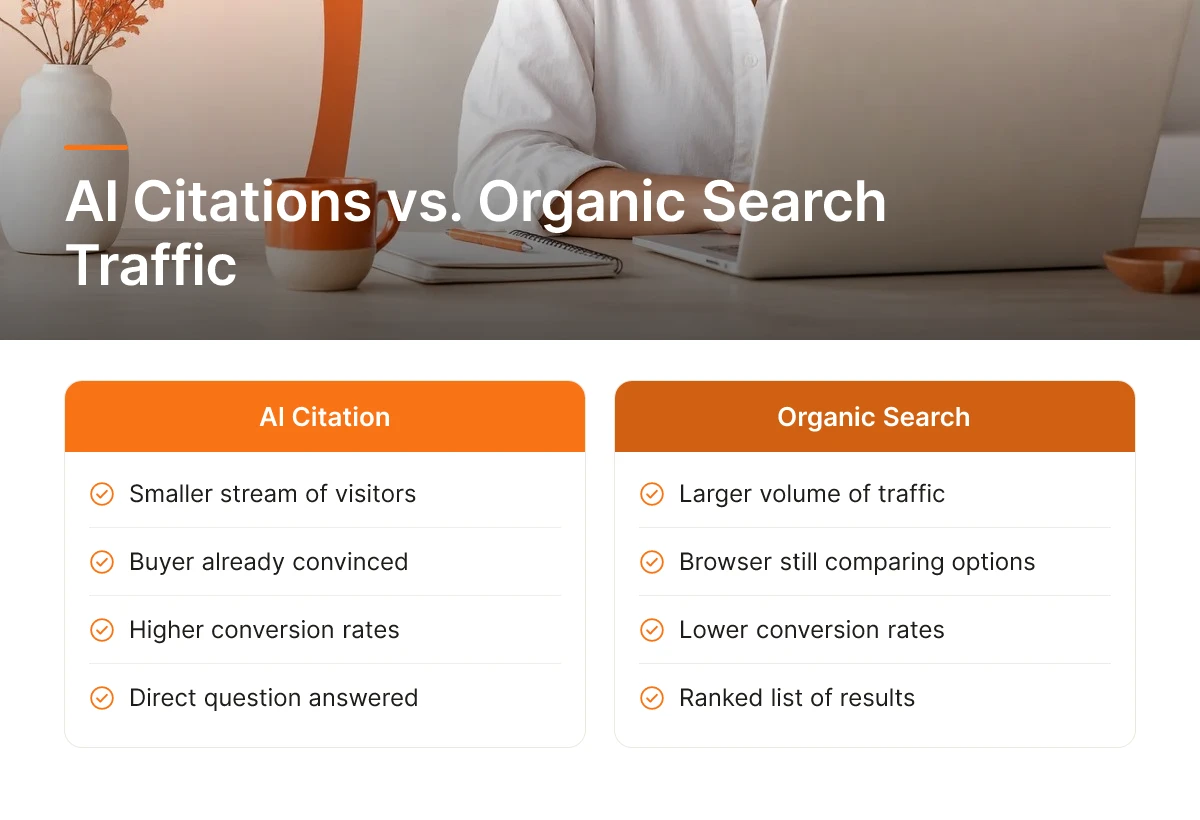
AI citations matter because they put your business in front of a buyer who already trusts the recommendation, which means fewer visitors but far more of them convert.
How Do AI Citations Drive Traffic and ROI Compared to Organic Search Traffic?
A Google search sends you a browser who's still comparing options. An AI citation sends you someone who asked ChatGPT or Perplexity a direct question, got your business named as the answer, and clicked through already convinced [1]. That's a smaller stream of visitors, but a much warmer one.
For an ecommerce store or a B2B SaaS company watching conversion rates, this matters more than raw traffic volume. First-party citations, where the AI names your site directly, build brand awareness and drive that high-intent click, while third-party citations that mention your brand favorably on someone else's page shape how prospects perceive you before they ever land on your site [1]. Both are worth tracking as part of answering what AI citations are and how to get them for your specific business.
Which Types of Content Get Cited Most by AI Systems?
AI systems cite structured, specific content far more than broad marketing pages, because retrieval models favor text that answers a narrow question cleanly. A vague "About Us" page rarely gets quoted; a detailed comparison table, FAQ, or how-to guide often does.
This plays out differently by sector:
- Ecommerce: individual product pages with specs, sizing, and use-case details outperform category landing pages.
- B2B SaaS: comparison pages ("X vs. Y") and feature-specific documentation get pulled into answers about which tool fits a particular need.
- Cyber security: trust and compliance content, SOC 2 explainers, data-handling policies, incident-response pages, gets cited when buyers ask AI tools to vet a vendor.
- Hotels: amenity pages, neighborhood guides, and location-specific FAQ content answer the "best hotel near X" queries AI engines field constantly.
Even when a user never clicks, appearing as the cited source builds recall, the AI effectively vouches for your business in front of someone who may book, buy, or sign up later. Moonrank's daily content generation targets exactly this pattern, publishing the structured guides and comparison pages that AI engines favor rather than generic blog filler, while its technical optimization layer handles the schema markup and structured data that help those pages get parsed and trusted in the first place. For more information, see Wikipedia Citations.
How Do Different AI Systems Decide What Content to Cite?
AI systems cite content that answers a specific question in plain, self-contained language, backed by consistent accuracy and recent updates on time-sensitive topics.
Answering "What Are AI Citations & How Do I Get Them?" requires understanding that large language models don't reason the way a human researcher does. They retrieve and rank passages based on how directly those passages resolve a query, then generate a response that stitches the best-matching pieces together. A paragraph that states "Shopify stores see higher average order value when they bundle products" gets pulled over a paragraph that implies the same point across three sentences of buildup. Self-contained clarity beats clever framing.
What Role Do Domain Authority and Content Freshness Play in AI Citation Decisions?
Domain authority and freshness act as trust filters that decide which otherwise-qualified pages make the cut.
Freshness matters most when the topic itself is time-sensitive, pricing pages, software feature comparisons, industry statistics, or anything tied to a product version number. A B2B SaaS page documenting integrations as of last quarter signals it's worth re-crawling; a page untouched for three years signals the opposite, even if the content was once accurate.
Domain authority, in this context, isn't the backlink-count metric SEO tools have used for a decade. It's built from consistency, the same facts about your business appearing the same way across your site, your directory listings, your review profiles, and any third-party mentions. Semrush describes this as the accumulation of first-party and third-party citations that shape how an LLM perceives a brand [1]. A security vendor whose certification claims match across its homepage, documentation, and press mentions reads as more trustworthy than one with conflicting figures scattered across pages, regardless of which site has more inbound links.
How Do Citation Patterns Differ Between ChatGPT, Google AI Overview, Claude, and Perplexity?
Each engine has a distinct citation style, so a page that earns a Perplexity citation won't automatically earn one from ChatGPT.
Perplexity tends to surface several linked sources per answer, often showing a visible list of citations a user can click through, closer in spirit to a research summary than a single authoritative answer [2]. Google AI Overviews lean heavily on pages that already rank well organically, drawing from the same crawl and index infrastructure that powers traditional search [1]. ChatGPT and Claude behave differently again: rather than listing many sources, they tend to favor content from well-known, heavily corroborated publishers, essentially voting for the source that multiple other sources agree with rather than a single obscure page making an isolated claim.
For an ecommerce brand or a cybersecurity vendor, this means a single optimization strategy won't cover all four engines. Moonrank's technical audit addresses this by building the schema markup, llms.txt configuration, and structured data each engine's crawler depends on, so a business doesn't have to reverse-engineer four separate citation logics on its own.
What Is the Step-by-Step Process to Optimize Your Content for AI Citations?
Getting cited comes down to five repeatable steps: answer one question clearly per page, add schema, format for extraction, keep facts consistent, and refresh often.
None of this requires a developer or an agency retainer. It's the same checklist Moonrank runs automatically for its customers, but an owner with a Shopify store or a B2B SaaS site can work through it manually in an afternoon. The goal of asking "What Are AI Citations & How Do I Get Them?" isn't abstract, it's a production process you apply page by page.
What On-Page and Technical Optimizations Increase Your Chances of Being Cited by AI?
Step 1: Answer one specific question per page, near the top. AI engines pull passages that directly answer a prompt, so bury your answer in the third paragraph and you lose the extraction. If your page covers "best CRM for small ecommerce teams," say it plainly in the first sentence, not after three paragraphs of company history.
Step 2: Add structured data. Schema markup is the code that tells AI engines exactly what your business does, its hours, pricing tier, product catalog, review scores, in a format machines parse without guessing. A cybersecurity vendor that marks up its FAQ schema and product schema gives ChatGPT and Perplexity a clean data source instead of forcing them to infer details from marketing copy. This is one of the technical gaps Moonrank's audit addresses directly, alongside llms.txt configuration, for businesses that don't have an engineer on staff to implement it.
How Should You Structure and Format Content to Make It More Citation-Worthy?
Step 3: Use headings, short paragraphs, and lists. AI systems lift self-contained chunks of text, not entire articles [1]. A three-sentence paragraph under a clear H3 is easier to extract cleanly than a dense 200-word block. Bulleted specs, numbered steps, and short definitional answers all work because they isolate one idea per chunk.
Step 4: Keep facts consistent everywhere. If your pricing page says a mid-range tier and your Google Business Profile lists something different, engines have no way to corroborate which is accurate, and inconsistency erodes the trust signal third-party citations rely on [1]. Hotels are especially exposed here: room rates, amenities, and cancellation policies need to match across your site, OTAs, and review platforms.
Step 5: Refresh key pages on a schedule. Stale content signals lower confidence to engines evaluating what's current. A B2B SaaS pricing page or feature comparison that hasn't changed in two years looks less trustworthy than one updated last month, even if the underlying facts haven't shifted much.
- Audit your top 10 pages for a single clear answer near the top
- Implement schema markup for products, FAQs, and reviews
- Break long paragraphs into scannable chunks with headings
- Reconcile pricing, hours, and specs across every listing
- Set a quarterly refresh cadence for high-value pages
Done manually, this is a recurring task, not a one-time fix, which is exactly why Moonrank automates daily publishing and technical optimization for $99/month instead of leaving it to a quarterly scramble.
How Do You Measure and Track AI Citations Across ChatGPT, Gemini, Claude, and Perplexity?
You measure AI citations by asking each engine the questions your customers actually ask, logging the answers, then tracking frequency, competitive share, and referral traffic over time.
Start with manual spot-checking. Open ChatGPT, Gemini, Claude, and Perplexity and type the questions a real customer would type, "best project management software for small teams" if you're a B2B SaaS company, or "most reliable managed firewall provider" if you're in cybersecurity. Record whether your brand shows up, where in the answer it appears, and which source the engine links back to. Do this weekly for a core list of 15-20 prompts and you'll start to see patterns: maybe Perplexity cites you for pricing comparisons but Claude never mentions you at all.
What Metrics and Tools Help You Monitor AI Citation Performance and ROI?
Three metrics matter most: citation frequency, share of voice, and referral traffic. Citation frequency is simply how often your brand appears across a fixed set of prompts over a given period. Share of voice tracks how often you're mentioned relative to the competitors named in the same answers, if an AI Overview lists five vendors and you're one of them, that's useful context even if you're not first [1]. Referral traffic closes the loop: check your analytics for sessions tagged as coming from chatgpt.com, perplexity.ai, or gemini.google.com, and cross-reference those against server logs to confirm the visits are real rather than bot crawls.
Answering "What Are AI Citations & How Do I Get Them?" for your own business means pairing these three signals, not relying on any single one. A high citation count with no referral traffic suggests the AI engine is mentioning you but not linking clearly enough for users to click through. Low citation frequency with strong traffic from the citations you do get suggests a volume problem, not a quality problem, worth fixing with more targeted content, not a rewrite of what's already working.
How Can You Compare Your Citation Rates Across Different AI Search Engines?
Comparing engines only works if you run the identical question set against each one on the same schedule, otherwise you're comparing noise, not performance. ChatGPT, Gemini, Claude, and Perplexity pull from different indexes and weigh sources differently, so a business might see strong Perplexity citations and near-zero presence in Claude for the same query [2]. Track results in a simple spreadsheet with columns for engine, question, cited (yes/no), position in the answer, and source URL referenced. Over a month or two, this reveals which engine rewards your content structure and which one needs different signals, more schema markup, clearer FAQ formatting, or more third-party mentions.
Checking four engines against twenty questions every week by hand is realistic for about as long as it takes to get tedious, which is why most SMBs either stop tracking or do it inconsistently. Moonrank runs this monitoring automatically, tracking how your business appears across ChatGPT, Gemini, Claude, and Perplexity and reporting citation frequency and competitive share without you opening a single chat window. At $99/month, it replaces a manual process that would otherwise eat hours a week, and it's part of the same system that handles the daily content publishing and technical optimization needed to earn citations in the first place.
Frequently Asked Questions
Do AI search engines always cite their sources?
No, AI systems only cite sources when the underlying model decides a claim needs external backing, and practice varies by engine [1]. Perplexity cites heavily by design, while ChatGPT and Gemini sometimes answer from trained knowledge with no citation at all. There's no guarantee of attribution even when your content directly informed the answer.
Can small businesses realistically compete for AI citations against larger brands?
Yes, AI citations reward clarity and structure, not domain authority or ad budget alone. A specialty hotel or a B2B SaaS tool with tightly focused, well-structured content on its niche can out-cite a generic enterprise page that buries the answer. This levels a field that traditional Google rankings, weighted heavily toward backlinks and domain age, never did.
How long does it take to start getting cited by AI engines after optimizing content?
Most businesses see initial citations within four to eight weeks of consistent technical and content optimization. Timelines vary by engine, Perplexity and ChatGPT tend to surface new, well-structured pages faster than Gemini. Consistency matters more than any single fix: ongoing publishing compounds visibility over time.
Does getting an AI citation guarantee website traffic?
No, a citation increases visibility and brand credibility, but many AI answers satisfy the user's question without a click [1]. Still, first-party citations build brand awareness and trust even when the user doesn't visit your site immediately, which can influence a future purchase decision.
Conclusion
AI citations work differently from Google rankings, they reward clear structure, direct answers, and machine-readable data over backlinks and domain age. Focus on three things: fix the technical signals (schema markup, llms.txt, structured data) that help AI engines parse your site, publish content consistently enough to stay current in retrieval systems, and track your citation performance across ChatGPT, Gemini, Claude, and Perplexity rather than guessing.
Doing this manually across four engines, every week, is a real time cost most SMB owners don't have. Moonrank automates the technical audit, the daily content, and the visibility tracking for $99/month, see your current AI search standing at moonrank.ai.
Sources & References
Recommended Articles
Explore more from our content library: