The Agency's Guide to SEO Rank Tracking Tools 2026
Rank tracking in 2026 means monitoring two separate things: where you appear in Google's blue links and AI Overviews, and whether AI engines like ChatGPT and...

Understanding SEO Rank Tracking Tools 2026 is essential. Rank tracking in 2026 means monitoring two separate things: where you appear in Google's blue links and AI Overviews, and whether AI engines like ChatGPT and Perplexity mention or recommend your business at all. These are different signals because AI engines answer conversationally and often skip citations entirely, so a tool built only for keyword-position tracking will miss most of your real visibility. Agencies managing client rankings now need both traditional position data and AI mention/citation tracking to report the full picture.
Why SEO Rank Tracking Tools Matter Differently in 2026
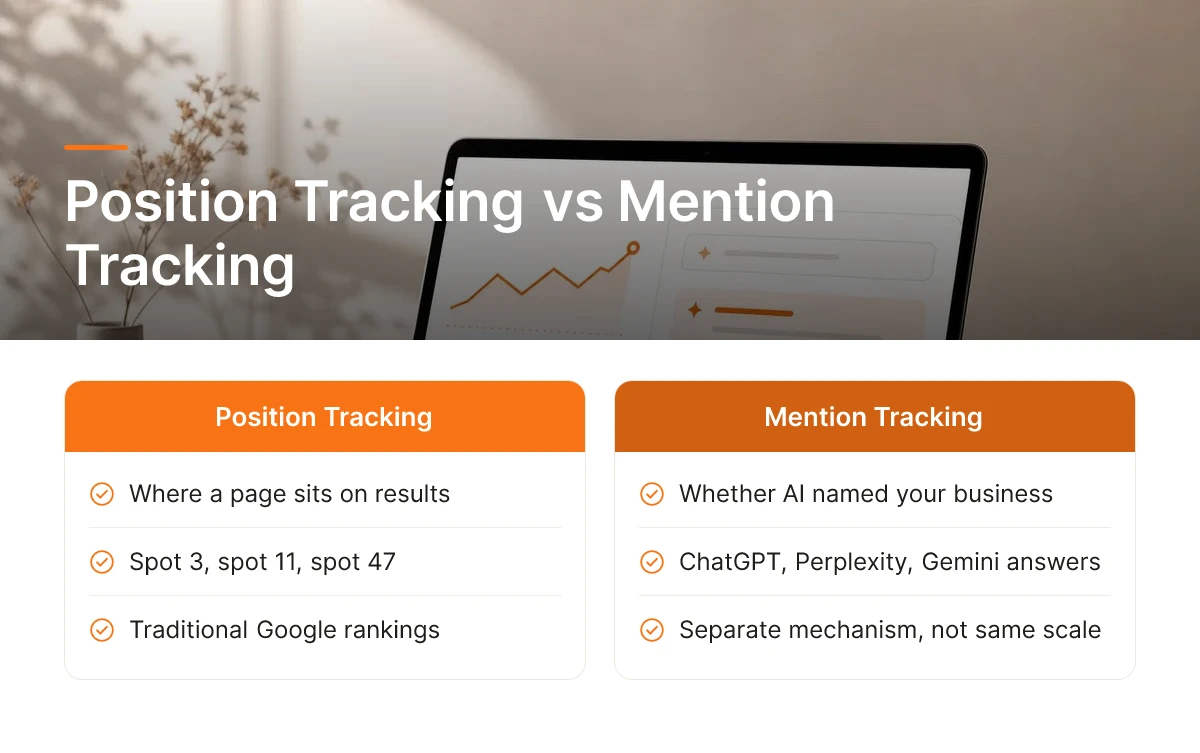
Position tracking and mention tracking are two separate mechanisms, not two points on the same scale, and conflating them is the most common mistake in client reporting today.
A keyword-position tool tells you where a page sits on a results page, spot 3, spot 11, spot 47. A mention tracker tells you whether ChatGPT, Perplexity, or Gemini named your business at all when a user asked a conversational question. A business can rank page one on Google and never get mentioned in a single AI answer, or show up by name in Perplexity while holding no meaningful Google position whatsoever. Good SEO Rank Tracking Tools 2026 buyers need to understand this is a measurement of two different systems, not a more advanced version of the same report.
Is Traditional Rank Tracking Still Relevant Alongside AI Search?
Yes, most purchase research still passes through Google at some point, and keyword position still predicts traffic for queries that aren't conversational in nature.
Someone comparing hotel booking sites or SaaS vendors by brand name, pricing page, or product category still types that into Google far more often than into a chat window. Non-branded, comparison, and transactional queries remain overwhelmingly a Google problem, and position data for those terms still correlates with click volume in a way agencies can defend to a client. The shift isn't that Google tracking became useless. It's that it stopped being sufficient on its own.
Comparing the ROI of Google Rank Tracking vs AI Search Visibility Tracking
Google rank gains connect to click data through Search Console; AI visibility often produces exposure with no click at all, which makes it harder to prove but not less real.
When a page moves from position 8 to position 3, Search Console shows the resulting impressions and clicks within days, a clean, attributable line from ranking to traffic. AI mentions rarely work that way. A user who asks ChatGPT "best project management tool for a 10-person team" and hears your brand recommended may never click anything; they may just remember the name and search it directly a week later, or type your URL straight into a browser [4]. That's zero-click brand exposure, real influence on consideration, almost impossible to trace back to the exact mention that caused it.
Agencies feel this gap first, because it surfaces in the room before it shows up in a report. A client asks on a monthly review call, "does ChatGPT know who we are?" even when AI visibility was never part of the signed retainer [1]. Saying "we don't track that" in that moment reads as outdated, regardless of how strong the Google rankings look on the slide behind it.
What to Track Beyond Google Rankings in 2026
A complete view in 2026 covers five surfaces: traditional organic results, the local pack, AI Overviews, chat answers from ChatGPT and Perplexity, and Claude, each with its own rules for who gets cited.
Any serious evaluation of SEO Rank Tracking Tools 2026 has to start here, because a tool that only logs blue-link positions is already missing half the picture. Google's AI Overviews now sit above organic results on a large share of informational queries, Seer Interactive's 2026 study found a 61% drop in organic click-through on queries where an AI Overview appears [2]. That is not a ranking problem in the old sense, it is a visibility problem that classic rank trackers were never built to see.
Which AI Search Engines Should SMBs and Agencies Actually Monitor?
Track Google's AI Overviews, ChatGPT, Perplexity, and Claude as four separate surfaces, not one bundled "AI search" line item.
Each engine pulls from different sources and weighs them differently. Perplexity leans on live web retrieval and footnotes every claim, ChatGPT blends retrieval with its training data, and Claude's answers in consumer contexts increasingly draw on partner search integrations. Treating these as interchangeable means missing the engine where a competitor is actually winning the citation. An agency managing a dozen clients needs a dashboard that separates these answers, not an average "AI visibility score" that hides which engine matters for which client.
How Zero-Click Results and AI Overviews Change What 'Ranking' Means
A page can rank, get cited by an AI Overview, and still send zero visitors, visibility and traffic have decoupled.
SparkToro's 2026 analysis of Similarweb data put the share of US Google searches ending without a click at 68% [2]. That means a page can be the exact source an AI Overview quotes, with zero referral traffic to show for it. Tracking rank position alone would call that page invisible; tracking citations would call it a win. AI engines also favor specific structures when choosing what to cite, pages with direct, scannable answers, clear headings, and structured data (schema markup) that spells out what the page is about get pulled more often than pages that bury the answer in narrative paragraphs. For more information, see Change Car Background Apps Vs Tools.
What to monitor also depends on the business. An ecommerce brand needs product-level mentions, is a specific SKU or collection page showing up when someone asks an AI engine to compare options. A B2B SaaS company cares most about comparison-query citations, the "X vs Y" and "best tools for Z" prompts where buying decisions start. A hotel needs local and intent-based queries tracked, since "best boutique hotel in [city]" behaves nothing like a generic keyword. A cybersecurity vendor cares less about traffic volume and more about whether AI engines cite the brand as a trusted, authoritative source at all. Moonrank's visibility tracking is built around this split, monitoring how a business shows up across ChatGPT, Gemini, Claude, and Perplexity in the terms that match its specific category, rather than a single generic score.
How to Compare Rank Tracking Tools Across Different Search Surfaces
Compare tools on four axes: which search surfaces they cover, how often they refresh data, how many keywords or queries they support, and whether AI tracking counts mentions or verifies real citations.
Any serious shortlist of SEO Rank Tracking Tools 2026 has to start here, because the category has split into two camps that don't measure the same thing. One camp still treats "rank" as a position on a Google results page. The other treats it as a question: did ChatGPT, Perplexity, or Gemini name your brand when a customer asked for a recommendation? A tool built for the first question rarely answers the second well, and vice versa.
Which Rank Tracking Tools Actually Track AI Visibility, and How Accurate Are They?
Most tools that claim AI visibility tracking are counting mentions, not confirming citations, and the distinction matters more than vendors usually admit. Mention-counting checks whether your brand name shows up somewhere in an AI-generated answer. Citation-level tracking goes further, confirming whether the AI engine actually linked to or sourced your page. Agencies evaluating tools should ask vendors directly which one they're selling, because the marketing language rarely draws this line clearly.
Accuracy is the harder problem. AI answers change by session, by user location, and by how a prompt is worded, the same query asked twice can return different brands [4]. That means any AI visibility score a tool reports is a sample of behavior, not a fixed ranking like a Google SERP position. Agencies should set this expectation with clients up front: a 62% visibility score this week isn't a guarantee of 62% next week, it's a snapshot across the prompts the tool happened to run.
What's the Real Cost Difference Between Premium, All-in-One, and Budget Tools?
Agencies generally land in one of three cost tiers, and the jump between them usually tracks a specific capability, not just a bigger feature list. Budget-friendly single-purpose trackers handle straightforward Google position monitoring at a low keyword cost, which suits a small client book with modest reporting needs [1]. Mid-range all-in-one suites bundle rank tracking with audits, backlink data, and white-label reporting, worth the step up once an agency is managing enough clients that juggling separate tools costs more time than the subscription saves [5]. Premium and enterprise platforms earn their price through refresh speed, deeper SERP feature detection, and scale, the jump that matters when 500+ keywords need daily or on-demand updates rather than weekly ones [1].
Before trusting any vendor's AI-tracking numbers, run a manual check: pick five to ten prompts relevant to a client's category, ask them directly in ChatGPT or Perplexity, and compare what you see against what the tool reports for the same queries. Consistent gaps are a signal the tool's sampling method doesn't match how real customers search, information worth knowing before a client sees it in a report. Moonrank's visibility monitoring was built around this same logic, tracking actual recommendations across ChatGPT, Claude, Perplexity, and Gemini rather than a single inferred score.
Which Rank Tracking Tool Fits Your Business Model and Budget?
The right choice depends on how many clients or brands you track, how technical your team is, and whether you need Google data alone or AI engine visibility too. Picking among the best SEO Rank Tracking Tools 2026 has to offer starts with your business model, not a feature checklist.
Dedicated Tracker vs All-in-One Suite vs Building Your Own with APIs
Three structural paths cover almost every buyer. A dedicated single-purpose tracker focuses on rank data, refresh frequency, and reporting, with little else bundled in. An all-in-one SEO suite folds rank tracking into a broader platform alongside backlink data, site audits, and keyword research. A custom-built dashboard, assembled from provider APIs, gives technical teams full control over refresh timing, data storage, and how rank data joins other internal metrics.
Agencies managing a large client roster tend to need the first option, or a suite with strong white-labeling, because multi-client reporting and branded exports save hours every month [1]. A single ecommerce or SaaS team without a dedicated SEO hire usually does better with an all-in-one suite, one login, one invoice, no juggling three vendors for data that should live together [3]. Technically staffed teams, which describes a lot of cybersecurity vendors and platform SaaS companies, often prefer the API route because it lets engineering pull rank data straight into existing dashboards rather than adapting workflows to a vendor's UI [1].
Which Integration Requirements Matter Most for Your Martech Stack?
Three integrations decide whether a tool earns its subscription. First, the ability to pull ranking data into GA4 so a position change can be matched against an actual traffic shift, not just assumed. Second, a connection to the CMS that flags content gaps directly from ranking drops, instead of leaving that correlation to a spreadsheet. Third, export formats that produce client-facing reports without manual reformatting, a non-negotiable for agencies billing on deliverables, not just dashboards [1].
Free options like Google Search Console cover Google-surface position and click data at no cost, but they report nothing about how a brand appears inside ChatGPT or Perplexity answers [1]. That gap is why most serious stacks now pair a free or low-cost Google tracker with a dedicated AI visibility layer. Moonrank fits that second role directly: it tracks how a business shows up in recommendations across ChatGPT, Gemini, Claude, and Perplexity, while its daily automated content and technical optimization work in the background to improve what gets tracked, all for $99 a month, a fraction of what a traditional agency retainer runs.
How to Implement Rank Tracking for AI Overviews and LLM Visibility
Adding AI visibility tracking to an existing workflow takes four steps: audit, baseline, automate, and correlate against GA4 traffic, in that order, not all at once.
Most agencies make the mistake of buying an AI tracking tool before they know which client queries even touch AI search. That produces dashboards full of numbers nobody asked for. The sequence below fixes that, and it's the same logic a solid list of SEO Rank Tracking Tools 2026 should help you apply, not just inventory.
Step-by-Step Setup for Tracking AI Search Visibility Alongside SERP Tracking
Step 1: Audit which queries actually trigger AI answers. Before tracking anything, run a client's priority keyword list through Google manually and note which ones surface an AI Overview, and separately test the same terms as conversational prompts in ChatGPT and Perplexity. Informational queries trigger AI Overviews far more than transactional ones, and Seer Interactive's 2026 study found a 61% drop in organic CTR specifically on informational queries once an AI Overview appears [2], a strong signal for which keyword set deserves AI tracking first.
Step 2: Set a manual baseline. Pick 15 to 25 priority prompts per client, phrased the way a real customer would ask them, and run them across the AI engines relevant to that industry. Log whether the brand is mentioned, where it ranks in the answer, and what sources the engine cites. This baseline matters because automated tools can miss context a human eye catches on the first pass.
Step 3: Automate and merge into one report. Once the baseline confirms which prompts are worth watching, connect a tool that runs AI-mention tracking on a recurring schedule, and push both Google position data and AI mention data into a single client-facing report. Splitting these across two dashboards is how agencies lose the thread on what's actually driving results, one report, one story.
How to Measure the Real Traffic Impact of AI Search Visibility vs Google Rankings
AI mentions rarely show up as referral traffic the way a blue-link click does, so the correlation has to happen in GA4 rather than in the rank tracker itself. Watch direct traffic and branded search volume in the weeks following an AI mention increase, someone who hears a brand recommended by ChatGPT typically searches the name directly or types the URL, not a tracked referral link. This is consistent with the broader shift Yotpo's 2026 research describes as "search everywhere," where visibility and attributable clicks have stopped moving in lockstep [4].
Review AI visibility monthly, not daily. Google's index shifts in ways daily tracking can justify; AI answers change on a slower, less predictable cycle, and checking them every day mostly produces noise an agency then has to explain away in a client call. A monthly cadence paired with a quarterly deeper audit keeps the signal clean.
For SMBs running this process without a dedicated analyst, Moonrank folds these steps into one system, it tracks brand mentions across ChatGPT, Gemini, Claude, and Perplexity automatically, then pairs that with daily content publishing and technical fixes like schema markup and llms.txt configuration, so the tracking data actually feeds action instead of sitting in a report nobody reads.

Frequently Asked Questions
Do I need a separate tool to track AI search visibility, or will my existing rank tracker eventually add it?
Most SMBs need a dedicated layer for AI visibility today because traditional rank trackers were built around SERP position, not citation frequency in ChatGPT or Perplexity. Some all-in-one suites are bolting on AI Overview tracking [4], but coverage is uneven across engines. Moonrank tracks visibility across ChatGPT, Gemini, Claude, and Perplexity directly, so you're not waiting on a legacy platform to catch up.
How often should agencies report AI search visibility to clients?
Monthly, at minimum, paired with your standard ranking report so clients see both channels side by side. AI citation patterns shift as models retrain and retrieval sources update, so agencies managing active campaigns often check weekly internally even if the client-facing report stays monthly.
Can Google Search Console show how often AI Overviews cite my site?
No, Search Console reports clicks and impressions from traditional Google search, not citation data from AI Overviews or chatbot answers. It's a free, useful baseline for classic rankings [1], but it has no visibility into whether ChatGPT, Gemini, or Perplexity mentioned your business in a generated answer, that requires a tool built for AI search tracking.
Does losing a Google ranking position matter less now that AI search exists?
No, it still matters, but it's no longer the full picture of your visibility. With a growing share of searches ending without a click [2], a ranking drop can coincide with steady or even improved AI citation activity, which is why tracking both signals together gives a more accurate read than either one alone.
Conclusion
Rank tracking in 2026 means watching two scoreboards at once: where you sit in classic blue links, and whether ChatGPT, Gemini, Claude, or Perplexity mention your business at all. Agencies and SMBs that only monitor SERP position are flying blind on the channel increasingly deciding first impressions. Pick a tool, or a stack, that reports both, on a cadence you'll actually review.
If you're a bootstrapped shop owner without time to manage three dashboards, start with Moonrank. It tracks your AI search visibility across all four major engines, publishes optimization content daily, and fixes the technical gaps keeping AI systems from recommending you, for $99/month, with a 3-day free trial at moonrank.ai.
Sources & References
- SEO Rank Tracking Tools 2026: The Agency's Guide | ThinkSmart Research
- 8 Best Rank Tracker Tools in 2026: Compared & Scored
- 15 Best SEO Tools to Improve Rankings in 2026 | Intelegencia
- 15 Best Keyword Tracking Tools For 2026: AI & Pixel Rank
- Best SEO Rank Tracking Tools for Agencies in 2026 Guide | Vectoron Blog
Recommended Articles
Explore more from our content library: