What Is AI Share of Voice and How SaaS Brands Measure It
AI share of voice is the share of AI-generated answers where your SaaS brand gets mentioned. Learn what it means and how to measure it across AI platforms.

AI share of voice is the percentage of AI-generated answers, across ChatGPT, Gemini, Claude, and Perplexity, where your SaaS brand gets mentioned or recommended compared to your competitors, for a defined set of relevant prompts. If you track 50 buyer-intent prompts in your category and your brand appears in 15 of them while a competitor appears in 30, your visibility is roughly half of theirs. It matters because buyers increasingly ask AI tools to shortlist software before they ever visit Google, so invisibility in those answers means losing deals before your sales team knows they existed.
What Is AI Share of Voice and Why Does It Matter for SaaS Brands?
AI share of voice measures how often a brand gets mentioned or recommended across a defined set of relevant AI answers, not some abstract sense of "visibility."[2] It's a count of actual mentions against actual prompts, compared across your category.
The formula behind it is simple even when the tracking isn't: divide your brand's mentions by total mentions across every brand in your category, for the same set of prompts.[1] A brand with 40% in a given category is winning two out of every five relevant conversations happening inside ChatGPT, Gemini, Claude, or Perplexity, and a competitor with 10% is losing most of them.[5]
SaaS buying cycles increasingly start inside a chat window instead of a search bar. A buyer typing "best project management tool for small teams" into ChatGPT is already narrowing a shortlist before a single vendor website gets a visit. If your product doesn't surface in that answer, you don't lose a click, you lose a candidate slot in a shortlist that may only contain three or four names.
Is This a Reliable Metric, or Does It Have Real Limitations?
Yes, but only when measured repeatedly, a single check can mislead because AI answers are non-deterministic and shift between sessions, even for the identical prompt. Ask the same question twice and a model may swap one recommended vendor for another based on phrasing, context window, or an update pushed that week. One favorable answer doesn't mean you have earned a durable position, and one bad answer doesn't mean you've lost one either. The metric becomes trustworthy when you sample the same prompt set repeatedly over weeks, tracking the pattern rather than any single snapshot.[4]
Why Is Being Recommended by AI Search Engines Different From Ranking in Google?
Google returns ten blue links and a page two; an AI answer synthesizes a single response and typically names only a handful of brands. There's no equivalent of ranking eleventh and still getting found by a patient searcher scrolling further. If the model doesn't cite you in that first synthesized answer, you're effectively absent from that buyer's research entirely, not buried, just gone.
This absence is also quiet. A Google ranking drop shows up in analytics as a traffic dip you can trace to a date. Losing ground here often shows up nowhere until a founder deliberately runs the prompts their buyers would run and notices a competitor's name where theirs used to appear, or should appear. That's the gap Moonrank's AI search visibility tracking is built to close for SaaS and e-commerce teams that don't have a dedicated analyst checking ChatGPT and Perplexity every week, monitoring brand mentions across engines automatically instead of relying on someone remembering to look.
How Do You Measure AI Share of Voice Across ChatGPT, Gemini, Claude, and Perplexity?
You measure it by running a fixed set of real buyer prompts through each platform, logging whether your brand shows up, then dividing mentions by total prompts, per platform, not blended.
The core formula is simple: tracked prompts where your brand appears divided by total tracked prompts, expressed as a percentage [2]. If you run 50 prompts on ChatGPT and your brand shows up in 15, that's a 30% share on that platform. The catch is you can't run this once and call it done, and you can't average across platforms and expect a meaningful number. ChatGPT, Gemini, Claude, and Perplexity each train on different data and retrieve information differently, so the same 50 prompts can produce four different scores [4].
How Do You Set Up an AI SOV Dashboard to Track Visibility Across Multiple Platforms?
Start with a fixed prompt list, the same questions, asked the same way, every time you measure. This matters because this is a trend metric, not a snapshot; a single audit tells you where you stand today, but a recurring dashboard tells you whether you're gaining or losing ground [1].
Build the dashboard around three elements: the prompt list itself, a re-run schedule (weekly or biweekly works for most B2B SaaS and ecommerce brands given how often model outputs shift), and a trend line per platform rather than one combined score. Treat ChatGPT, Gemini, Claude, and Perplexity as four separate tracks on the same dashboard. A brand can lead comfortably on Perplexity, which leans on live web retrieval, while being nearly invisible on Claude, which weights training data and citation patterns differently [4]. Checking only one platform and assuming it represents your overall standing is the most common measurement mistake. Moonrank's AI search visibility tracking is built around exactly this problem, it monitors how a business appears across ChatGPT, Claude, Perplexity, and Gemini continuously, instead of leaving SMB owners to manually re-run prompts and guess whether last month's optimization actually moved the number.
What Data Should You Collect to Calculate Your Actual Visibility Share?
Collect more than a yes/no mention flag, or the number will mislead you. For each response, log: whether your brand was mentioned, where it appeared in the answer (first-named carries more weight than buried in a list of six), which competitors appeared alongside it, and the sentiment of the mention, neutral, favorable, or critical [3].
Equally important is prompt selection. Don't just test your brand name, test the problem-based and comparison-based language real buyers actually type, like "best rank tracking tool for a small ecommerce store" or "alternative to [competitor] for SaaS companies." Branded queries inflate your score artificially; unprompted category queries reveal the number that actually reflects whether a prospective customer discovers you without already knowing you exist [5].

How Does AI Share of Voice Compare to Traditional Search Engine Rankings?
Traditional rank tracking measures position on a page of ten blue links; this metric measures whether one generated answer names your brand at all, there is no "page two" to hide on. For more information, see 2025 Gartner Peer Insights Voice Of The Customer.
A Google ranking is a spot in a list. A user scans ten results, forms their own judgment, and clicks whichever one looks most relevant. An AI answer skips that step entirely: the model synthesizes a single response, and your brand either appears in it or it doesn't. There's no partial credit for ranking eighth. You're either part of the synthesis or you're invisible to that query.
Tracking Cadence Is Fundamentally Different
Classic SERP positions are largely stable day-to-day, a page ranking third for a keyword this week is usually still ranking third next week, barring an algorithm update. AI answers don't behave that way. The same prompt, asked twice in the same hour, can return different brand mentions depending on phrasing, session context, and which model version answered [4]. That volatility means this kind of tracking needs more frequent, prompt-level monitoring rather than a weekly rank-check cadence, you're tracking a moving target, not a fixed position.
What Carries Over From SEO, and What Doesn't
Some signals still matter in both worlds. Clear, well-structured content and authoritative third-party mentions help a page rank on Google and help a brand get cited in an AI answer [1]. What's changed is the weighting. Backlink volume, long a dominant ranking signal, carries less influence in AI synthesis than corroboration, whether multiple independent, trustworthy sources describe your brand consistently [5]. AI systems are less interested in counting links and more interested in confirming facts across sources before including a brand in an answer.
When Should a SaaS Brand Prioritize AI Visibility Over Google Rankings?
Prioritize this kind of visibility when your buyers research conversationally before they ever touch a search box, when the purchase involves real evaluation time, or when Google rankings in your niche are already locked up. B2B SaaS buyers increasingly ask tools like ChatGPT or Perplexity to shortlist vendors before comparing pricing pages themselves, a high-consideration purchase where conversational research happens early. In saturated categories where the top ten Google spots have been owned by the same incumbents for years, competing on AI citations can be the more winnable fight. Moonrank's visibility tracking is built around exactly this shift, monitoring how a SaaS brand's name surfaces across ChatGPT, Gemini, Claude, and Perplexity rather than treating AI mentions as a side effect of SEO.
What's the Difference Between AI Share of Voice and Other Visibility Metrics?
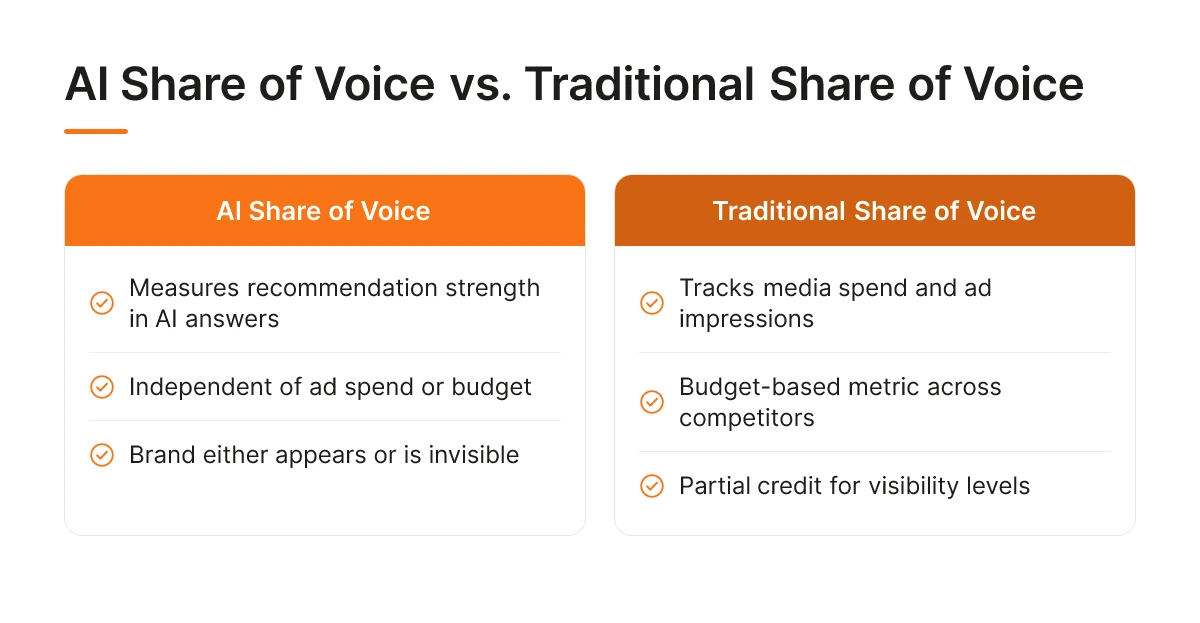
This metric measures recommendation strength inside AI answers, while traditional share of voice tracks ad spend and impressions, and brand mention counts just tally appearances without judging their quality.
Traditional marketing share of voice compares a brand's media spend or ad impressions against competitors in the same channel, it's a budget metric. This has nothing to do with spend; a brand with zero ad budget can still earn a high score if its content is structured and cited well enough for models to recommend it [2]. These are different mechanisms entirely, and conflating them leads marketers to assume paid visibility translates into AI visibility, which it doesn't.
Brand mention tracking is closer but still incomplete. A tool that counts every time ChatGPT or Perplexity says your company name treats a one-line comparison the same as a direct recommendation. Calculations here typically weigh both frequency and prominence, whether the brand led the answer or got buried in a list of also-rans [1]. For a B2B SaaS company, the difference between "also consider X" and "the best option for mid-market teams is X" is the difference between a missed deal and a demo request.
How Do You Use This Metric to Prove Marketing ROI to Stakeholders?
Present it as a leading indicator next to existing funnel metrics, not as a standalone revenue number nobody can independently verify.
This measures influence that happens before a click, a buyer asking an AI tool for a recommendation and never touching your website until later, if at all. That interaction won't show up in Google Analytics, which is why it complements traffic and conversion data rather than replacing it [3]. Treat a rising trend as context for other numbers, not a substitute for them. To connect it to pipeline, add a simple self-report field to demo request and signup forms asking how the lead found the company, and watch for AI tools showing up as an answer. Pair that with timing: if visibility in a given category climbed over a quarter and branded search or demo requests climbed alongside it, that correlation is worth reporting even without a direct attribution model [4]. Tools like Moonrank's AI search visibility tracking exist precisely to surface that trend data for ChatGPT, Gemini, Claude, and Perplexity so marketing teams have a number to point to when a board or founder asks what AI search is actually doing for the business.
How Do You Improve Your AI Share of Voice With Content and Technical Optimization?
You raise your standing by publishing fact-dense, well-structured content, earning third-party corroboration, and fixing the technical signals that let AI crawlers attribute facts to your brand correctly.
What Specific Content and Technical Changes Actually Move the Needle on AI Recommendations?
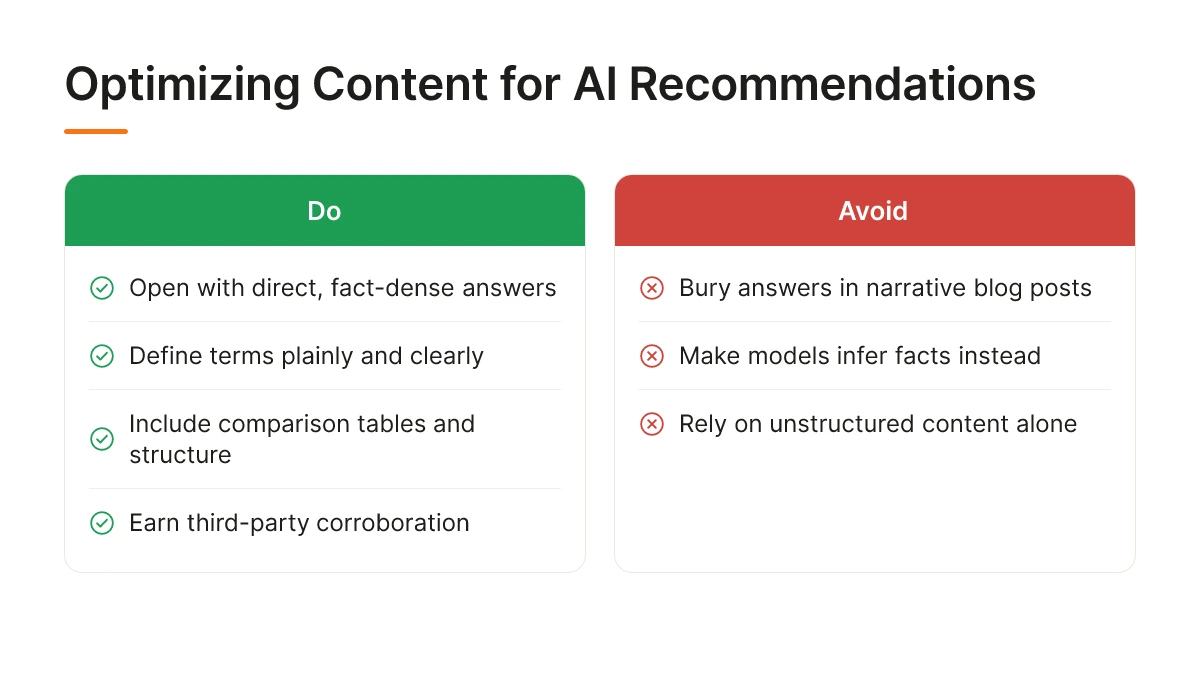
AI models synthesize answers from content that gives them a clean fact to extract, not from content that makes them infer one. A page that opens with a direct answer, defines its terms plainly, and includes a comparison table gets pulled into a generated response far more easily than a narrative blog post that buries the point in paragraph four. Semrush's own framing of this metric backs this up: it rewards brands that show up often and prominently, which starts with making the underlying facts easy to find and quote [1].
Structure matters on the technical side too, even though it works quietly in the background. Schema markup, clean HTML hierarchy, and an llms.txt file don't write your content for you, but they tell AI crawlers what your business does, what a page is about, and which facts belong to which entity. Moonrank builds this layer automatically, structured data, citation building, and llms.txt configuration, so a business doesn't need an engineer to make its site legible to ChatGPT, Gemini, Claude, and Perplexity.
Corroboration from outside your own website matters just as much as what's on it. AI systems weight independent mentions, reviews, comparison sites, industry roundups, forum threads, because repeated outside confirmation signals that a claim is reliable, not self-serving [3]. A brand that only talks about itself on its own domain has a thinner evidence trail than one that's also named, favorably, on sites it doesn't control. This is why earning citations elsewhere is treated as a GEO fundamental rather than a nice-to-have [2].
Do Real Brands See Measurable Growth, and What Does That Growth Look Like?
Realistic growth looks gradual: a brand starts out named in only a handful of tracked prompts and, as structured content and outside corroboration accumulate, becomes a consistent presence across most of the prompts that matter to its category. That shift tracks with how models retrieve information, more well-formed, well-corroborated facts in circulation means more chances to be the one cited [4]. It rarely happens from a single piece of content; it compounds over weeks as fresh pages, consistent facts, and new mentions stack up.
- Publish direct-answer content for "best tool for X" and comparison-style queries in your category.
- Keep product facts, pricing tier, features, category, consistent everywhere they appear online.
- Add structured data and an llms.txt file so crawlers attribute claims to the right brand.
- Re-test your tracked prompts monthly; model updates and competitor activity shift results often [5].
For businesses without time to run this cycle manually, Moonrank handles the daily content publishing, technical optimization, and prompt-tracking loop as one system, priced for SMB budgets rather than agency retainers. Start tracking and building your this strategy at moonrank.ai.
Frequently Asked Questions
How often should I re-check my AI share of voice?
Check weekly if you're actively publishing content, monthly at minimum otherwise. AI models update their training data and retrieval sources on different schedules, so a weekly cadence catches shifts fast enough to adjust your content strategy before a competitor locks in the gains. Monthly checks work for mature brands with stable visibility.
Can a small SaaS brand compete with larger competitors on AI share of voice?
Yes, this metric rewards content relevance and technical readability more than brand size or ad budget. Unlike paid search, you can't buy your way into an AI answer. A smaller B2B SaaS company with sharper, more structured content on its niche can outrank a larger, less-optimized competitor [2].
Does AI share of voice vary by industry or buyer type?
Yes, both the baseline share and the model you should prioritize shift by industry and buyer research behavior. Visibility on Perplexity can look very different from the same brand's standing on ChatGPT or Gemini, since each model pulls from different sources and ranks them differently [4]. B2B SaaS buyers and ecommerce shoppers also phrase prompts differently, which changes which brands surface.
Is a high AI share of voice always positive, or can sentiment make it negative?
No, a high share with negative sentiment can hurt more than low visibility would. If your brand appears often in AI answers but gets described as overpriced, unreliable, or a poor fit, you're amplifying the wrong message at scale. That's why sentiment analysis, not just mention counts, should sit alongside your share-of-voice tracking [2].
What's a realistic first step for a SaaS brand that has never measured this before?
Start small: pick 15 to 20 prompts your actual buyers would type, including comparison and "best tool for" phrasing, and run them manually across ChatGPT, Gemini, Claude, and Perplexity. Log whether your brand appears, where, and alongside which competitors. That baseline, even done by hand once, tells you more than guessing, and gives you something to compare against once you start tracking on a regular cadence.
Conclusion
this approach is the clearest signal you have for whether ChatGPT, Gemini, Claude, and Perplexity recommend you or your competitor. Three things matter most: measure it consistently across models, not just once; fix the technical gaps, schema markup, structured data, llms.txt, that keep AI systems from trusting your content; and publish often enough to stay in the data these models pull from. Most SMBs can't do all three manually without an agency retainer. If you run an ecommerce or B2B SaaS brand and haven't checked where you stand, start by running your brand name and three competitor names through ChatGPT and Perplexity this week, then see what Moonrank's visibility tracking shows at moonrank.ai.
Sources & References
- How to measure AI share of voice using Semrush
- AI Share of Voice: Ultimate GEO Metric for Growth | OptimizeGEO
- AI Share of Voice - Definitions, FAQs & How HubSpot Helps
- What Is Share of Voice and How to Measure It in 2026
- AI Share of Voice (AI SOV): Definition & Key Metrics
Recommended Articles
Explore more from our content library: