What Is ChatGPT Shopping and How Products Get Featured in It
Products get featured in ChatGPT shopping recommendations when ChatGPT can pull clean, structured product data — accurate titles, prices, availability, and...

Understanding ChatGPT shopping visibility is essential. Products get featured in ChatGPT shopping recommendations when ChatGPT can pull clean, structured product data, accurate titles, prices, availability, and attributes, from a merchant's feed or site, typically through schema markup, product feeds, and APIs that connect to its shopping sources. Unlike Google Shopping, where paid placement and bid strategy matter, ChatGPT currently favors structured, accurate, up-to-date data and credible third-party signals like reviews. SMBs improve their odds by fixing feed data quality, adding structured data to product pages, and keeping stock and pricing information current.
How Do You Get Your Products Visible in ChatGPT Shopping Recommendations?
ChatGPT selects products by reading structured product feeds, schema markup, and data shared through merchant partnerships, there is no bid or auction involved. OpenAI's merchant program lets retailers share product feeds directly, and ChatGPT uses that data, along with the Agentic Commerce Protocol, to match shoppers to products as they compare options and ask follow-up questions [2]. That's a fundamentally different mechanism than buying placement, and it means ChatGPT shopping visibility depends on data quality rather than marketing budget.
What Product Data and Feed Attributes Does ChatGPT Prioritize?
ChatGPT weighs five feed attributes most heavily: title clarity, price accuracy, availability status, category and attribute completeness, and image quality [1]. A title like "Men's Running Shoe, Size 10, Black" gives ChatGPT more to match against a shopper's request than a SKU-coded name that only makes sense in an internal catalog. Price and stock status need to stay current, since ChatGPT is matching live shopper intent to what's actually purchasable, not a snapshot from last quarter [1]. Complete attributes, size, color, material, use case, help ChatGPT place a product correctly when a shopper describes what they want in plain language rather than searching exact keywords [4].
How Does ChatGPT Shopping Visibility Differ From Traditional Google Shopping Ranking Factors?
Google Shopping rewards bid strategy, Merchant Center feed optimization, and historical click-through rates, spend and performance history both matter. ChatGPT, by contrast, sources and ranks products based on how complete and trustworthy the underlying data is, with no equivalent to a cost-per-click auction [1][2]. A merchant with a smaller ad budget but a cleaner, well-structured feed can appear where a competitor with a larger Google Ads spend does not. This shift moves the competitive advantage away from media spend and toward catalog hygiene and technical implementation, exactly the kind of structured data and schema work that determines whether an AI system can parse a site at all.
Reviews and third-party content also appear to shape which products ChatGPT surfaces. Content that describes a product in natural language, comparison articles, buying guides, review sites, seems to function as a trust signal alongside the feed itself [1][3]. For e-commerce brands and B2B SaaS companies selling physical add-ons or hardware, this means ChatGPT shopping visibility isn't just a feed exercise; it also depends on how the product is described across the web, not only inside a merchant's own data pipeline.
What Technical Steps Do SMBs Need to Take to Optimize for ChatGPT Shopping Visibility?
ChatGPT shopping visibility starts with five concrete tasks: clean product data, correct schema markup, a synced feed, accurate attributes, and a fast-loading site. None of these require a developer team, they require sequence and consistency.
What's the Step-by-Step Process for Optimizing Product Feeds and API Integration?
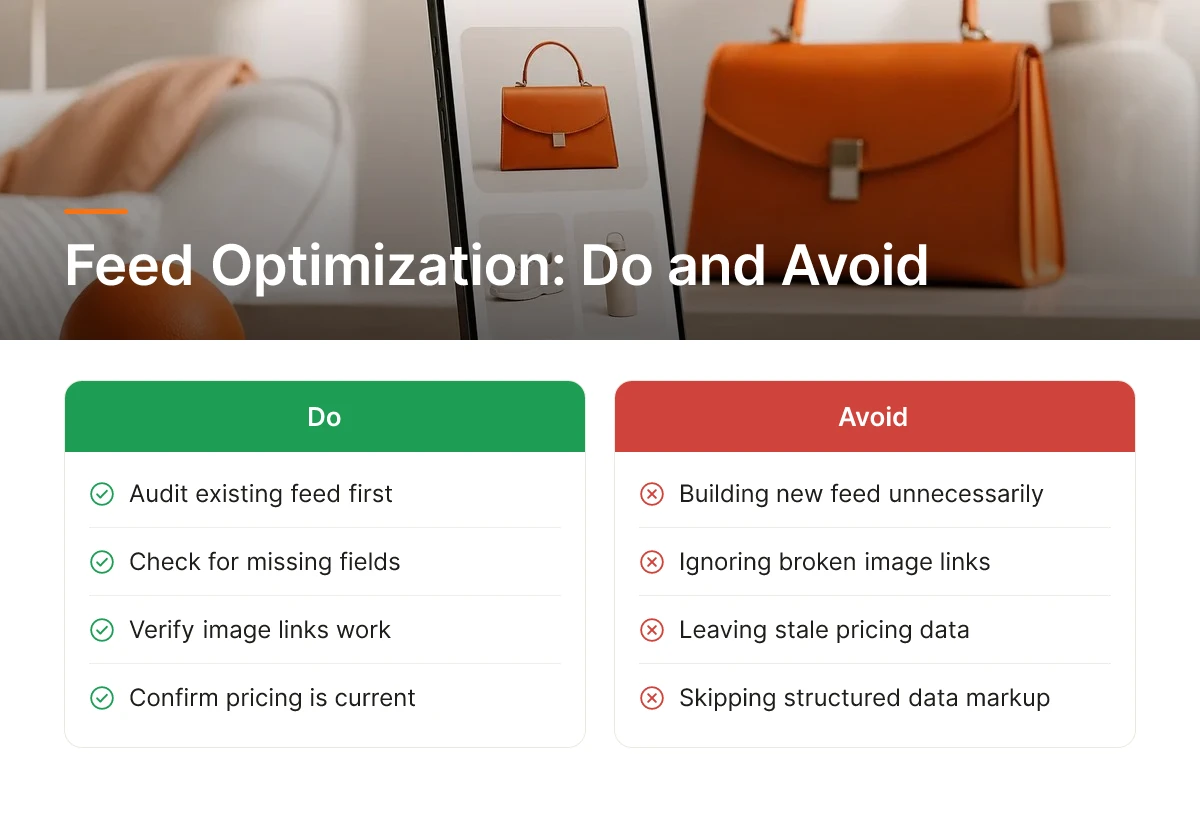
Start by auditing the product feed you already have. Most SMBs running Shopify or a similar platform already generate a feed for Google Shopping or Meta, check it for missing fields, broken image links, and stale pricing before building anything new.
Next, add or fix structured data on every product page: Product, Offer, and AggregateRating schema tell AI systems what the item is, what it costs, and whether other customers trust it [1]. BigCommerce's 2026 merchant guidance frames this as the second of five sequential steps, after opening the site to AI crawlers and before syndicating the feed to AI surfaces [1].
Once schema is in place, connect the feed to a system that updates automatically rather than relying on a static export. OpenAI's own merchant documentation describes ChatGPT shopping as pulling from shared product feeds that sync through existing commerce systems or supported providers, without requiring a rebuilt catalog [2]. A feed that updates nightly can still show a product as in stock after it sold out, real-time or near-real-time API sync is what keeps availability and pricing trustworthy at the moment a shopper asks ChatGPT for a recommendation.
Finally, apply for or enable the relevant program access, OpenAI's Agentic Commerce Protocol is the current mechanism for feed sharing and, in some cases, in-chat checkout [2].
How Do You Ensure Attribute Accuracy and Data Quality for AI Shopping Visibility?
Data quality is less glamorous than schema markup but matters just as much. ChatGPT, Google AI Mode, and Perplexity all depend on complete, accurate product data to match items to shopper intent [1], a product missing size, color, or material fields is a product that won't surface for a query that specifies one of those details.
Three practices cover most of this work: use consistent naming conventions across every SKU, fill every relevant attribute field rather than leaving optional ones blank, and remove duplicate or conflicting listings that confuse which version of a product is current. These are the same hygiene tasks that improve a Google Shopping feed, which is part of why most stores are closer to ready than they think.
Page performance still counts. AI citation checks and crawlers depend on pages that load quickly and render cleanly on mobile, since a slow or broken product page can get skipped even with perfect schema behind it.
None of this demands an enterprise IT department, a store owner with a Shopify account and a few focused afternoons can work through the checklist, which is the same reasoning behind Moonrank's approach: automating the schema markup, feed hygiene checks, and structured data work that SMBs don't have time to do manually, at a fraction of agency cost.
How Does ChatGPT Shopping Visibility Compare to Other AI Shopping Channels Like Perplexity and Claude?
Each AI assistant sources products differently, so a tactic that works in one channel does not automatically transfer to the next. ChatGPT runs on structured product feeds, Perplexity leans on live web crawling, Google AI Mode blends both, and Claude's commerce layer is still forming.
What Are the Key Differences in How Perplexity, Google AI Mode, and Claude Commerce Surface Products Compared to ChatGPT?
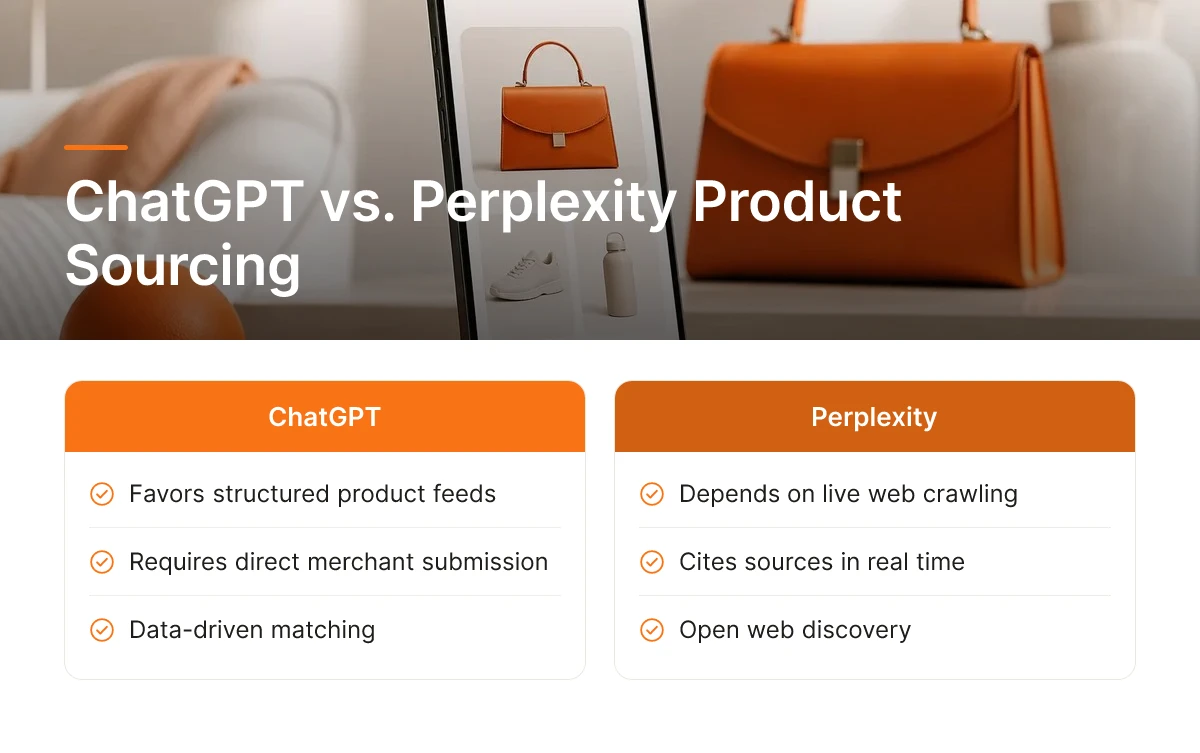
ChatGPT favors merchants who submit structured product feeds directly, while Perplexity depends more heavily on crawling the open web and citing sources in real time [2]. That distinction matters for where you put effort first. ChatGPT's merchant program lets brands share product feeds through existing systems without rebuilding a catalog, and the assistant matches products to shoppers based on preferences and context [2]. Perplexity, by contrast, pulls from live search results and third-party pages, so it rewards brands with strong organic content and citations rather than a submitted feed alone [1].
Google AI Mode sits between the two. It draws on the same Shopping feed data that powers traditional Google Shopping results, then layers AI-generated summaries on top [1]. If your Merchant Center feed is already clean, Google AI Mode has a head start compared to channels with no existing feed relationship.
Claude's commerce features remain newer and less standardized than ChatGPT's or Perplexity's [3]. There is no equivalent merchant feed program publicly documented at the same maturity level. That does not mean Claude is irrelevant, it means the fundamentals (accurate pricing, clear availability, structured markup) carry over regardless of which assistant eventually formalizes its own ingestion method.
Should SMBs Prioritize ChatGPT Shopping Visibility Over Other AI Platforms?
Fix core structured data and feed quality before chasing platform-specific tactics, because clean product data improves visibility across ChatGPT, Perplexity, Google AI Mode, and Claude at once. Accurate schema markup, consistent pricing, and up-to-date availability are not ChatGPT-specific requirements, they are baseline signals every AI shopping surface checks before recommending a product [1]. Only after that foundation is solid does it make sense to layer on ChatGPT's feed submission process or Perplexity-specific citation building. This prioritization question matters more for a small e-commerce team or a solo Shopify founder than for a large retailer with a dedicated data team. An enterprise can run parallel optimization tracks for every channel; an SMB owner usually has time for one solid pass. Moonrank's technical audit addresses this directly by fixing schema markup, llms.txt configuration, and feed-level data hygiene once, so the same groundwork improves ChatGPT shopping visibility and standing in Perplexity, Google AI Mode, and Claude without separate manual projects for each platform.
How Do You Measure and Track Your Visibility in ChatGPT Shopping Results?
Track three things on a repeating schedule: how often your products show up for relevant prompts, how accurate that listing data is, and how much referral traffic actually converts. ChatGPT shopping visibility isn't a one-time audit, it's a number that moves as your feed, reviews, and content change, so measuring it once tells you almost nothing.
What KPIs and Metrics Should You Monitor to Measure Visibility Success?
Four metrics matter most for SMBs without a dedicated analytics team.
- Appearance rate: the share of realistic shopper prompts in your category where your product shows up at all.
- Data accuracy: whether the price, stock status, and specs ChatGPT displays match what's actually on your site. Stale pricing or "in stock" errors quietly kill trust and conversions.
- Position and framing: are you the first product mentioned, or buried after three competitors, and is the description accurate to how you'd describe the product yourself?
- Referral traffic and conversion: sessions arriving from ChatGPT, and whether they buy. Early data suggests AI-referred shoppers convert at notably higher rates than typical traffic, with one study citing a 42% lift in conversion for AI-referred visitors against non-AI traffic [1]. That makes even modest visibility gains worth chasing.
Before paying for monitoring software, run the test manually. Open ChatGPT, type the prompts a real customer would use, "best waterproof hiking boots under $150," not your brand name, and log what appears, how often, and with what details. Do this weekly across five or ten prompts that matter to your catalog. It's slow, but it's free, and it tells you immediately whether your product feed and content work from Part 3 are landing.
How Do You Monitor Negative Reviews and Sentiment in ChatGPT Shopping Results?
ChatGPT draws on third-party reviews and retailer data to judge trustworthiness, so outdated or negative source content can suppress a product even when the feed itself is clean [3]. A cluster of old one-star reviews, a discontinued-but-still-listed variant, or a review site with stale specs can all quietly distort what the model says about you.
Treat this the way you'd treat reputation management anywhere else: check what review platforms and retailer pages say about your products, correct inaccurate listings at the source, and encourage recent customers to leave fresh reviews. The goal isn't to erase criticism, it's to make sure the most current, accurate signal is the one feeding the model.
Run this check on a cadence, not as a one-off. AI answers vary across sessions and even across identical prompts, so a single good result doesn't confirm visibility any more than a single bad one confirms failure. Consistent, repeated testing is what turns a snapshot into a trend, and a trend is what tells you whether your optimization work is actually paying off.
What Tools and Platforms Can Help Automate ChatGPT Shopping Visibility Optimization?
SMBs generally pick from three paths: handle it manually in-house, bring in a tool built for tracking and feed fixes, or run an all-in-one automated platform that handles monitoring and optimization together.
Each path trades off cost, speed, and how much ongoing attention it demands from someone who already has a full-time job running the business. The right choice depends on how much structured data and feed work already exists, and how much time the owner can realistically give to upkeep every week.
How Can SMBs Automate Daily Optimization and Monitoring Without Hiring Expensive Agencies?
Automation handles the repetitive, time-sensitive parts well: continuous feed monitoring, structured data upkeep, and flagging data drift, like a price that changed on the site but not in the feed, or a product that went out of stock without an update pushed through. These are exactly the kind of errors that break ChatGPT shopping visibility silently, because a feed that stops validating simply stops appearing, with no warning email from OpenAI.
What automation doesn't replace is judgment: deciding which third-party review sites are worth pursuing for trust signals, writing comparison content that actually answers how a shopper talks, or interpreting why a competitor suddenly outranks you in a specific query. Those calls still need a person who understands the business, even if a tool is doing the heavy lifting on data hygiene.
On cost, the spread is wide. Budget-friendly automated platforms sit at one end, built to run hands-off for a flat monthly fee. Premium agency retainers sit at the other, often bundling strategy calls and custom reporting at a price built for brands with dedicated marketing budgets, not solo Shopify owners. For most SMBs, the gap between those tiers is the gap between affording ongoing optimization at all and not doing it.
Daily automated monitoring beats periodic manual checks for a simple reason: feed errors and pricing drift compound fast, and ChatGPT's product-matching logic reacts to whatever state your feed is in right now, not what it looked like last month [2]. A weekly spreadsheet check misses a three-day outage in your Merchant Center feed; a daily automated scan catches it before it costs a week of lost visibility.
This is the gap Moonrank is built to close. It runs daily automated content generation and publishing, tracks how a business appears in recommendations across ChatGPT, Gemini, Claude, and Perplexity, and handles the technical layer, schema markup, llms.txt, structured data, citation building, that keeps AI systems able to parse and trust a product catalog, all without the business owner touching a line of code. For an e-commerce or B2B SaaS team that wants ChatGPT shopping visibility handled on autopilot instead of chased manually every week, start at www.moonrank.ai.

Frequently Asked Questions
Can small businesses realistically compete with large retailers for ChatGPT shopping visibility?
Yes, because organic placement in ChatGPT can't be bought, which levels the field between small merchants and large retailers [1]. Selection depends on complete, accurate product data and trust signals, not ad budget or brand size, so a well-structured feed from a small Shopify store can outrank a sloppy one from a national chain.
Does running ads guarantee a product appears in ChatGPT shopping recommendations?
No, organic placement in ChatGPT, Google AI Mode, and Perplexity cannot be purchased [1]. Products surface based on structured data accuracy and third-party trust signals, so merchants need clean feeds and credible reviews, not ad spend, to show up in results.
How often should SMBs update their product feed for AI shopping visibility?
Update feeds as often as inventory, pricing, or availability changes, stale data is a common reason products drop out of recommendations. AI shopping engines pull from product feeds continuously, so a feed that syncs daily with your store's actual stock and pricing gives you better odds than one refreshed monthly or quarterly.
What before-and-after signs indicate a visibility improvement from optimization work?
Look for increased AI-referred site traffic, more conversions from that traffic, and your products actually appearing when you test relevant shopper queries. AI-referred visitors already convert 42% better than non-AI traffic [1], so a jump in that segment's volume after fixing structured data or feed syndication is a concrete sign the work paid off, not just a vanity metric.
Conclusion
ChatGPT shopping visibility comes down to three things: clean structured data, a product feed that syncs with reality, and content that answers the questions shoppers actually ask [1][2]. Retailers who treat this as a one-time setup will fall behind merchants who keep their feeds current and their product pages answer-ready [3][4]. None of this requires a bigger budget, it requires consistent technical upkeep most SMB owners don't have time for.
Start by auditing whether your product pages currently answer a real shopper question in plain language. If they don't, that's your first fix, and tools like Moonrank can handle that optimization work automatically for $99/month.
Sources & References
- Get Your Products Into ChatGPT, Google AI Mode & Perplexity in 2026
- Power product discovery in ChatGPT
- How ChatGPT Shopping Works in 2026 | Darkroom Blog
- ChatGPT Shopping: when artificial intelligence becomes your new shopping assistant
Recommended Articles
Explore more from our content library: