Why AI Shopping Assistants Are Changing Ecommerce Discovery
AI shopping assistants like ChatGPT and Perplexity recommend ecommerce products by pulling from structured data, product feeds, reviews, and content that...

Understanding AI shopping assistants ecommerce is essential. AI shopping assistants like ChatGPT and Perplexity recommend ecommerce products by pulling from structured data, product feeds, reviews, and content that clearly states what a store sells, not from traditional keyword rankings. For SMBs, this means visibility now depends on how clean, specific, and machine-readable your product information is, separate from how well you rank in Google. Stores that format product details for AI comprehension get cited in shopping conversations; those that don't stay invisible no matter how strong their Google SEO is.
How Do AI Search Engines Like ChatGPT and Perplexity Recommend Ecommerce Products?
AI assistants read your product feed, reviews, and structured data to understand what you sell, then synthesize that into a direct answer rather than a list of links.
This is a mechanical shift, not a marketing one. Traditional Google SEO rewards backlinks, domain age, and keyword density. AI shopping assistants ecommerce visibility works on a different input entirely: can the assistant parse your product data cleanly enough to trust it? Perplexity Shopping, for example, blends conversational search with real-time product data to return curated, context-rich recommendations instead of a standard results page [1]. ChatGPT's shopping behavior follows a similar logic, it synthesizes information from a wider set of unstructured sources, including Reddit threads, forums, and product reviews, alongside the structured product data merchants publish directly [2].
What Data Sources Do AI Assistants Use to Surface Product Recommendations?
Assistants draw from product feeds, schema markup, customer reviews, and crawlable on-site content, not from link graphs. Conversational AI tools increasingly pull from customer behavior signals and product data together, combining structured catalog information with unstructured signals like review sentiment to decide what to surface in a shopping conversation [5]. Reviews in particular carry more weight than most store owners assume: AI shopping assistants treat reviews as a credibility signal because they verify claims made in product descriptions, not just supplement them [3]. A store with an unstructured PDF catalog and no review data gives the assistant almost nothing to work with, regardless of how well that same store ranks on Google.
How Do AI Search Engines Decide Which Stores to Cite?
Citation comes down to parsability and trust signals, not ad spend, domain age, or paid placement. Perplexity explicitly prioritizes relevance and transparency over paid placement in its shopping results [1], which means a smaller store with cleanly tagged attributes can out-cite a bigger competitor with messier data. What makes a store citable: consistent product naming across pages, explicit attributes (size, material, price, availability), and content that states plainly what the product does and who it's for. An entity audit, checking whether your brand, products, and attributes are described consistently across your own site and third-party sources, is the starting point for earning that visibility [2]. Stores that bury specs in images, use inconsistent naming between collection pages and product pages, or rely on JavaScript-rendered content that crawlers can't parse tend to get skipped entirely.
Why Ecommerce Stores Need AI Shopping Assistants Visibility, Not Just Google Rankings
A high Google ranking no longer guarantees a shopper ever sees your product, because a growing share of discovery now happens inside a single AI answer instead of a search results page.
Shoppers used to type a keyword, scan ten blue links, and click through to compare. That behavior is shifting toward asking an assistant directly: "what's the best running shoe for flat feet under $150" or "compare these three espresso machines." Perplexity Shopping was built around exactly this pattern, understanding a natural-language question and returning curated recommendations instead of a generic results list [1]. ChatGPT's shopping features work the same way, synthesizing product quality and fit from a wider pool of sources rather than just matching keywords [3].
How Does Visibility in ChatGPT or Perplexity Impact Traffic and Sales Differently Than Google Rankings?
A Google ranking earns a click and asks the shopper to keep deciding; an AI citation can deliver the recommendation itself and close the loop before the shopper ever visits a site. Perplexity's model prioritizes relevance and transparency over paid placement, meaning a product gets surfaced because it matches the question well, not because someone bought the slot [1]. That compresses the traditional funnel, awareness, comparison, and decision can now happen in one exchange. For a store owner, this means AI shopping assistants ecommerce visibility isn't a parallel marketing channel to Google traffic; it's a different point of entry into the same purchase decision, often a shorter one.
The risk is showing up nowhere in that exchange while still ranking well on Google. AI assistants pull from a broader public record, reviews, forums, Reddit threads, structured product data, and synthesize across all of it, rather than ranking pages by backlinks and keyword match [2]. A product page optimized purely for Google's crawler can be well-ranked and still invisible by default inside an AI answer, because the two systems are scoring fundamentally different signals [2].
None of this replaces Google SEO. Search traffic still converts, and most stores will keep investing in it. But treating AI shopping assistants ecommerce visibility as optional leaves a growing slice of product discovery traffic on the table, traffic that arrives already warmed up, if it arrives at all.

What's the Difference Between Traditional SEO and AI Shopping Search Visibility?
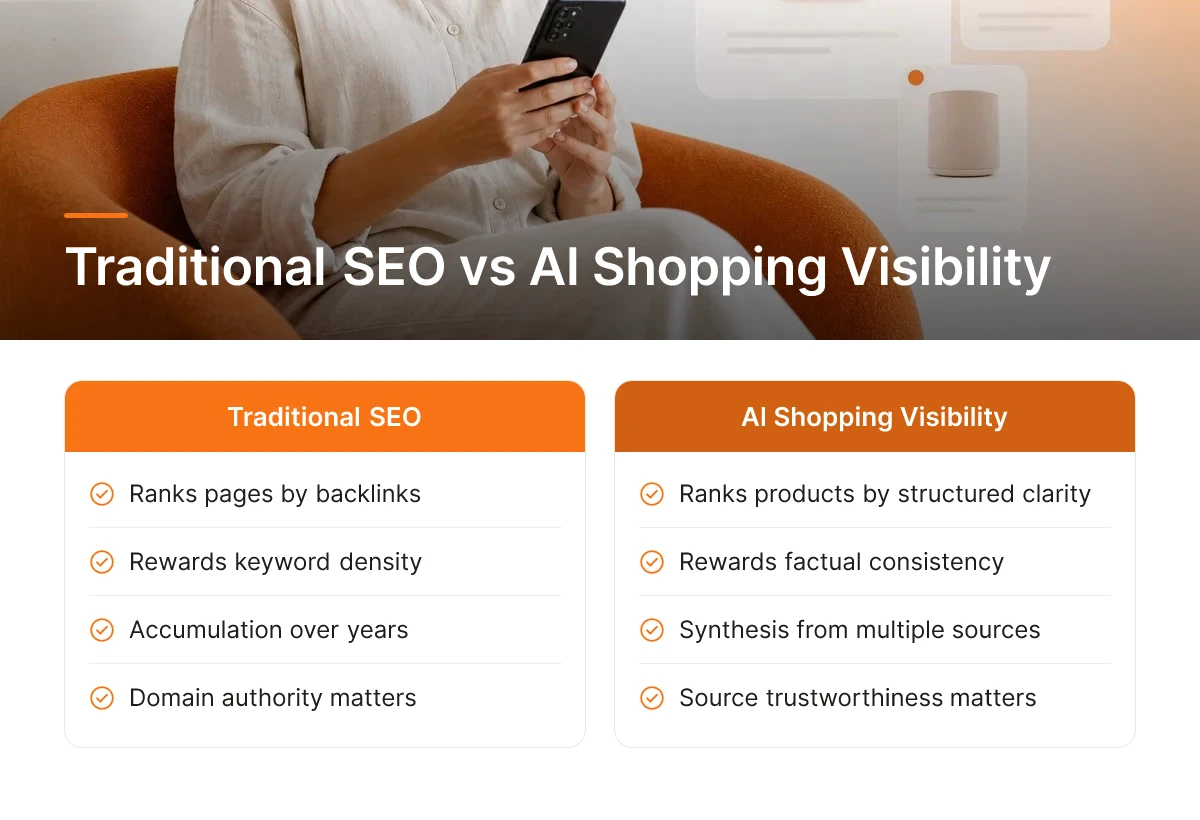
Google ranks pages by backlinks and keyword density; AI engines rank products by structured clarity, factual consistency, and whether the source can be trusted. That single shift changes almost every tactic an ecommerce store has relied on for the past decade.
Traditional SEO rewards accumulation, more links, more keyword mentions, more domain authority built up over years. AI shopping assistants ecommerce visibility works on a different logic entirely: a synthesis engine like ChatGPT or Perplexity reads your product page, your reviews, and whatever else is written about you across the web, then decides whether your product deserves to be mentioned in its answer [2]. It's less a ranking contest and more an audition for inclusion.
What Ranking Factors Matter Most for AI Search Engines Versus Google's Algorithm?
Google's algorithm still leans heavily on links pointing to a page and how often target keywords appear in the content. AI engines instead weigh whether the product data is structured enough to parse, whether the facts about it stay consistent everywhere they appear, and whether the surrounding sources, reviews, forums, comparison articles, back up what the brand claims [2].
This is why visibility now depends less on keyword rankings and more on what researchers call the public record of a product's quality: Reddit threads, review sites, and third-party mentions all feed into what the AI assistant decides to say [2].
Why Do Keyword Rankings and Backlinks Work Differently in AI-Powered Shopping Discovery?
A product page with zero backlinks can still get cited by an AI assistant if the page is structured clearly and the facts on it hold up against outside sources, something that almost never happens in a Google ranking, where backlinks remain a near-prerequisite for competitive terms. The AI doesn't care how many sites link to you; it cares whether your page answers the question a shopper actually asked.
That also changes what "good content" means. A blog post stuffed with a high-search-volume keyword might rank on Google and still get ignored by an AI assistant, because the assistant is looking for direct answers to comparison or recommendation questions, "which running shoe is best for flat feet," not "best running shoes 2026." Content written to satisfy a search-volume target rather than a specific question tends to get passed over.
Freshness and consistency matter more here too. Google can tolerate a product description that hasn't been updated in two years as long as the page still ranks. AI engines are more sensitive to mismatches, if your spec sheet says one thing and a retailer listing says another, that inconsistency can knock you out of consideration entirely. Keeping descriptions, reviews, and specs aligned across every channel is now part of the job, not an afterthought.
How Can SMBs Get Products Recommended by AI Shopping Assistants Without Expensive Agencies?
A small team can do most of the groundwork itself: clean product descriptions, consistent specs, and structured data don't require an agency retainer to fix.
The work that actually moves the needle for AI shopping assistants ecommerce visibility is less exotic than most owners expect. Assistants like ChatGPT and Perplexity synthesize answers from product data and the broader public record, reviews, specs, forum mentions, rather than ranking pages by backlinks [2]. That means the first pass is largely a content hygiene exercise: write product titles and descriptions the way a customer would phrase a question, standardize specs across your catalog, and make sure every page has schema markup so the assistant can parse what you sell without guessing.
Can SMBs Automate AI Search Optimization, or Does It Require Manual Work for Each Product?
It doesn't have to be manual, automation tools can handle the recurring parts, so optimization isn't a per-product chore repeated by hand every time inventory changes.
Writing new product copy, updating schema, and publishing supporting content for a 200-SKU catalog by hand isn't realistic for a two-person team. This is where automated platforms earn their keep. Moonrank, for example, runs daily content generation and technical optimization, schema markup, llms.txt configuration, citation building, on autopilot after onboarding, which is the kind of ongoing maintenance that otherwise eats a founder's week. The goal is treating AI visibility as infrastructure that runs in the background, not a project you revisit once a quarter.
On cost, the realistic choice isn't "agency or nothing." A self-managed approach using budget-friendly automation tools can cover the same ground, structured data, fresh content, visibility tracking, that a premium or enterprise SEO agency retainer promises, without the markup that comes from paying for an account manager and a content team. For a store owner weighing a few hundred dollars a month against a five-figure annual agency contract, the self-managed path is the one that scales with a lean budget.
Tracking matters as much as the production work. Guessing whether changes helped is wasted effort; checking how your brand actually shows up across ChatGPT, Gemini, Claude, and Perplexity is what tells you whether the optimization is working [4]. Without that feedback loop, teams often keep publishing content that never gets cited anywhere.
Timelines also differ from traditional Google SEO. Because AI engines re-crawl and re-synthesize answers more frequently than Google re-indexes and re-ranks a page, early signals, a product mention in a test query, a citation appearing where it wasn't before, can show up in weeks rather than the months typical of organic ranking gains.
What Technical and Content Changes Do Ecommerce Sites Need for AI Search Visibility?
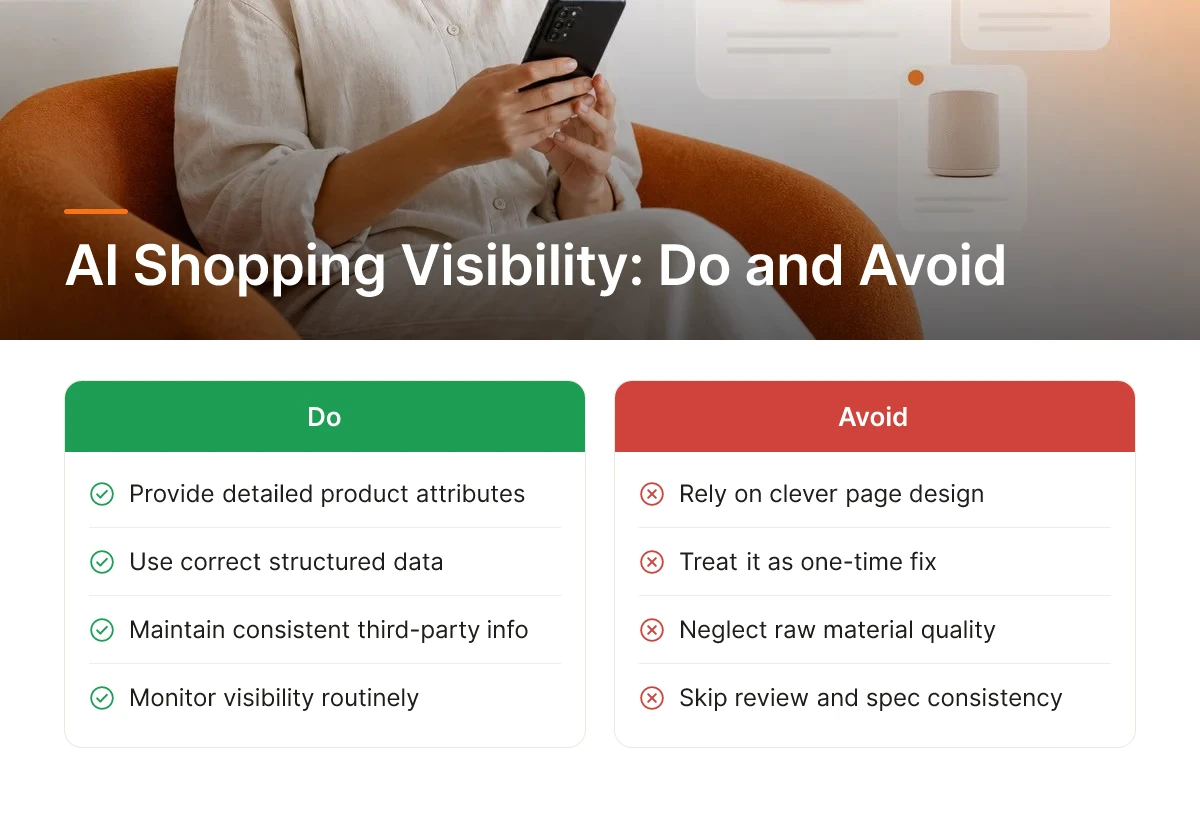
Visibility in AI shopping assistants ecommerce contexts depends on detailed product attributes, correct structured data, consistent third-party information, and routine monitoring, not a one-time fix.
AI assistants don't browse a site the way a shopper does. They pull fragments of product data, reviews, and public mentions, then synthesize an answer [2]. That means the raw material a site provides matters more than clever page design.
How Should Product Descriptions and Structured Data Be Formatted to Rank in AI Shopping Searches?
Write product descriptions that answer the actual questions a shopper would type into ChatGPT or Perplexity, not just a style statement. Name the material ("100% merino wool"), the sizing specifics ("runs small, order one size up"), and the use case ("suited for cold-weather hiking, not everyday wear"). A synthesis engine favors text it can lift directly as an answer, so vague copy like "premium quality, stylish design" gives it nothing to work with.
Schema markup is the extra layer of code behind a product page that labels each piece of information, price, availability, material, size, rating, so a machine doesn't have to guess what it's reading. Without it, an AI assistant has to infer meaning from loose text, and inference introduces errors. With it, the assistant can confirm facts with confidence, which is a large part of why entity clarity matters more than keyword density now [2].
What Compliance and Data Privacy Considerations Apply When Optimizing for AI Search Engines?
Product feeds built for AI consumption need the same privacy discipline as feeds built for ad platforms. Audit product and customer data exports before syndicating them, and confirm no order details, loyalty IDs, or personal identifiers leak into public-facing feeds or review exports. Be transparent on-site about what customer data feeds into personalization or review displays, since AI assistants increasingly surface review content directly in their answers [3].
Consistency matters as much as accuracy. AI engines cross-check a brand's own site against reviews, forums, and marketplace listings, and gaps between them erode trust in the answer [2]. A product listed as "waterproof" on-site but described as "water-resistant" on a retailer page creates ambiguity that a synthesis engine may resolve by excluding the product rather than guessing.
None of this is a single project with a finish line. AI visibility shifts as assistants update models and shoppers phrase questions differently, so tracking appearance across ChatGPT, Gemini, Claude, and Perplexity needs to become a standing habit, not a launch checklist [4]. Moonrank builds this into its daily cycle, automated content publishing, schema and llms.txt optimization, and ongoing visibility tracking, so ecommerce owners get a system that keeps adjusting instead of a report that goes stale. Store owners who treat this as infrastructure, not a one-time audit, are the ones still showing up in AI answers a year from now.
Frequently Asked Questions
What percentage of product discovery is already happening through AI assistants instead of Google?
There's no single clean percentage, but the shift is measurable and fast, Adobe Analytics reported AI-driven traffic to US retail sites jumped 805% year over year over Black Friday 2025 [4]. Perplexity alone was handling over 100 million weekly queries by late 2024, many of them product-related [1]. The trend line matters more than any one snapshot number, and it points up, not down.
Do AI shopping assistants replace the need for traditional ecommerce SEO?
No, AI shopping assistants add a layer on top of SEO rather than replacing it. They synthesize structured product data and unstructured sources like reviews and forums [2], so your site still needs solid technical foundations plus a strong public record beyond your own pages.
How long does it take to see results from optimizing for AI search visibility?
Most stores start seeing shifts in AI recommendation patterns within a few weeks to a couple months, not years. Because AI assistants re-crawl and resynthesize answers continuously rather than waiting for a slow backlink-driven ranking cycle, fixes to structured data, llms.txt, and content freshness can show up in test queries sooner than traditional Google ranking changes typically do.
Can small ecommerce stores compete with large retailers for AI assistant recommendations?
Yes, AI assistants weigh relevance and clarity of product information over brand size or ad spend. Perplexity Shopping, for example, prioritizes relevance and transparency over paid placement [1], so a small store with clean structured data, detailed specs, and genuine reviews can outrank a bigger competitor with thinner or less organized product content.
Conclusion
AI shopping assistants now read your product pages, reviews, and public mentions the way a synthesis engine reads evidence, not the way Google's crawler reads keywords [2]. The practical takeaways: fix your structured data and llms.txt so assistants can parse your catalog, treat reviews as a visibility asset rather than just a trust signal, and track your brand's AI recommendations as a recurring check, not a one-time audit. Store owners without a dedicated SEO team don't need to manually chase each of these. Start by running your product pages through Moonrank's AI visibility tracker at www.moonrank.ai to see exactly where ChatGPT, Gemini, and Perplexity currently place your brand against competitors.
Sources & References
- Perplexity Shopping Is Changing the Way We Shop Online
- ChatGPT Shopping & The New Ecommerce SEO Strategy
- AI Shopping Assistants Are Redefining eCommerce: What Brands Should Do To Stay Visible in ChatGPT Search | Yotpo
- AI Visibility for Commerce | Paz.ai
- How AI Shopping Assistant Capabilities are Changing Retail and E-Commerce
Recommended Articles
Explore more from our content library: