How Perplexity vs ChatGPT Search Sources Affect Your SaaS
Perplexity and ChatGPT Search recommend different sources because they weigh signals differently: Perplexity leans heavily on real-time crawling and...

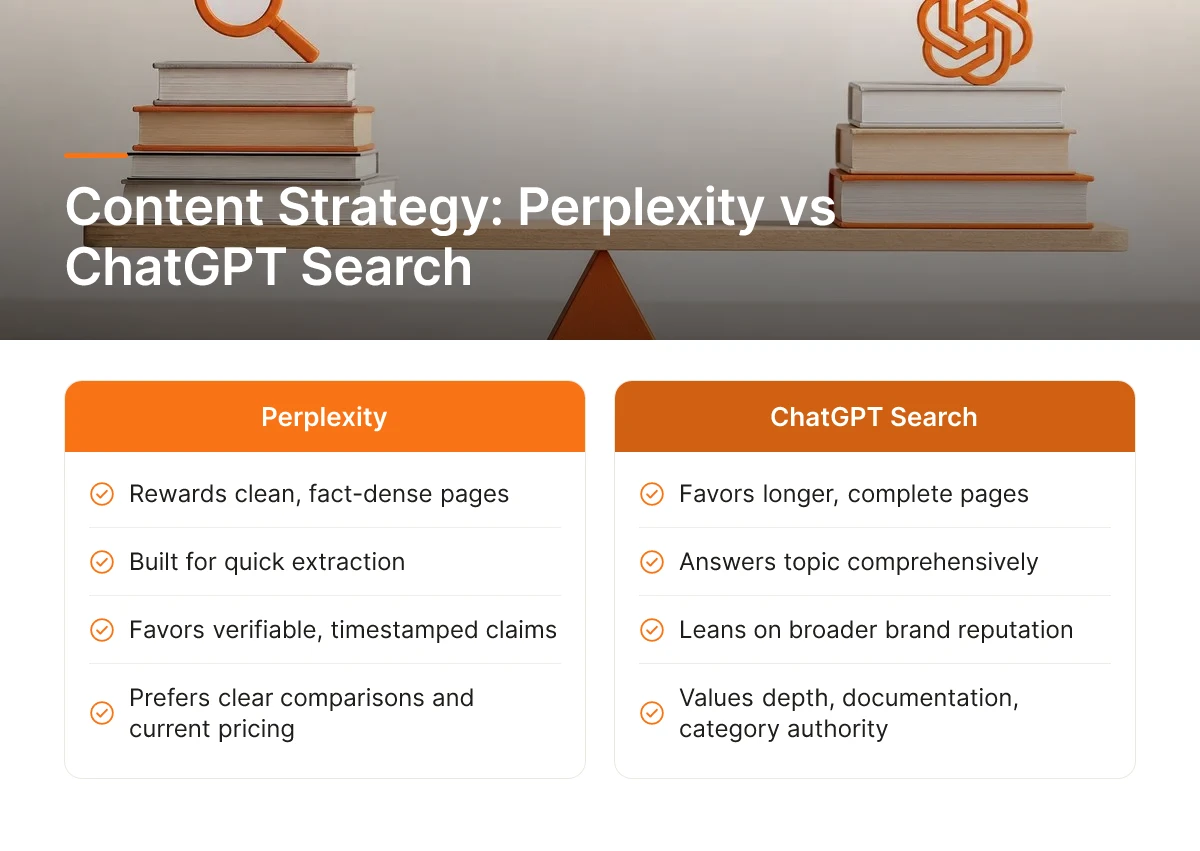
Understanding Perplexity vs ChatGPT search is essential. Perplexity and ChatGPT Search recommend different sources because they weigh signals differently: Perplexity leans heavily on real-time crawling and citation-style ranking, favoring fresh, well-structured pages with clear facts and data. ChatGPT Search blends its training knowledge with live retrieval, often favoring established, topically authoritative domains and clearly structured comparison or how-to content. For a SaaS business, this means Perplexity rewards frequently updated, specific pages, while ChatGPT Search rewards consistent topical depth and structured answers. Optimizing for both requires clean structure, current information, and clear factual statements AI models can extract and cite directly.
Perplexity vs ChatGPT Search: How Do They Differ in Source Selection?
The core difference comes down to mechanics: Perplexity re-crawls and re-ranks the live web for nearly every query, while ChatGPT Search blends stored training knowledge with a narrower retrieval layer. That single design choice explains most of what a SaaS team notices when comparing Perplexity vs ChatGPT search results for the same product category.
Perplexity works like a citation engine. It sends out live queries, pulls a ranked list of sources, and builds its answer directly from what it finds at that moment, which is why its output often reads like an annotated bibliography. ChatGPT Search, by contrast, leans on a hybrid approach, it already "knows" a lot about established domains from training, and it uses retrieval mainly to fill gaps or confirm current facts rather than to rebuild its worldview from scratch every time [3].
Does Perplexity Favor Real-Time or Evergreen Content Differently Than ChatGPT Search?
Perplexity generally surfaces fresh content faster because it re-indexes results per query instead of relying on a fixed snapshot of the web. A changelog update, a new pricing page, or a product announcement published this morning has a real shot at appearing in a Perplexity answer by afternoon. ChatGPT Search can pick up timely content too, since it uses live retrieval through its search index, but it tends to anchor on domains it has already reinforced as authoritative, which slows down how quickly brand-new pages break through [4].
For B2B SaaS companies that ship release notes or security advisories on a tight cadence, this gap matters. Evergreen comparison pages and documentation tend to hold steady in ChatGPT Search, while fast-moving updates get rewarded more consistently on Perplexity.
How Do Domain Authority, Topical Relevance, and Recency Signals Differ Between the Two Engines?
Domain authority isn't scored the same way across either engine. Perplexity rewards pages with clear factual density, specific numbers, named entities, direct answers to the question asked, because its ranking logic is built around pulling citable snippets, not just trusted brand names [5]. ChatGPT Search instead rewards consistent topical coverage: a site with many interlinked pages on the same subject signals authority in a way that persists across sessions, since that reinforcement is partly baked into how the model treats the domain over time [2].
Topical relevance clusters, a cybersecurity vendor publishing dozens of pages on compliance, threat detection, and incident response, for example, help visibility on both engines, but the effect is more pronounced for ChatGPT Search's trust signals [1]. Perplexity will still cite a single strong, data-rich page even if the rest of the site is thin.
What Content and Technical Optimization Strategies Work Best for Each Engine?
Perplexity rewards clean, fact-dense pages built for quick extraction, while ChatGPT Search favors longer pages that answer a topic completely. Winning the Perplexity vs ChatGPT search comparison means building one technical foundation, then adjusting content depth and formatting for how each engine actually reads a page.
Which On-Page SEO Elements Matter Most for Perplexity vs ChatGPT Search?
Structured data is the shared starting point. Schema markup tells both engines what a SaaS page is actually about instead of making them guess from prose, Product schema identifies your pricing tiers and features, FAQ schema flags question-answer pairs as citable units, and Organization schema confirms who runs the site and establishes the entity behind the content [3].
Beyond schema, the two engines diverge in what they reward on the page itself. Perplexity performs a retrieval step first, pulling candidate pages from a search index, then scores which passages answer the question most directly [4]. Clear H2s and H3s, short paragraphs, and bulleted comparisons help Perplexity extract a clean snippet without wading through dense paragraphs, a page structured like an FAQ page gets lifted into an answer far faster than one structured like a magazine feature [2].
ChatGPT Search works differently. It rewrites a user's question into one or more backend searches, sometimes issuing follow-up queries for more precise results, and tends to favor pages that cover a topic in full rather than fragments scattered across multiple short posts [4]. A SaaS comparison page that addresses pricing, integrations, limitations, and use cases in one place gives ChatGPT Search more surface area to draw from than five thin posts covering the same ground separately.
How Should SaaS Businesses Tailor Content Format and Depth for Each Engine?
Depth strategy should split by engine rather than default to one template. For Perplexity visibility, build concise, fact-forward pages: named numbers, dated claims, and a direct answer in the first two sentences of each section [3]. For ChatGPT Search trust, build comprehensive guides that leave no adjacent question unanswered, these longer pages act as a single authoritative source ChatGPT can cite repeatedly across related queries.
Crawlability underpins both strategies. An llms.txt file and unblocked access for crawlers like OAI-SearchBot are baseline requirements, block the bot and a SaaS site becomes invisible to ChatGPT Search regardless of content quality [4]. Moonrank's technical audit handles this layer automatically, configuring llms.txt, schema, and structured data alongside the daily content publishing that keeps both concise and comprehensive formats in rotation.
How Do Perplexity and ChatGPT Search Handle Source Credibility and Freshness Differently?
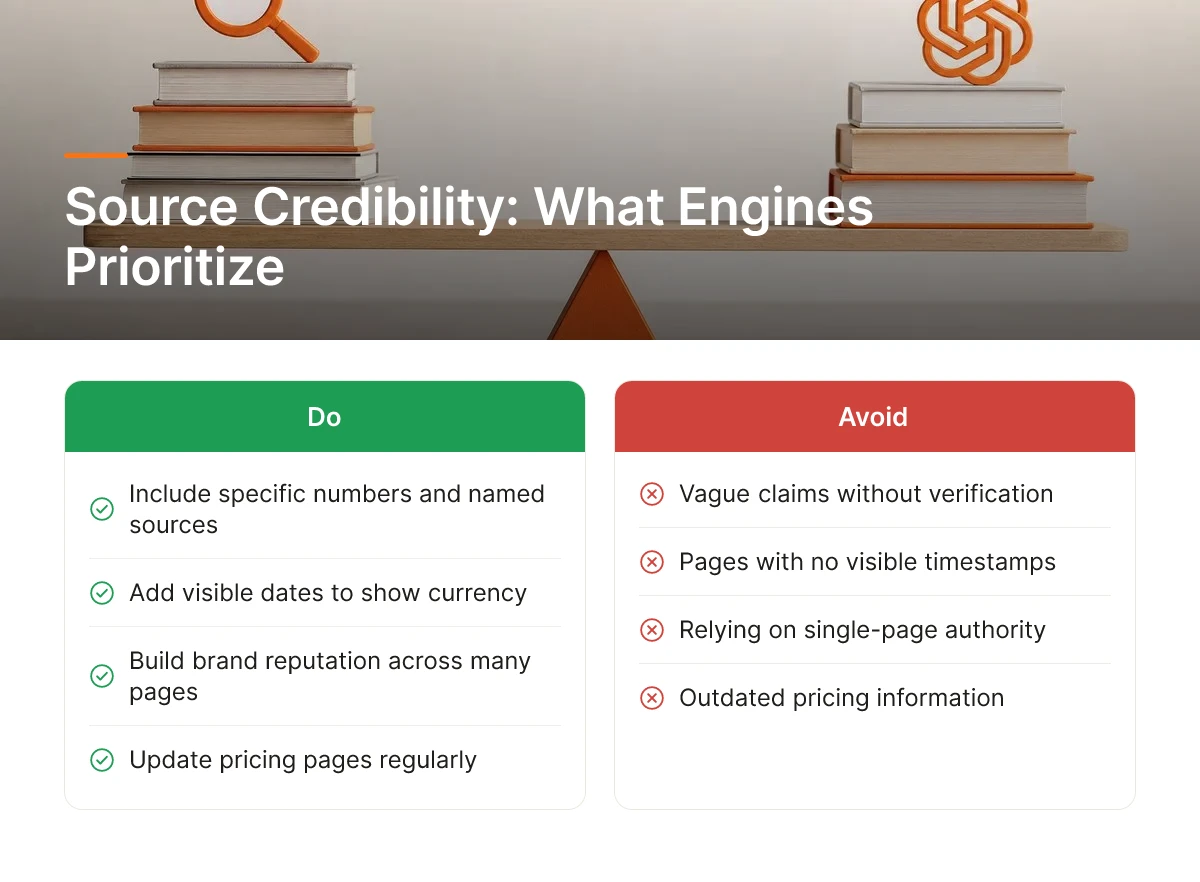
Perplexity rewards pages with verifiable, timestamped claims, while ChatGPT Search leans on broader brand reputation built across many pages and mentions. The distinction matters for any Perplexity vs ChatGPT search strategy because the two engines are checking different things before they cite you.
Perplexity's citation model favors content that reads like evidence: specific numbers, named sources, and dates that show the information is current [1]. A pricing page updated last quarter beats one with no visible date, because Perplexity's retrieval step treats freshness as a proxy for accuracy. ChatGPT, by contrast, draws more on consistency, if your claims about a product feature or security certification match across your site, your reviews, and third-party mentions, ChatGPT treats that agreement as a trust signal before it decides to cite the brand at all [4].
What Data Privacy, Compliance, and Enterprise Security Factors Influence Which Sources Each Engine Trusts?
Cybersecurity and B2B SaaS buyers ask pointed questions, "Is this vendor SOC 2 compliant?" or "Does this platform support SSO?", and both engines look for pages that answer those questions directly. A dedicated security or trust page, with compliance frameworks named explicitly (SOC 2, ISO 27001, GDPR), gives both Perplexity and ChatGPT Search a concrete passage to lift into an answer. Vague marketing language about "enterprise-grade security" without naming a framework gives either engine nothing citable. For security-focused buyers, this page often matters more than the homepage.
Do Perplexity and ChatGPT Search Weight User Reviews, Case Studies, and Third-Party Validation Differently?
Third-party validation shifts visibility on both platforms, but the mechanism differs. Perplexity tends to pull directly from review platforms and comparison sites when a claim needs backing, since those pages carry explicit, checkable statements [1]. ChatGPT Search is more likely to reinforce a brand it already recognizes from multiple consistent mentions, a case study, a review site listing, and the brand's own site all saying the same thing about results or capabilities [4]. Neither engine invents trust from nowhere; both are checking whether outside sources confirm what a company claims about itself.
For hotels and ecommerce sites, this plays out through structured review content and clear policy pages, cancellation terms, shipping timelines, return windows, written in plain, checkable language rather than buried in PDFs. Moonrank's technical optimization work, including schema markup and citation building, targets exactly this gap: making sure the structured data and policy content both engines look for is actually machine-readable [4].
Which AI Search Engine Is More Likely to Recommend Your SaaS Business?
Perplexity tends to reward SaaS pages with clear comparisons and current pricing, while ChatGPT Search leans toward sites with depth, documentation, and established category authority.
That split is the core of the Perplexity vs ChatGPT search question for any SaaS marketing team deciding where to put content effort first. Neither engine works off a single ranking signal, both pull candidate pages, then select based on how well a page answers the specific question asked [4]. But the kind of page that wins differs enough that a SaaS brand optimizing for one engine alone will likely stay invisible in the other.
What Specific SaaS Content Types Does Each Engine Favor?
Perplexity's audience skews toward people actively evaluating tools, and the platform favors pages that make evaluation easy: comparison tables, transparent pricing tiers, and pages updated recently enough to reflect current features [5]. A pricing page last touched a year ago, with no mention of a recent release, is a weaker candidate than a competitor's page refreshed last month.
ChatGPT Search behaves differently. It favors brands that show up consistently across a broader set of pages, comprehensive guides, FAQ-style documentation, and content that establishes a brand as a recognized name in its category rather than a single standout page [3][4]. Mentions across multiple sources also matter more here, since a brand referenced in many places tends to get surfaced more often [4].
Both content types still matter for every SaaS brand. A comparison page captures the buyer who's close to a decision; a guide captures the buyer still framing the problem. Skipping either one leaves a gap one engine will exploit against you.
How Do Integration Capabilities and API Availability Affect Source Selection for Developer Queries?
For queries about integrations, APIs, or technical setup, documentation quality becomes the deciding factor over marketing copy. ChatGPT Search tends to surface structured, well-organized documentation and technical guides more consistently, reflecting its preference for depth and category authority on narrow technical topics [3]. Perplexity will still cite a strong API doc page, but it's more likely to pull a developer-focused comparison or a recent changelog entry if one exists.
A B2B SaaS company with a public API should treat its developer docs as a visibility asset, not just a support resource.
The practical takeaway: build fact-dense, current pages for one engine's habits and deep topical guides for the other's, and don't choose. Moonrank's technical audit and daily content publishing cover both needs at once, keeping comparison pages current and category guides consistent across the business's niche.
What Tools and Monitoring Approaches Help Track Visibility Across Perplexity vs ChatGPT Search?
Tracking visibility across Perplexity vs ChatGPT search requires watching citation frequency and brand mention consistency, not keyword position, because these engines don't produce a ranked list.
A page ranking #1 on Google can still get skipped entirely by ChatGPT's answer synthesis, and a domain with no top-10 rankings can still earn a citation in Perplexity if it directly answers a sub-question the model fans out to search for [4]. Rank trackers were built for a results page with ten blue links. Neither engine works that way anymore.
How Can SaaS Teams Measure Recommendation Rates and Source Attribution Across Both Engines?
Build a list of 15-20 prompts a prospect would realistically type when evaluating your category, "best [category] tool for small teams," "alternatives to [competitor]," "[competitor] vs [your product]." Run each prompt in both ChatGPT search and Perplexity, then log three things for every response: whether your brand appears, which competitors appear alongside you, and which URLs get cited as sources.
Do this weekly rather than once. Source selection shifts as AI crawlers re-index content, and a prompt that ignored you in week one may cite you in week three once a new page gets picked up [4]. For a B2B SaaS team, this manual audit alone can reveal whether Perplexity favors your comparison pages while ChatGPT pulls from your documentation or a third-party review site instead.
What Metrics Beyond Traditional SEO Rankings Indicate Success in AI Search Visibility?
Three metrics matter more than rank position: citation frequency (how often your domain appears across repeated prompt runs), share of recommendation (how often you appear relative to named competitors), and mention consistency (whether the same facts about your product get repeated accurately across engines). Platform performance genuinely varies, a source cited heavily by one engine can be absent from another's answers entirely [2], so tracking needs to happen per-engine, not as a single blended score. Manual tracking costs time, not money, but it scales poorly past a handful of prompts tracked by hand. Automated monitoring platforms sit at a mid-range cost relative to that time investment and catch shifts a weekly manual check would miss.
Moonrank runs this monitoring automatically, tracking how often your business gets recommended across ChatGPT, Gemini, Claude, and Perplexity, then pairs that visibility data with daily content publishing and technical fixes, schema markup, llms.txt configuration, citation building, aimed at the specific gaps the tracking surfaces. Instead of manually logging prompts every week, you get an ongoing view of where you stand in Perplexity vs ChatGPT search and what to fix next, without hiring an agency. See how it works at www.moonrank.ai.

Frequently Asked Questions
Does Perplexity or ChatGPT Search update its sources more frequently?
Both re-query the web for most questions, but they pull fresh candidates differently each time rather than on a fixed schedule. ChatGPT rewrites your query into one or more live searches and can issue follow-up searches for precision [4]. Perplexity leans more heavily on real-time retrieval with visible citations, which rewards recently updated pages over static ones [5].
Can a small SaaS brand compete with larger companies for AI search recommendations?
Yes, because citation selection favors clear, well-structured answers over brand size or domain authority. Both engines look for pages that answer a specific question clearly and are mentioned in multiple places across the web [4]. A small SaaS company with one well-written comparison page can out-rank a larger competitor's vague marketing copy, which is why Moonrank focuses on daily content built around actual buyer questions rather than brand reputation alone.
Do product comparison pages help more with Perplexity or ChatGPT Search?
Comparison pages tend to help with both, but for different reasons tied to how each engine selects sources. ChatGPT favors pages it can crawl and parse quickly through OAI-SearchBot [4], while Perplexity's audience values source transparency and detailed, numbers-backed content [5]. A single well-built comparison page can earn citations on both platforms if it states facts plainly.
How often should SaaS content be updated to stay visible in AI search results?
Refresh core pages at least monthly, and update any page with pricing, features, or statistics as soon as those numbers change. Answer engines favor pages with current data and named authors or dates [3]. Moonrank handles this with daily automated publishing, so SaaS sites never fall behind on freshness signals without manual upkeep.
Conclusion
ChatGPT Search and Perplexity reward different signals: ChatGPT favors crawlable, fast-loading pages reachable by OAI-SearchBot [4], while Perplexity leans toward transparent, number-backed content cited across multiple sources [5]. A SaaS site optimizing for only one engine risks invisibility on the other. The practical move is to publish comparison and buyer-question pages with real data, refresh them regularly, and verify both bots can actually crawl your site. Start by auditing your current AI visibility across ChatGPT, Perplexity, Gemini, and Claude at moonrank.ai to see where your SaaS brand already gets recommended and where it's missing entirely.
Sources & References
- AI Search Guides, SEO, ChatGPT, Perplexity, Gemini, AI Overviews, Claude | CI Web Group
- Platform Performance Variance: Understanding AI Search Fragmentation | Am I Cited
- AEO for SaaS: Get Cited by ChatGPT and Perplexity | DesignMe
- How do ChatGPT, Gemini and Perplexity choose their sources?
- Perplexity vs ChatGPT vs Google AI Mode: Where Each AI Cites Different Sources. | Pravin Kumar
Recommended Articles
Explore more from our content library: