Why Your Brand Needs Knowledge Graph SEO for AI Answers
Your brand needs a presence in knowledge graphs because AI search engines like ChatGPT, Perplexity, and Claude don't crawl your website the way Google does —...

Understanding brand knowledge graph SEO is essential. Your brand needs a presence in knowledge graphs because AI search engines like ChatGPT, Perplexity, and Claude don't crawl your website the way Google does, they pull from structured entity sources like Wikidata, Wikipedia, business databases, and schema markup to decide what your business is and whether to recommend it. If your brand's name, offerings, and facts aren't consistently recorded across these sources, AI systems have nothing reliable to cite, so they recommend competitors instead. A website alone, no matter how well-written, doesn't guarantee an AI engine understands or trusts who you are.
How Do AI Search Engines Use Knowledge Graphs to Recommend Brands?
AI search engines answer questions by retrieving pre-structured facts about entities, not by crawling and ranking web pages in real time the way Google traditionally has. When someone asks ChatGPT or Perplexity for a recommendation, the system is matching the question against what it already "knows" about businesses in that category, not running a live scan of the open web to find the best-optimized page.
This is the mechanical core of brand knowledge graph SEO: visibility depends less on page-level optimization and more on whether your business exists as a clearly defined entity inside the databases these models draw from. A knowledge graph, as a structured map of entities and their relationships, is the backbone AI systems use to understand that a business exists, what it does, and how it relates to competitors, locations, and products [5].
Which Knowledge Graph Sources Do AI Systems Actually Reference?
The concrete sources are more limited and more specific than most business owners assume. Wikidata and Wikipedia sit near the top, alongside business and company databases, review platforms, and the structured data (schema markup) embedded directly in your own site's code [5]. Author schema and other structured data markers like JSON-LD help define a brand, its team, and the relationships between its content and entities in the graph [4].
Consistency matters as much as presence. If your business name, address, offerings, and leadership show up differently across these sources, AI systems have conflicting signals to reconcile, and often resolve that conflict by citing a competitor whose facts line up cleanly [2].
Why Doesn't Your Website Alone Guarantee AI Search Visibility?
A fast, well-written, conversion-optimized site can still be invisible to an AI assistant's recommendation layer if it has no footprint in these external entity sources. Traditional SEO rewards strong on-page content and backlinks; AI search recommendation rewards a business that is independently corroborated across multiple structured, third-party records [3].
This is the difference between being "known" and being "indexed." A page can be indexed, crawled, stored, searchable, without the business behind it ever being recognized as a distinct, trustworthy entity. Being known means an AI system can confidently state who you are, what you sell, and why you're relevant, because that information is corroborated outside your own domain, not just asserted on it [2].
For ecommerce brands and B2B SaaS companies especially, where buyers often ask AI assistants to compare vendors before ever visiting a site, that entity-level recognition determines whether you're even part of the conversation.
How Do Traditional Search Engines and AI Systems Read Your Brand Data Differently?
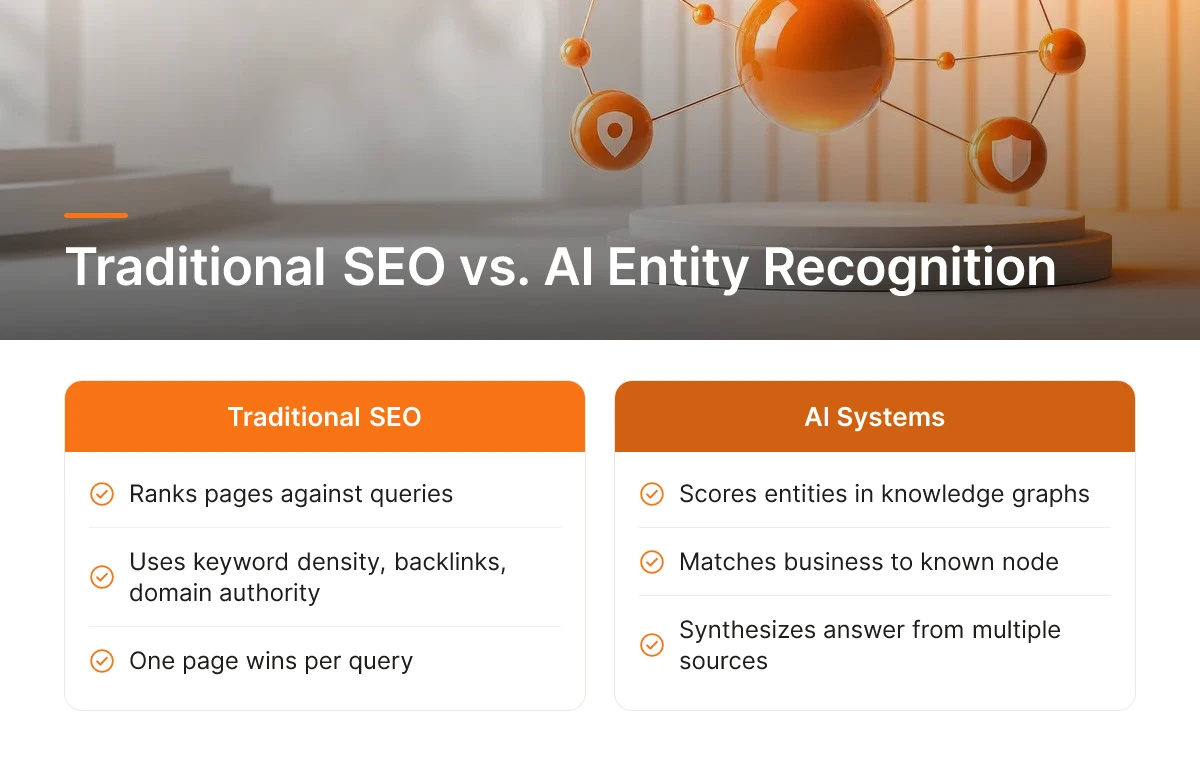
Google's classic ranking model scores pages; AI systems score entities, meaning they're matching your business to a known node in a knowledge graph, not just crawling a URL for keywords and backlinks. That distinction is the whole reason brand knowledge graph SEO behaves differently from the SEO playbook most SMB owners already know.
How Does Entity Recognition Differ From Keyword-Based Ranking?
Traditional SEO ranks a page against a search query using signals like keyword density, backlink count, and domain authority. One page wins the top slot and the decision is made per-query, per-page.
AI systems work differently. They identify your business as an entity, a company, a product, a location, and pull what they know about that entity from a knowledge graph before they ever generate a sentence recommending you [5]. A knowledge graph maps entities and the relationships between them, and it's become the backbone of how AI engines understand who's who in a given category [5]. If your brand isn't cleanly represented as a node in that structure, you're not losing a ranking position, you're invisible to the matching process entirely.
Why Is Cross-Platform Consistency Critical for AI but Optional for Traditional SEO?
A single strong page can rank well in Google even if other mentions of your business elsewhere are messy. AI systems don't extend that same tolerance, because they cross-reference multiple sources to confirm facts about a brand before citing it, rather than making a single-page ranking call [2]. Visibility in AI-generated answers develops when trust and relevance signals line up consistently across a brand's directory listings, website, and third-party mentions, no single tactic guarantees inclusion [2]. That's why inconsistent name, address, and phone (NAP) data or conflicting business descriptions do more than dilute SEO value, they actively suppress AI recommendations. If an AI system finds four different category descriptions for the same business across Google Business Profile, Yelp, an industry directory, and its own website, it can't confidently confirm what that business is, so it leaves it out of the answer rather than guess.
Picture two competing hotels. One lists itself as "boutique hotel," "lodging," "inn," and "hospitality venue" across four directories. The other uses one consistent entity description everywhere: a 12-room boutique hotel in a specific neighborhood, with matching NAP data on every listing. The second hotel gives AI systems a clean, corroborated node to cite. The first gives them a contradiction to avoid.
Maintaining accurate structured data and consistent business information across platforms is now a measurable input to AI visibility, not a background hygiene task [2].
How Do You Audit Your Brand Knowledge Graph SEO Gaps?
An audit means checking every source an AI engine might pull from, Wikidata, Wikipedia, directories, your own site, and asking directly what the AI already believes about your brand. It takes an afternoon for a single-location business and surfaces most of the problems worth fixing.
What Does a Brand Entity Audit Look Like?
Start by searching your exact brand name on Wikidata and Wikipedia to see whether an entity exists at all. Most SMBs find nothing, no entity, no entry, no structured record an AI system can reference [5]. Next, check the major business directories (Google Business Profile, Bing Places, industry-specific listings like hotel aggregators or app marketplaces for B2B SaaS) and compare what each one says about your business.
Then go straight to the source: ask ChatGPT, Gemini, Claude, and Perplexity "what do you know about [your brand]?" and "what does [your brand] do?" The answers reveal exactly what's missing or wrong, because these models draw on the same entity signals rather than inventing facts from nothing [2].
Four gap types show up repeatedly in this kind of brand knowledge graph SEO audit:
- Missing entity entirely, no Wikidata item, no structured listing anywhere
- Outdated details, a former founder still listed, a closed location showing as active, discontinued products still described as current
- Conflicting category classification, one directory lists you as "software company," another as "consulting firm," confusing which queries you should surface for
- No structured data on-site, no schema markup telling crawlers who you are, what you sell, and how you relate to other entities [3]
How Do You Resolve Conflicting or Outdated Information Across Sources?
When Wikipedia, Wikidata, social profiles, and directories disagree, resolve conflicts by fixing the sources AI systems weight most heavily first, typically your own site's structured data, Wikidata, and major directories, then work outward [5]. Claim every unclaimed profile, submit correction requests where you can't edit directly, and make sure your "about" information reads identically everywhere: same founding year, same category, same locations.
Multi-location brands, hotels especially, can't treat this as a single head-office fix. Each property needs its own consistent entity record: correct address, amenities, and category at that specific location, not just a parent brand listing that AI assistants then misapply to every branch.
Moonrank's technical audit checks these signals, structured data, directory consistency, entity classification, automatically and flags gaps without requiring you to manually crawl five different databases.
What Schema Markup and Data Consistency Practices Help Your Brand Get Recommended by AI?
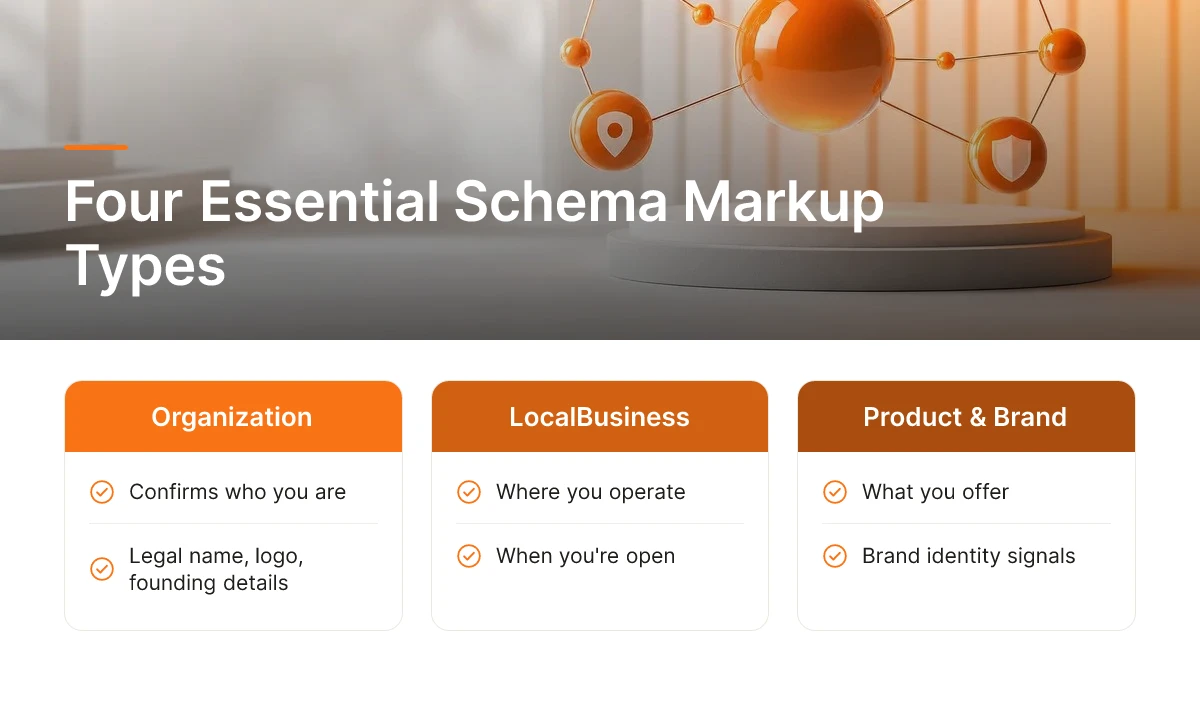
Four schema types, Organization, LocalBusiness, Product, and Brand, give AI systems the structured data that tells AI engines exactly what your business does, and keeping that data consistent everywhere it appears is the practical core of brand knowledge graph SEO.
Which Schema Markup Types Matter Most for AI Search Recommendations?
Each schema type answers a different question an AI system asks about your business. Organization schema confirms who you are: legal name, logo, founding details, and official social profiles. LocalBusiness schema tells an AI engine where you operate and when you're open, which matters when a customer asks for "a hotel near downtown Austin" or "a repair shop open on Sundays." Product schema describes what you sell, price, availability, reviews, so an AI engine can compare your offering against a competitor's in real time. Brand schema ties all of it together, linking your name, logo, and entity identity across every page so the AI stops treating you as a collection of disconnected pages and starts treating you as one recognizable entity.
Schema App's research on entity SEO notes that linking entities clearly helps brands build authority even when users never click through to the site [3]. That's the point: structured data earns recognition whether or not it drives a visit.
How Do You Implement and Maintain Structured Data AI Systems Can Rely On?
Schema isn't a one-time setup. It needs updating whenever your offerings, locations, or leadership change, because an AI system citing a closed location or a former CEO erodes trust fast, both the AI's trust in your data and the customer's trust in the answer they got.
Consistency matters as much as completeness. If your schema says one phone number, your Wikidata entry says another, and your Google Business Profile lists a third, AI systems face conflicting signals and often default to silence rather than guessing [5]. Matching facts across schema markup, Wikidata claims, and directory listings reinforces confidence; mismatches erode it.
The right schema also depends on the business. An ecommerce store needs Product and Offer schema with live pricing and stock status. A B2B SaaS company needs SoftwareApplication and Organization schema describing features, pricing tiers, and integrations. A hotel needs LocalBusiness and Hotel schema covering amenities, room types, and booking details. Moonrank builds this technical layer, schema markup, llms.txt configuration, and citation consistency, into its daily automated optimization, so the upkeep doesn't fall on a business owner who has no time to track schema changes manually.
How Do You Measure Whether Your Knowledge Graph Optimization Is Working?
Success shows up as consistent, repeatable mentions in AI answers, not a keyword position, because AI engines don't publish rankings the way Google does.
A page-one Google position tells you where a URL sits in a list. ChatGPT, Gemini, Claude, and Perplexity don't work that way, they synthesize an answer from multiple sources and either name your brand or they don't [5]. That means the old scoreboard is gone. The new one is binary and recurring: did the assistant mention you, and did it mention you again next week.
What Metrics Show Your Brand Is Actually Being Recommended by AI?
Track three things: mention rate (how often your brand comes up across a set of category questions), share of voice against named competitors, and the accuracy of what gets said about you. A furniture retailer optimizing for "best outdoor patio sets" cares less about a search engine results page and more about whether Perplexity names them alongside two competitors or drops them entirely. Accuracy matters too, AI engines pull from structured data and third-party mentions [3], so an outdated address or discontinued product line can get repeated as fact even after you've fixed your site.
How Do You Track Mentions Across ChatGPT, Gemini, Claude, and Perplexity?
The manual version is straightforward in concept: open each assistant, ask the questions a prospective customer would ask in your category, and note whether your brand appears and in what context. For a B2B SaaS company that might mean asking "what's the best project management tool for a 20-person agency" across all four engines and logging the results in a spreadsheet.
It breaks down fast. Four assistants, a dozen realistic queries, and competitor comparisons means 40-plus checks, repeated weekly, because AI answers shift as models retrain and new content gets indexed. Brand visibility develops through overlapping trust signals built over time [2], so a single spot check tells you almost nothing; the trend across weeks is the actual signal. That's the part that doesn't scale for an owner who also runs the business.
This is the part of brand knowledge graph SEO that benefits most from automation. Moonrank tracks brand mentions and recommendation frequency across ChatGPT, Gemini, Claude, and Perplexity continuously, and pairs that tracking with the daily content publishing and structured data work, schema markup, llms.txt, citations, that actually moves those mention rates. Instead of guessing whether last month's changes worked, you see the trend line.
If you want that visibility tracked for you instead of checked by hand, start at www.moonrank.ai.

Frequently Asked Questions
Do I need a Wikipedia page for my brand to show up in AI search results?
No, a Wikipedia page helps but isn't required for AI search visibility. What matters more is consistent, accurate information about your business across your website, structured data, review sites, and business directories [5]. AI systems piece together brand understanding from many sources, not one. Schema markup and consistent business details across the web do more heavy lifting for most SMBs than chasing notability on a single platform.
Can a small business realistically build a knowledge graph presence without an agency?
Yes, a small business can build this presence without an agency by focusing on structured data, consistent business information, and regular content [2]. The work is mechanical and repeatable rather than creative, which is exactly why automation tools like Moonrank handle it well. Moonrank implements schema markup, llms.txt files, and citation building on autopilot for $99 a month, well below typical agency retainers.
How long does it take for AI search engines to pick up changes to my brand's structured data?
Expect weeks rather than days, since AI engines rely on crawled and indexed data that refreshes on its own schedule. Google's AI Overviews pull from continuously updated web data [1], but individual AI models vary in how often they retrain or refresh retrieval sources. Consistent signals maintained over months tend to outperform one-time fixes.
Does knowledge graph optimization replace traditional SEO, or work alongside it?
It works alongside traditional SEO, not instead of it. A strong technical and on-page SEO foundation remains the base layer that supports entity clarity and topical authority [2]. Brands that already rank well on conventional signals tend to have an easier time getting recognized and cited by AI search engines, since the two disciplines reinforce each other.
Conclusion
Showing up in AI search answers comes down to three things: consistent business information across the web, structured data that tells AI systems what you do, and content that answers the specific questions your customers ask [2][5]. None of this requires a Wikipedia page or a six-figure agency contract, it requires discipline applied over time. For a Shopify owner or B2B SaaS founder without a marketing team, the practical path is automating the parts that don't need human judgment: schema markup, citation building, and daily content. Start by auditing whether ChatGPT and Perplexity currently describe your business accurately at all, then fix the gaps at moonrank.ai.
Sources & References
- Google's AI Overviews are Shaping Search. Here's What SMB-Serving Orgs Can Do About It | Yext
- How to Improve Brand Visibility in AI Search Engines - Rare Blue Moon
- How Does Entity SEO Support Brand Authority in AI Search?
- 7 Strategies to Improve Brand Visibility in AI Search
- Why Your Brand's Knowledge Graph Matters for AI Search Visibility | Aurora Intelligence
Recommended Articles
Explore more from our content library: