What Is an llms.txt File and Should Your Website Have One
Most SMBs don't need an llms.txt file yet, but adding one is low-risk and worth doing as a small, forward-looking step. An llms.txt file is a plain-text file...

Most SMBs don't need an llms.txt file yet, but adding one is low-risk and worth doing as a small, forward-looking step. An llms.txt file is a plain-text file at your site's root that gives AI engines like ChatGPT, Gemini, and Claude a concise, structured summary of your business, products, and key pages. Adoption among major AI platforms is still limited and inconsistent, so it should supplement, never replace, solid technical SEO, structured data, and clear website content that AI engines already use to understand your business.
What Is an llms.txt File and Why Should SMBs Care?
An llms.txt file is a plain-text markdown document placed at your website's root directory that summarizes what your business does, what it sells, and which pages matter most to an AI system scanning your site [3]. Think of it as a short brief written for a machine reader instead of a human one, no design, no marketing copy, just a direct explanation of your business and links to the pages that back it up.
What Problem Does llms.txt Solve for Businesses Seeking AI Recommendations?
AI agents browse the web differently than human visitors or traditional search crawlers, and raw HTML often gets in their way [1]. A Shopify store with heavy JavaScript, pop-ups, and nested navigation menus can bury the actual product information an AI model needs under layers of code it has to parse before it understands anything useful.
An llms.txt file strips that away. Instead of asking an AI crawler to guess your value proposition from a cluttered homepage, it hands over a clean summary: who you are, what you sell, and where the definitive answers live [3]. For a B2B SaaS company with dense product documentation or a hotel site with scattered booking pages, that clarity can matter more than it would for a simple five-page brochure site [4].
Are ChatGPT, Gemini, and Claude Actually Using LLMs.txt Files Right Now?
Adoption is real but far from settled, some major AI developer platforms publish their own llms.txt files, while general-purpose consumer AI search behavior remains unconfirmed and inconsistent. OpenAI, Anthropic, Cloudflare, and Stripe now publish llms.txt indexes for their own developer documentation [4], which signals the format has traction in technical and documentation contexts. But there's no confirmation that ChatGPT, Gemini, or Claude systematically crawl and prioritize llms.txt files across the open web the way they crawl standard HTML. BuiltWith data shows the file has been adopted by well over a million live sites [4][3], yet presence of the file doesn't prove any AI platform is reading or citing it in generated answers [4].
That gap is exactly why SMBs should treat an llms.txt file as a signal, not a guarantee. Competition for this kind of AI-readiness is still low, and the cost of adding the file is minimal compared to a full technical SEO overhaul or an agency retainer. Moonrank builds llms.txt configuration into its broader technical AI audit, alongside schema markup and structured data, so businesses get the forward-looking setup without needing to understand the specification themselves.
How Do You Create and Implement an llms.txt File?
Building an llms.txt file means writing a plain-Markdown summary of your business, then linking the handful of pages that explain what you sell and how you work. There's no software to install, a text editor and your website's root directory access are enough.
What Should You Include in Your llms.txt File, and How Is It Structured?
The format is a Markdown document: an H1 with your business name, a short description paragraph, then H2-grouped lists of links. A documentation-focused version of the standard typically separates sections like "Docs," "API Reference," and "Optional" context, pointing AI crawlers to canonical pages instead of making them guess [2]. For an e-commerce or SaaS site, that same pattern translates to sections for Products, Pricing, About, and Contact.
The priority isn't completeness, it's relevance. Include the pages that answer "what does this business do and sell," not every URL on your sitemap. A site with 40,000 product pages doesn't need to list each one; it needs three or four links that explain the catalog structure and link to category hubs. One technical breakdown of the file describes its real job as pointing an agent toward "the right guide" on a large site, not cataloging the entire site [4].
A practical build process looks like this:
- Draft a two-to-three sentence description of your business in plain, factual language.
- List the priority URLs: homepage, core product or service pages, pricing, about, and contact.
- Format the list in Markdown, grouped under clear H2 headings.
- Upload the file to your site's root directory so it's reachable at yourdomain.com/llms.txt.
What Common Configuration Errors Hurt Your AI Search Visibility?
The most common mistakes are broken links, stale page references, and marketing copy where a factual description belongs. An llms.txt file that links to a discontinued product page or a 404'd docs URL tells an AI crawler your site isn't maintained, the opposite of the trust signal the file is meant to send. Overly promotional phrasing ("industry-leading," "best-in-class") also works against the file's purpose, since it's meant to state what a business does, not sell it.
Length is another failure point. Files that try to cover every page end up vague; shorter, specific files tend to perform better because an agent can scan them quickly [3]. Because there's no single enforced schema, one technical review notes the proposal is still at version 2 with no formal ratification [4], clarity and accuracy matter more than matching an exact template. Getting the structure "close enough" while keeping every link live and every description factual beats a perfectly formatted file full of outdated claims.
This is also where the technical audit layer inside a platform like Moonrank does the maintenance work automatically, checking for broken links and stale references as part of its ongoing optimization, rather than leaving an SMB owner to re-audit the file manually every quarter.

How Does llms.txt Compare to Other AI Visibility Methods?
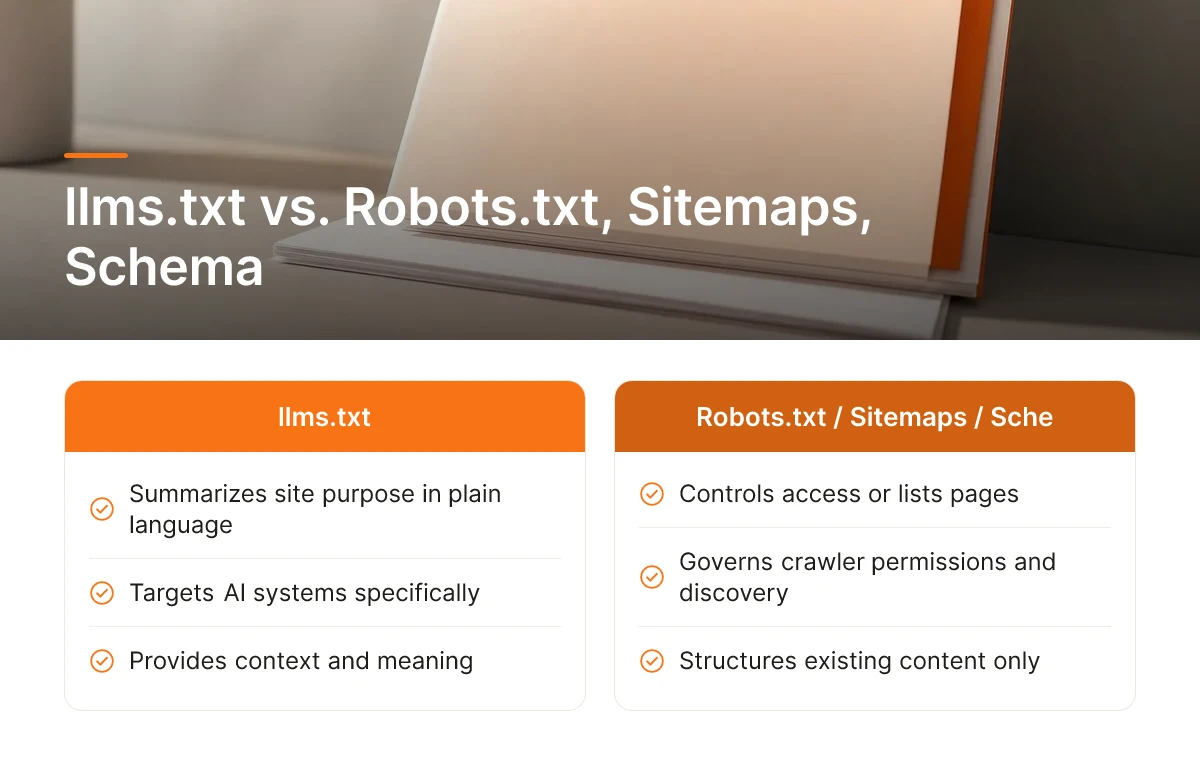
An llms.txt file summarizes a site's purpose in plain language, while robots.txt controls crawler access, sitemaps list pages for discovery, and schema markup structures existing content, each one does a different job.
How Does llms.txt Differ from Robots.txt, Sitemaps, and Schema Markup?
Robots.txt is a gatekeeper. It tells crawlers, search engines, AI bots, scrapers, what they're allowed to touch and what's off-limits. It has no opinion about what your content means; it only governs access.
A sitemap is a map, not a summary. It lists every URL on a site so a crawler can find pages it might otherwise miss, particularly on large catalogs or documentation hubs. Schema markup goes a layer deeper: it tags the content you already have, a product's price, a hotel's room availability, a SaaS plan's features, so machines can parse what's already there with more confidence.
An llms.txt file does none of that. It's a curated, Markdown-based pointer to the pages a business considers its definitive sources of truth, written in a format a language model can scan quickly instead of crawling an entire site structure [3]. It doesn't block, list, or tag, it explains, in the kind of plain-language summary a human editor might write for a new hire.
Should You Use llms.txt Alongside Your Existing SEO Strategy, or Instead of It?
Alongside, these standards aren't competing with each other, and none of them makes the others optional. A well-optimized site typically runs robots.txt, a sitemap, schema markup, and an llms.txt file at the same time, because each handles a different part of how machines find and interpret content.
Where the llms.txt file still falls short is confirmed influence. Clean, well-written content and accurate structured data carry more demonstrated weight with AI engines than an llms.txt file does on its own, Google has stated directly that Search does not read the file, including for its generative AI features [4]. Treat it as a small addition layered on top of solid technical SEO, not a shortcut that lets you skip schema markup, page speed, or content quality.
What belongs in that file depends on the business. An ecommerce store should point to its product catalog and return policy; a SaaS company should prioritize pricing tiers and integration docs; a security vendor should surface compliance and trust pages; a hotel should lead with booking pages and amenities. This is exactly the kind of technical detail Moonrank handles automatically as part of its daily optimization work, configuring the llms.txt file alongside schema markup and citation building, so business owners don't have to figure out file formats themselves.
What Are the Risks of Implementing llms.txt Incorrectly?
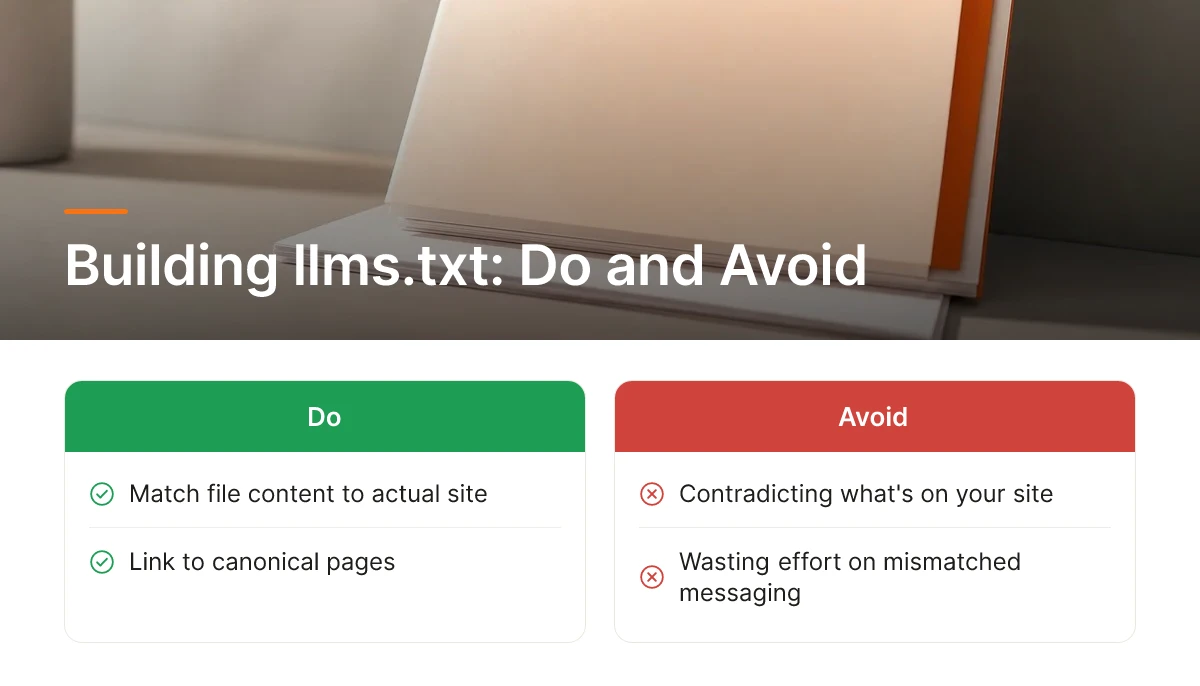
A poorly built llms.txt file rarely tanks your rankings directly, but it can waste hours and create mismatched messaging if it contradicts what's actually on your site. The bigger risk isn't penalty, it's irrelevance or confusion.
Can a Poorly Configured llms.txt File Hurt Your AI Search Visibility?
Not in the way a broken robots.txt or a noindex tag can. Google has stated plainly that Search ignores llms.txt, including for its generative AI features [4], and no major AI provider has confirmed that an incorrect file causes a visibility penalty. The real cost is wasted effort: a founder spends an afternoon drafting a file that then sits unread by half the systems it was meant for, while the time could have gone toward fixing actual crawlability or schema gaps.
The sharper risk is inconsistency. If your llms.txt file describes a product line you discontinued last quarter, lists a pricing tier you retired, or links to URLs that now 404, you've handed a confident-sounding but wrong summary to any AI agent or coding assistant that does reference it [3]. For an e-commerce brand, that might mean an AI assistant recommending a SKU that no longer exists. For a B2B SaaS company, it might mean a sales prospect getting fed an outdated feature list.
Marketing language is the other common mistake. AI systems are built to extract factual, citable statements, not adjectives. A line like "the industry's most innovative inventory platform" gives a language model nothing concrete to repeat, while "manages inventory across 3 warehouse locations with real-time sync" gives it something it can actually cite [1]. Keyword-stuffed descriptions read the same way to an AI parser as they do to a skeptical human: as noise to filter out.
A short review habit avoids most of this. Keep the llms.txt file current, keep every line factual, keep the whole document short enough to scan in under a minute, and revisit it any time your core offering, pricing structure, or product catalog changes. Treat it like a changelog, not a one-time task.
How Do You Know If Your llms.txt File Is Working?
There is no dashboard that tells you an AI platform read your llms.txt file, the honest answer is you check indirectly and track trends, not isolated proof.
No major AI platform publishes a log of which llms.txt files it fetched or how it weighted that file against your HTML, your reviews, or your backlinks. OpenAI, Anthropic, and Google have not released usage data confirming when or how often they parse the file [4]. That means validation today is a mix of indirect signals, not a single pass/fail test. If you're expecting a clean confirmation screen, you won't find one, and any tool that claims to show you "AI read your llms.txt" is reporting a guess, not a fact.
What Tools Can You Use to Validate Your llms.txt Implementation?
Two different questions get confused here, and separating them matters. The first is: is the file correctly formatted and reachable? The second is: do AI engines actually use it? Tools only answer the first. Markdown linters and llms.txt validators confirm your file sits at the root domain, uses proper Markdown structure, and doesn't throw errors a parser would choke on, some tools, including Chrome Lighthouse, now check for the file's presence and structure [4]. That's useful hygiene, the same way you'd validate a sitemap.xml. But a clean validator pass tells you nothing about whether ChatGPT or Perplexity pulled from it when answering a customer's question.
For that second question, the only realistic method is asking directly. Prompt ChatGPT, Gemini, and Claude about your business by name and by category, then compare the response against the summary and links in your this practice. If the AI describes your product accurately, cites the right pages, or recommends you in a category query, that's a reasonable signal, though not proof the file itself caused it, since structured data and schema markup influence the same outcome [1].
What Results Have SMBs Realistically Seen After Implementing llms.txt?
Expect gradual shifts, not a before/after snapshot. Documentation teams report llms.txt helps AI assistants cite the correct canonical page instead of an outdated one [2], but for a five-page brochure site or a small e-commerce store, the case for measurable impact is harder to make on its own [4]. Changes in how often a business gets mentioned or recommended tend to show up alongside other work, better schema, more structured product data, stronger citations, making it difficult to credit the this method in isolation.
The practical approach is to track AI visibility over weeks and months as one input among several, not as a single experiment with a control group. That's the logic behind pairing an this strategy with ongoing technical optimization and visibility monitoring rather than treating it as a one-time fix, which is the model Moonrank runs for SMBs that don't have time to check ChatGPT and Claude by hand every week.
Frequently Asked Questions
Do I need an llms.txt file if I already have strong SEO?
Strong SEO and AI search visibility solve different problems, so yes, llms.txt is still worth adding. Good rankings on Google tell you crawlers find your pages; they say nothing about whether an AI agent can parse your content fast enough to cite it. An this approach gives that agent a clean roadmap. For e-commerce and B2B SaaS sites with large catalogs or documentation sets, that roadmap matters more as content volume grows.
Does llms.txt replace the need for schema markup?
No, llms.txt and schema markup do separate jobs and work best together. Schema markup tells AI systems what your content means at the data level, product price, reviews, company type. llms.txt tells an agent where to find your most authoritative pages. Dropping either one leaves a gap the other can't fill.
How long should an llms.txt file be?
Keep it short, a focused list of links with one-line descriptions, not a full copy of your site. Most practical examples run to a single page: a few headers grouping content by topic, each followed by markdown links to your canonical docs, product pages, or policies. Longer sites can split detail into a companion llms-full.txt file [2].
Will adding llms.txt guarantee ChatGPT or Claude recommends my business?
No single file guarantees a recommendation, and no credible source claims otherwise. Google has said its Search systems ignore llms.txt entirely, including for generative features [4], and adoption among major AI providers remains limited to developer documentation use cases [4]. Treat it as one signal among many, not a shortcut around real content and technical optimization work.
Conclusion
llms.txt is a low-cost, low-risk addition to your site, not a substitute for the content, schema markup, and citation signals that actually drive AI recommendations. If you run an e-commerce store or a B2B SaaS product, prioritize clean documentation and structured data first, then treat llms.txt as a finishing touch an agent might use. Don't expect it to move the needle alone, and don't skip the harder technical work waiting for it to become a bigger standard than it currently is.
If keeping up with schema markup, citations, and daily content publishing sounds like more than your team has time for, Moonrank runs that work on autopilot starting at $99/month. See how it works at www.moonrank.ai.
Sources & References
- What Is LLMs.txt? The Guide to AI Search & GEO
- What is llms.txt? Why it’s important and how to create it for your docs | GitBook Blog
- How AI Agents Should Read Your Site: LLMs.txt
- The Complete Guide to llms.txt: Should You Care About This AI Standard?
Recommended Articles
Explore more from our content library: