Choosing SEO Visibility Tracking Software for AI Search
Learn why SMBs need SEO visibility tracking software that monitors AI engines like ChatGPT and Gemini, not just Google rankings, to stay visible.

SMBs need SEO visibility tracking software that covers AI search engines because Google rankings no longer show the full picture of how customers find your business. ChatGPT, Gemini, and Perplexity generate direct answers and source recommendations instead of ranked links, so a page can rank well on Google yet never get mentioned by an AI engine. Tracking both separately shows where you're actually visible, and where you're invisible, across the places people now search.
Why SMBs Need SEO Visibility Tracking Software for AI Search, Not Just Google
Google rank tracking measures where you sit on a results page; AI search visibility measures whether an engine mentions you at all inside its answer. Those are two different scoreboards, and most SMBs are still only watching one of them.
What's the Difference Between Traditional SEO Visibility and AI Search Visibility?
Traditional SEO visibility tracks keyword rank, position changes, and click-through from a results page, metrics built around the idea that a human scans ten blue links and picks one. AI search visibility works on a different premise: the engine reads dozens of sources, synthesizes an answer, and either cites your business by name or leaves it out entirely. There's no position 4 or position 9 inside a ChatGPT answer, you're either part of the recommendation or you're invisible. This is exactly why seo visibility tracking software built for the AI era has to monitor citations and mentions, not just rank positions.
How Do ChatGPT, Gemini, and Perplexity Recommend Sources Differently Than Google?
Each engine pulls from a different mix of sources and weighs them on its own terms. Perplexity leans heavily on real-time web retrieval, Gemini draws on Google's index plus its own grounding layer, and ChatGPT blends training data with live browsing depending on the query [2]. None of them replicate Google's link-and-authority model exactly, freshness, content structure, and how clearly a page answers a specific question all factor in differently across engines [1]. A page optimized purely for Google's ranking signals can be a poor fit for how an AI model decides what to cite.
The gap shows up differently depending on what you sell:
- An ecommerce brand ranking on page one for "best running shoes for flat feet" can still get skipped when a shopper asks ChatGPT the same question directly.
- A B2B SaaS company might never appear in a Perplexity answer about "top alternatives to [competitor]," even while its comparison page ranks well on Google.
- A cybersecurity vendor can lose compliance-driven buyers who ask Gemini about SOC 2-ready vendors and never see the vendor mentioned.
- A boutique hotel can watch a competitor get named in "best place to stay in Austin" while its own listing, despite solid local SEO, goes unmentioned.
A business can hold a top-three Google position and have zero presence across AI-generated answers, the two aren't correlated the way most owners assume. That's the blind spot seo visibility tracking software is meant to close: by watching both systems separately, you catch the gap between ranking well and actually getting recommended.
What Features Should You Look for in AI Search Visibility Tracking Software?
The right seo visibility tracking software separates results by engine, tracks real customer questions rather than just your brand name, and shows you the actual AI answer behind every score.
Most tools on the market today describe themselves broadly as "AI visibility" platforms, but the feature set underneath varies widely [2]. Before you commit to one, check for the five capabilities below. They determine whether the data you get is something you can act on or just a number to stare at.
Why You Need Per-Engine Results, Not a Blended Score
ChatGPT, Gemini, and Perplexity pull from different sources and answer the same question differently, so a single averaged "visibility score" hides more than it reveals. A platform that identifies which sources shape each engine's answers and how often competitors show up in those same answers gives you a far more useful signal than one combined number [1]. If your tool only reports one score across all engines, you can't tell whether you're invisible on Perplexity but doing fine on ChatGPT, and that's the difference between fixing a citation gap and fixing nothing at all.
Prompt Tracking: Monitor the Questions Customers Actually Ask
Good tracking software monitors dozens of realistic customer prompts, not just searches for your company name. Most tools work by having you supply the questions your audience actually types, "best project management software for remote teams," not "[Your Brand] reviews", then reporting whether and how often you appear in the generated answer [2]. For an ecommerce brand or a B2B SaaS company, that means tracking category questions, comparison questions, and "best for X" questions where competitors are already winning the mention.
Citation Detection: Named, Quoted, or Ignored?
There's a real difference between being cited as a source, being quoted directly, and being left out of the answer entirely, and your tracking tool should distinguish between all three. Being named as a reference link carries different weight than having your product description quoted verbatim inside the AI's response. A tool that lumps these together as one "mention" metric is flattening data you need separated to prioritize fixes.
Which Integrations Matter Most for Your Marketing Tech Stack?
Visibility data only matters if it connects to the systems where your team already works, your CMS, your analytics dashboard, and marketing platforms like HubSpot. Without that connection, AI visibility becomes a report someone glances at once a month instead of a metric that shapes what content gets published next. Moonrank, for example, ties visibility tracking directly to its own daily content publishing, so a citation gap in Perplexity can turn into a content fix without a separate handoff between tools.
How Do You Evaluate Data Accuracy Across AI Visibility Tracking Methods?
Judge accuracy by whether the tool shows you the actual AI-generated response it captured, not just a percentage or score. Scores can be calculated inconsistently between vendors, but a raw response lets you verify the citation, the quote, or the omission yourself. If a platform won't show its work, treat the score with skepticism. For a broader comparison of how different platforms approach this problem, see this comparison of AI visibility tracking tools.

How Do You Set Up AI Visibility Tracking for Your Content?
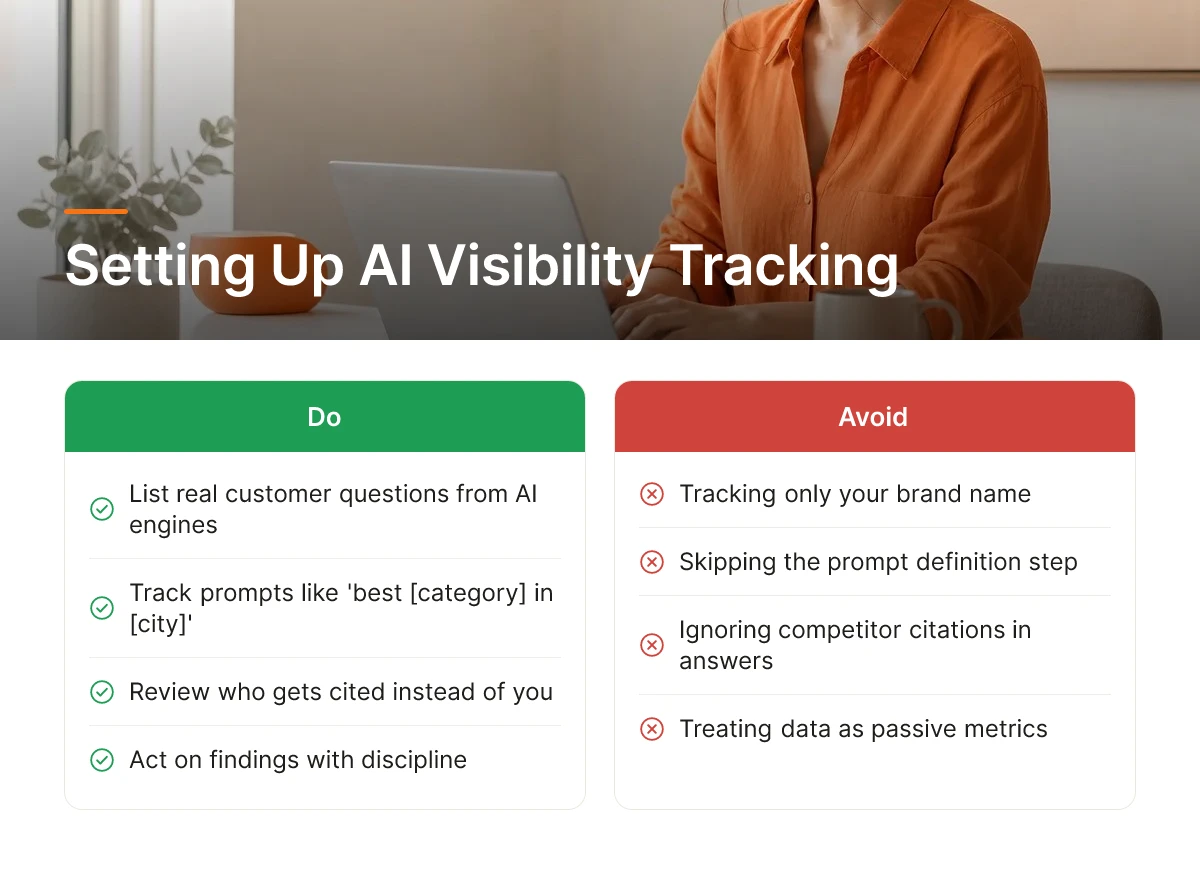
Setting up seo visibility tracking software takes four steps: define your prompts, connect your engines, review who gets cited instead of you, and feed that back into content. None of it requires engineering skill, it requires discipline about what you track and how often you act on it. For more information, see Service As Software Back Office.
What's a Step-by-Step Setup Process for Beginners?
Start by listing the questions real customers actually type into ChatGPT, Gemini, or Perplexity, not your brand name. A boutique hotel owner should track prompts like "best boutique hotel in [city] for a weekend trip," not just "[hotel name] reviews." A B2B SaaS founder should track "best [category] tool for small teams," since that's the buying-stage language a prospect uses before they know your product exists.
Next, connect your tracking tool to the AI engines that matter for your business and take a baseline reading before changing anything. Most AI visibility platforms work by running your prompt list against each engine on a schedule and logging whether your brand appears, how often, and in what position relative to competitors [2]. That baseline is your reference point, without it, you can't tell whether a later content push actually moved the needle.
Then review the results for a pattern: which competitors or third-party sources keep getting cited in your place. If a competitor's pricing page shows up for a prompt you'd expect to win, that's a signal your own page lacks the structured, specific answer AI engines are pulling from. AI visibility tools exist specifically to show when a competitor is cited instead of you, so this comparison is the core output to act on [1].
How Do You Connect Tracking to Your Content and Technical Optimization Workflow?
Tracking data is only useful if it feeds a workflow, not a report nobody reads. When a gap shows up, the fix is usually one of three things:
- Rewrite the page to directly answer the tracked prompt.
- Add schema markup so engines can parse what the page is about.
- Publish a new page that didn't exist yet.
Moonrank handles this loop automatically, it tracks visibility across ChatGPT, Gemini, Claude, and Perplexity, then uses the gaps it finds to drive daily content publishing and technical fixes like schema and llms.txt configuration, without the business owner writing a word.
Set a recurring cadence, weekly or biweekly, so visibility checks become routine, tied to each publishing cycle rather than a one-time audit. AI engines update their outputs constantly, so a snapshot from three months ago tells you little about today.
How Do AI Visibility Tools Compare on Accuracy, Integration, and Cost?
The honest answer: no two tools measure AI visibility the same way, so comparisons come down to prompt coverage, how deeply a tool fits your existing workflow, and what the data actually costs you in time, not just subscription price.
What Does Pricing Actually Buy You?
Pricing in this category spans a wide range, budget-friendly tools aimed at small teams tracking a handful of prompts, up to premium platforms built for agencies managing dozens of client accounts across multiple AI engines [2]. The cheaper tier usually trades off breadth: fewer prompts tracked, less frequent refreshes, and narrower competitor coverage. Enterprise-tier platforms add team permissions, white-label reporting, and API access, which matters for agencies but is overhead a solo founder rarely needs [2].
Why Prompt Coverage Changes the Accuracy of Your Data
The biggest accuracy gap between tools isn't the interface, it's how many prompts they sample and how often they refresh that list. A tool that checks 20 static prompts once a week gives you a snapshot, not a trend. Tools built for continuous monitoring track a broader, regularly refreshed prompt set, which matters because AI engines like ChatGPT and Perplexity update their answers as new content gets indexed and cited [1]. If your prompt list is narrow, you'll miss the queries where a competitor just started getting recommended instead of you.
Which Tools Work Best Alongside Your Existing SEO Platform?
Integration depth is where tools diverge most. Some are standalone dashboards you check separately from everything else; others plug directly into the reporting workflows marketing teams already use, so AI visibility sits next to traditional rank data instead of living in its own tab [2]. If you're already running a traditional rank tracker, ask whether it's adding AI engine monitoring as a bolt-on feature or whether you need a dedicated layer built specifically for how generative engines cite and recommend brands. Traditional rank trackers were built to watch Google's blue links, most weren't designed to parse how ChatGPT or Gemini synthesize an answer, which is a different data problem entirely.
The real cost of any seo visibility tracking software isn't the invoice, it's the hours spent setting it up and interpreting what it reports. A cheap tool that takes a week to configure and produces data nobody on your team understands costs more than a pricier one that just works. Moonrank skips this calculation for SMBs by folding AI visibility tracking into an automated system that also handles the content and technical fixes needed to improve what it measures, rather than leaving you with a dashboard and no action plan.
What ROI Can You Expect From Tracking AI Search Visibility?
The return shows up as a chain: more citations in AI answers lead to more referral clicks, and those clicks show up as traffic you can measure in standard analytics. Tracking the chain, rather than guessing at it, is what separates a real ROI case from a hope.
How Do You Connect AI Visibility Improvements to Traffic and Conversion Gains?
Start with referral source data. ChatGPT, Perplexity, and Gemini all pass traffic to your site as identifiable referral sources in tools like Google Analytics, so you can see sessions arriving specifically from AI platforms rather than lumping them into "direct" traffic. Tagging your key pages with UTM-style parameters when you publish new content sharpens this further, letting you trace a spike in AI-referred visits back to the exact page or technical fix that triggered it, instead of guessing which change mattered.
The effect compounds over time. Once an AI model cites your business as a trustworthy source for one question, it becomes more likely to surface you again for related follow-up questions in the same research session [2]. A hotel that gets cited for "best boutique hotels in Austin" has a better shot at also appearing when someone asks a follow-up about neighborhoods or amenities, one citation increases the odds of the next.
To isolate impact, set a before/after comparison window around a specific change. Pick a date you published new schema markup or a batch of content, then compare AI referral traffic and citation frequency in the weeks before versus after. This is the same discipline good seo visibility tracking software applies to Google rankings, now applied to generative engines.
For high-consideration purchases, B2B SaaS evaluations, cybersecurity vendor shortlists, hotel bookings, the payoff often happens upstream of the final conversion. A buyer might ask Claude to compare security platforms, never click through, then visit your site directly weeks later after your name stuck. That is a real effect that any seo visibility tracking software worth using should be built to surface, not just the final-click conversion. Moonrank's AI search visibility tracking reports exactly this kind of exposure across ChatGPT, Gemini, Claude, and Perplexity, so you can connect technical and content changes to visibility gains even when the sales cycle is long [1].

Frequently Asked Questions
Do I still need traditional Google rank tracking if I track AI search visibility?
Yes, both still matter because Google remains a major traffic source even as AI engines grow. Google rank tracking shows where you stand in classic search results and zero-click SERPs, while AI visibility tracking shows whether ChatGPT, Gemini, Claude, and Perplexity actually recommend you. They measure different discovery channels, and a business losing ground in one can still be gaining in the other.
How often should SMBs check their AI search visibility?
Check weekly at minimum, since AI model outputs shift as training data, retrieval sources, and citations change. Daily monitoring is better if you're actively publishing new content or testing technical fixes, because it shows whether changes are moving the needle before a full month passes.
Can small businesses realistically compete for AI search visibility against larger brands?
Yes, AI engines prioritize clear, structured, well-cited information over brand size or domain authority alone. A local hotel or niche SaaS tool with tight schema markup, consistent citations, and specific content about its actual service can outrank a vague enterprise page. Visibility here rewards clarity and relevance more than marketing budget, which levels the field for SMBs willing to fix the technical basics.
What's the first thing to check if your business isn't showing up in AI answers at all?
Check whether AI engines can actually parse your site, missing schema markup, no llms.txt file, or thin, unstructured content are the usual culprits. If an AI crawler can't understand what your business does or finds no third-party sources confirming it, it has nothing reliable to cite, regardless of how good your product is.
What should you look for when comparing different AI visibility tracking platforms?
Compare how many prompts each platform tracks, how often it refreshes data, and whether it shows per-engine breakdowns across ChatGPT, Gemini, Claude, and Perplexity rather than one blended score. Also check whether it integrates with your existing marketing stack. For a side-by-side look at how various platforms stack up, this overview of top AI visibility tools is a useful starting point.
Conclusion
AI search visibility runs on different signals than Google rankings, citations, structured data, and content AI engines can actually parse and trust. Treat it as a separate metric worth its own tracking, check it on a weekly cadence, and fix technical gaps like missing schema or llms.txt before worrying about content volume. Small businesses that get these basics right can outrank far bigger competitors, because AI engines reward clarity over brand size.
Start by running a free technical audit of your site at moonrank.ai to see exactly what's blocking ChatGPT, Gemini, Claude, and Perplexity from recommending your business.
Sources & References
- How do you rank in AI? Top AI Visibility Tools Overview
- Best AI Visibility Tracking Tools (2026 Comparison)
Recommended Articles
Explore more from our content library: