A Guide to the Best SEO Tools for Small Business Owners
Discover the best SEO tools for small business owners, from affordable platforms to AI-search visibility tracking that replaces costly agency retainers.

The best SEO tools for small business are the affordable, self-service platforms that replace agency retainers while also covering visibility in AI search engines like ChatGPT, Perplexity, and Gemini, not just Google rankings. Small businesses get the most value from tools that combine technical fixes (schema markup, site structure), content publishing, and AI-visibility tracking in one budget-friendly subscription, instead of paying separately for each function or hiring an agency to manage them.
Why Small Businesses Need Affordable SEO Tools Instead of Agencies
Small businesses need affordable SEO tools instead of agencies because retainers charge premium rates for strategist time a self-service platform can automate at a fraction of the cost.
A full-service SEO agency retainer sits at the premium end of the market, often priced for mid-size or enterprise budgets, with scoped packages built around account management, reporting calls, and ongoing strategy adjustments [1]. That overhead exists because a human strategist is doing the keyword research, writing the briefs, and compiling the monthly report. None of that work disappears when a business switches to tools; it just moves from a biller's timesheet to a dashboard the owner controls.
What's the Real Cost Difference Between an SEO Agency and Self-Service Tools?
The gap comes down to who gets paid for the labor, a strategist's hourly time, or a software subscription that runs the same tasks automatically.
Agencies price in account managers, research hours, and client reporting, which is why even a scoped, right-sized package still carries meaningful monthly overhead [1]. Self-service tools, including free options like BrightLocal and Ahrefs' free offerings [2], shift that labor to automation the business owner runs directly. The best SEO tools for small business take this further by bundling keyword research, technical fixes, and content publishing into one subscription instead of forcing an owner to stitch together several free tools and still do the strategy work by hand [5].
Can Small Businesses Compete in Search Without Professional SEO Help?
Yes, when the tool handles technical setup, content cadence, and performance tracking that used to require a hired specialist.
The tasks an agency charges for, schema markup, consistent publishing, rank and visibility tracking, are mechanical once a tool automates them. Moonrank, for example, runs daily content generation and technical optimization (schema markup, llms.txt, structured data) on autopilot for $99 a month, replacing the ongoing work an agency would otherwise bill for separately. That matters most for businesses with lean marketing functions: an ecommerce store with one marketing hire, a B2B SaaS company without a content team, a cybersecurity vendor whose marketer also handles demand gen, or a boutique hotel where the owner doubles as the marketing department. None of these teams have spare hours for manual SEO upkeep, which is exactly where automated tools close the gap agencies used to fill.
Best SEO Tools for Small Business: What to Look for in an Affordable Platform
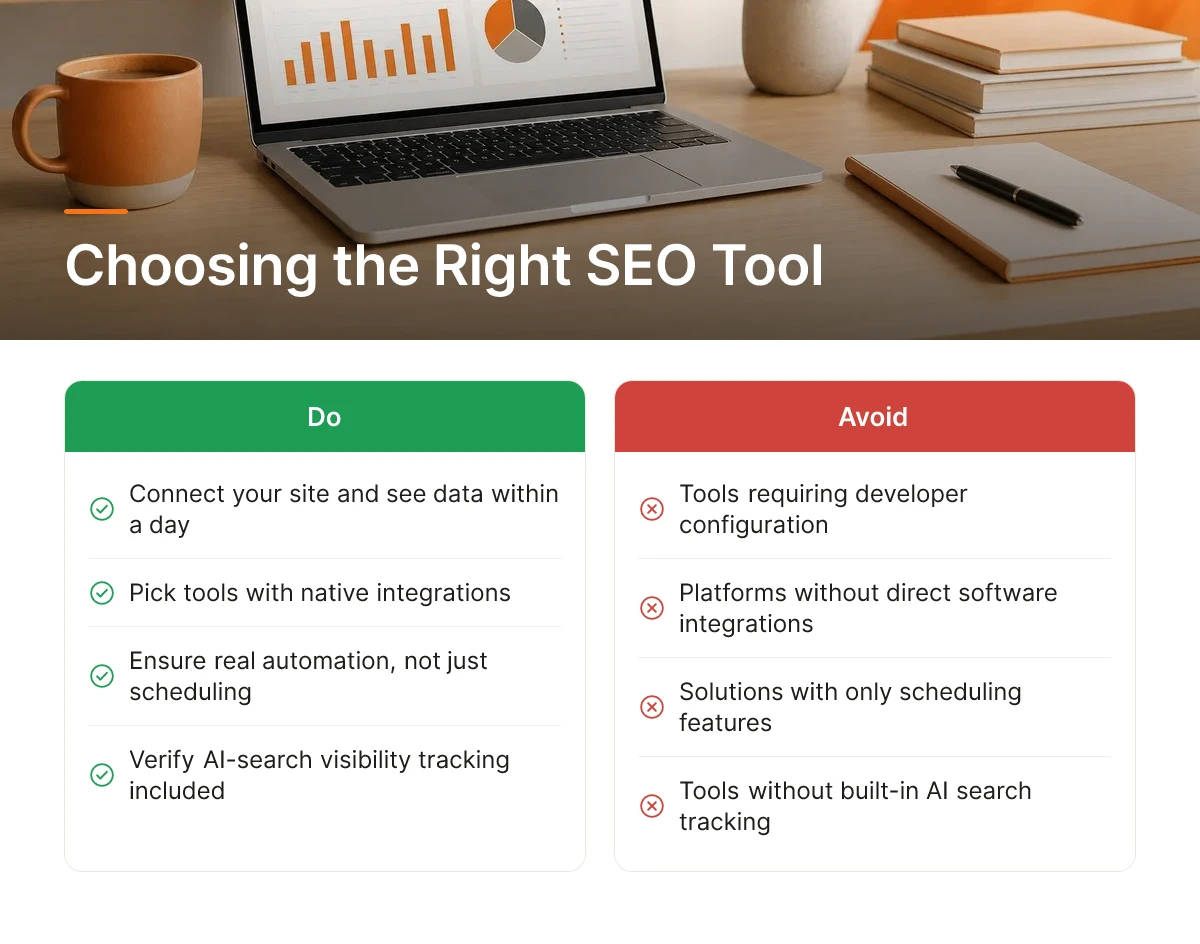
The best SEO tools for small business owners share four traits: fast setup, native integrations, real automation (not just scheduling), and AI-search visibility tracking built in from the start.
Most small business owners don't have a marketing team to run a new platform, so evaluation needs to be quick and concrete. Before subscribing to anything, check it against these four criteria:
- Ease of setup: Can you connect your site and start seeing data within a day, or does it require a developer to configure tracking scripts and crawl settings?
- Platform integrations: Does it plug directly into the software you already run, Shopify, WordPress, a CMS, or does it expect you to export spreadsheets and import them manually?
- Automation depth: Does the tool actually publish content and fix technical issues, or does it just generate a report and leave the work to you?
- AI-search visibility tracking: Is tracking how your brand appears in ChatGPT, Gemini, Claude, and Perplexity a core feature, or an afterthought bolted onto a traditional keyword-rank dashboard?
That last point matters more each year. Industry coverage increasingly treats AI search visibility as a distinct category rather than a Google SEO add-on [4], and tools that treat it as an afterthought tend to show shallow, infrequent data rather than ongoing monitoring.
How Do Free SEO Tool Tiers Compare to Paid Plans for Small Business Needs?
Free tiers work for a quick audit but cap the keywords, pages, or reports you can track, and that ceiling arrives faster than most owners expect. A free keyword tool or crawler is useful for a one-time check [2], but a growing Shopify store with 200 product pages or a B2B SaaS site with a documentation library will hit tracking limits long before the quarter ends. At that point, the business is flying blind on exactly the pages driving revenue, which is the traffic the limitation starts costing.
Which SEO Tools Integrate With Platforms Small Businesses Already Use?
Look for native connections to Shopify and WordPress specifically, since manual export/import workflows introduce lag and human error that a small team can't absorb. A tool that pulls product and page data automatically catches new listings and blog posts the same day they go live, rather than waiting for someone to remember a weekly export. Moonrank, for example, auto-publishes optimized content directly to a business's site and runs technical fixes, schema markup, llms.txt configuration, structured data, without the owner touching a CMS plugin.
Technical needs also differ by business type. Cybersecurity vendors and B2B SaaS companies need their documentation pages, API references, and gated whitepapers structured so AI engines can parse and cite them accurately. Ecommerce stores and hotels need the same attention paid to product pages and location pages, since those are what a customer's AI assistant pulls from when answering "best [product] near me."
How SEO Tools Help Small Businesses Get Discovered by AI Search Engines
The best SEO tools for small business now do two jobs at once: earn a position on a Google results page and earn a mention inside an AI-generated answer. Those are different targets, and a tool built only for the first one will leave a business invisible on the second.
What's the Difference Between Optimizing for Traditional Search and AI Search?
Traditional SEO competes for a ranking slot, position one through ten on a results page a person scrolls through. AI search optimization competes to be the business ChatGPT, Perplexity, or Claude actually names when someone asks "what's a good hotel near downtown" or "which cybersecurity vendor handles SOC 2 compliance." There's no page to scroll. The engine reads across many sites, synthesizes an answer, and cites a handful of sources, sometimes just one.
That shift changes what a tool needs to do. Rank tracking still matters, but it no longer tells the whole story of whether a business gets found [4]. A small business can hold a respectable Google position and still never appear in an AI-generated recommendation, because the engine weighted a competitor's content as clearer or more trustworthy. Schema markup and structured data matter more here than in classic SEO, because they translate a business's offerings into plain-language signals, what it sells, where it operates, who it serves, that an AI engine can parse and trust without guesswork [5].
How Does Automated Daily Content Help Small Businesses Rank in AI Search Results?
AI engines pull recommendations from sources that demonstrate depth on a topic over time, not a single optimized landing page. Publishing fresh, relevant content every day builds that topical footprint, covering the angles, questions, and use cases a buyer might ask about, so the engine has more material connecting the business to the query [1]. For more information, see 5 Ways Consumer Engagement Tools Drive Sales.
This is where automation changes the economics for a small operator. A solo founder or shop owner can't write daily content alongside running the business, which is exactly the gap Moonrank was built to close, it generates and publishes SEO content automatically every day, handles the technical side with schema markup and llms.txt configuration, and tracks visibility specifically across ChatGPT, Gemini, Claude, and Perplexity, alongside standard Google rankings. For a business that wants to show up in both search worlds without hiring a content team, pairing that kind of automated publishing with AI visibility tracking is becoming the practical baseline, not an extra.
Choosing SEO Tools on a Tight Marketing Budget
On a lean budget, the best seo tools for small business owners are the ones that automate publishing and technical fixes without requiring a developer or a marketing hire.
Every SMB owner wants a bigger feature list. But a longer feature list usually means more screens to learn, more settings to configure correctly, and more time spent before the tool produces anything useful. The owners who get the most out of a limited budget pick tools around three priorities, not ten.
What Features Matter Most for Businesses With a Tight Marketing Budget?
Three capabilities carry the most weight when budget is the constraint: automated content publishing, visibility tracking across both traditional search and AI engines, and technical fixes that don't need a developer. Automated publishing matters because content gaps are what kill momentum, most owners stop updating a blog after a few weeks, not because the strategy failed but because writing takes time they don't have [5].
Visibility tracking matters for a different reason. Google already returns zero-click results for a large share of searches as users shift toward AI-generated answers [3], so a tool that only reports Google rankings is reporting half the picture. Technical fixes, schema markup, structured data, site health issues, round out the list because these are the barriers that quietly block both Google and AI engines from understanding what a business sells [1].
How Do Tool Costs Compare When You Factor in Setup Time and Learning Curve?
Setup time and learning curve function as a hidden cost that rarely shows up in a pricing table. A budget-friendly tool that takes weeks to configure, connecting data sources, mapping keywords, writing custom schema by hand, can end up costing more in owner or employee hours than a mid-range tool that launches in a day.
Roughly speaking, tool categories fall into three tiers. Budget-friendly tools tend to be single-purpose: a rank tracker, a free keyword tool, a basic audit crawler [2]. Mid-range tools bundle a few functions but still expect the owner to run strategy and publishing manually. Premium platforms and agencies offer the most depth but come with retainers that price out most small operators [3]. Moonrank sits in the mid-range tier on price but behaves like a premium tool on output, daily automated content, technical optimization, and AI visibility tracking run without the owner touching a dashboard, at $99/month rather than the $3,000-plus agencies typically charge [3].
Run a quick self-check based on business type. Hotels and ecommerce stores need automation built around location pages and product pages, the pages customers and AI engines query most. B2B SaaS and cybersecurity brands need automation geared toward gated content and technical-depth pages that establish credibility with both buyers and large language models.
How Fast Small Businesses See Results From SEO Tools
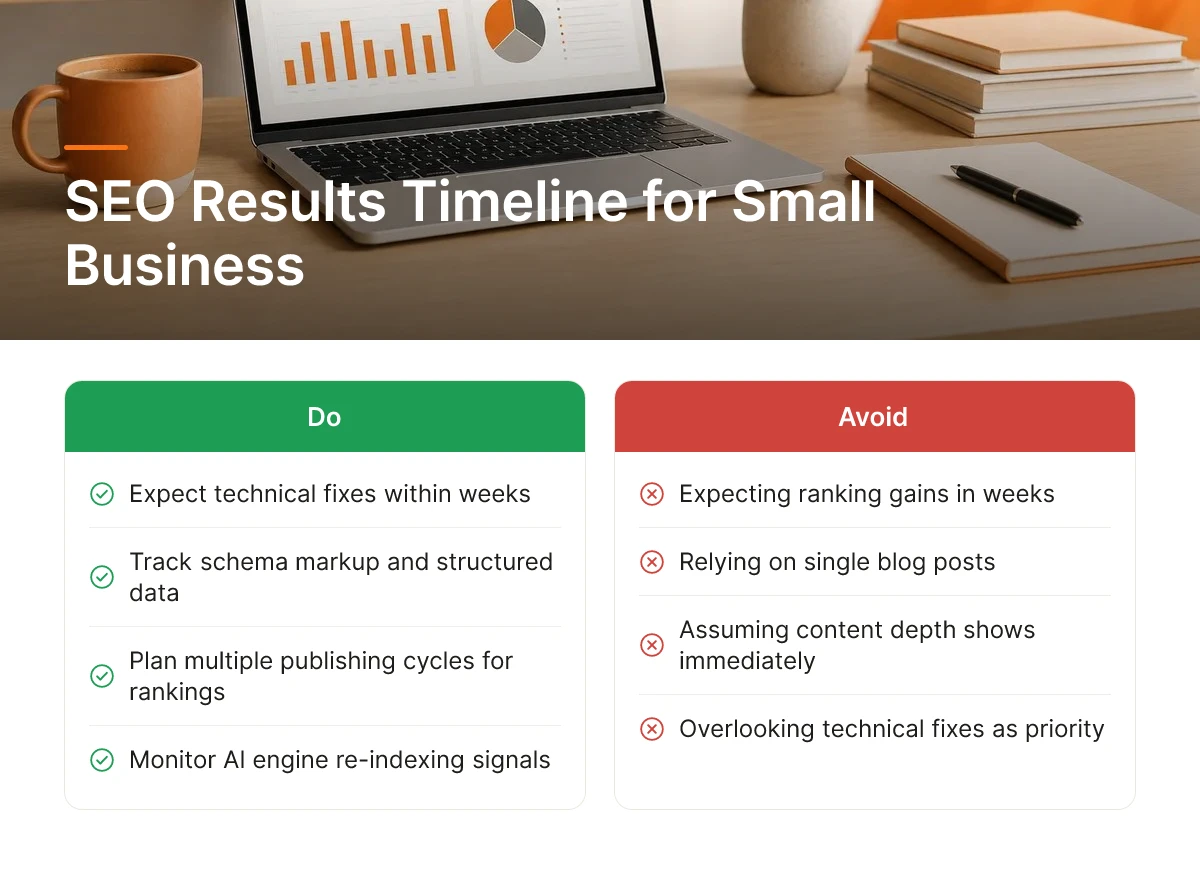
Most small businesses see technical fixes register with AI engines within weeks, while content depth and ranking gains take several publishing cycles longer to show up. The order matters, and so does who's tracking it.
What's a Realistic Timeline for Small Businesses to See Traffic Gains?
Technical fixes move first. Schema markup, llms.txt configuration, and structured data tell AI engines what a business actually sells, and that signal typically gets picked up the next time ChatGPT, Gemini, Claude, or Perplexity crawl and re-index the site. That's a matter of weeks, not months.
Content depth builds next. A single blog post rarely moves a ranking, AI engines and traditional search both reward sustained publishing that covers a topic from multiple angles over repeated cycles [4]. A business publishing daily content will build that depth faster than one publishing monthly, simply because there are more data points for the crawler to find and trust.
Rankings and referral traffic follow last, once the technical layer and the content layer are both established. This is why scoped SEO programs recommend fixing technical barriers and mapping buyer intent before scaling content or authority work [1], skipping the foundation just delays everything downstream. For a small e-commerce store or a B2B SaaS company watching a competitor get recommended in AI search results, the honest timeline is weeks for technical signals, and a few months of consistent publishing before traffic and visibility gains compound.
Do Small Businesses Need Case Studies Before Investing in SEO Tools?
No, the right tool generates its own proof within the first reporting cycle, which is more useful than a stranger's case study anyway. Every business's starting point, niche, and competitive field is different, so an agency's showcase client rarely predicts what happens on a different website with different competitors.
What actually de-risks the decision is tracking. If a tool measures how a business appears in AI engine recommendations before and after it starts publishing and optimizing, the business owner gets a direct before/after comparison using their own data, not a borrowed success story. That's the standard worth applying when evaluating the best seo tools for small business: can it show you your own trajectory, or does it just ask you to trust the brochure?
Moonrank is built around that principle. It runs daily automated content publishing, fixes the technical gaps, schema markup, llms.txt, citations, that keep AI engines from trusting a site, and tracks visibility across ChatGPT, Gemini, Claude, and Perplexity from day one, so a business owner sees their own progress rather than waiting on someone else's. Full details and a free trial are at www.moonrank.ai.
Frequently Asked Questions
Do small businesses still need an SEO tool if they already post on social media?
Yes, social posts rarely get indexed or cited by search engines and AI assistants the way website content does. Social platforms keep most engagement inside their own apps, while ChatGPT, Gemini, and Perplexity pull answers from crawlable web pages, structured data, and citations. A small business that only posts on Instagram or LinkedIn stays invisible to both Google and AI search.
Can one tool handle both Google rankings and AI search visibility?
Some tools try, but most were built for Google first and added AI features later [4]. That matters because AI search visibility depends on different signals, schema markup, llms.txt files, and citation building, not just keywords and backlinks. Moonrank was built specifically to track and improve AI search visibility across ChatGPT, Gemini, Claude, and Perplexity, rather than bolting it onto a traditional ranking tool.
What size of small business benefits most from SEO automation tools?
Businesses generating roughly $150K to $900K in annual revenue tend to benefit most, profitable enough to invest in growth tools but too small for a full agency retainer. This includes solo-run e-commerce stores, local service businesses, and early-stage B2B SaaS companies without a dedicated marketing hire.
Should a small business switch tools if it outgrows a free tier?
Switch once manual work starts eating hours you'd rather spend running the business, not just when you hit a feature cap. Free tools like keyword finders or basic audit checkers [2] work for occasional checks, but they still require someone to act on the findings. Automated, paid tools make sense once content publishing and technical fixes need to happen continuously rather than in occasional bursts.
How many SEO tools should a small business run at the same time?
Most small businesses do better with one consolidated platform than three or four single-purpose tools, since juggling separate logins for keyword research, rank tracking, and content publishing eats time an owner doesn't have. A platform that covers technical fixes, publishing, and AI-search visibility in one place reduces both cost and the mental overhead of switching between dashboards.
Conclusion
Picking the right SEO tool for a small business comes down to three decisions: fix technical and measurement gaps before buying more traffic [1], match the tool to your actual team size rather than its feature list, and stop treating AI search visibility as optional, it now sits alongside Google rankings, not behind them [4]. Free tools work for occasional audits; automated platforms earn their cost once daily publishing and technical upkeep become more than one person can manage. If your business has never checked how it appears in ChatGPT or Perplexity results, start there, run a free visibility check at moonrank.ai before deciding what to fix next.
Sources & References
- Affordable SEO Services for Small Businesses Guide
- 10 Free SEO Tools for Businesses | CO- by US Chamber of Commerce
- The Best Local SEO Agencies for Small Businesses That Actually Move the Needle
- The 11 Best SEO Tools in 2026 | Zapier
- Best SEO Tools for Small Businesses: Build a Stack You Will Actually Use
Recommended Articles
Explore more from our content library: