Why Local SEO Optimization Still Matters for Hotels
Local SEO optimization still matters for hotels because guests now find and vet properties through AI search engines like ChatGPT and Perplexity, not just...
Local SEO optimization still matters for hotels because guests now find and vet properties through AI search engines like ChatGPT and Perplexity, not just Google Maps, and ranking there depends on structured, frequently updated content rather than agency guesswork. Hotels that automate schema markup, location pages, and content refreshes get recommended more often, at a fraction of traditional agency cost. The core shift: visibility now means being cited by AI assistants, not just appearing in a local pack.
How Can Hotels Use AI and Automation for Local SEO Optimization Without Hiring an Agency?
Hotels can run local seo optimization without an agency by pairing automated content generation with technical fixes that AI engines check before recommending a property. The two pieces work together: fresh, well-structured content gives AI systems something to cite, and clean technical signals let them trust what they find.
How Does AI-Powered Content Automation Improve Visibility in AI Search Engines Like ChatGPT and Perplexity?
Automated content generation keeps a hotel's location and amenity pages updated on a schedule, which matters because AI engines weigh recency alongside relevance when choosing what to surface. A property page that hasn't changed in two years signals staleness; one that's refreshed regularly with current amenities, seasonal offers, and neighborhood details gives AI assistants a reason to treat it as current.
Generative search engines interpret and synthesize information rather than just listing links [5], which means the underlying content needs to answer specific guest questions directly, not just rank for a keyword. A hotel that publishes clear, updated pages about its room types, parking policy, or pet rules on an ongoing basis gives tools like ChatGPT and Perplexity more material to pull from when a traveler asks for a recommendation. Manually rewriting these pages every month isn't realistic for a small property team, which is where automated daily publishing, the core mechanism Moonrank runs for its hotel customers, replaces what used to require a content writer on retainer.
What Role Does Technical SEO Play in Getting Recommended by AI Search Engines?
Technical SEO remains the foundation AI engines pull from, because schema markup, site speed, and consistent business data determine whether a hotel's content gets parsed correctly in the first place. Schema markup, structured data that tells search systems exactly what a hotel offers, down to room types, amenities, and location, translates a webpage into a format machines can read reliably [4]. Without it, an AI engine may misread or simply skip a property's details, no matter how good the content is.
Site speed and crawlability affect whether AI crawlers can even access that structured data, and consistent NAP (name, address, phone) data across directories strengthens the trust signals AI systems rely on when choosing what to recommend [3]. Reviews add another layer: recent, detailed guest feedback influences both rankings and AI-generated recommendations [3].
The agency model handles this through periodic manual audits and retainers that run into the thousands monthly, with fixes rolled out weeks after an issue is found. Automation platforms instead monitor schema, crawlability, and listing consistency continuously, catching drift before it costs visibility. Moonrank, for example, runs technical audits and schema implementation alongside daily content publishing for $99/month, covering a layer of work that previously meant hiring an agency or juggling several separate tools.
None of this is about Google alone anymore. Hotels now need to show up when travelers ask ChatGPT, Gemini, Claude, or Perplexity for recommendations, four distinct systems with their own retrieval logic, each one a channel a property can lose bookings to if it's invisible there.
What's the Difference Between Local SEO and Paid Local Advertising Like Google Ads?
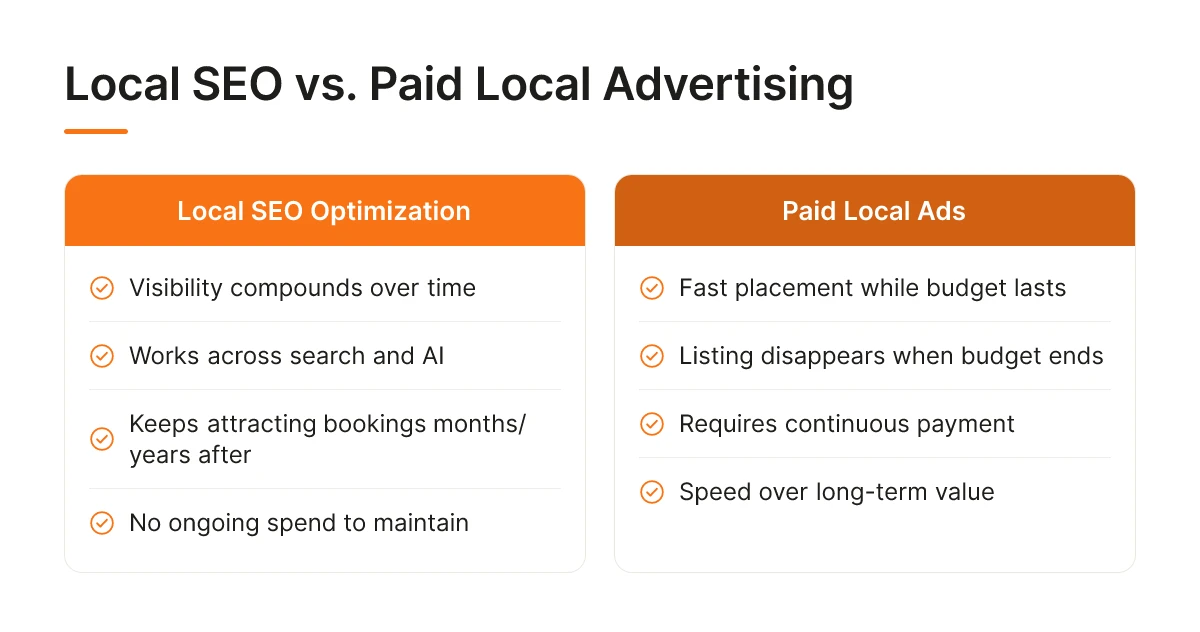
Paid ads rent placement for as long as you keep paying, while local seo optimization builds visibility that compounds and keeps working across both search engines and AI assistants.
Run a Google Ads campaign for a hotel and the moment the budget runs out, the listing disappears. That's the trade-off: speed for rent. SEO works differently, a well-optimized page about your property's location, amenities, and guest experience can keep attracting bookings for months or years after it's published, without additional spend to maintain the placement.
The gap matters more now because of where paid ads simply don't exist. ChatGPT, Claude, Perplexity, and similar AI assistants don't sell ad placements the way Google does, there's no sponsored slot when a traveler asks "best boutique hotel in Austin with a pool." Whatever gets recommended comes from organic signals: structured content, trustworthy citations, consistent business information. A hotel that only invests in paid search has zero presence in that channel, no matter how big the ad budget [5].
Cost structure diverges too. Paid ads scale with competition, the more hotels bidding on the same travel keywords, the more each click costs, and that spend has to continue indefinitely to stay visible. SEO content, once published and properly optimized with schema markup and structured data, keeps generating visibility without a recurring bid war. It's a different kind of investment: upfront effort against ongoing rent.
When Should a Local Business Invest in SEO Automation Versus Paid Search Ads?
Lean on paid ads for short-term, high-urgency moments: a new property launch that needs bookings immediately, a last-minute seasonal promotion, or filling rooms during a slow week. Paid search is the right tool when the goal is a quick spike and the business can absorb the ongoing cost.
Lean on SEO automation when the goal is sustained visibility and brand discovery, the traveler who isn't booking today but is researching, comparing, or asking an AI assistant for recommendations next month. Moonrank fits this second case directly: it publishes optimized content daily, handles the technical signals AI engines look for, and tracks how a hotel shows up across ChatGPT, Gemini, Claude, and Perplexity, all without the hotel owner writing a line of content or managing a bidding strategy.
Can You Do Local SEO Optimization Yourself, and What Does the Process Involve?
Yes, a hotel owner can run local SEO optimization without an agency, but the process is a recurring operational habit, not a one-time checklist.
The work breaks into two categories: setup tasks you do once per property, and maintenance tasks that never stop. Owners who treat local SEO as a project they "finish" tend to lose visibility within months, because both Google and AI engines reward businesses that keep showing current, accurate signals, not businesses that got everything right one quarter and then went quiet.
What Are the Key Steps to Implement Local SEO Without Agency Help?
Start with the business listing itself. A complete, accurate Google Business Profile with consistent name, address and phone (NAP) details across every directory is foundational, inconsistent listings confuse both searchers and the AI systems trying to verify your property [4]. From there, the core steps are:
- Claim and complete every listing, Google Business Profile plus relevant directories and travel sites, with matching NAP data everywhere [3].
- Build location-specific pages, a dedicated page per property (not a single generic "locations" page) that names the neighborhood, nearby landmarks and local amenities travelers search for.
- Publish content on a regular cadence, local guides, event tie-ins, seasonal offers, since original, locally relevant content is one of the factors AI and Google systems weigh when deciding which businesses to surface [1].
- Maintain structured data, schema markup that tells search engines and AI tools what your hotel is, where it sits, and what it offers, which both Google and generative engines rely on to interpret relevance [4].
- Collect and respond to reviews continuously, recent, detailed reviews influence both ranking and the purchase decision itself [3].
None of these steps is complicated individually. The difficulty is doing all five, correctly, at the same time, indefinitely.
How Do Multi-Location Businesses or Franchises Handle Local SEO at Scale?
A single boutique property can manage this manually with a spreadsheet and some discipline. A ten-property or fifty-property brand cannot, the same process multiplied across locations becomes a full-time administrative job, and manual duplication introduces errors in NAP data that undermine trust signals brand-wide.
The realistic path for multi-location hotel brands is template-based automation: one optimized structure, page layout, schema format, content cadence, applied consistently across every property, with location-specific details populated automatically rather than rebuilt by hand each time. This is where a platform like Moonrank fits for hotel groups: it runs daily content generation and technical optimization (schema markup, structured data, citation consistency) across properties on autopilot, so a five-location brand gets the same posting cadence and listing accuracy as a single-property owner, without hiring a person to replicate the work five times over.
The honest tradeoff is time. Manual local SEO optimization for one property might take a few focused hours weekly; sustaining content refreshes, schema updates and listing audits across many properties, manually, scales close to linearly with headcount. Automation doesn't remove the strategy decisions, but it does remove the repetitive execution that otherwise eats an owner's week.
What Metrics Should You Track to Measure Local SEO Success?
Measuring local seo optimization now requires two separate scorecards: one for traditional search performance and one for how often an AI assistant recommends your hotel by name.
Traditional metrics still matter and shouldn't be dropped just because AI search has entered the picture. Track branded search volume (how many people search your hotel's name directly, a sign that other visibility efforts are building recognition), direct booking page traffic (not just site-wide sessions, but visits to the actual reservation flow), and review volume and velocity (how many reviews you're accumulating per month, not just your star average) [4]. Guest reviews influence both rankings and booking decisions, and recent, detailed reviews carry more weight than old ones sitting untouched [3].
Which KPIs Matter Most for Tracking AI Search Engine Visibility and Recommendations?
AI search visibility needs its own KPIs because the underlying mechanics differ from ranking in a list of blue links. The two metrics worth building a habit around are citation frequency, how often tools like ChatGPT, Gemini, Claude, or Perplexity mention your property when someone asks for a recommendation in your area, and share-of-voice, meaning how your citation rate compares to the two or three hotels you actually compete with for the same traveler. A property that shows up in 1 of every 10 relevant AI answers while a nearby competitor shows up in 6 of 10 has a visibility gap no star rating will fix on its own.
Referral traffic from AI engines is also becoming trackable, though it behaves differently than a typical Google click. Visits arriving from ChatGPT, Perplexity, or Gemini often show up in analytics as direct or referral traffic from unfamiliar domains, so it helps to tag and segment these sources separately rather than lumping them into general organic traffic. This is still an early signal, but it's measurable today, and ignoring it means missing where a growing share of research-stage travelers are starting their search [2].
Visibility without conversion isn't a win. A hotel can rack up AI citations and review volume and still see no movement in direct bookings or inquiry form submissions if the content being surfaced doesn't answer the traveler's actual question or lead cleanly to a booking page [5]. Connect the two by checking, on a monthly basis, whether weeks with higher citation frequency or review velocity correlate with upticks in direct booking page traffic, not just impressions.
Finally, factor in voice search, a growing source of conversational, question-style local queries ("what's a pet-friendly hotel near downtown"). Tracking visibility for these longer, question-based phrases, not just short keywords, captures a query type that's expanding alongside AI assistant adoption [1].
What Tools and Automation Can Replace Expensive Local SEO Agency Services?
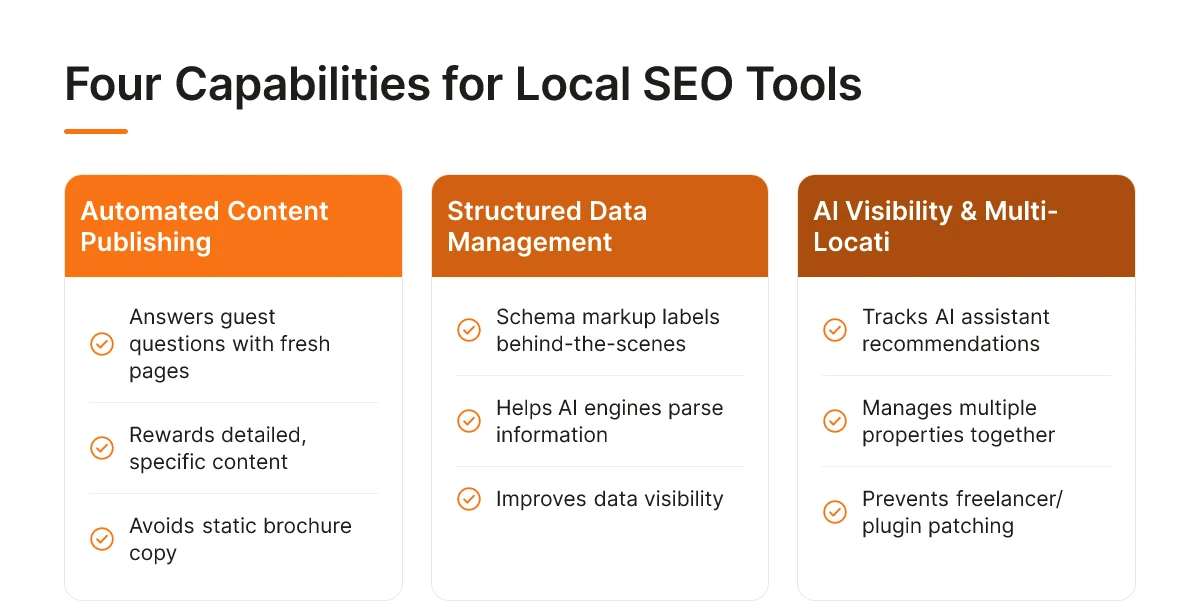
A platform built for local seo optimization needs four capabilities working together: automated content publishing, structured data management, AI visibility tracking, and multi-location support. Miss any one of these and a hotel group ends up patching the gap with a freelancer, a plugin, or a spreadsheet, which defeats the point of automating in the first place.
Automated content publishing matters because AI search engines reward sites that answer specific guest questions with fresh, detailed pages, not static brochure copy [3]. Structured data management, often called schema markup, is the behind-the-scenes labeling that tells AI tools exactly what a property offers: room types, amenities, location, pricing tiers [4]. AI visibility tracking closes the loop by showing whether a hotel actually shows up when someone asks ChatGPT or Perplexity for a recommendation in a given city. And multi-location support matters for any hotel brand with more than one property, since each location needs its own accurate, locally specific signals rather than one generic page stretched across every address.
How Do Automated SEO Platforms Compare to Traditional Local SEO Tools and Agencies?
Agencies, point tools, and automation platforms solve the same problem at three different costs and skill requirements. Agencies bring manual expertise, a strategist writing content, a consultant adjusting technical settings, but charge premium retainers for that hands-on work. Traditional SEO tools are often cheaper upfront but require someone on staff who understands how to configure them, interpret the reports, and act on the findings, which few independent hotels have time for. Automation platforms sit between the two: they handle content creation and technical signals continuously, without requiring the hotel owner to learn schema markup or hire a full-time marketer.
Running separate vendors for content, technical SEO, and reporting creates its own cost, not just in fees, but in coordination. A hotel owner juggling a content writer, a technical consultant, and a rank-tracking subscription has to keep all three aligned, which rarely happens cleanly in practice. A single platform that handles publishing, structured data, and visibility tracking together removes that coordination tax entirely.
Moonrank was built for exactly this shift. It runs daily automated content generation for a hotel's specific niche and keywords, manages the schema markup and llms.txt configuration that help AI engines parse and trust the property's site, and tracks how that property appears across ChatGPT, Gemini, Claude, and Perplexity, all without agency pricing. Instead of a $3,000+/month retainer, hotels get the same core functions for $99/month, running on autopilot after a short setup.
If your property is still invisible when travelers ask AI tools for recommendations, start a free trial at www.moonrank.ai and see what automated visibility tracking turns up.
Frequently Asked Questions
Does local SEO optimization still matter if a hotel already runs paid ads on Google?
Yes, paid ads disappear the moment a campaign ends, while organic and AI search visibility keeps working around the clock. Travelers increasingly research hotels through conversational AI tools before they ever see an ad [2]. A hotel relying only on paid placement misses guests who ask ChatGPT or Perplexity for recommendations instead of searching Google directly.
How long does it take to see results from local SEO automation?
Most hotels notice initial visibility shifts within four to eight weeks, with stronger gains by month three. Technical fixes like schema markup and consistent business listings tend to show up faster than content-driven rankings, since AI systems need repeated signals over time to trust and surface a property consistently [4].
Can voice search queries affect how hotels show up in local search?
Yes, voice and conversational queries favor hotels with clear, direct answers to specific questions rather than generic keyword pages. AI search increasingly interprets intent instead of just matching keywords, rewarding content structured around real guest questions like "pet-friendly hotels near the airport" [3]. Hotels that write for how guests actually speak, not just how they type, capture more of this traffic.
Do small, independent hotels need the same local SEO approach as big chains?
No, small hotels compete differently, leaning on specificity and trust signals rather than brand recognition or marketing budgets. Accurate listings, detailed guest reviews, and locally specific content let independent properties stand out in AI search results even against larger chains [4]. The fundamentals matter more than scale: consistency, clarity, and original local content often outweigh a bigger ad spend.
Conclusion
Hotels that win in local search now treat AI visibility as seriously as Google rankings, accurate listings, structured data, fresh reviews, and content written around real guest questions all feed the same trust signals that ChatGPT, Gemini, and Perplexity rely on [3][4]. The properties falling behind aren't doing less SEO; they're doing SEO built for a search engine that no longer reflects how guests actually search.
Start by auditing your Google Business Profile and site schema this week, then build a content cadence you can actually sustain. If daily publishing and technical upkeep aren't realistic for your team, Moonrank handles both automatically for $99/month, so your property keeps showing up in AI recommendations without hiring an agency.
Sources & References
- Local SEO Strategies for Google and AI Search
- 6 Ways to Improve Your Local SEO Strategy in the Age of AI Search | Yext
- The New Rules of Local Visibility in an AI-Driven Search World
- Local SEO for Hotels: 10 Tips to Boost Bookings | Mews
- Why Digital Marketing for Hotels Is Moving from SEO to GEO
Recommended Articles
Explore more from our content library: