Building a Content Marketing Strategy for Hotel Visibility
Learn how to build a content marketing strategy for hotels that helps ChatGPT, Perplexity, and Claude confidently cite your property to travelers. Discover.

A content marketing strategy for hotels built for AI search visibility means creating structured, specific content about your property that ChatGPT, Perplexity, and Claude can confidently cite when travelers ask for recommendations, without hiring an expensive agency. This differs from traditional content marketing: instead of optimizing for keyword rankings and backlinks, you're optimizing for clear, factual, well-structured answers about your hotel's location, amenities, and guest experience that AI engines can extract and trust. The core steps of a strong content marketing strategy are defining your niche questions, publishing answer-first content, and adding structured data so AI tools can verify what you offer.
What You'll Need Before Building Your Content Marketing Strategy
You need admin access to your website CMS, a written list of guest FAQs and amenities, and your existing content library, reviews, blog posts, and booking pages, before you touch anything else.
Gather these first because every later step in this content marketing strategy depends on having raw material to work with. Pull your room types and rates, cancellation and pet policies, parking details, nearby attractions, and the questions your front desk answers every day over the phone. Export your best guest reviews too, they contain the exact phrasing travelers use when describing why they booked you, which is useful when you start writing answer-first content.
AI engines like ChatGPT and Perplexity need structured, specific facts, not brand copy. A line like "luxury boutique experience in the heart of the city" tells an AI model nothing it can cite. A line stating you have 42 rooms, are four blocks from the convention center, and allow dogs under 30 pounds for a nightly fee gives the model something concrete to repeat when a traveler asks for a recommendation [2]. Specificity is what gets extracted; adjectives get ignored.
How Is This Different From Optimizing for Google?
Google rewards keyword matching and backlinks; AI engines reward content that answers a question directly enough to quote [1]. Writing for Google often means repeating a phrase like "pet-friendly hotel in Austin" across a page. Writing for AI search means answering "does this hotel allow dogs" in one clear sentence the model can lift and attribute to you. That shift in mindset, from ranking for a phrase to being the cited answer, shapes every piece of content you produce from here.
Why SMBs and Hotels Need This Approach Specifically
You don't need an agency retainer or a content team to do this, one owner-operator or marketing person can run the entire process. Independent hotels and small hospitality brands often assume AI visibility requires the same budget as traditional SEO campaigns [3]. It doesn't. The work is narrower: document what's already true about your property, structure it clearly, and publish it consistently. Tools like Moonrank are built for exactly this gap, automating the daily publishing and technical setup, schema markup, structured data, so a solo marketer can maintain AI visibility without hiring out the work or learning to code.
Setting Realistic Expectations for the First 90 Days
A content marketing strategy for AI visibility rarely produces citations in the first week. Expect the early weeks to be mostly groundwork, auditing existing content, fixing inconsistent business details, and publishing the first batch of answer-first pages. Visibility tends to build gradually as AI engines crawl and re-crawl your site, cross-reference your details against other sources, and gain enough confidence to start citing you. Treat the first quarter as a setup phase, not a results phase, and judge progress by consistency of publishing rather than by immediate mentions.
Build Your Content Marketing Strategy Around Guest Questions
Start your content marketing strategy by listing the exact questions travelers type into ChatGPT or Perplexity, not the keywords a generic SEO checklist suggests.
A hotel owner doesn't need to guess what guests want to know, they already know, because guests ask the front desk every day. "What's the best area to stay near downtown?" "Do you allow pets?" "Is there free parking?" "How far are you from the convention center?" These are the real questions AI assistants field when someone asks for a recommendation [3]. Generic keywords like "hotel near me" or "boutique hotel rooms" don't map to how people actually phrase requests to a chatbot.
AI engines favor content that reads like a direct answer, not a brochure. Milestone Internet's research on hotel content notes that context, not just content, determines whether an AI assistant surfaces a property in its answer [3]. That means the structure of the answer matters as much as the information itself.
Key Steps to Create a Strategy Without an Agency
- Collect the questions first. Pull them from front-desk logs, email inquiries, review site comments, and OTA Q&A sections. Aim for 20-30 real guest questions before writing anything.
- Group questions by topic. Batch them into categories, policies (pet, cancellation, check-in), location (parking, distance to venues, neighborhood safety), and amenities (breakfast, Wi-Fi, accessibility). Batching lets you write in focused sessions instead of jumping between unrelated topics.
- Build one template and reuse it. Every page follows the same shape: question as the heading, direct answer in the first sentence, supporting detail after. A solo founder or hotel manager can produce five or six of these pages in an afternoon once the template is set.
- Publish consistently. A content marketing strategy only works if it's maintained, stale answers about parking rates or pet fees erode trust fast, both with guests and with AI systems citing the page.
How to Structure Content for AI Discovery
Write the answer first, then explain, AI engines extract and quote the opening sentence more often than buried paragraphs [1]. "Yes, we allow dogs under 40 pounds for a $25 nightly fee" works better than three sentences of scene-setting before the actual policy.
This format doesn't sacrifice traditional search. Google's featured snippets reward the same answer-first structure, and AI Overviews pull from the same signals the Business Gateway guide identifies as central to AI readiness [2]. Structuring for clarity serves both channels, there's no need to choose one over the other. Moonrank builds this question-mapping and answer-first structure into its daily content generation, so a hotel owner doesn't have to run the research and writing process manually.
Mapping Content to the Guest Journey
Not every question belongs at the same stage. Pre-booking questions, pet policies, parking, proximity to a venue, should live on pages a traveler or AI engine can find before they've committed to a property. Post-booking questions, check-in instructions, what's included in the room, local recommendations, belong on pages that serve guests after they've already booked. Mapping content this way keeps your site organized and gives AI engines a clearer signal about which page answers which type of query, rather than cramming every fact onto a single overloaded page.

Publish Content Formats and Technical Signals AI Engines Trust
AI engines trust hotels that pair the right content formats with technical signals like schema markup, consistent business details, and dated updates. A content marketing strategy that ignores these mechanics gets written off by AI engines no matter how good the writing is, because these tools verify facts before they recommend anything. For more information, see Marketing Manager.
Schema markup is a block of code added to your site that labels information in a format machines read easily, your address, room rates, amenities, check-in times, instead of making an AI guess at it from paragraph text. Think of it as filling out a form instead of writing an essay: a language model scanning your homepage can confirm "pet-friendly: yes" or "price tier: mid-range" in one pass if that data sits in structured markup, rather than piecing it together from marketing copy. Hotels without this structure force AI engines to infer details, and inference is exactly where models hesitate to recommend a business [2].
Optimizing Content Types for Different AI Engines
Three formats consistently earn citations: FAQ pages, comparison pages, and detailed amenity pages. FAQ pages answer the exact phrasing guests type into ChatGPT or Perplexity, "is parking included," "what's the cancellation policy", in a question-and-answer structure that AI engines can lift almost verbatim [1]. Comparison pages, like a neighborhood guide stacking your property against three nearby alternatives, give models the contrastive detail they need to justify a recommendation over a competitor. Detailed amenity pages, a full breakdown of the spa, the breakfast program, the meeting rooms, perform better than a single generic "Amenities" tab because models retrieve specific, narrow pages more reliably than broad ones [3].
Technical Elements That Matter Most for AI Visibility
Two technical factors decide whether that content gets surfaced at all: freshness and consistency. AI engines favor recently updated, dated content because a visible "last updated" timestamp signals the information is still accurate, a policy page updated eight months ago carries more weight than one untouched for three years [2]. Second, your name, address, phone number, and policies need to match exactly across your website, booking platforms, and directory listings. When a hotel's address reads one way on its homepage and another way on a travel site, AI engines treat the mismatch as a trust problem and often omit the business rather than risk a wrong recommendation. Moonrank handles both of these mechanically, it builds the schema markup, llms.txt configuration, and citation consistency into its daily technical optimization, so a hotel doesn't need a developer to keep its structured data current.
Writing Style Details That Improve Extraction
Beyond structure, small writing choices affect how easily an AI model can lift a sentence. Favor concrete numbers over ranges where possible, "check-in starts at 3 p.m." instead of "check-in is in the afternoon." Avoid stacking qualifiers before the fact, lead with the fact itself. Short declarative sentences extract more cleanly than long compound ones, so when editing a page, look for any sentence over 25 words and consider splitting it. These habits sound minor individually, but across dozens of pages they compound into a site that's measurably easier for a model to quote accurately.
Track Metrics That Show Your Content Marketing Strategy Is Working
The clearest proof your content marketing strategy works is whether your hotel actually gets named when travelers ask ChatGPT or Perplexity for recommendations. Traditional metrics like pageviews or keyword rank won't tell you that. You need to run the prompts yourself, regularly, and track what comes back.
Metrics and KPIs That Matter Most
Start by testing the exact questions a guest would ask: "best boutique hotel near downtown Austin with a pool," "family-friendly hotel in Charleston walking distance to restaurants." Run these across ChatGPT, Gemini, Claude, and Perplexity on a set schedule, log whether your property appears, and note which competitors do instead. This is the single most direct signal available for a content marketing strategy built around AI search, closer to brand monitoring than classic rank tracking.
Beyond raw mentions, watch for secondary signals that confirm AI engines are sending real people your way. Direct booking inquiries that reference something oddly specific, a guest mentioning an amenity or neighborhood detail that only appears in your blog content, are a strong tell that an AI answer steered them there. A branded search uptick, where more people search your hotel's name directly after a period of AI visibility work, is another sign worth tracking alongside standard booking engine analytics and email sign-ups.
How to Allocate Time and Budget as an SMB
Budget-friendly DIY works if you're willing to manually prompt-test weekly and write content yourself in off-hours, but it's slow and easy to abandon after a few months. Mid-range tooling, software that automates publishing and checks AI visibility for you, fits most independent hotels better, since it removes the daily grind without agency-level spend. Premium or enterprise support still makes sense for larger portfolios managing dozens of properties at once. Moonrank sits in the mid-range tier, automating daily content and tracking mentions across ChatGPT, Gemini, Claude, and Perplexity without requiring a hotel owner to write anything [1].
Whatever tier you choose, spend the bulk of your time on high-intent questions, "pet-friendly hotel with late checkout near the airport", rather than generic posts about "top 10 travel tips," since those rarely match how guests actually prompt AI engines [2].
Building a Simple Tracking Routine
You don't need a dashboard to start tracking AI visibility, a shared spreadsheet works fine. List your top 10-15 guest questions in one column, then add a column for each AI engine you're testing. Once a week, run each question and note whether your hotel appears, in what position, and alongside which competitors. Over a few months this simple log reveals patterns, which question types you win on, which engines favor your content, and where a competitor keeps edging you out, that would be invisible from a single spot-check.
Common Mistakes to Avoid With Your Hotel Content Strategy
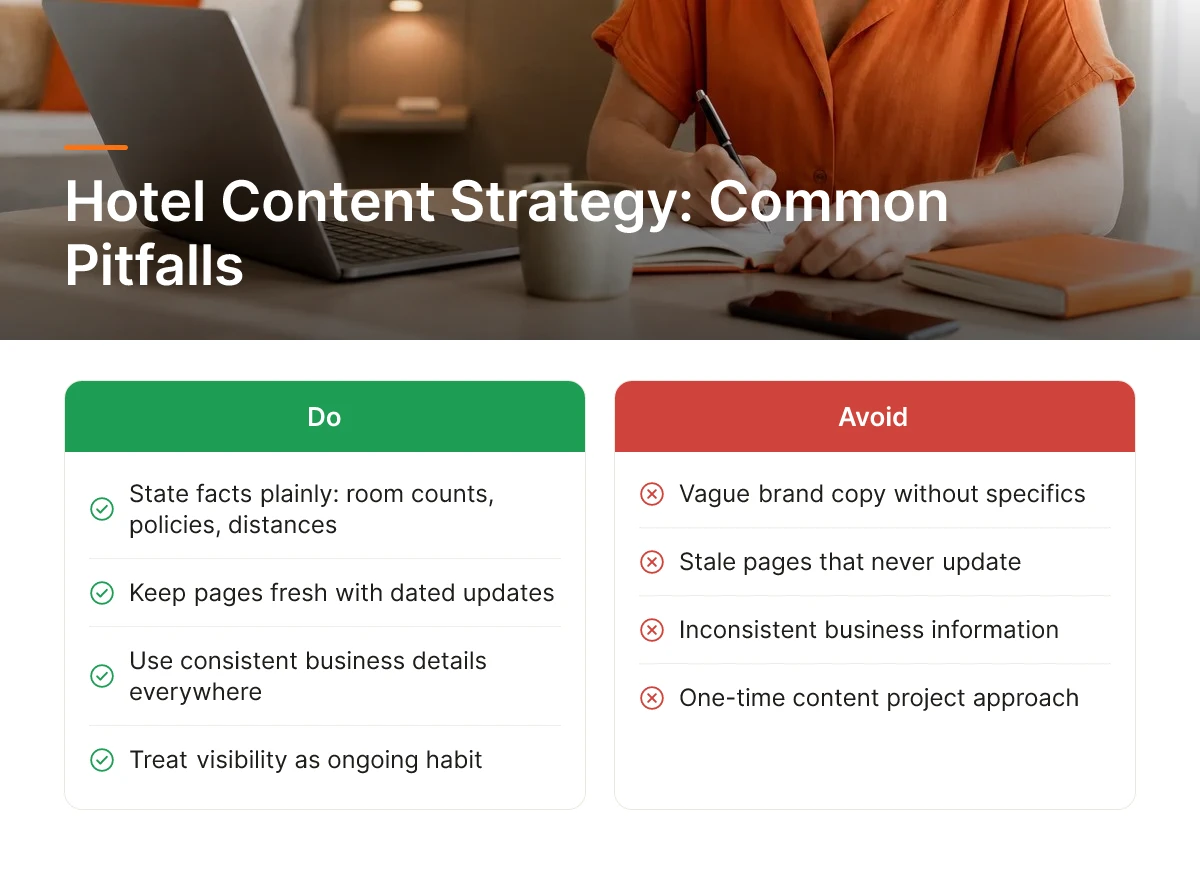
Four mistakes keep hotels invisible to AI engines: vague copy, stale pages, inconsistent business details, and treating visibility as a one-time project instead of an ongoing habit.
The first mistake is writing brand copy that sounds polished but says nothing specific. "Experience luxury on the coast" gives ChatGPT or Perplexity nothing to quote when a traveler asks for "a pet-friendly hotel near Charleston with a late checkout." AI engines pull answers from content that states facts plainly, room counts, policies, distances, prices, amenities. A content marketing strategy built on mood and atmosphere instead of answerable specifics gets skipped in favor of a competitor's page that actually names the dog-walking area and the 2 p.m. checkout policy.
The second mistake is publishing once and walking away. AI engines favor sources that show signs of being current, which means a hotel's seasonal packages, pricing, and local event tie-ins need refreshing on a schedule, not left to age for a year [1]. A page about "summer rates" still live in November tells the model your content isn't maintained, and that erodes trust in everything else on the site.
The third mistake is letting business details drift out of sync across the web, one address on the website, another on a directory listing, a phone number that's outdated on a third-party travel site. AI engines cross-reference sources, and conflicting details make them less confident recommending the property at all [2].
The fourth mistake is treating AI visibility as a project with an end date. It's a publishing habit, not a launch.
How Successful SMBs Avoid These Failures
Hotels that stay visible treat content, technical signals, and consistency as a standing routine, not a quarterly task. That's where Moonrank fits: it publishes fresh, answer-first content daily, keeps schema markup and business details aligned across the web, and tracks how the property shows up across ChatGPT, Gemini, Claude, and Perplexity, all on autopilot, for a fraction of what an agency charges. Visit www.moonrank.ai to put the routine on autopilot instead of managing it by hand.
Frequently Asked Questions
How is content marketing strategy different when optimizing for AI search engines vs. Google?
Google rewards keyword-matched pages and backlinks; AI search engines like ChatGPT and Perplexity reward clear, well-structured facts they can quote and cite [1]. Instead of chasing rankings for a search results page, you're writing content that gets pulled directly into a generated answer. That means structured data, consistent business facts across the web, and direct answers to real customer questions matter more than keyword density [2].
Do I need to share my content marketing strategy with other departments at my hotel?
Yes, especially front desk, sales, and guest services teams, since they hear the real questions guests ask before booking. Their input helps you write content that answers actual objections, parking, pet policies, event space capacity, which is exactly what AI engines look for when generating recommendations.
How often should I update my hotel's content marketing strategy for AI search visibility?
Review it monthly and refresh core pages at least quarterly, since AI engines favor sources with current, consistent information [3]. Seasonal content, local events, holiday packages, weather-driven travel tips, needs faster turnaround, often every few weeks, to stay relevant when travelers are actively researching.
What real-world signs show a content marketing strategy is actually driving AI recommendations?
Watch for direct mentions: ask ChatGPT, Gemini, Claude, and Perplexity your own "best hotel in [city]" style questions and see if your brand appears. Other signals include referral traffic from AI platforms in your analytics, guests mentioning they "asked ChatGPT" during booking, and increased branded search volume following new content publication.
Can a small hotel compete with large chains using the same content marketing strategy?
Yes, independent hotels often compete better in AI search than in traditional SEO because AI engines reward specificity over domain authority. A small property with precise, well-structured answers about its own rooms and policies can get cited ahead of a chain hotel with generic, templated copy, since the model has more concrete detail to work with.
Conclusion
A content marketing strategy built for AI search comes down to three things: publish consistently, structure every page so AI engines can extract clear facts, and track your actual visibility inside ChatGPT, Gemini, Claude, and Perplexity rather than guessing. Most SMBs fail not from bad writing but from inconsistency, publishing once a month, then stopping, with no technical layer behind it.
Moonrank handles all three automatically, publishing daily content and fixing the schema and structured data gaps that keep AI engines from trusting your site. Your next step: run a visibility check at moonrank.ai to see where your business stands today.
Sources & References
- GEO strategy - how to get ChatGPT to recommend your company
- AI Search Optimisation Guide: Boost Your Small Business Visibility with ChatGPT, Google AI Overviews, and Local SEO Strategies | Business Gateway
- How to Develop a Content Marketing Strategy for Your Hotel
Recommended Articles
Explore more from our content library: