How to Fix SEO for Ecommerce Sites with Thin Product Pages
Thin and duplicate product content hurts e-commerce SEO because templated descriptions across thousands of SKUs give Google and AI engines like ChatGPT and...

Understanding seo for ecommerce sites is essential. Thin and duplicate product content hurts e-commerce SEO because templated descriptions across thousands of SKUs give Google and AI engines like ChatGPT and Perplexity nothing distinct to index or cite, so pages get filtered out of search results and skipped in AI recommendations alike. Fixing it means adding unique, specific details (use cases, materials, comparisons) at scale rather than relying on manufacturer copy-paste, and structuring that content so both ranking systems and AI summarizers can parse it. The payoff is visibility in two systems at once, not just one.
What You'll Need Before Fixing SEO for Ecommerce Sites with Thin Product Pages
Before changing a single product description, you need a full picture of which SKUs are thin or duplicated across your catalog, not a page-by-page guess.
This is the part most store owners skip. They open one product page, notice the description reads like boilerplate, rewrite it, and move on. But seo for ecommerce sites with large catalogs is a pattern problem, not a page problem. If 2,000 SKUs share the same manufacturer paragraph with only the size or color swapped, fixing one page does nothing, Google and AI engines like ChatGPT and Perplexity still see 1,999 near-identical pages competing against each other [4]. You need the full list of duplicates before you touch the template.
Sort by content source first
Not all thin content is equal. Manufacturer-supplied descriptions are almost always the most duplicated, since dozens of retailers paste the same spec sheet copy onto their own listings. Descriptions your team wrote manually, even short ones, tend to be more unique by default. Sorting your catalog by content source gives you a fast, practical filter for where to start.
Gather these four things before you start
- Admin or editor access to your CMS or platform templates, since fixes often happen at the template level, not the individual page level
- A spreadsheet or crawl export listing every product URL, its description source, and word count
- Traffic data showing which category or collection pages drive the most visits, so you prioritize the SKUs that sit underneath them first
- A clear view of duplicate clusters, groups of pages with matching or near-matching copy
This applies whether you run Shopify, WooCommerce, BigCommerce, or a custom-built platform. The template editor looks different in each, but the underlying mechanism, templated copy creating indistinguishable pages, is identical [1]. Get the audit right first, and the actual content fixes go faster.
Diagnose Why Thin Product Content Blocks SEO for Ecommerce Sites
Thin, duplicated product copy is the single biggest reason catalog pages fail to rank or get cited by AI engines, because search systems can't tell your SKUs apart from each other, let alone from a competitor's.
How Duplicate Content Across Thousands of SKUs Hurts Visibility in Google and AI Search
When hundreds of SKUs share the same manufacturer-supplied description, Google treats them as duplicate signals rather than distinct pages worth separate placement in results. Its own guidance on ranking systems confirms that content quality and distinctiveness remain foundational to how pages get surfaced, even as generative features sit on top of that core ranking layer [2]. In practice, that means Google often indexes a single version of a near-identical product description and drops the rest, leaving dozens or hundreds of your pages invisible even though they're live and technically crawlable.
AI engines compound the problem instead of softening it. Generative search tools summarize and cite the source they judge most distinct and well-structured, which means a templated page gets passed over the moment a competitor publishes original copy, comparison detail, or clearer structured data for the same product [1]. One industry analysis of e-commerce AI visibility frames this directly: generative engines reward sites that build what it calls "connective tissue" between product data and context, not sites that repeat manufacturer boilerplate across the catalog [1]. For any SEO for ecommerce sites strategy, this is the mechanism to fix first, duplicate content doesn't just rank poorly, it gets actively skipped during AI citation selection.
What Unsolved Duplicate Content Costs a High-Volume Catalog Over Time
The cost compounds because new SKUs keep launching on the same broken template. A catalog that ships 50 new products a month using the same manufacturer description pattern adds 50 more duplicate-content problems before anyone fixes the first batch, the backlog grows faster than a manual content team can clear it.
Industry practitioners who work directly with large catalogs describe this as a structural issue, not a copywriting one: trying to hand-write unique descriptions for every PDP at scale is rarely realistic, and the fix usually needs to happen at the collection and category level instead [4]. Before prioritizing fixes, group product URLs by description similarity to identify which categories carry the worst duplication, apparel variants, electronics accessories, and private-label goods are common offenders. That diagnostic step tells you where templated content is actively suppressing visibility, so remediation work starts where the compounding cost is highest rather than wherever is easiest to fix first.

Generate Unique Product Content at Scale Without Agency Costs
AI writing tools can produce unique product content fast, but only if they're fed real product data, otherwise they just generate a new version of the same duplicate content problem.
Do AI-Generated Product Descriptions Improve SEO or Add to the Duplicate Content Problem?
It depends entirely on what the AI is working from. Feed a large language model the manufacturer's boilerplate copy and ask it to "rewrite this," and it produces a paraphrase, different words, same lack of substance, and search engines increasingly recognize that pattern. Google's own guidance on ranking systems for generative search features makes the point directly: the quality signals that mattered for traditional SEO still apply, because AI features are rooted in the same core ranking and quality systems [2].
The fix is grounding. Feed the model product-specific inputs, exact dimensions, materials, weight, compatibility, who the product is actually for, and it generates sentences that say something no other page says. A ceramic mug description that mentions an 11-ounce capacity, dishwasher-safe glaze, and stacking compatibility with a specific product line reads nothing like a competitor's generic "perfect for your morning coffee" copy. This is the dividing line in SEO for ecommerce sites: AI as a research-to-copy pipeline works, AI as a rewording machine doesn't.
What Is the Fastest Way to Add Unique Content to Hundreds of Product Pages?
Build a template with variable fields instead of writing one static block per product. A workable structure pulls in who the item is for, how it compares to two or three similar SKUs in the catalog, and the two or three most common use cases customers mention in reviews or support tickets. Structured attributes, size, material, compatibility, color, feed into the template as data points, not just as a spec table, which is what produces genuinely distinct sentences rather than reshuffled ones.
- Rank categories by traffic and revenue, and tackle the top tier manually or with heavy human review first.
- Batch-process the long tail using the attribute-driven template, since most of those pages need to be merely distinct, not exceptional.
- Route near-duplicate variants (same product, different size or color) to variant schema rather than unique paragraphs, which search engine optimization specialists already recommend for large catalogs with naturally similar products [4].
The real advantage of automating this is continuity. An agency content sprint covers a catalog once and goes stale as new SKUs get added; a tool that runs the same template-plus-attribute process daily keeps pace with the catalog automatically. Moonrank's daily content generation works this way for store owners, it pulls niche-specific inputs and publishes continuously, instead of leaving a six-month gap until the next agency invoice.
Optimize Product Pages for Both Google Search and AI Recommendations
Google ranks pages on crawlable signals and backlinks; AI engines extract and summarize the single clearest answer on a page. Vague product copy fails both systems, but for different reasons, Google can't find enough unique signal to rank it, and AI engines have nothing specific enough to quote.
That distinction matters more as generative search becomes a real distribution channel. Google's own documentation confirms that foundational SEO practices still apply to generative AI features, since those features run on the same core ranking and quality systems as traditional search [2]. The practices that built organic traffic for a decade haven't disappeared, they've been joined by a second, stricter test: can a language model lift a sentence from your page and hand it to a shopper as a direct answer?
How Do You Get Recommended by AI Search Engines When Product Pages Are Thin?
Add schema markup, the structured data that tells search engines exactly what a product is, its price tier, and whether it's in stock, because both Google and AI engines parse it faster than they parse prose. Variant schema in particular lets you describe sizes, colors, and materials as structured fields instead of rewriting near-identical paragraphs for every SKU [4].
Structured data solves the parsing problem, but it doesn't solve the answer problem. AI engines favor pages that answer specific buyer questions directly in the body copy, does this fit a size 10 foot, is this compatible with a 2019 model, how does it compare to the next tier up. A short Q&A block addressing three or four real buyer questions does more for citation odds than a spec table, because it's phrased the way a shopper's question is phrased.
- Pull actual questions from customer support tickets or search queries, not guesses
- Answer each in one or two direct sentences placed near the top of the page
- Keep the spec table for exhaustive detail, but don't rely on it as the only content layer
Should Ecommerce Sites Optimize Differently for AI Search Than for Google?
No, the underlying fix is the same content discipline, but AI visibility adds a citability layer that Google ranking doesn't require as strictly.
Unique, specific, well-structured copy serves both systems at once. What changes is phrasing: a sentence written to be extracted and quoted by an AI engine needs to stand alone as a complete, specific claim, not a fragment that only makes sense in context. This is the core mechanic behind seo for ecommerce sites today, one content investment, two retrieval systems, each with its own test for what counts as useful.
Tracking has to follow the same split. Clicks and impressions from Google Search Console still matter, but they no longer tell the full story. Track citation and recommendation appearances across ChatGPT, Gemini, Claude, and Perplexity separately, because a product page can lose Google rank while gaining AI recommendations, or the reverse. Moonrank's visibility tracking reports both sides, showing where a store shows up in AI recommendations alongside traditional ranking signals, so ROI gets measured across the full picture instead of just one channel.
Common Mistakes to Avoid When Fixing SEO for Ecommerce Sites
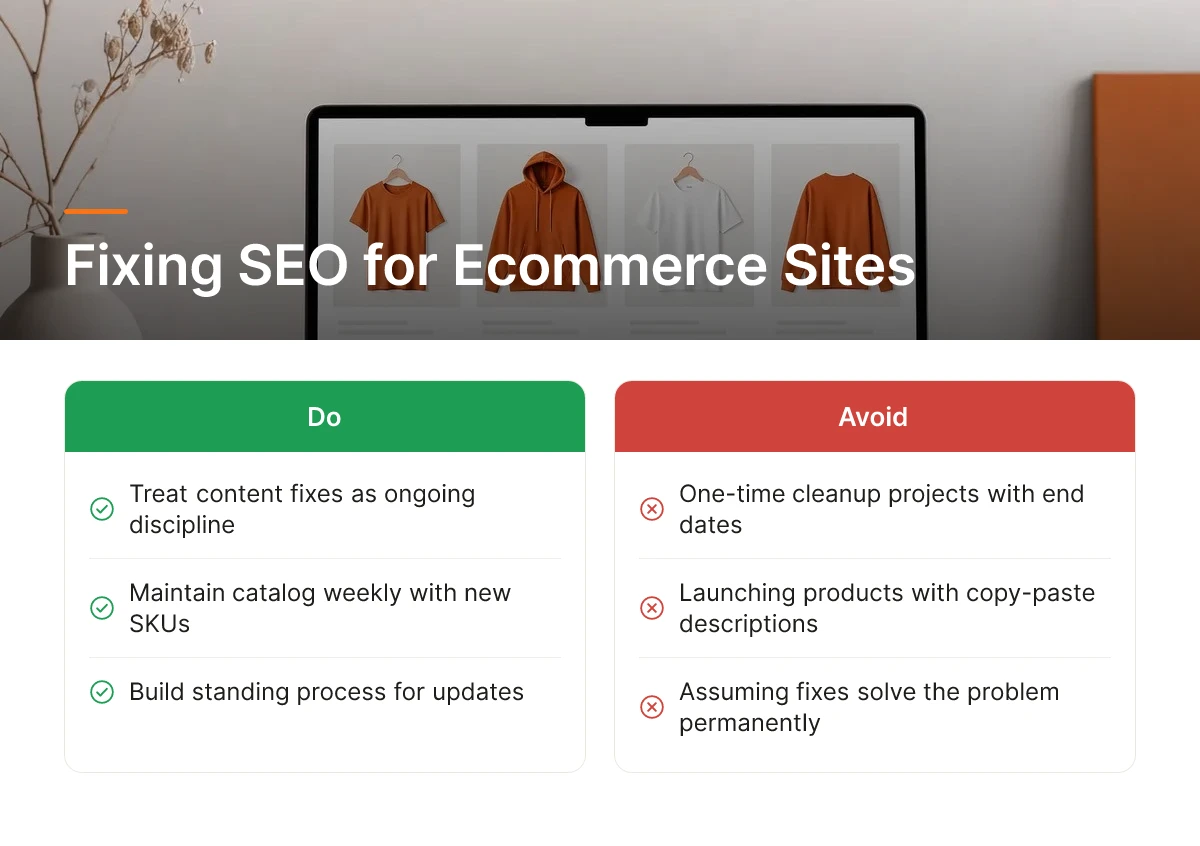
Most store owners treat a product content fix as a one-time cleanup rather than a standing process, and that single assumption undoes most other progress.
Here are the recurring errors worth naming, because each one quietly cancels out the effort that came before it.
- Treating it as a project with an end date. A catalog that adds new SKUs every week needs content maintenance every week. Fixing 500 thin pages in a quarter feels like progress, but if 40 new products launch the following month with the same copy-paste descriptions, the catalog is back where it started. SEO for ecommerce sites only works as an ongoing discipline, not a one-time sprint.
- Using AI to rewrite descriptions without real product data behind it. Running thin descriptions through a generic AI rewriter often produces text that sounds different but says nothing new, same vague attributes, same lack of specificity, just reshuffled. Variant schema tied to real attributes (size, material, compatibility) solves the duplication problem that rewording alone cannot [4].
- Watching Google rankings while ignoring AI citations entirely. A store can hold steady positions in Google and still be invisible when a shopper asks ChatGPT or Perplexity for a recommendation. Generative engines answer with structured picks pulled from sources they trust, not necessarily the sources ranking on page one [1]. Tracking rankings alone misses whether product pages are being cited or recommended at all.
- Picking the wrong budget tier for the job. Full-service agency engagements are typically priced around ongoing strategy, research, and account management, reasonable for stores that need custom positioning work, but often more than a catalog-maintenance problem requires. Automation-driven tools sit in a more budget-friendly tier built specifically for the repetitive, high-volume work of keeping large catalogs current.
This is where an automated layer earns its keep. Moonrank tracks visibility across Google and AI engines like ChatGPT, Gemini, Claude, and Perplexity, then publishes the unique content updates, grounded in product attributes, not generic rewrites, that keep thin pages from drifting back into duplication. Instead of a one-time fix, it runs as the continuous process the catalog actually needs. See how it works at www.moonrank.ai.
Frequently Asked Questions
Can AI-generated product descriptions actually improve SEO, or do they make duplicate content worse?
AI-written descriptions help only if each one adds distinct detail; copy-pasted templates across similar SKUs can still trigger thin or duplicate content flags. The better fix for near-identical products is variant schema instead of rewriting every description [4]. AI tools work best generating differentiated collection and category copy, not spinning minor word swaps across product variants that search engines will still treat as duplicates.
What metrics matter most for e-commerce SEO when visibility is split between Google and AI engines?
Track organic rankings and Search Console data alongside a separate measure of how often AI engines cite or recommend your brand [1]. Google still evaluates generative results using core ranking and quality systems [2], so traditional metrics like indexation and click-through rate remain relevant. Add citation frequency and AI Visibility Score tracking as a second layer [1].
How much should e-commerce SEO cost, and when is automation worth it instead of an agency?
Costs range from budget-friendly automated tools to premium agency retainers, and the right choice depends on catalog size and team bandwidth. A store with hundreds of near-duplicate SKUs rarely needs a full agency team to write unique category content and manage technical fixes. Moonrank, for example, runs daily content publishing and schema optimization for e-commerce sites at a flat $99/month, replacing manual agency work with automation built for AI search visibility.
Do I need different product content for Shopify, WooCommerce, or BigCommerce stores?
No, the content strategy stays the same; only the technical implementation changes. Collection pages, internal links, and schema markup [4] matter regardless of platform. What differs is how each platform handles URL structure and schema injection, so technical setup should follow platform-specific documentation while content strategy stays identical.

Conclusion
Thin and duplicate product content is not a problem you solve by rewriting every description. Fix it at the structural level: variant schema instead of unique copy for near-identical SKUs, optimized collection pages that carry the ranking weight [4], and authority content that builds the "connective tissue" AI engines use to cite your store [1]. Pair that with visibility tracking across both Google and AI engines, since the two now require separate measurement [1][2]. Start by auditing your ten highest-traffic product pages this week to see which ones rely on duplicate descriptions that collection-page fixes could resolve instead.
Sources & References
- AI Visibility for Ecommerce, Explained | Yotpo
- Google's Guide to Optimizing for Generative AI Features on Google Search | Google Search Central | Documentation | Google for Developers
- How Do You Fix Thin Content Across Similar Ecommerce Product Pages?
Recommended Articles
Explore more from our content library: