Why Mobile SEO Optimization Decides Your Hotel Bookings
Mobile SEO optimization decides hotel bookings since travelers search, compare, and book on phones, often asking AI tools like ChatGPT for recommendations.

Mobile SEO optimization decides your hotel bookings because most travelers search, compare, and book on their phones, often asking AI tools like ChatGPT or Perplexity directly for recommendations instead of scrolling Google. If your hotel's site is slow, hard to navigate on mobile, or missing the structured details AI engines need to recommend you, travelers book a competitor instead. Winning mobile discovery today means satisfying both traditional mobile search and AI-driven recommendations at once, since they increasingly influence the same booking decision.
How Do I Get My Hotel Found on Mobile Devices Where AI Search and Google Compete?
Your hotel competes on two fronts at once: the Google results page travelers have used for years, and the direct answer an AI assistant gives before a results page even loads. Mobile seo optimization now means satisfying both audiences on the same screen, often in the same search session.
Why Do Mobile Searchers Use Different Platforms, and How Does That Affect Where My Hotel Shows Up?
Travelers split across platforms out of habit, not strategy, some still type "boutique hotel downtown" into Google, while others open ChatGPT or Perplexity and ask for a direct recommendation. A traveler planning a conference trip might ask an AI assistant "what's a good boutique hotel near the convention center" and expect a short list with a reason attached, rather than ten blue links to evaluate themselves. Google itself has acknowledged that its AI-driven features still pull from the same underlying Search systems it has always used, which means the fundamentals of being indexed and understood haven't disappeared, they've just gained a second layer of interpretation [1]. A hotel that only optimizes for one platform is invisible to roughly half the booking conversation happening on mobile.
What Content and Technical Factors Matter Most for Visibility on Mobile AI Search Engines Like ChatGPT and Perplexity?
Both Google and AI assistants reward the same underlying signals: fast-loading mobile pages, clear room and amenity details, and information structured well enough for a machine to quote accurately. A well-optimized hotel website is often the difference between a fully booked property and one struggling to fill rooms, because a slow or cluttered mobile page loses travelers before they see a room rate [3]. Hotel SEO guides consistently point to the same baseline requirements: accurate business information, descriptive amenity and location details, and a site structure that search engines can read without friction [4]. For AI engines specifically, that means content phrased in a way that answers a direct question, "does this hotel allow pets," "is there parking near the conference center", rather than buried in marketing copy. This is also where structured data and clean technical signals matter beyond Google rankings: they're what lets an AI engine lift a direct, trustworthy answer instead of skipping the hotel entirely. Moonrank builds this layer automatically for SMB hotels, handling schema markup, structured data, and daily content publishing so a boutique property shows up accurately whether a traveler types into Google or asks Perplexity directly, without the hotel owner touching code.
Picture the same traveler running two searches five minutes apart: one types "boutique hotel near the conference center" into Google and scrolls a map pack and ten listings; the other asks an AI assistant the identical question and gets one paragraph with two or three named hotels. If your property isn't structured for both readings, only one of those travelers ever sees your name.
Before moving to the next stage of mobile seo optimization, confirm these baseline items are in place on your hotel's mobile site:
- Mobile pages load quickly and the booking calendar opens without delay
- Room types, amenities, and policies are written in plain, direct sentences
- Contact details and address match exactly across your site and directory listings
- Schema markup identifies your property as a hotel with structured amenity data
- Recent reviews and accurate pricing tiers are visible without extra clicks
What's the Difference Between Mobile SEO Optimization for AI Search Engines and for Google?
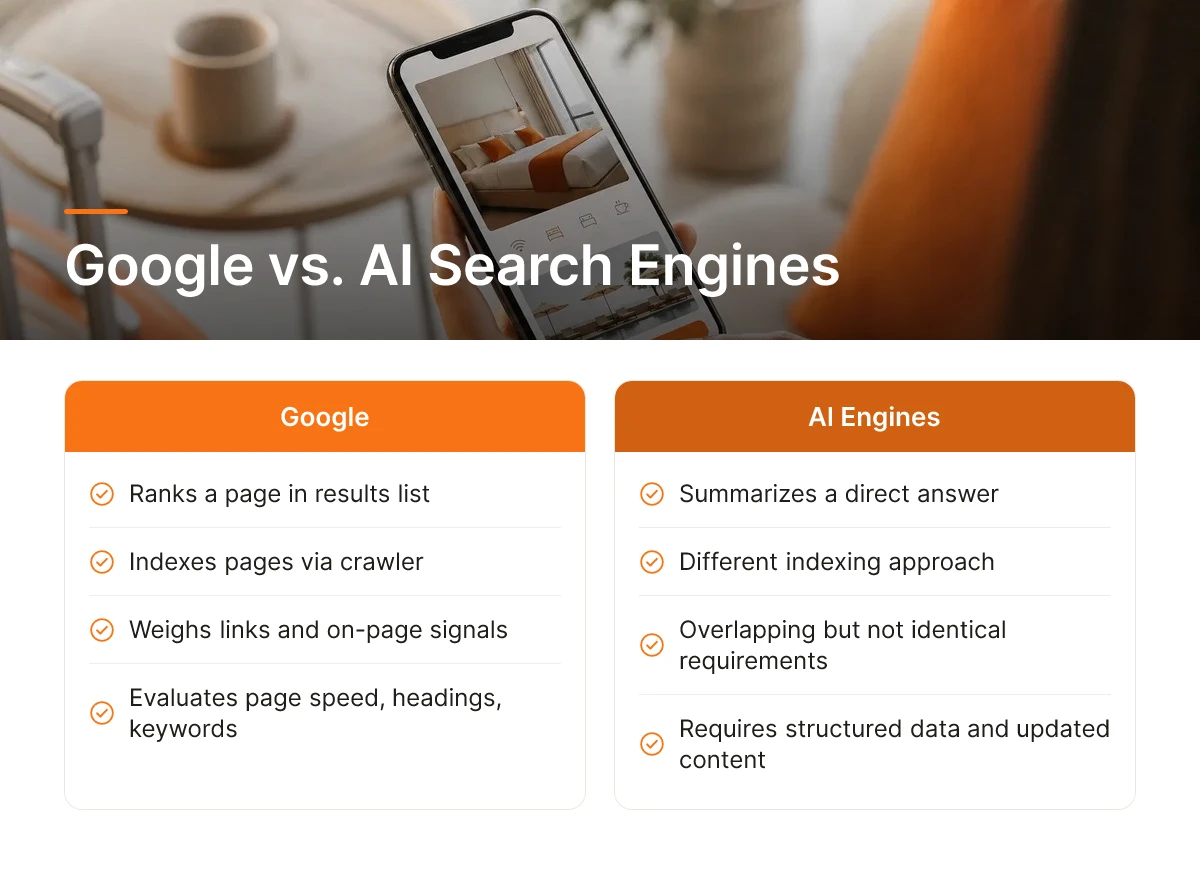
Google ranks a page; AI engines summarize an answer, so mobile seo optimization now means satisfying two different evaluation systems with overlapping but not identical requirements.
How Do AI Search Engines Index and Recommend Hotels Differently Than Google's Mobile Results?
Google's mobile search still works the way it has for years: a crawler indexes your hotel's pages, counts links pointing to them, and weighs on-page signals like page speed, headings, and keyword relevance to decide where you land in the results list [1]. A guest on a phone searching "boutique hotel downtown Austin" gets ten blue links ranked by that system, and your job is to be one of the first three.
AI assistants work differently. Instead of returning a ranked list, ChatGPT, Gemini, Perplexity, and Claude pull facts from several sources at once, your website, but also review platforms, booking sites, and travel guides, and synthesize them into a single recommendation. Google's own guidance on AI-powered search confirms this still depends on the same underlying Search systems, meaning there's no secret "AI SEO" trick separate from solid fundamentals [1]. But fundamentals alone don't guarantee a mention: AI engines favor content that's unambiguous and easy to extract over content that's merely keyword-optimized. A hotel's star rating, cancellation policy, and amenities need to appear as clear, structured facts, not buried in marketing copy, because that's what the AI model can confidently repeat to a traveler without risking an inaccurate answer.
Should My Hotel Use the Same Mobile Strategy for AI Search and Traditional Search, or Separate Approaches?
Hotels don't need two separate playbooks, but they do need to extend their existing one. A fast, mobile-friendly site with accurate contact details, room descriptions, and an updated Google Business Profile [1] still forms the base layer for both systems. Hotel SEO guidance has long emphasized technical performance and accurate listings as prerequisites for visibility [3], and that hasn't changed. Where the paths split is structured data and third-party corroboration. AI engines lean more heavily on schema markup, consistent NAP (name, address, phone) data across directories, and what independent sources, OTAs, review sites, local guides, say about your property [2]. A hotel can rank on page one of Google's mobile results through strong backlinks and page speed, yet never get recommended by an AI assistant if its review profile is thin, its amenities aren't marked up in structured data, or third-party sites describe it inconsistently. That gap is exactly where tools like Moonrank focus: layering schema markup, llms.txt configuration, and citation building on top of the content a hotel already publishes, so AI engines can trust and repeat its facts, not just crawl them.
How Do I Know If My Hotel Is Actually Visible to Mobile Searchers Across AI and Google?
Check two separate things: your mobile rankings in Google Search Console, and whether ChatGPT, Perplexity, or Gemini actually name your hotel when someone asks a travel question. Most hotel owners have only ever checked the first one.
That gap matters because a property can look perfectly healthy on one side of the ledger and be invisible on the other. Mobile seo optimization now means tracking both signals side by side, not treating Google rankings as a stand-in for AI visibility.
What Metrics Should I Track to Measure Mobile Optimization Across AI and Traditional Search?
On the Google side, pull mobile-specific rankings, impressions, and click-through rate from Search Console's Performance report, filtered to the mobile device segment. Watch for queries where you rank on page one but get few clicks, often a sign your listing looks weaker on a phone screen than the sites around it.
On the AI side, there's no dashboard yet, so the metric is simpler and more direct: does the hotel get mentioned by name when someone asks a relevant question? Ask ChatGPT, Perplexity, and Gemini things like "best boutique hotel in [your city]" or "hotel near [landmark]" and note whether your property shows up, how it's described, and whether the details are accurate.
How Can I Audit My Hotel's Mobile Visibility in AI Search Engines Versus Google?
Run the same set of phrases through both channels on your phone and compare the results side by side. Try searches like "hotel near [landmark]" and "[city] boutique hotel" in Google's mobile search, then ask the identical question to an AI assistant, and note where your hotel appears, how it's described, and whether the information is current.
This is where most hotels find the real surprise. A property can rank comfortably on Google mobile search, appearing in the local pack and organic results a traveler sees on their phone [3], while being completely absent from AI answers, or worse, described with outdated room counts, old amenities, or a defunct phone number. That mismatch usually traces back to thin or missing structured content: AI systems rely on clear, well-organized information about your property, and if your site doesn't supply it in a format they can parse, they either skip you or guess, sometimes incorrectly.
Running this audit once is useful. Running it every week across three or four AI platforms, for a dozen key phrases, is not something most owner-operators have time to sustain by hand. That scaling problem is exactly why manual spot-checks only get you so far, and why an automated layer for tracking AI visibility becomes worth considering as the next step.
What Should I Prioritize First for Mobile Discovery Across Search Platforms?
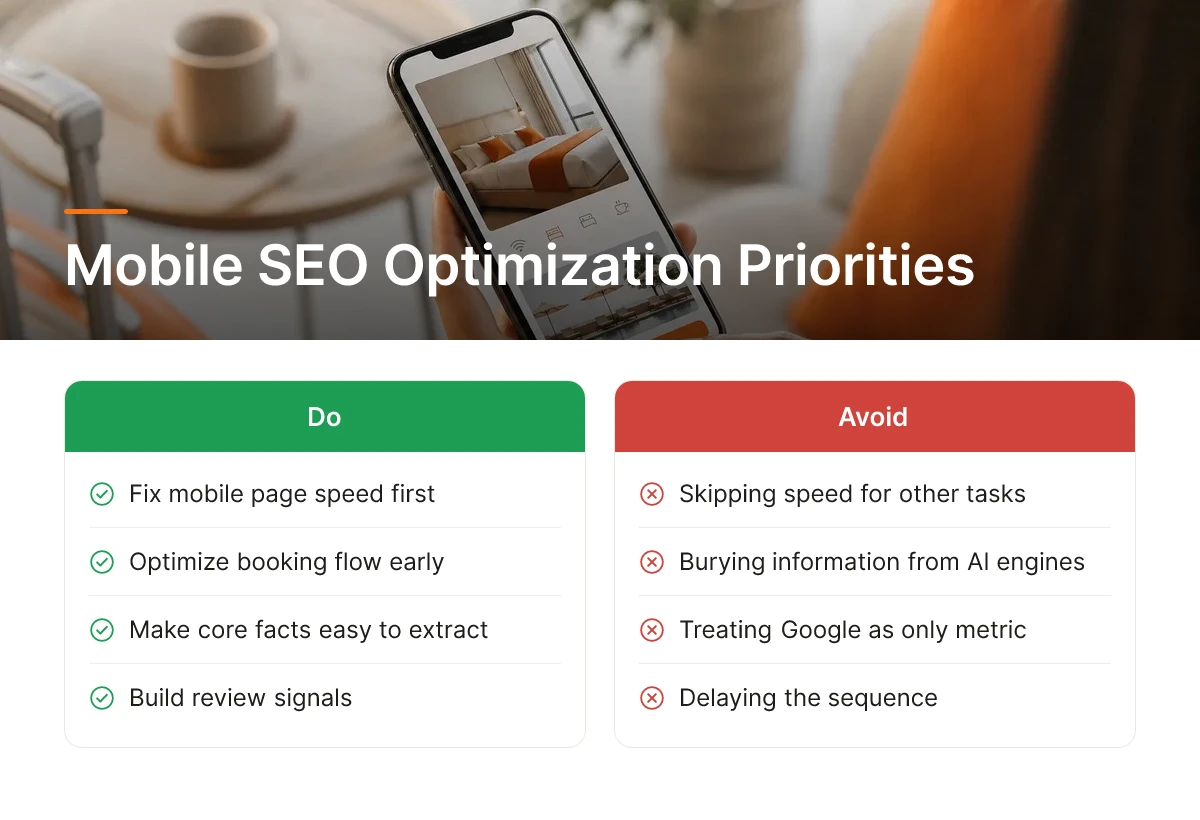
Fix mobile page speed and booking flow first, then make your core facts easy to extract, then build review signals, in that order, before anything else.
Mobile seo optimization for a hotel isn't one task; it's a sequence. Guests and AI engines both reward the same fundamentals, just in different ways, a slow site loses the guest, while messy or buried information loses the AI engine's trust. Working through the sequence in the right order keeps costs low while covering both audiences at once.
What Are the Quick Wins for Mobile Visibility in AI Search Engines Without Expensive Agency Help?
Start with speed and navigation. If a traveler taps through from ChatGPT or Perplexity to your site and the booking calendar takes eight seconds to load on a phone, you lose the reservation no matter how well you ranked to get them there. A clean, fast mobile booking flow is the foundation everything else sits on, no amount of AI visibility work pays off if guests bounce at checkout.
Next, make your factual information easy to lift and quote. AI engines pull specifics, neighborhood, walking distance to landmarks, amenities like a pool or free breakfast, pricing tier (budget, mid-range, or upscale), and cancellation policy, directly from your pages when answering a traveler's question [4]. Write these facts in plain, direct sentences rather than burying them in marketing copy or PDFs, since clear text is what both Google's AI features and other AI engines rely on alongside strong SEO fundamentals [1].
Third, shore up reviews and third-party mentions. AI systems weigh reputation signals from booking platforms and review sites heavily when deciding which property to recommend, and a well-optimized web presence across these channels can be the difference between staying booked and struggling to fill rooms [3]. Responding to reviews and keeping your listings consistent across these sites costs time, not money.
In short, a practical mobile seo optimization sequence for most hotels looks like this:
- Fix mobile page speed and streamline the booking flow
- Rewrite amenity, policy, and location details in clear, quotable sentences
- Add or update schema markup so facts are machine-readable
- Strengthen reviews and keep third-party listings consistent
- Monitor AI assistant mentions alongside traditional mobile rankings
This order matters because AI recommendation visibility for hotels is still wide open, most properties haven't optimized for it yet, so early movers gain ground that's harder to win once competitors catch up. None of these three steps require an agency retainer; a hotel team can handle speed fixes, factual updates, and review management in-house with focused effort before ever spending on outside help.
What Tools Can Automate Mobile SEO Optimization for AI Search Engines?
A growing category of platforms now tracks how a business shows up across AI assistants and traditional mobile search, then fixes visibility gaps automatically instead of leaving an owner to hunt for problems one app at a time.
For a hotel, mobile seo optimization used to mean checking Google rankings and making sure the site loaded fast on a phone. That job has expanded. A guest on a phone might ask Perplexity "best boutique hotel near the convention center" or tell ChatGPT to compare three properties before booking, and if your hotel's structured data is missing or your content hasn't been updated, you simply don't come up. Automation exists to close that gap without adding hours to an owner's week.
How Can I Automate Daily Mobile Optimization Across AI Search Engines Without Managing It Manually?
Automated platforms handle three jobs that would otherwise require constant manual checking: monitoring whether AI assistants mention your property, flagging technical issues like outdated schema markup or missing structured data, and publishing fresh content on a schedule rather than whenever an owner finds time.
Compare that to the manual alternative. A hotel marketing manager trying to track mobile visibility by hand would need to query ChatGPT, Perplexity, and Google separately every day, screenshot the results, and compare them against competitors, then still have no system for fixing what's broken. That's roughly what a hotel SEO strategy already asks of an operator just for traditional rankings [3], before AI search visibility is even part of the job. Few independent hotels have staff time for that, which is part of why hospitality SEO guides increasingly stress ongoing monitoring over one-time fixes [2].
Automated tools instead run the check daily, in the background, and surface only what needs attention, a missing LocalBusiness schema tag, a stale room-rate page, a competitor newly appearing in AI answers where you don't.
Moonrank is built for exactly this kind of ongoing, cross-platform work. It tracks how your hotel appears across ChatGPT, Gemini, Claude, and Perplexity, publishes optimized content automatically every day, and handles the technical layer, schema markup, llms.txt configuration, citation building, that tells AI systems what your property actually offers. None of it requires an owner to write content or touch code. Moonrank is positioned as a budget-friendly alternative to traditional SEO agency retainers, which makes continuous mobile seo optimization and AI visibility monitoring realistic for a single hotel or small chain rather than something reserved for brands with full marketing teams.
If your hotel is losing bookings to competitors that show up when guests ask AI assistants for recommendations, start a trial at www.moonrank.ai and see where you currently stand before fixing anything.

Frequently Asked Questions
Does my hotel need a mobile app to show up in AI search results?
No, a mobile app is not required for AI search visibility. What matters is a fast, well-structured mobile website with accurate business details, clear schema markup, and up-to-date information that AI engines can read and trust. Guests ask ChatGPT or Perplexity for recommendations on their phones, not inside a hotel's app.
How quickly can a hotel see results from mobile SEO optimization efforts?
Most hotels notice early signals within 4 to 8 weeks, though full visibility gains often take longer. Technical fixes like mobile page speed and structured data get indexed fairly fast, but AI engines need repeated, consistent signals before they start recommending a property regularly.
Do online travel agencies affect how AI search engines recommend my hotel?
Yes, OTA listings influence AI recommendations because they're a major source of structured, verifiable information about your property [2]. AI engines cross-reference details like pricing, amenities, and guest reviews across multiple sources. Keeping your OTA profiles and your own mobile site consistent helps AI systems trust and surface your hotel over competitors with mismatched data.
Can a small independent hotel compete with big chains in AI search recommendations?
Yes, independent hotels can compete because AI engines prioritize accurate, well-structured information over brand size alone. A boutique property with complete, consistent details across its mobile site, Google Business Profile, and OTA listings [2][4] can outrank a chain hotel with outdated or conflicting information. Consistency and technical readiness matter more than marketing budget here.
Does mobile seo optimization matter more than desktop optimization for hotels?
Yes, for most hotels mobile seo optimization matters more because the majority of travel searches and bookings now happen on phones rather than desktops. A site that performs well on mobile but is overlooked on desktop still captures most of the booking traffic, while the reverse often costs a hotel real reservations. Prioritize mobile speed, layout, and structured data first.
Conclusion
Mobile search and AI search now run on the same signals: fast-loading pages, accurate business details, and structured data that machines can parse without guesswork [1]. Hotels, ecommerce stores, and SaaS businesses that keep this information consistent across their own site, Google Business Profile, and third-party listings put themselves in a stronger position to get recommended, not just ranked.
The fastest next step is an audit: check whether your mobile site's schema markup, load speed, and business details actually match what's listed everywhere else. Moonrank runs this audit automatically and keeps it current every day, see how your business looks to AI search engines at www.moonrank.ai.
Sources & References
- How to Help Your Business Appear in Google’s AI Search Results | West Geauga Chamber of Commerce
- A Hotelier’s Quick Guide To Hotel SEO Marketing
- Hotel SEO: How To Boost Online Visibility & Bookings | GuestPoint
- What is Hotel SEO? A Guide to Maximize Your Hotel Website’s Visibility | HotelRunner
Recommended Articles
Explore more from our content library: