What On-Page SEO Optimization Means for SaaS Landing Pages
On-page SEO optimization shapes titles, meta descriptions, and headers on SaaS landing pages so AI engines like ChatGPT and Perplexity can cite your product.

Understanding on page seo optimization is essential. On-page SEO optimization for AI search means shaping the elements on your SaaS landing page, titles, meta descriptions, headers, and content structure, so that ChatGPT and Perplexity can understand, trust, and recommend your product. Unlike traditional Google-focused SEO, this prioritizes clear answers in the first 100 words, logical heading hierarchy, and self-contained content blocks that AI engines can extract and cite directly. For resource-constrained teams, this means a small set of high-use fixes rather than a sprawling checklist.
What Is On-Page SEO Optimization for AI Search Engines?
On page seo optimization for AI search engines means writing and structuring page elements so a model can lift them out whole and use them in an answer. ChatGPT and Perplexity do not rank ten blue links and let a user click through, they read a page, extract the parts that answer the query, and synthesize a response in their own words. If your headline, meta description, or first paragraph is vague, there is nothing clean for the model to pull, and it moves to a competitor's page instead.
This is a real shift in what "optimized" means. A page can rank well in Google while reading as useless to an AI engine looking for a quotable passage.
How Does On-Page SEO for AI Search Engines Differ from Google SEO?
Google's ranking algorithm leans heavily on signals that build up over time, backlinks, crawl frequency, click-through history, domain age [4]. On-page elements matter, but they work alongside months or years of accumulated authority signals. AI answer engines work differently: they favor content that is clear, self-contained, and structured well enough to quote directly, regardless of how old the domain is [1]. A well-written, well-structured product page published last week can get cited by Perplexity before an older competitor page ever does, because the model is grading the passage itself, not the site's link history. That is also why format and schema carry as much weight as keyword strategy in AI citation, structure signals meaning in a way raw keyword density never could [1].
Why Do Meta Descriptions, Headers, and Content Structure Matter for AI Search Visibility?
Meta descriptions, headers, and content structure matter because they are the signals an AI model uses to summarize what your product does and who it serves, often without reading the full page. Semantic clarity is one of the core factors generative engines weigh: every page needs to state plainly what it is, who it is for, and what expertise backs it, because large language models do not make complex inferences the way a human reader might [2]. A header that reads "Features" tells a model nothing. A header that reads "How Moonrank Tracks AI Search Visibility Across ChatGPT and Perplexity" gives it something to extract and attribute correctly.
This distinction matters most on SaaS landing pages, where product positioning has to be unambiguous for an AI engine to recommend it accurately. A B2B SaaS tool with blurry, jargon-heavy copy risks being summarized incorrectly or skipped entirely, because the model cannot confidently describe what the product does or who should buy it.
Which On-Page Elements Matter Most When Resources Are Limited?
Fix your title tag, meta description, and top-of-page product summary first, they take an hour combined and shape how AI engines describe you to every user who asks.
A small e-commerce team or a two-person B2B SaaS marketing department can't rewrite an entire site in a week. On page SEO optimization works best as a sequence, not a checklist tackled all at once. The order matters because some elements change how AI engines interpret your entire site, while others only polish a single page.
What On-Page SEO Fixes Deliver the Biggest Visibility Gains for SaaS Landing Pages?
The three highest-use fixes are a one-sentence product description near the top of the page, a descriptive title tag, and a specific meta description. AI answer engines pull from well-structured, authoritative content, and format matters as much as keyword choice [1]. If an AI model can't state what your product does in one sentence, it won't recommend you over a competitor who makes that easy.
LLMs don't make complex inferences, every page needs to state explicitly what it is, who it serves, and what expertise backs it [2]. A vague hero line like "Smart solutions for modern teams" gives a model nothing to cite. "Moonrank tracks your brand's visibility across ChatGPT, Gemini, Claude, and Perplexity and publishes SEO content daily" gives it a quotable fact.
Should You Prioritize Title Tags, Meta Descriptions, or Content Optimization First?
Fix title tags and meta descriptions before touching deeper content, they're the fastest edits and directly shape how AI engines summarize your page in a response.
Both live in your page's HTML head, take minutes to edit in most CMS platforms, and get re-crawled quickly. Title tags and meta descriptions are among the crucial on-page factors that appear directly in a page's source code and influence how search systems understand it [4]. Changing them costs almost nothing and gives you a fast read on whether your summarization in AI tools improves.
Content optimization comes second, and it's heavier lifting: rewriting vague SaaS marketing copy, "helping businesses to reach new heights", into direct, factual statements an AI model can quote, such as naming your exact pricing tier, your category, and the specific problem you solve. Beyond that, a short list of cheap wins can move the needle quickly as part of ongoing on page seo optimization:
- Rename ambiguous headers like "Our Approach" to something literal, such as "How It Works"
- Add a clear use-case list, for example "for Shopify stores" or "for hotel booking pages"
- State the specific problem your product solves in one plain sentence
- Remove jargon that forces the reader, or the model, to guess at meaning
- Add a short FAQ block that mirrors real buyer questions
None of these require a developer, and all of them make your page easier for an AI engine to summarize correctly.

How Do You Structure Landing Page Content to Get Recommended by ChatGPT and Perplexity?
Put the answer first, structure headings around real buyer questions, and keep each paragraph self-contained so an AI model can extract it without surrounding context. This is the part of on page seo optimization that most SaaS teams get backwards, they write for a reader scrolling slowly, not a model scanning for an extractable answer.
How Should You Use Your Target Keyword in the First 100 Words for AI Search Engines?
State what your product does and who it's for within the first 100 words, before any origin story, mission statement, or industry scene-setting. AI answer engines pull from content that identifies itself clearly and fast, semantic clarity about what a page is, who it serves, and what expertise backs it matters more than narrative framing because LLMs don't make complex inferences [2]. If a B2B SaaS landing page opens with three sentences about "the changing world of software," the model has nothing concrete to cite yet.
Write the opening paragraph the way you'd answer a direct question from a prospect: name the product, name the user, name the outcome. For an e-commerce inventory tool, that might read: "This tool syncs Shopify stock levels across warehouses for stores running multiple sales channels." No throat-clearing. The keyword or core offer phrase should appear naturally in that first block, not forced in as an afterthought. Effective on page seo optimization at this stage is less about keyword placement and more about stating facts a model can lift verbatim.
What Content Structure and Heading Hierarchy Works Best for AI Search Engine Indexing?
Use one H1 that states the core offer plainly, then H2s that each answer a single, distinct question a buyer or an AI model might ask. Structured headers that match query patterns help AI systems map your content onto the questions users are actually typing or speaking into ChatGPT or Perplexity [1]. Avoid vague H2s like "Our Approach", write them as questions or direct statements, the same way this article's own headings work.
Under each H2, write short, self-contained paragraphs where each one fully answers its question without requiring the reader to have absorbed the three paragraphs before it. Long flowing narrative copy forces an AI model to stitch meaning across sentences, which increases the chance it skips your page for a competitor's cleaner answer. Format and clarity now carry as much weight as keyword strategy did in older SEO practice [1].
Close the page with an FAQ section that mirrors the exact questions AI engines are trying to resolve for searchers, "What does this integrate with," "Is there a free trial," "How is this different from an agency." This section-by-section layout is exactly what Moonrank's content automation builds into every page it publishes, pairing answer-first copy with the schema markup and structured data that help AI engines parse and trust the page without manual editing from the business owner.
What's the Fastest Way to Audit and Fix On-Page SEO for AI Visibility?
The fastest audit takes 30 minutes: read your top five pages like a skeptical AI model would, then ask a model directly what it thinks each page is about.
Small teams don't need an enterprise SEO suite for this. A founder, a Shopify owner, or a solo B2B marketer can run this process with a spreadsheet and two browser tabs, one open to the page, one open to a chatbot. A simple step-by-step version of this on page seo optimization audit looks like this:
- Open your top five landing pages and read only the title, meta description, and first paragraph of each
- Ask an AI model directly what it thinks each page's product does and who it's for
- Compare the model's answer to your actual positioning and note any gaps
- Rewrite the weakest title tags, meta descriptions, or opening paragraphs first
- Re-run the same prompts a week later to confirm the fix changed the model's summary
What On-Page SEO Mistakes Are Hurting Your AI Search Visibility Right Now?
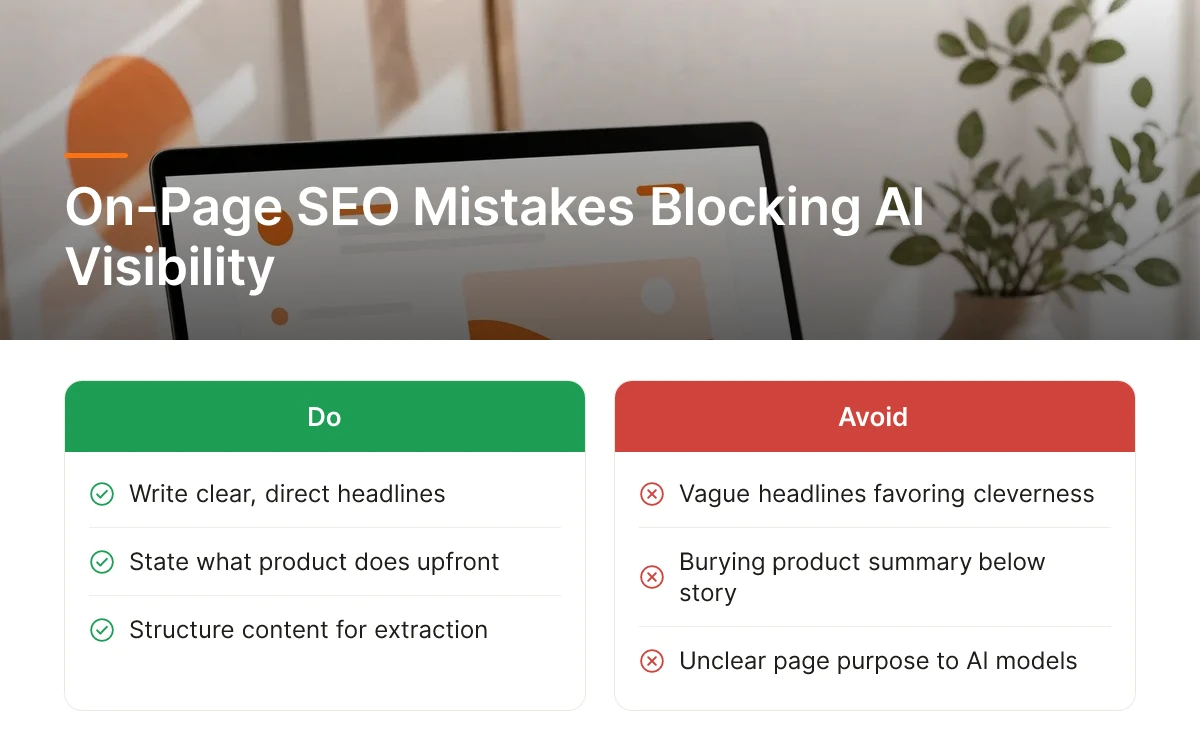
Four mistakes show up constantly on SMB pages, and each one blocks an AI model from understanding what you sell. Vague headlines that favor cleverness over clarity, "rethink Your Workflow" tells a model nothing about what the product does. Buried product descriptions that sit three scrolls down instead of in the first 100 words, where both crawlers and readers look first. Missing or generic meta descriptions, often just the site name repeated, that waste a chance to state positioning in plain language. And walls of unstructured text with no headers, lists, or clear sections, which make it hard for a model to pull a clean answer to cite.
Every page must state explicitly what it is, who it's for, and what expertise backs it, because language models don't make complex inferences the way a human reader does [2]. If a visitor has to scroll and guess, so does the model, and it will just cite a competitor who made the answer easier to find.
How Do You Measure On-Page SEO Success When Optimizing for AI Search Engines?
Success means showing up in the actual answer, not climbing a traditional rank position that AI search engines don't display. Run the prompts a real customer would type, "best project management tool for a 10-person team," "top boutique hotel in [city]", into ChatGPT and Perplexity, and check whether your brand gets named. Compare that answer against how you'd describe your own positioning. If the model's summary misses your core differentiator or omits you entirely, that's your fix list.
This manual check is the cheapest diagnostic available for on page seo optimization aimed at AI visibility, and it works without any paid tool. Track results over time in a simple log: prompt, date, whether you appeared, and what the model said about you.
Recheck after you publish a meaningful content change, not on a fixed weekly calendar, since AI engines re-crawl and re-index on their own schedule and a rigid cadence either wastes time or misses changes. Moonrank's AI search visibility tracking automates this comparison across ChatGPT, Gemini, Claude, and Perplexity, so a business owner sees shifts in brand mentions without manually re-running prompts after every edit.
How Can Automation Help You Optimize On-Page SEO at Scale?
Automation replaces the one-time manual audit with a system that checks title tags, meta descriptions, and content structure every day against what AI engines are actually citing right now.
A manual approach treats on page seo optimization as a project with a start and end date. Someone audits the page, fixes the headers, rewrites the meta description, and moves on. The problem is that AI answer engines like ChatGPT and Perplexity re-crawl and re-weigh sources continuously, not once a quarter [1]. A page that matched citation patterns in January can fall out of favor by March if a competitor restructured their content or a model update changed what counts as a well-formed answer. Static optimization decays. Automated monitoring doesn't.
What On-Page SEO Tools and Automation Can Replace Expensive Agency Work?
Automation replaces the slow, billable-hour cycle of agency audits with always-on checks that catch drift the moment it happens. A traditional agency workflow runs on a retainer: a strategist reviews your site, delivers a report, and schedules changes weeks later. That cadence made sense when Google's index updated slowly. It doesn't match how often AI engines re-index and re-rank content [3]. Automated tools instead run the same checks, header structure, answer clarity, entity consistency, on a schedule measured in days, not quarters, at a cost structure that is typically far more budget-friendly than an ongoing agency retainer. For a Shopify store or a B2B SaaS team without an in-house SEO hire, that gap in speed and cost is usually the deciding factor.
How Does Moonrank Automate On-Page Optimization for AI Search Engine Recommendations?
Moonrank runs three jobs on autopilot: it tracks how your business shows up across ChatGPT, Gemini, Claude, and Perplexity, publishes optimized content to your site on a daily schedule, and flags on-page issues, a weak title tag, a missing header structure, thin content, before they cost you a citation. Instead of a single technical audit, Moonrank applies schema markup, llms.txt configuration, and structured data continuously, so the signals AI crawlers rely on stay current as those systems change what they reward [2]. No writing, no manual publishing, no waiting on an agency's next sprint.
If your on-page work currently depends on a periodic audit or a freelancer's to-do list, that's the gap worth closing first. Try Moonrank at www.moonrank.ai for ongoing, hands-off on-page optimization instead of a one-time fix that starts aging the day it's delivered.

Frequently Asked Questions
Does on-page SEO optimization for AI search engines replace traditional SEO for a SaaS landing page?
No, it builds on traditional SEO rather than replacing it. Clean title tags, fast load times, and clear headers still matter for Google [4]. But AI answer engines add new requirements on top: semantic clarity, schema markup, and content structured for citation rather than just keyword matching [1][2].
How often should you update landing page content to stay visible in AI search results?
Review and refresh core landing pages at least monthly, since AI engines favor current, well-maintained content over stale pages. Competitors publishing fresh material regularly gain an edge in citation frequency. Moonrank addresses this with daily automated content publishing, so updates happen without manual effort from the business owner.
Can a small SaaS team realistically compete with larger competitors on AI search visibility?
Yes, AI engines reward clarity and structure over brand size or ad budget. A well-structured page from a small SaaS company can get cited over a larger competitor's vaguer content [2]. The bigger constraint is usually time and consistency, which is why automated tools like Moonrank exist for teams without dedicated SEO staff.
What's the difference between optimizing a blog post and optimizing a SaaS landing page for AI engines?
A blog post optimizes for answering a specific question in depth, while a landing page optimizes for clearly stating what the product does, for whom, and why to trust it [2]. Landing pages need tighter semantic clarity upfront, AI engines don't infer; they need the value proposition stated directly in the first few lines [2].
Do you need technical SEO skills to do on page seo optimization for AI search?
No, most of the highest-impact work, rewriting title tags, meta descriptions, headers, and opening paragraphs, requires no coding or technical background. Basic schema markup and llms.txt configuration benefit from technical help but aren't strictly required to start. Many small teams handle the content-level fixes themselves and only bring in technical support, or an automated tool, for the structured data layer.
Conclusion
On-page SEO optimization for AI search now means writing for citation, not just rankings: clear headers that match how people phrase questions, schema markup that tells AI engines exactly what your SaaS product does, and content refreshed often enough to stay current [1][2]. Start with one page, your homepage or top pricing page, and rewrite the opening paragraph to state plainly what you do and for whom.
If maintaining that pace manually isn't realistic for your team, Moonrank handles the daily content publishing and technical optimization automatically, then tracks how your business shows up across ChatGPT, Gemini, Claude, and Perplexity. Visit moonrank.ai to see where your SaaS currently stands in AI search.
Sources & References
- How to Optimize SaaS Content for AI Search and Answer Engines in 2026
- How do you optimize a website for ChatGPT and Google AI? • Bonhomme
- AI Search Content Optimization: The Updated Guide
- On-Page SEO Guide: How to Optimize Landing Pages for Search - Portent
Recommended Articles
Explore more from our content library: