Why My Website Is Not Ranking and What to Do About It
Your website isn't ranking in AI search because ChatGPT, Perplexity, and similar tools recommend sources differently than Google does — they pull from...

Understanding why my website not ranking is essential. Your website isn't ranking in AI search because ChatGPT, Perplexity, and similar tools recommend sources differently than Google does, they pull from indexed, crawlable content that clearly answers a specific question, carries structured data they can parse, and shows consistent authority signals across the web. If your site has indexing gaps, thin or vague content, missing schema markup, or little third-party mention, AI engines have nothing reliable to cite. Fixing visibility means addressing technical access, content clarity, and authority signals together, not just traditional keyword rankings.
Why My Website Is Not Ranking in AI Search Results
Most site owners asking why my website not ranking in ChatGPT or Perplexity assume it's one broken thing, but it's usually a combination of four separate problems stacking on top of each other.
A site can rank on page one of Google and still be completely absent from an AI-generated answer. That's because Google and AI search engines don't work the same way. Google crawls and ranks a massive index of pages for a given query. AI engines like ChatGPT and Perplexity pull from a far more selective pool of sources when constructing an answer, favoring pages they can parse quickly, trust immediately, and cite with confidence [1]. Being indexed by Google says nothing about whether an AI engine considers your page reliable enough to reference.
What Are the Main Reasons AI Search Engines Don't Recommend Certain Websites?
The causes generally fall into four buckets, and most visibility problems trace back to one or more of them.
- Indexing and crawlability: if search engines (AI or traditional) can't access or index your pages, nothing downstream matters [1].
- Technical structure: missing or malformed schema markup, the structured data that tells search engines exactly what a page is about, leaves AI engines guessing instead of citing [1][2].
- Content clarity: pages that ramble instead of answering one specific question directly give AI engines nothing clean to extract [1][2].
- Authority and mentions: if no other sites reference your business consistently, AI engines have no corroborating signal that you're a trustworthy source [2].
Schema markup deserves particular attention here. Without it, a page about, say, a boutique hotel's cancellation policy might read clearly to a human but look like an undifferentiated block of text to an AI crawler trying to match a query to an answer. Structured data acts as a label, it tells the engine "this is a FAQ," "this is a product," "this is a local business with these hours", and its absence is one of the most common and most fixable reasons a well-written page still gets skipped.
How Do I Diagnose Whether Indexing, Technical, Content, or Authority Issues Are Blocking AI Recommendations?
Run three quick checks before assuming the problem is complicated.
- Indexing: search your exact page URL on Google to confirm it's indexed at all. If it's not there, nothing else in this list matters yet.
- Content clarity: open the page and ask whether it answers one clear question in the first few sentences, or whether a reader has to dig for the point [2].
- Authority: search your brand name plus your category and see whether independent sites, directories, or review platforms mention you at all [2].
This three-step audit won't fix anything by itself, but it tells you which of the four buckets to prioritize, and that's the difference between guessing and actually solving why my website not ranking in AI search.
How Do AI Search Engines Decide Which Websites to Recommend?
AI search engines pull facts from several sources at once to build a single answer, rather than ranking ten blue links, so being easy to extract and quote matters more than hitting a keyword a certain number of times.
Google's model asks "which page deserves the top spot." ChatGPT, Perplexity, and Gemini ask "what's the most accurate, well-supported answer I can assemble right now, and which sources back it up." That shift explains a lot of the confusion behind why my website not ranking in AI results even when it still performs fine in classic search.
What Ranking Factors Matter Most for AI Search Engine Visibility Right Now?
Three things carry the most weight: whether the content can be parsed cleanly, whether it answers the actual question near the top of the page, and whether other sources confirm the same facts about the business.
- Structured, extractable content. Clear headings, direct answers in the first sentence or two, and clean formatting let an AI system lift a fact without guessing at context. A page that buries the answer under three paragraphs of preamble is harder to quote than one that states it plainly.
- Structured data markup. Schema markup, the structured data that tells AI engines exactly what a business does, where it's located, and what it offers, gives these systems a machine-readable shortcut instead of forcing them to infer meaning from prose.
- Cross-site consistency. If a business's name, services, and details read the same way on its own site, its directory listings, and third-party mentions, AI systems treat that agreement as a trust signal [2]. Contradictions, different service descriptions on different platforms, do the opposite.
How Do AI Search Engines Evaluate Content Quality and Authority Differently Than Google?
AI engines weigh corroborated, well-structured answers and consistent brand mentions more heavily than raw backlink volume.
Google's authority model leans heavily on links: the more sites that point to a page, the more it's treated as a vote of confidence. AI search engines still value credibility, but they build it from a broader set of trust signals, consistency of information across multiple sites, content that directly answers real customer questions, and freshness, since outdated details get skipped in favor of something more current [1]. A page can rank reasonably well on Google through link equity alone and still get ignored by an AI system if its answers are vague, scattered across the page, or contradicted elsewhere online [2]. This is also where a tool like Moonrank fits the gap, it builds schema markup, llms.txt configuration, and citation consistency into a site automatically, rather than leaving a business owner to figure out AI-readability fixes manually.

What's the Difference Between Ranking in Google and Getting Recommended by AI Search Engines?
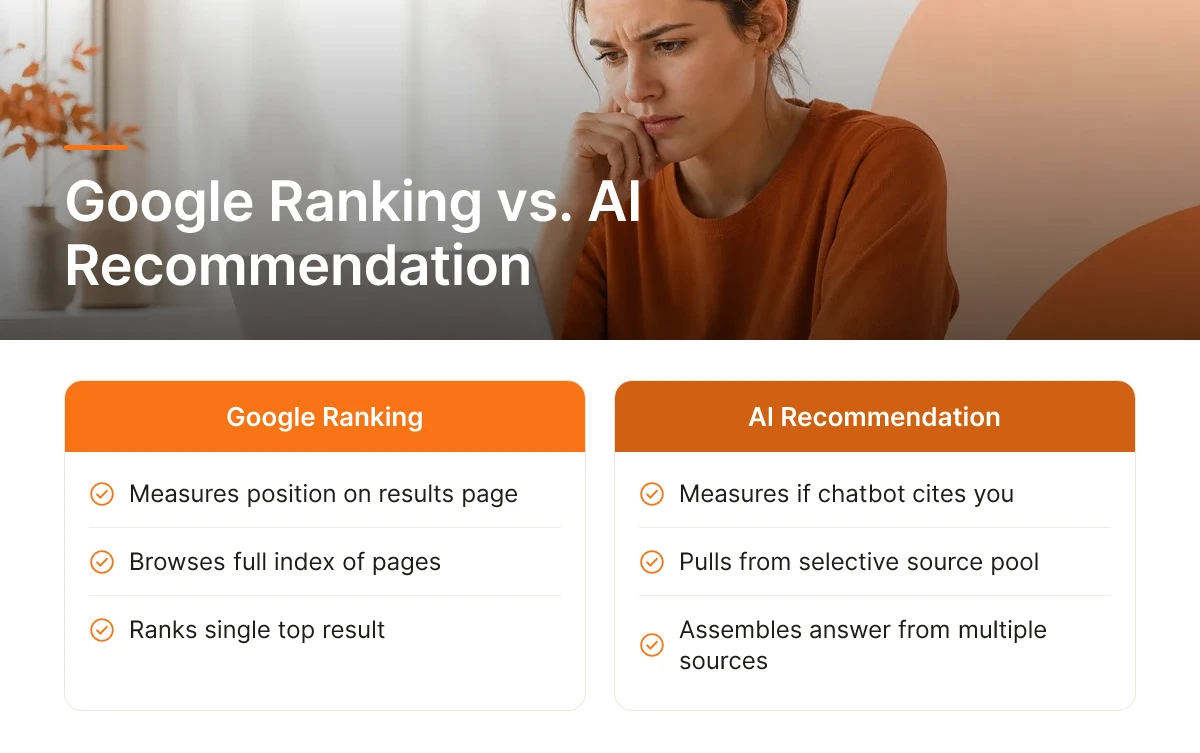
Google ranking measures position on a results page; AI recommendation measures whether a chatbot cites you as the answer, and the two use different inputs entirely. A business can dominate one and be invisible in the other, which is the root cause behind many "why my website not ranking" searches that start on Google and end up pointing at ChatGPT or Perplexity instead.
Can a Website Rank Well on Google but Still Not Get Recommended by AI Search Engines?
Yes, a page-one Google position guarantees nothing in AI search because these tools don't browse results the way a person does. Google ranks a full page against a query using hundreds of signals, including backlinks and click behavior. ChatGPT and Perplexity instead sample a narrower set of sources, often favoring content that answers a question in a self-contained paragraph they can quote directly [1]. A plumbing company might rank third on Google for "emergency plumber near me" and still never get mentioned when someone asks ChatGPT the same thing, because the AI tool pulled its answer from a competitor's clearer, more directly quotable service page [2].
What Optimization Strategies Work for AI Search Engines but Not Traditional Search?
Link-building and keyword density produce diminishing returns for AI visibility, while clear, structured, directly-answerable content produces outsized gains. Traditional SEO tactics were built around persuading a crawler to rank a whole page. AI search engines instead extract and reassemble fragments, so a page stuffed with keywords but short on plain-English answers often gets skipped entirely, regardless of its backlink profile [1]. Writing for AI visibility means shifting from "rank the page" to "answer the question", short, self-contained passages that state the fact, the price range, or the service area without requiring the reader to scroll. Worcester Interactive's research on local business visibility makes a similar point: businesses that clearly explain their services and answer real customer questions get selected by AI tools more often than those that merely rank well [2].
None of this makes Google SEO and AI visibility opposing goals. Both systems still reward genuine topical authority, accurate business information, and site credibility, they just weight those signals differently [3]. A site with thin content and no real expertise will eventually struggle in both channels; the difference is which signals get prioritized first.
What Fixes Actually Improve Your Visibility in AI Search Results?
Fixing why my website not ranking in AI search comes down to five concrete changes: crawlability, schema, single-answer page structure, third-party citations, and competitor gap analysis.
None of these fixes work in isolation. Skip one and the others lose much of their effect, a perfectly structured page an AI crawler can't reach is invisible regardless of content quality.
How Do I Audit What Top-Recommended Competitors Have That My Site Is Missing?
Ask ChatGPT or Perplexity the exact question your customers would ask, "best CRM for a 10-person sales team" or "most reliable fulfillment partner for Shopify stores", and study whoever gets named. Check their pages for three things: structured data in the page source, a direct one-sentence answer near the top of the relevant page, and mentions of their brand on sites you don't own, like directories, review platforms, or comparison articles [2]. Worcester Interactive's research frames this plainly: a strong Google ranking does not guarantee an AI mention, because these engines weigh business-detail consistency and competitor presence differently than traditional ranking factors [2]. If a competitor's name, address, and service descriptions match exactly across ten sites and yours match on three, that gap is often the deciding factor.
Which Technical Optimizations and Content Changes Have the Biggest Impact on AI Search Recommendations?
Start with crawlability, robots.txt rules that don't block key pages, a submitted and current sitemap, and a server that responds quickly and consistently, because no content or schema fix matters if AI crawlers can't reach the page in the first place [1]. From there, add or correct schema markup: Organization, Product, Service, and FAQ schema tell AI engines exactly what entity they're looking at, what it offers, and what question each page answers. Next, restructure pages around one clear question per section instead of long, meandering copy. AI engines extract passages, not entire articles, so a page that answers "what does this product cost" in one tight paragraph gets pulled far more reliably than a page that buries the answer in paragraph six [1][3]. Finally, build consistent mentions across third-party sites, directories, industry publications, review platforms, since these external citations are a trust signal AI engines check before recommending a business [2]. An ecommerce brand with accurate schema, a sitemap AI crawlers can actually parse, direct-answer product pages, and a dozen consistent external mentions is doing what it takes to move from invisible to recommended. Moonrank automates this exact combination, schema markup, llms.txt configuration, citation building, and daily published content, so a business doesn't have to run this audit manually every month.
How Long Does It Take to See Results After Fixing Your AI Search Visibility?
Most businesses see technical fixes reflected within a few weeks, but actual re-recommendation by ChatGPT or Perplexity can take two to three months to show up consistently.
The gap confuses a lot of business owners typing "why my website not ranking" into Google the week after they fix their schema markup and expecting instant results. AI engines don't operate on Google's indexing clock. Google can re-crawl a page in days; an AI engine's underlying knowledge may only refresh on a slower cycle, and even after it ingests your updated content, the model still has to decide your business deserves a mention the next time someone asks a relevant question. Re-crawling and re-recommendation are two separate events, and the second one lags the first.
What's a Realistic Timeline for Re-Indexing and Re-Recommendation After Implementing Fixes?
Think of it in three phases rather than one single moment of "fixed." Technical changes, structured data, a corrected llms.txt file, cleaned-up crawlability, tend to surface first, because they remove barriers that were blocking access rather than building new trust from scratch. That's usually visible within the first few weeks after a re-crawl.
Content and authority signals move slower. Publishing content that directly answers customer questions, building citations, and keeping business information consistent across the web are cumulative processes, they compound rather than flip a switch. Expect the first measurable shift in AI-generated answers around four to eight weeks, with fuller recovery often taking a full quarter or more, especially in competitive categories like hotels or B2B SaaS.
How Do I Track Whether My Changes Are Improving My AI Search Visibility?
Set up a simple, repeatable check rather than waiting for traffic reports to tell the story weeks later. Run the same set of prompts in ChatGPT and Perplexity every one to two weeks, "best [your category] in [your city]," "top [your service] for [use case]", and log whether your business appears and how it's described.
Alongside that, watch two quantitative signals: referral traffic from AI platforms in your analytics, and the frequency of direct brand mentions in AI-generated answers over time. A rising trend in either is a stronger signal than a single good result.
This is the layer Moonrank is built around, it runs the same visibility checks automatically across ChatGPT, Gemini, Claude, and Perplexity, so you can see whether your fixes are compounding instead of guessing. Combined with daily published content and maintained structured data, the gains tend to build month over month rather than arrive as a one-time bump.

Frequently Asked Questions
Does fixing AI search visibility also help my Google rankings?
Yes, in most cases, the two overlap more than they conflict. Clear site structure, fast load times, and content that directly answers customer questions help both Google's crawlers and AI engines like ChatGPT and Perplexity parse your site [1]. Structured data and fresh, specific content tend to support both goals at once, so fixing one rarely hurts the other.
Can a brand-new website get recommended by AI search engines quickly?
It's possible but not guaranteed, AI engines favor sites with credibility signals, not just age. A new site with accurate business details, clear schema markup, and content that answers real customer questions can get cited faster than an older site with thin or inconsistent information [2].
Do I need a developer to add schema markup for AI search visibility?
Not necessarily, many platforms offer plugins or built-in tools for basic schema, though complex setups may still need technical help. Schema markup is structured data that tells AI engines exactly what your business does, and getting it wrong can cause more harm than skipping it. Moonrank handles this automatically as part of its technical optimization, so business owners don't touch code.
Why does my competitor get cited by ChatGPT when their content looks thinner than mine?
Thinner content can still win if it's more accessible, better structured, or matches the exact phrasing of customer questions. AI engines prioritize content they can parse and trust over content that's simply longer [1]. Your competitor's business details may also be more consistent across the web, which strengthens credibility signals that AI search tools weigh heavily [2].
Conclusion
A website that doesn't appear in ChatGPT or Perplexity usually has a fixable problem: AI engines can't access the content, the content doesn't answer real customer questions, or the technical signals, schema markup, consistent business details, structured data, are missing or outdated. Start by auditing whether your site's information is current and whether it directly answers the questions your customers actually ask.
If you'd rather not manage daily content updates and technical fixes manually, Moonrank handles AI search optimization on autopilot, publishing content, fixing technical gaps, and tracking your visibility across ChatGPT, Gemini, Claude, and Perplexity for $99/month.
Sources & References
- 5 Ways to Fix Your Website Visibility in AI Search | Kuroma Blog
- Why Isn’t My Business Showing Up in AI Search Results?
- 5 Reasons Your Website Isn't Ranking (And How To Improve Them) | Digital Marketing Institute
Recommended Articles
Explore more from our content library: