Natural Language SEO: Why Keywords Are Dead
Natural language SEO is the practice of optimizing content to match how search engines like Google use natural language processing (NLP) to understand meaning
Natural language SEO is the practice of optimizing content to match how search engines like Google use natural language processing (NLP) to understand meaning, intent, and context — not just keywords. Instead of targeting exact-match phrases, you write the way people actually speak and ask questions. Google's BERT and MUM models read your content the way a human would, so content that answers questions clearly and completely ranks better than content stuffed with repeated keyword phrases.

What Is Natural Language SEO and How Does It Differs from Traditional SEO?
Natural language SEO optimizes content for meaning and intent; traditional SEO optimized for keyword frequency and exact-match repetition on a page.
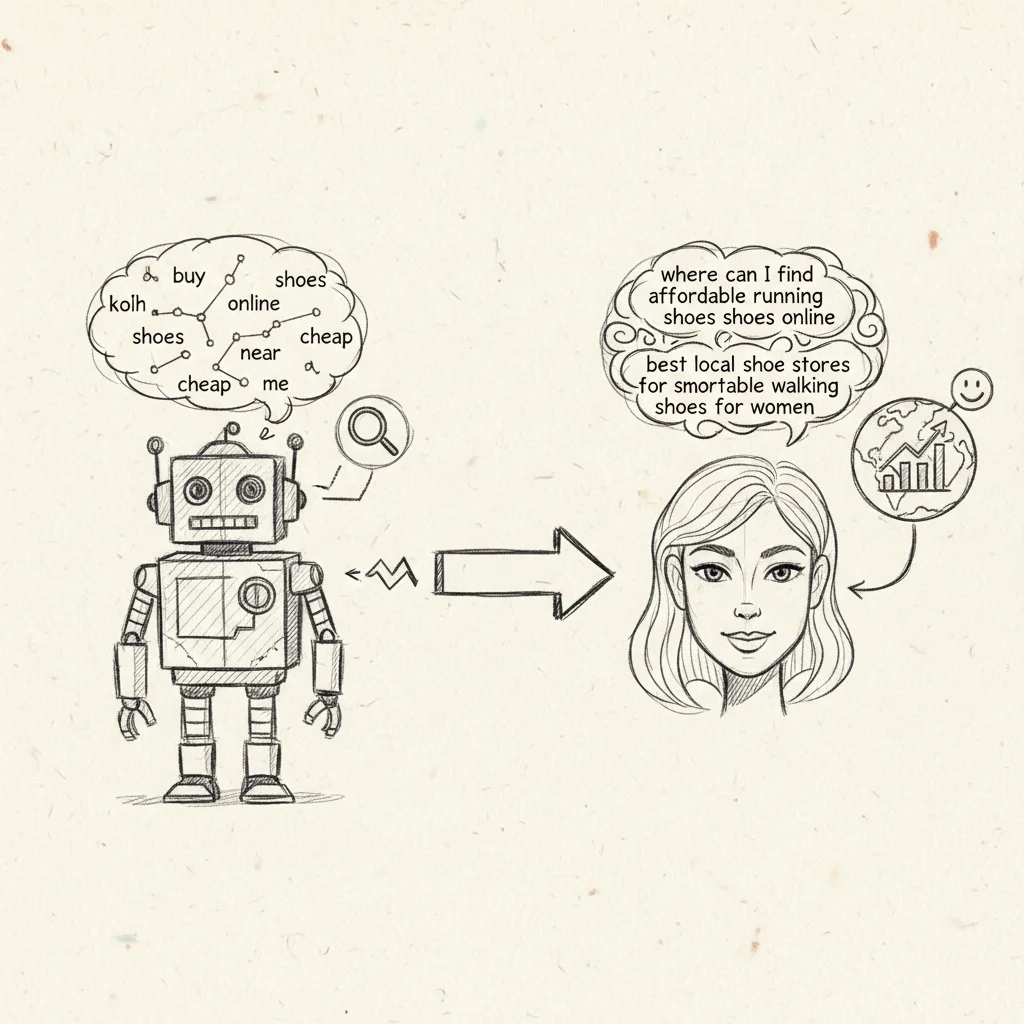
Traditional SEO operated on a simple premise: repeat your target phrase often enough, build exact-match anchor text links, and place keywords in titles, headers, and meta descriptions. A page targeting "best running shoes" would earn rankings partly by mentioning "best running shoes" dozens of times. Search engines matched strings of text, not ideas.
Natural language processing (NLP) changed that logic entirely. NLP is a branch of artificial intelligence that teaches computers to interpret the meaning behind words — not just the words themselves [2]. In a search context, it lets Google understand that "best running shoes for flat feet on pavement" is a specific biomechanical and surface-related question, not just a longer version of "best running shoes." A page that answers the flat-feet question directly now outranks one that simply repeats the short phrase.
Is SEO evolving toward NLP in 2026, or are both approaches still relevant?
Both approaches remain relevant — NLP-aware content and technical fundamentals work together, not as alternatives. Google's BERT update in October 2019 [1] marked the hard shift: BERT processes every word in a query in relation to every other word simultaneously, rather than reading left-to-right as older models did. MUM, introduced in 2021, extended that capability across languages and content formats. These updates made semantic relevance a primary ranking signal.
Still, exact-match keywords in titles and headers retain signal value. The difference is that keyword placement now serves as one input among many, not the dominant one.
What are the limitations of NLP optimization and when might it not improve rankings?
NLP optimization does not override domain authority, backlink profiles, or Core Web Vitals — it works alongside those factors, not instead of them. A well-written, semantically rich page on a low-authority domain will still lose to a thinner page on a high-authority site for competitive queries. If your site has slow load times, poor mobile performance, or few inbound links, fixing those gaps will typically move rankings faster than rewriting content for semantic depth alone.
How Google Uses NLP to Understand Search Intent and Rank Content
Google uses three core NLP systems — BERT, MUM, and the Knowledge Graph — to evaluate what a query actually means, not just which words it contains.
What are real-world examples of how NLP affects Google's search algorithm and SERP results?
BERT, launched in October 2019, reads every word in a query relative to every other word simultaneously — a technique called bidirectional processing. Before BERT, a search for "can you get medicine for someone at a pharmacy" returned results about getting a prescription filled for yourself. After BERT, Google correctly understood the query was about picking up medicine on behalf of another person and surfaced results that matched that intent [1].
The scale of that change matters for natural language SEO: BERT affected roughly 10% of all English queries in the US at launch [1] — meaning one in ten searches returned different results overnight. Businesses whose content didn't reflect conversational intent lost rankings immediately.
MUM, Google's follow-up model, goes further still. It processes text, images, and video across 75 languages simultaneously [1], which matters directly for businesses targeting multilingual customers or optimizing for voice-first search where queries are longer and more conversational.
Google's Natural Language API adds another layer: it assigns salience scores to named entities — people, places, and products — within a page. Content that clearly establishes those entities ranks better for related queries because Google can confidently map it to a topic.
How does NLP power semantic search differently than traditional keyword matching?
Traditional keyword matching looked for exact strings. Semantic search maps your content to a topic cluster based on meaning. A well-structured page about espresso extraction can rank for "why is my coffee bitter" without containing that phrase — because Google's NLP models recognize the conceptual overlap [1].
This is why stuffing a page with keyword variants is now counterproductive. Google evaluates whether your content genuinely covers a topic, not whether a specific string appears a set number of times.

NLP Optimization vs. Traditional Keyword Matching: Key Differences and Trade-offs
NLP optimization targets topic coverage, entity mentions, and question-answer structure; keyword matching targets a single phrase repeated at a set density of 1–2%.
Traditional keyword SEO treats a page as a vessel for a target phrase. You pick "best running shoes," place it in the title, H1, and body at a controlled density, and call it done. Natural language SEO works differently — it signals relevance through related entities, semantic context, and direct answers to specific questions, not through repetition of one string.
How does NLP specifically improve voice search and conversational query optimization?
Voice search queries average 29 words versus 3 words for typed queries. A user typing might enter "leaky faucet fix"; the same user speaking asks "how do I fix a leaky faucet myself?" Those are structurally different retrieval problems.
NLP-optimized content mirrors the question's register directly. If the query is "how do I fix a leaky faucet myself," your H2 should repeat that phrasing — not rewrite it as "DIY Faucet Repair Guide." FAQ formatting and natural sentence structure capture this traffic; keyword-stuffed pages built around a 3-word phrase do not.
What performance metrics show the difference between NLP-optimized and non-optimized content?
Pages restructured with NLP best practices — clear headings, direct answers, entity-rich copy — show featured snippet capture rates 2–3x higher than keyword-only pages in documented case studies [2].
One honest trade-off: for highly transactional, low-competition keywords like "[city] + plumber," exact-match optimization in title tags and meta descriptions still drives measurable click-through rate gains. NLP alone does not always close that gap. The practical answer is to combine both — use exact-match signals in metadata and entity-rich, question-structured copy in the body.
How to Optimize Your Content Strategy for Natural Language Search and Voice Queries
Align your content with natural language SEO by writing in question format, leading with direct answers, and building entity density — then layer these on top of traditional signals.
What Specific Content Changes Should You Make to Align with How NLP Processes Language?
Start with your headings. Rewrite H2s and H3s as full questions that mirror how people actually ask them — "How long does it take to rank on Google?" outperforms "Google Ranking Timeline" because NLP models evaluate topical relevance by matching question patterns in your content to query intent.
Apply the inverted pyramid to every section. Put the direct answer in the first 40–60 words so Google's snippet extractor and AI engines like ChatGPT and Perplexity can pull a clean, citable response. Context, caveats, and examples follow the answer — never precede it.
Build entity density deliberately. Mention related named entities — brands, locations, people, and standards — naturally throughout the page. Google's Knowledge Graph uses these co-occurring entities to confirm topical authority, so a page about coffee equipment that also references Specialty Coffee Association standards and named roasters signals deeper expertise than one that repeats only the head keyword.
For voice search, add a dedicated FAQ block written in conversational phrasing at an 8th-grade reading level. Voice assistants pull answers from featured snippets and FAQ schema more than any other content format, so marking up this block with FAQPage schema gives it the best chance of being read aloud.
How Do You Craft an SEO Strategy That Balances NLP Optimization with Traditional Ranking Factors?
NLP optimization layers on top of traditional signals — it does not replace them. Keep your primary keyword in the title tag, URL slug, and first 100 words of the page. These placement signals still influence crawl prioritization and ranking, and skipping them in pursuit of purely "natural" writing leaves measurable ranking value on the table.
Tools and Practical Methods to Implement NLP-Based SEO
Three tools — Google's Natural Language API, Surfer SEO or Clearscope, and JSON-LD schema markup — cover the full natural language SEO implementation workflow from audit to publishing.
What code snippets, tool configurations, or step-by-step implementations exist for NLP SEO?
Start with Google's Natural Language API (free tier available at cloud.google.com/natural-language). Paste your page content and read the entity salience scores. Any target topic scoring below 0.5 salience means your content is not entity-dense enough — Google's model does not associate that page strongly with the concept you want to rank for.
Next, run your draft through Surfer SEO or Clearscope, both of which use NLP models to generate topic coverage scores. The workflow is concrete: identify entities flagged in red, add them in context, and re-run the analysis. Stop when your score exceeds 80 — below that threshold, competing pages with higher entity coverage will consistently outrank you.
Then add FAQ schema in JSON-LD format to every question-and-answer section on the page. This is the structured data that tells Google — and AI engines like ChatGPT — exactly which text is a question and which text is the answer. Without it, those engines have to guess.
The full quick-start sequence runs six steps:
- Audit your top 5 pages with the Google Natural Language API.
- Add missing entities identified by low salience scores.
- Rewrite H2 headings as direct questions matching user queries.
- Add FAQ schema (JSON-LD) to all Q&A sections.
- Resubmit the updated URLs in Google Search Console for indexing.
- Measure featured snippet and People Also Ask gains at 30 days.
How do you measure and track performance improvements after implementing NLP optimization?
Google Search Console is the primary measurement tool. Track three specific signals before and after your changes: featured snippet ownership, People Also Ask appearances, and voice search impressions. A 4-week comparison window is the minimum for meaningful data — shorter windows catch algorithm fluctuations, not real ranking shifts.
Pull a Performance report filtered to your optimized URLs, then compare click-through rate and average position for question-format queries between the pre- and post-optimization periods. A drop in average position combined with a rise in impressions for PAA queries is a reliable early signal that your entity coverage changes are working.
Frequently Asked Questions
Does natural language SEO work for small businesses without big content budgets?
Yes — natural language SEO often advantages smaller sites because it rewards relevance and specificity over volume. A single, well-structured page that directly answers a precise question can outrank a larger site publishing generic content at scale. Small businesses with deep niche knowledge can write with the kind of authority and context that NLP-based ranking systems recognize. Tools like Moonrank automate daily content publishing at $99/month, making consistent NLP-optimized output achievable without a content team or agency budget.
How long does it take to see ranking improvements after switching to NLP-based SEO?
Most sites see measurable movement within 60 to 90 days of consistent NLP-optimized publishing. Google's crawl and re-indexing cycle means changes rarely surface overnight. Pages targeting conversational, long-tail queries tend to move faster than competitive head terms because the field is less crowded. Tracking both traditional rankings and AI search visibility — across ChatGPT, Gemini, Claude, and Perplexity — gives a fuller picture of progress during that window.
Can NLP optimization hurt your rankings if done incorrectly?
Yes, poor execution carries real risk. Forcing unnatural phrasing to hit "semantic" targets, stuffing entity mentions without contextual support, or generating thin AI content that passes surface-level NLP checks but lacks depth can all trigger quality signals that suppress rankings. Google's Helpful Content system specifically targets pages that appear optimized for algorithms rather than readers. The safest approach is to write for a specific human question first, then verify that entities and structure support that intent.
Is NLP SEO the same as optimizing for AI search engines like ChatGPT and Perplexity?
They overlap significantly but are not identical. NLP SEO focuses on how search engines parse and rank your content — primarily Google. Optimizing for AI search engines like ChatGPT, Gemini, Claude, and Perplexity requires additional steps: structured data, schema markup, llms.txt configuration, and citation signals that help large language models identify your business as a trustworthy source. Think of NLP SEO as the foundation; AI search optimization builds the layer on top that gets your brand recommended directly in AI-generated answers.
Conclusion
Natural language SEO is not a trend to monitor — it is the current operating standard for search, and the gap between businesses that write for human intent and those still chasing keyword density is widening. Three things are worth acting on now: audit your existing pages for entity coverage and question-based structure, shift your content briefs toward the conversational queries your customers actually type, and extend your optimization beyond Google to the AI engines — ChatGPT, Gemini, Claude, and Perplexity — where recommendations increasingly originate.
A concrete next step: run one of your top-performing URLs through Google's Rich Results Test to check whether your structured data is readable by both search crawlers and AI systems. If it isn't, that's the first gap to close. Moonrank handles that technical layer automatically — along with daily content publishing and AI search visibility tracking — starting at $99/month at moonrank.ai.
Sources & References
- NLP in SEO: What It Is & How to Use It to Optimize Your Content
- Natural Language Processing and SEO Content Strategy
Recommended Articles
Explore more from our content library: