How an AI SEO Agency Can Replace Your Traditional Retainer
Discover how an AI SEO agency approach automates content, audits, and visibility tracking, replacing much of what a traditional agency retainer covers.

Understanding ai seo agency is essential. AI tools can replace most of what a traditional SEO agency does, keyword research, content production, technical audits, and now visibility tracking inside ChatGPT and Perplexity, at a fraction of the ongoing cost, because automation handles the repetitive work agencies used to bill hours for. Human judgment still matters for strategy, brand voice, and interpreting results. For most SMBs, that means a mid-range software subscription plus a few hours of oversight replaces a premium retainer, while adding a capability most agencies still don't offer: optimizing for AI search engines, not just Google.
Can AI Replace an AI SEO Agency for Small Businesses?
AI can take over the repetitive, pattern-based work an agency bills hours for, but it can't replace the judgment calls that decide your brand's direction. That split is the whole story of why an ai seo agency approach, software plus a little oversight, now beats a traditional retainer for most small businesses. As this comparison of traditional SEO and AI SEO explains, the two approaches complement each other rather than one fully replacing the other.
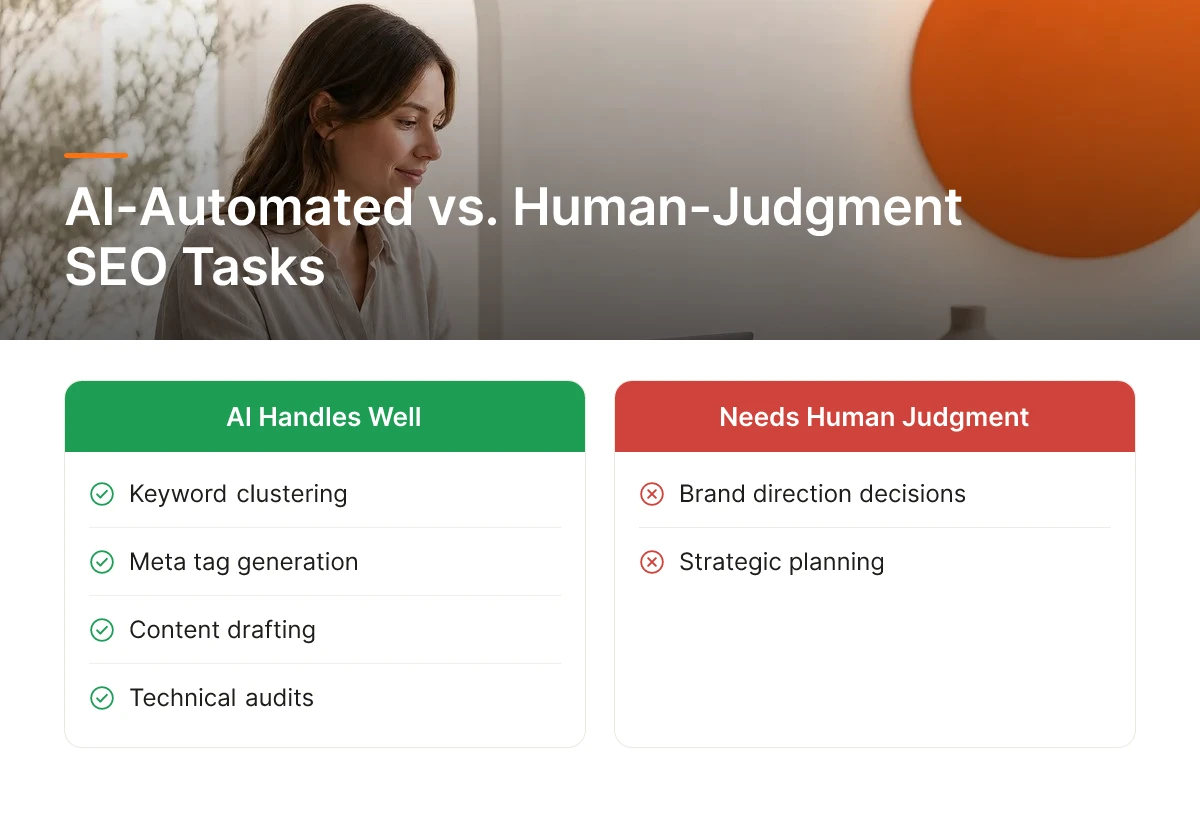
What Specific SEO Tasks Can AI Automate, and Which Still Need Human Judgment?
Five tasks are now handled well by software: keyword clustering, meta tag generation, content drafting, technical audits, and schema markup creation. Each one follows a repeatable pattern, group similar search terms, write a tag under a character limit, structure a paragraph around a direct answer, flag broken links or missing alt text, tag a page so machines can parse it. Pattern-based, repetitive work is exactly what software is built to do faster and cheaper than a person billing by the hour.
Other tasks still need a person in the loop. Brand positioning, deciding how your business wants to sound relative to competitors, requires judgment calls a model can't make on its own. Nuanced editorial voice, the kind that makes a restaurant's blog sound like the owner rather than a template, still benefits from a human pass. Interpreting ambiguous performance data (is a traffic dip seasonal or a sign something broke) and making high-stakes strategic pivots, entering a new market, rebranding, responding to a reputation hit, are decisions software can inform but shouldn't make alone.
How Does AI-Driven SEO Differ From Traditional SEO in Approach and Results?
Traditional SEO runs on manual, hours-billed cycles: an agency audits your site once a quarter, drafts a handful of posts, and reports back weeks later. AI-driven SEO runs continuously, publishing, auditing, and re-checking technical signals every day without waiting for a scheduled check-in. That's a difference in approach, not just a cheaper price tag on the same service.
Moonrank builds on that distinction directly. It runs daily automated content generation, technical audits, and schema markup updates on autopilot, then layers in visibility tracking across ChatGPT, Gemini, Claude, and Perplexity, something most agencies still don't offer at any price. The tasks that still need a human, reviewing tone, weighing a big strategic shift, stay with the business owner, while the repetitive load moves to software running in the background every day.
How AI SEO Tools Replace What Agencies Charge For
Automated platforms replicate an agency retainer's output, content, technical fixes, reporting, by running the same tasks as software instead of billable hours.
A premium-tier SEO retainer typically bundles three cost centers: account management (the strategist who joins your monthly call), manual reporting (someone building a dashboard you could build yourself), and content production (writers drafting articles on a schedule). Enterprise agencies add a fourth layer, link-building outreach and PR, which drives the retainer even higher. None of these line items is about strategy. Most of the invoice pays for hours spent on repeatable production work.
What's the Actual Cost Difference Between AI Tools and Hiring an Agency?
The difference comes down to paying for a team's hours versus running one subscription that works continuously without breaks or billable increments.
An agency staffs a strategist, a writer, and an account manager against your account, and you pay for their combined time whether or not the work scales with your needs that month. Software collapses that structure: one system handles keyword research, drafts and publishes content daily, applies schema markup and structured data, and tracks visibility, all without a payroll behind it. Moonrank runs this exact stack at a budget-friendly monthly subscription, positioned specifically against agencies charging premium retainers for comparable scope. The mechanism isn't magic, it's that once content generation and technical audits are automated, the marginal cost of running them daily approaches zero, which is why an ai seo agency alternative can undercut traditional pricing by an order of magnitude rather than a small percentage.
Which Industries See the Biggest ROI From Switching to AI-Powered SEO?
Businesses with high-volume, repeatable content or catalog needs see the fastest payback because automation scales with volume in a way human hours can't.
Content-heavy SMBs publishing several articles a month, local service businesses (restaurants, boutique hotels, specialty retailers) that need consistent local citations and structured data, and ecommerce sellers with large product catalogs all benefit because the task itself, write, tag, publish, repeat, is what software does best. A Shopify store with 400 SKUs needing schema markup across every product page is a volume problem, not a creativity problem.
Agencies still earn their retainer for businesses that need heavy custom strategy work, executive positioning, or PR-driven link building, those tasks depend on relationships and judgment that automation doesn't replicate yet. The honest comparison isn't "agency versus software" as a universal winner; it's matching the tool to the type of work that needs doing.

Optimizing for Google vs. Optimizing for AI Search Engines
Google ranks pages by crawling links and weighing on-page signals like keywords and site authority; AI engines instead synthesize an answer and pull from sources they judge trustworthy and well-structured [1]. That's a real mechanical difference, not just marketing language. Google hands you a page of ten blue links. ChatGPT or Perplexity hands your customer one answer, often naming two or three businesses by name, or none at all if your site doesn't give it enough to work with.
How Do ChatGPT, Perplexity, and Claude Decide Which Websites to Recommend?
These engines favor sites with clear entity definitions, structured data, and factual statements that show up consistently across the web [3]. If your restaurant's hours, service area, or pricing tier appear one way on your homepage and a different way on your Google Business Profile, that inconsistency makes an AI engine less likely to cite you, it can't confirm which version is true. Schema markup helps here because it tells the AI system directly what your business does, rather than making it guess from paragraph text [1][3].
This is also where a well-run ai seo agency earns its keep for an e-commerce owner or a B2B SaaS team without a technical hire: someone has to keep those facts aligned across the site, directories, and structured data, every day, not once a quarter.
Can You Optimize for Google and AI Search Engines at the Same Time?
Yes, schema markup, clear headings, and factual accuracy improve your standing with Google and with AI answer engines at the same time [3]. The two systems don't require contradictory work. A product page with a direct answer near the top, a clean H2/H3 structure, and consistent claims about pricing or availability helps Google's crawlers parse the page and gives an AI model the clean, quotable statement it needs to cite you.
That overlap is the practical argument for running one content strategy instead of two. A Shopify store or SaaS company doesn't need a separate "AI content" budget bolted onto its existing SEO spend. Moonrank builds on this overlap directly, it runs the technical audit (schema, llms.txt, structured data), publishes daily content built around clear entity definitions, and tracks how that shows up in ChatGPT, Gemini, Claude, and Perplexity, all from one budget-friendly subscription instead of a premium agency retainer split across tools.
How to Measure Whether Your AI SEO Is Working
Track two sets of numbers side by side: how often AI engines mention and cite your business, and whether that translates into the traffic and conversions you'd expect from any SEO channel.
What Metrics Matter Most for Tracking AI Search Visibility?
Watch three AI-specific signals every month. First, brand mention frequency, how often ChatGPT, Perplexity, Gemini, or Claude name your business when someone asks a question in your category. Second, citation rate, whether those engines actually link to or reference your site as the source, not just a competitor's. Third, share of voice, how your mention count compares to the two or three competitors you'd expect to see in the same answer.
Traditional metrics still matter and shouldn't be dropped. Organic traffic, keyword rankings, and conversion rate from organic visitors remain the backbone of any SEO measurement plan, and they're the numbers that connect visibility to revenue. An AI engine can mention your business a dozen times a month, but if none of that turns into site visits or sales, something in the funnel, not the visibility, needs fixing.
Moonrank's visibility tracking layer reports on all three AI-specific signals across ChatGPT, Gemini, Claude, and Perplexity, so a business owner isn't manually prompting each engine every week to check if they got mentioned.
How Long Does It Take to See Results From AI SEO?
Expect AI visibility to move before your Google rankings do, because AI engines can start citing fresh, well-structured content within days, while Google's index typically takes longer to reflect new pages the same way [1]. That gap surprises a lot of business owners who assume ranking movement is the first sign anything is working, for AI search, it's often the last.
Technical fixes, schema markup, llms.txt configuration, cleaner site structure, tend to show impact within a few weeks, since they remove barriers that were already blocking AI systems from reading and trusting your content [3]. Content-driven visibility gains take longer and build over a few months of consistent publishing, as AI engines accumulate enough citations and mentions of your brand to treat you as a reliable source in a given category.
This is the part where most SMB owners either give up too early or hire an ai seo agency expecting overnight results neither traditional SEO nor AI search visibility ever delivers. Set a 90-day review point, track the metrics above monthly, and judge the trend line rather than any single week's numbers.
Getting Started With an AI SEO Agency Alternative
Replacing an ai seo agency starts with a first-week audit, technical fixes, and automated publishing setup, not a full rebuild of your site.
Here's a realistic first-week sequence for a Shopify store owner or B2B SaaS founder ready to stop paying agency retainers:
- Day 1-2: Audit current visibility. Search your business name and top three products or services in Google, then ask ChatGPT and Perplexity the same questions a customer would ask. Note whether you show up, whether competitors do, and what gets cited.
- Day 3-4: Fix technical fundamentals. Check for schema markup, the structured data that tells AI engines exactly what your business does, and confirm you have an llms.txt file so AI crawlers can read your site cleanly. Most SMB sites are missing both [1].
- Day 5-7: Set up automated content publishing. Pick keywords tied to your actual niche, not generic industry terms, and get a publishing cadence running so content ships daily instead of whenever you find time.
What Are the Most Common Mistakes SMBs Make Implementing AI SEO Alone?
The biggest mistake is chasing content volume while ignoring the technical structure that lets AI engines actually read and trust that content. Publishing three blog posts a week means nothing if your site lacks the structured data, clear headings, and direct answers AI systems look for when deciding what to cite [3].
The second mistake is treating AI visibility as a one-time setup rather than something to monitor continuously. AI engines change how they source and cite answers regularly, so a business that checks its visibility once and moves on will drift out of recommendations without noticing. The third mistake is skipping measurement entirely, publishing content and hoping it works, instead of tracking whether ChatGPT, Gemini, Claude, or Perplexity actually mention your business.
What Does a Realistic Implementation Timeline Look Like?
Expect initial technical fixes and setup to take the first few weeks, with visibility trends becoming clear over the following months rather than days. AI answer engines synthesize responses from crawled and cited content [1], and that indexing and trust-building takes sustained, consistent publishing, not a single sprint.
This is exactly the gap Moonrank fills. It runs the daily content publishing, handles the schema markup and llms.txt configuration, and tracks your visibility across ChatGPT, Gemini, Claude, and Perplexity automatically, so you get the output of an ai seo agency without the retainer or the manual upkeep. Start with the free trial at moonrank.ai and see where your business stands this week.
Frequently Asked Questions
Do I still need an SEO agency if I use AI SEO tools?
Most SMBs don't, once the tool handles daily content, technical fixes, and visibility tracking together. Agencies still make sense for large enterprises with complex sites or unusual technical setups. But for a typical Shopify store or local service business, a budget-friendly automated platform like Moonrank covers what a premium retainer used to.
Will AI SEO tools work for a local service business, not just ecommerce?
Yes, local businesses often see faster gains because AI engines favor clear, specific answers to "near me" and category questions. A restaurant or boutique hotel benefits from structured data and consistent content just as much as an online store, since ChatGPT and Perplexity pull from the same signals regardless of business type.
What's the biggest risk of switching from an agency to AI SEO tools?
The main risk is choosing a tool that only automates content and skips technical AI-readability work like schema markup and llms.txt. Content alone won't get you cited if AI engines can't parse your site's structure. Check that any tool you consider handles both publishing and technical optimization, not just one piece of the puzzle.
Can small businesses realistically compete with bigger brands in AI search results?
Yes, AI engines cite based on clarity and trust signals, not just brand size or ad budget. A specialty retailer with well-structured, specific content can get recommended over a national chain with a generic website. Consistency matters more here: daily, focused content and clean technical signals often beat sporadic effort from a bigger competitor.
Should a business run AI SEO tools and a traditional agency at the same time?
Some businesses do, especially during a transition period, but it's rarely necessary long-term once the automated platform proves it covers content, technical audits, and visibility tracking. A short overlap can help you compare output directly before dropping the retainer, as long as you're tracking the same metrics against both approaches.
Conclusion
AI search engines reward businesses that publish consistently, fix technical readability gaps, and track where they actually show up, not the businesses with the biggest ad budgets. Agencies were built for Google-era SEO; most SMBs now need daily content and schema work handled automatically, not billed hourly. Start by checking how ChatGPT and Perplexity currently answer questions about your business or niche. If your name doesn't come up, that's your baseline. Visit moonrank.ai and run a visibility check to see exactly where you stand before deciding your next move.
Sources & References
- AI SEO Does Not Replace Traditional SEO, Squarewebsites Plugins
- AI Search Visibility: Small Business Guide | Veriqo Studio
Recommended Articles
Explore more from our content library: