How to Run a Free SEO Audit and Know When You Need More
Learn what an seo audit free tool actually checks, its limits versus paid options, and how to turn free audit results into a real, prioritized action plan.

Understanding seo audit free is essential. Yes, you can audit your website's SEO health and AI search visibility without paying anything, using free tools that scan technical issues, on-page signals, and increasingly, how well ChatGPT or Perplexity understand your site. Running an seo audit free scan works well for a first diagnostic, spotting broken links, missing meta tags, slow load times, and structured data gaps. Their main limits are crawl depth (fewer pages scanned), fewer re-audits, and no ongoing monitoring, which is where paid tools eventually add value as your site grows.
What Can a Free SEO Audit Actually Check?: seo audit free
A free SEO audit checks technical health, on-page structure, and, increasingly, whether AI engines like ChatGPT or Perplexity can find and cite your site. Most tools bundle these into a single scan you run by entering your URL. This is particularly relevant for seo audit free.
On the technical side, expect checks for crawlability (can search bots reach your pages at all), broken links, page speed, mobile-friendliness, duplicate meta tags, and missing alt text on images. These are the fundamentals that most audit tools, free or paid, treat as table stakes [2]. Semrush's free checker, for example, scans meta tags, headings, page speed, and mobile usability in one pass [2].
On-page checks go a level deeper. A decent seo audit free tool will flag weak or duplicate title tags, broken header structure (multiple H1s, skipped H2s), poor keyword placement in body copy, and internal linking gaps, pages on your site that nothing else links to, which makes them harder for both search engines and AI crawlers to find. SEOptimer frames this as identifying "problems that could be holding your site back," paired with a prioritized list of fixes [1].
What Are the Limitations of Free Audits Compared to Paid Tools?
Free audits cap how much of your site they scan and how often you can re-scan it, which limits how far you can trust the results on larger sites. The mechanism is straightforward: free tiers restrict crawl depth, so a 500-page e-commerce catalog might only get 20-50 pages checked, leaving deeper product or blog pages unexamined. Free plans also throttle re-audit frequency, you might get one scan a month instead of on-demand checks. That's fine for a startup diagnostic. It's not enough once you're actively fixing issues and need to confirm they're resolved, or once you want ongoing tracking rather than a single snapshot in time.
Do Free SEO Audits Include AI Search Engine Visibility Checks?
Some do, but the free version is usually a shallow pass rather than a full picture. Newer tools have started adding an AI visibility layer, checking whether your brand shows up in AI-generated answers and how well large language models can parse your content [1][5]. SEOptimer positions this around "LLM accessibility, identity, and citability" [1], while SEO Site Checkup markets an "LLM Visibility Checker" alongside its traditional technical audit [5]. In practice, free versions tend to show a single visibility snapshot rather than tracking how that visibility changes week to week. That ongoing monitoring, plus the technical fixes (schema markup, llms.txt, structured data) that actually move the needle on AI citability, is where a platform like Moonrank operates, running these checks continuously instead of as a one-time scan.
What Should You Do With the Results of a Free Audit?
Treat the report as a starting checklist, not a finished project. A typical seo audit free report groups findings by severity, critical crawl errors, moderate on-page gaps, and minor polish items. Work through them in that order rather than jumping straight to the longest or most technical-sounding item on the list. Most business owners get more value from fixing five critical issues than from chasing every minor recommendation the tool surfaces.
Free vs Paid SEO Audit Tools: What's the Real Difference?
Free and paid audits check the same signals, the gap is depth, frequency, and who fixes what the report finds. When considering seo audit free, this point stands out.
Every tool in this category, free or paid, scans the same underlying signals: title tags, header structure, page speed, broken links, and increasingly, whether an AI engine like ChatGPT or Perplexity can parse and cite your content. The data source doesn't change much between tiers. What changes is how much of it you get, how often, and whether anyone acts on it.
What Features Do You Lose With a Free Tier Instead of Paying?
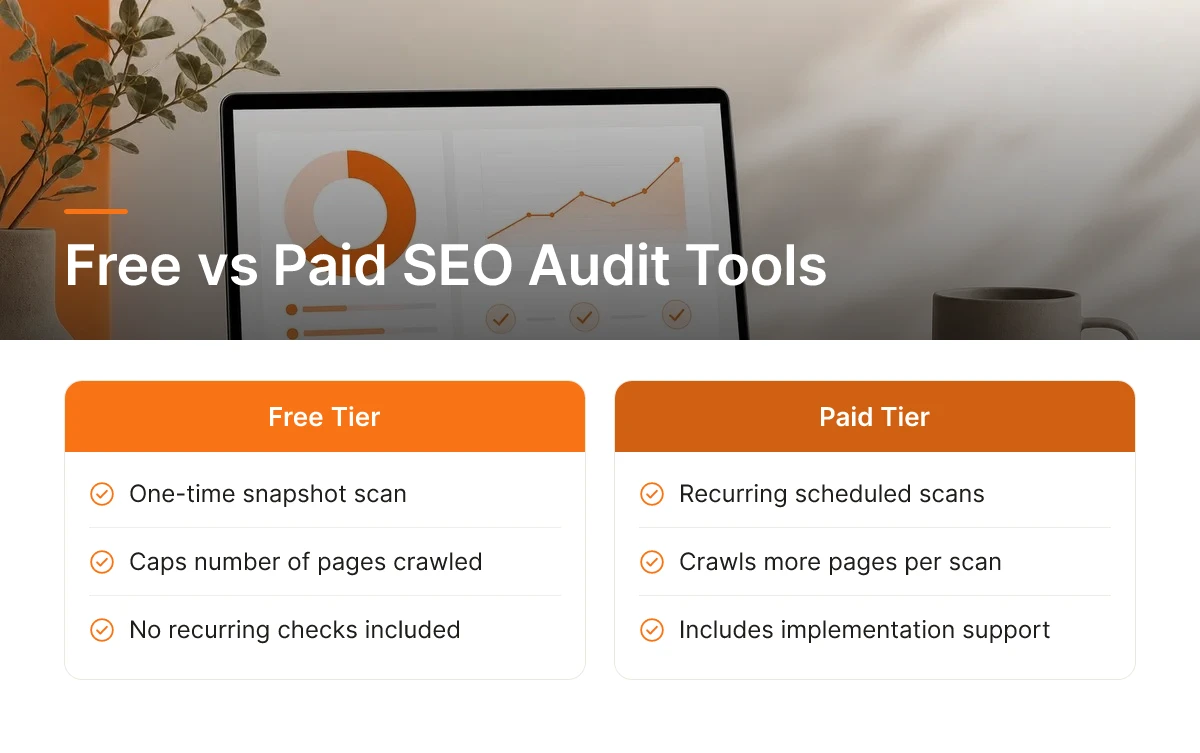
A free tier usually caps the number of pages it crawls, runs as a one-time snapshot instead of a recurring check, and skips white-label or historical reporting. Semrush's free SEO Checker, for example, positions itself as a quick scan and points users toward its paid Site Audit product for anything beyond a single-pass report [2]. SEOptimer frames its free tool the same way, a fast diagnostic, with premium tiers enableing branded PDF exports and lead-generation features for agencies managing multiple clients [1].
None of this means the free version lies to you. It means a 40-page Shopify store gets a workable snapshot for free, while a 400-page catalog with new SKUs added weekly hits crawl ceilings fast and needs a paid plan or an automated platform just to keep the data current.
Why Choose a Free Audit Tool Over Hiring an SEO Agency?
A free tool tells you what's broken. An agency, or an automation platform, tells you what's broken, ranks it by impact, and fixes it. That distinction matters more than any feature comparison chart. Running an seo audit free scan is a fine starting point, but the report is a to-do list, not a solution.
This is where cost tiers usually decide the outcome. A budget-friendly free tool feels like enough when a business is small and issues are minor. A mid-range paid tool feels justified once weekly monitoring becomes necessary. Premium agency retainers get delayed the longest, because a large monthly fee is hard to justify for a business without a marketing team, even when the audit clearly shows structural problems. For those exploring seo audit free, this matters.
That gap is exactly why automation platforms have started bundling audit-style monitoring with the fixes themselves. Moonrank, for instance, pairs AI search visibility tracking with daily content publishing and technical fixes, schema markup, llms.txt configuration, structured data, so a business isn't stuck reading a report it has no time to act on. Instead of juggling a free audit tool, a content calendar, and a technical consultant, the audit and the remediation live in one system.
Which Free SEO Audit Tool Fits Your Type of Business?
The right free tool depends on your site type, an online store, a content blog, and a SaaS product each surface different problems in an audit. For more information, see Review Audit.
Running a seo audit free of charge only pays off if the tool checks the things that actually break rankings for your kind of site. A generic scan that only flags broken links and missing meta descriptions misses the issues that matter most for a 2,000-SKU Shopify store or a gated SaaS demo page.
Best Free SEO Audit Approach for E-commerce vs Blogs vs SaaS
E-commerce stores should prioritize product page duplication, category crawl depth, and structured data for products. Duplicate descriptions across color or size variants confuse crawlers, and categories buried five clicks deep rarely get indexed consistently, an audit that checks product schema markup matters more here than one that just counts word counts.
Content-heavy blogs face a different set of risks. The priority is internal linking, content freshness signals, and keyword cannibalization, multiple posts competing for the same query, which splits ranking authority instead of concentrating it. A blog with 300 posts and no internal linking strategy is leaving authority on the table regardless of how well any single article is written. This directly impacts seo audit free outcomes.
SaaS sites need to look at landing page structure, the technical crawlability of gated content, and schema for software products. If your pricing page or feature comparison sits behind a form, search engines and AI systems like ChatGPT or Perplexity can't read it, and can't recommend you when a prospect asks for alternatives in your category. Semrush's checker, for example, evaluates crawlability and technical issues as part of its standard scan [2], which is a reasonable baseline test for whether gated pages are even reachable.
How Do Free Tools Differ on White-Label or Branded Reports?
White-label or branded PDF reporting matters mainly to agencies and freelancers auditing client sites, not to a typical SMB owner checking their own store or SaaS product. Some tools build entire pricing tiers around this feature [1], since consultants need polished reports to hand to clients.
If you're auditing your own business, skip that decision entirely. Match tool depth to your site's actual complexity, a five-page landing site doesn't need a 172-point technical audit built for enterprise sites [3], and a 2,000-product catalog needs more than a surface-level scan. Chasing the tool with the longest feature list wastes time better spent fixing what the audit actually finds. Moonrank takes a different approach for the fixing part: instead of handing you a report and leaving you to sort schema markup and llms.txt configuration yourself, it runs the technical optimization and publishes new content daily, on autopilot, at a cost designed to be more accessible than an agency retainer.
Which Free Tools Are Worth Trying First?
Rather than testing every seo audit free option available, pick one general-purpose scanner and one that leans into AI visibility checks, then compare the two reports. Overlap between them is a strong signal, if both flag the same broken schema or missing meta descriptions, that issue deserves priority. Where they diverge, usually around AI citability or content depth, is where it pays to dig manually rather than trust either tool blindly.
How Often Should You Run a Free SEO Audit?
Run a check after any major site change, after every content push, and on a recurring schedule, monthly for active sites, quarterly for quieter ones. This is particularly relevant for seo audit free.
Redesigns, platform migrations, and new product pages all touch the technical elements an audit measures, page speed, schema markup, internal linking. A Shopify store adding a new collection page or a SaaS company shipping a redesigned pricing page should re-run an seo audit free tool immediately afterward, not wait for the next scheduled check. New content matters too: publishing five blog posts a week without checking how they render for crawlers is how duplicate meta descriptions and broken schema pile up unnoticed.
What Does Re-Auditing Regularly Actually Reveal About Progress?
A single audit is a snapshot, it tells you where you stand today, not whether the fixes from last month worked. Comparing scores across audits is what shows real movement: did that schema markup you added actually get recognized, or did a site update quietly undo it? Semrush frames this as a report that flags what passed inspection and what still needs attention [2], but that judgment only means something in context, against last quarter's report, not in isolation. One SMB owner might see their score climb after fixing broken internal links; another might see a new drop in mobile performance after a theme update they didn't think twice about. Neither story shows up in a single scan.
Free audit tools complicate this in a practical way: most cap how often you can re-run a scan on the same domain, which means the business owner has to remember to check manually rather than relying on an automatic monitor [3]. That's manageable for a quarterly cadence. It's harder to sustain if a site changes weekly.
The stakes are higher now because AI engines don't wait for a scheduled crawl the way search indexes historically did, they re-evaluate sources on an ongoing basis, and a broken llms.txt file or missing structured data compounds the longer it sits unfixed. Moonrank's approach builds this cadence in rather than leaving it to memory: it tracks AI search visibility across ChatGPT, Gemini, Claude, and Perplexity continuously and re-optimizes technical signals like schema markup and citations as an ongoing process, not a once-a-quarter fire drill.
What Signals Suggest You've Outgrown Free Audits?
A few practical signs point to outgrowing a seo audit free tool: hitting crawl limits before your whole site gets scanned, needing to check a page the same week you fixed it instead of waiting for the next allowed scan, or managing multiple client sites where manual re-checking eats hours every week. None of these mean the free tool was wrong to start with, they just mean the business has grown past what a single-pass scan can support.
Turning Free SEO Audit Results Into an Action Plan
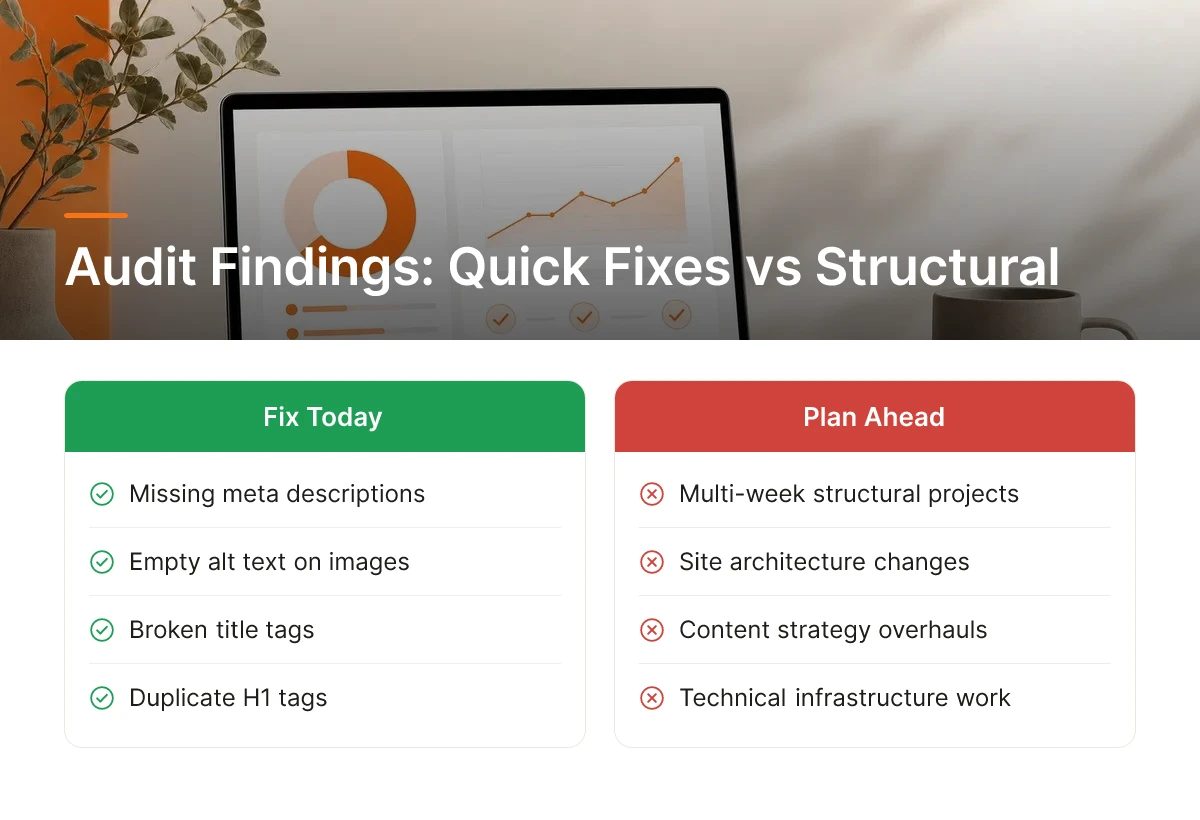
An audit report only creates value once you sort its findings into what to fix today, what to fix this month, and what to automate permanently. Most reports from an seo audit free tool return a mix of one-click fixes and multi-week projects, and treating them the same way wastes time on either end.
How Do You Turn an Audit Score Into a Real Action Plan?
Split every finding into two buckets before you touch anything: quick technical fixes and structural fixes. Missing meta descriptions, empty alt text, broken title tags, and duplicate H1s fall into the first bucket, most can be corrected in an afternoon with a CMS or Shopify plugin.
Structural fixes are different. Thin category pages, missing internal links between related products, or a content gap where competitors rank for terms you don't even target, these require planning, not a checklist. Semrush's own audit framework groups issues by crawlability, on-page signals, and content depth [2], and that order is a reasonable default for prioritization. Fix anything blocking a crawler first, broken redirects, blocked resources, orphaned pages, because none of your other fixes matter if search engines and AI crawlers can't reach the page. Then handle on-page signals: titles, headers, schema markup. Only after that should you invest in content depth, since new content takes longer to index and rank than a metadata fix.
What Real-World Results Can SMBs Expect From Acting on Findings?
Expect fewer errors and gradual visibility gains, not an overnight jump to page one. SEOmator's audit data across more than 100,000 sites found a median score of 71 out of 100 [3], which means most small business sites, even reasonably healthy ones, carry a steady backlog of fixable issues rather than a single catastrophic problem. Closing that backlog tends to compound: crawl efficiency improves, pages get indexed faster, and AI engines that rely on structured, citable content have an easier time parsing your site. When considering seo audit free, this point stands out.
The catch is that a website is not static. New products, new blog posts, and template changes reintroduce issues every time you publish. Re-running a manual audit every month and hand-fixing what it finds works for a handful of pages, it stops working once your catalog or content library grows past a few dozen.
That's the gap Moonrank fills. Instead of treating an audit as a one-time report, Moonrank runs technical AI-readability fixes, schema markup, llms.txt configuration, citation building, continuously, publishes optimized content daily, and tracks how your business shows up across Google, ChatGPT, Gemini, Claude, and Perplexity. It replaces the cycle of re-auditing and manually patching issues with a system that keeps fixing them, at a cost designed to be accessible for small businesses. Start with a free audit to see where you stand, then let Moonrank keep you there.
Frequently Asked Questions
Can a free SEO audit tool check if AI engines like ChatGPT recommend my business?
Most free SEO audit tools check traditional signals like page speed and meta tags, not whether ChatGPT or Perplexity actually recommend you. Some newer tools have started adding AI visibility checks, but this coverage is inconsistent [1]. To see how your business shows up across ChatGPT, Gemini, Claude, and Perplexity specifically, you generally need a tool built for AI search tracking rather than a standard site checker.
Is a free SEO audit accurate enough to trust for business decisions?
A free SEO audit is accurate enough to flag major problems, but not detailed enough to guide every decision. It's a reliable starting point for catching broken tags, slow pages, or missing structured data [3]. For decisions involving budget or a full site rebuild, pair the audit's findings with a closer manual review of your highest-traffic pages. For those exploring seo audit free, this matters.
How many pages does a free SEO audit typically scan?
Free SEO audits usually scan somewhere between a handful of pages and several dozen, depending on the tool's crawl limits. Some platforms run over 170 individual checks per site but still cap the number of URLs crawled in the free tier [3]. Larger sites often need a paid crawl to cover every page.
Should a small business run a free audit before or after redesigning a website?
Run it before and after a redesign, not just once. A pre-redesign audit shows what's already broken, so you don't rebuild around the same problems; a post-launch audit confirms the new site didn't introduce fresh technical issues like missing schema or broken redirects.
Do free SEO audits work for sites built on any platform, like Shopify or WordPress?
Yes, most free SEO audit tools work on any live website regardless of platform, including Shopify, WordPress, or a custom build. They crawl your public pages the same way a search engine or AI crawler does, so platform mostly affects which specific fixes, like app-based schema plugins versus theme edits, you'll need to apply.
Conclusion
A free SEO audit is a solid first pass, it catches broken tags, slow pages, and missing structured data. But it won't tell you whether ChatGPT, Gemini, or Perplexity actually recommend your business, and that gap matters more every quarter as customers ask AI engines for suggestions instead of typing searches into Google. This directly impacts seo audit free outcomes.
Start with a free audit to clear out technical debt. Then track your actual visibility across AI engines, since that's the part most free tools skip entirely. Run a free scan at moonrank.ai to see where your business stands with AI search engines today.
Sources & References
- Analyze Websites With Free SEO Audit & Reporting Tool - SEOptimer
- Free SEO Checker: Check for SEO & AI Search Issues
- Free SEO Audit Tool, 172 Checks + AI Visibility - SEOmator
- Reclaim Lost Traffic with LLM-Ready SEO Intelligence | SEO Site Checkup
Recommended Articles
Explore more from our content library: