How an AI Visibility Tracker Helps Your Brand Get Noticed
An AI visibility tracker reveals how often your business appears when people ask ChatGPT, Gemini, or Perplexity questions related to what you sell.
An AI visibility tracker shows you how often, and how favorably, your business shows up when people ask ChatGPT, Gemini, or Perplexity questions related to what you sell. Unlike traditional rank tracking, it monitors conversational answers and citations instead of blue links, since AI engines pull from different signals: structured data, third-party mentions, and content that directly answers a question. For SMBs, tracking this closes the gap between being invisible in AI answers and being the brand an AI recommends by name.
What Does an AI Visibility Tracker Actually Measure?
An AI visibility tracker measures how often your brand gets mentioned, cited, or recommended inside an AI-generated answer, not where a webpage ranks on a results page.
That distinction matters because the unit of measurement has changed. Traditional SEO tools count rankings: position 3 for a keyword, a blue link on page one. An ai visibility tracker counts something different, whether ChatGPT names your hotel when someone asks for a boutique stay in a specific city, or whether Perplexity cites your SaaS product when a buyer asks for a comparison of security compliance tools. The output isn't a rank number. It's a mention, a citation, or a recommendation, each carrying its own weight depending on whether your brand was named first, buried in a list, or left out entirely.
How Is AI Visibility Different From Traditional Search Engine Visibility?
Traditional search ranks pages using links and keyword relevance; AI engines synthesize answers from structured data, customer reviews, and third-party content scattered across the web. Google's crawler is largely scoring your own site. ChatGPT, Gemini, and Perplexity are pulling from a wider pool, your schema markup, what G2 or Capterra says about your software, what a travel blog wrote about your hotel, what a Reddit thread says about your cybersecurity product. A page can rank well in Google and still be invisible in an AI answer, because the AI isn't reading your site the way a search crawler does, it's reading what the web says about you, and it demands machine-readable signals like structured data and clear source attribution to trust what it finds [1].
What's the Connection Between AI Visibility and Traffic or Lead Generation?
Getting cited in an AI answer can deliver a visitor who has already finished their research and arrives ready to buy, skipping the comparison-shopping phase that normally eats days or weeks. A shopper who asks ChatGPT "best waterproof hiking boots under $150" and gets your Shopify store named isn't browsing ten tabs, they're one click from checkout. A B2B buyer who asks Perplexity for SOC 2-compliant vendors and hears your name has effectively pre-qualified themselves before they ever hit your homepage [3].
Ecommerce, B2B SaaS, cybersecurity, and hospitality businesses carry outsized exposure to this shift. Buyers in these categories increasingly ask AI tools for a shortlist before they ever type a brand name into a search bar, which means a business that's invisible in those answers loses the sale before the funnel even starts. This is exactly the blind spot an ai visibility tracker is designed to expose before it costs you pipeline.
How Do You Monitor and Measure Visibility in AI Search Engines?
You monitor AI visibility by running the same set of real customer prompts through ChatGPT, Gemini, and Perplexity on a fixed schedule, then logging whether and how your brand shows up each time.
The method is simple in concept, harder in practice. Pick the 15 to 30 questions your actual customers ask, "best project management software for small teams," "top boutique hotels in Charleston," "most secure password manager for startups", and run them across each platform at the same cadence every week. An ai visibility tracker automates this instead of someone manually retyping prompts into four different chat windows and copy-pasting results into a spreadsheet.
One-off checks give you a snapshot, and snapshots mislead. AI answers aren't static search results pulled from a fixed index, they're generated fresh each time, which means the same prompt asked twice in one day can return different competitor sets, different phrasing, even different sentiment toward your brand [1]. A single good result doesn't mean you're visible; it might mean you got lucky that session. Tracking matters because it replaces one lucky (or unlucky) screenshot with a pattern you can trust.
What Are the Key AI Visibility Metrics You Should Be Tracking?
Four metrics separate a useful visibility tracking practice from guesswork.
- Mention frequency, how often your brand appears across repeated runs of the same prompt set, not just whether it appeared once.
- Citation position, whether you're named first, buried third, or only mentioned in a list at the bottom of the answer; position affects how many readers actually notice you.
- Sentiment, whether the AI describes your brand positively, neutrally, or with a qualifier that undercuts trust ("budget option," "less established").
- Share of voice, how your mention count stacks up against named competitors in the same category, across the same prompt set and time window.
Industry tools frame this as tracking "brand mentions, # and %, and linked mentions, # and %" across AI Overviews, AI Mode, ChatGPT, Gemini, and Perplexity results [2]. The same logic applies whether you're an ecommerce store watching for "best running shoes for flat feet" or a B2B SaaS company watching for "top CRM for solo consultants", the metrics don't change, only the prompts do.
How Accurate Are Different AI Visibility Tracking Platforms, and What's Their Methodology?
Accuracy depends on three methodology choices: how many prompt variations a platform runs, whether it accounts for geographic and account-level variation, and how often it refreshes data.
A tool that tests one phrasing of one question per week is going to miss the variation that real customers introduce, people ask the same question a dozen different ways. Geography matters too, since AI engines can return different local results depending on account signals and region [5]. And refresh rate matters because AI model updates and retraining cycles can shift results within days, not months, which is a different pace than classic Google rank tracking ever moved at. When evaluating any visibility platform, including Moonrank's own AI search visibility monitoring layer, ask directly how many prompt variants it runs per keyword, how it handles regional differences, and how frequently it re-checks, those three answers tell you more about accuracy than any dashboard screenshot.

Which AI Visibility Metrics Actually Drive Business Results?
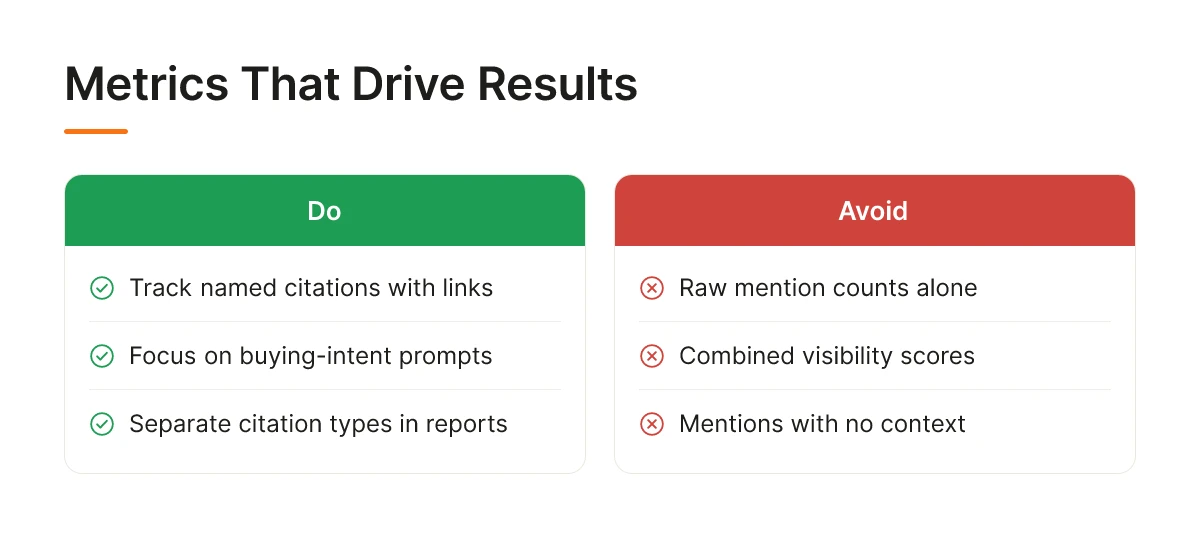
Mentions that include your brand name with no link or context rarely translate into revenue; citations tied to buying-intent prompts do. An effective ai visibility tracker separates the two instead of reporting one combined "visibility score" that hides the difference.
Which AI Visibility Metrics Correlate Most Strongly With Conversions and Revenue?
Raw mention count is a vanity metric: it tells you an AI engine knows your brand exists, nothing more. What correlates with pipeline is a named citation, your business recommended by name or linked, inside a prompt that signals someone is ready to buy, like "best project management software for remote teams" or "top boutique hotels in Charleston."
The mechanism is simple. When ChatGPT, Gemini, or Perplexity names your business in answer to a commercial-intent question, it functions like a trusted referral, the AI did the filtering work the searcher would have done manually, so the person clicking through already trusts the recommendation. That's a warmer lead than a typical organic search click, where the visitor still has to compare five results themselves. Industry tracking tools already treat this distinction as core functionality: SE Ranking's visibility toolkit separates brand mentions from linked mentions specifically because the two behave differently downstream [2], and Ahrefs' checker reports sentiment and competitive ranking alongside raw visibility for the same reason [4].
How Do You Integrate AI Visibility Data With Tools Like Google Analytics or HubSpot?
Visibility data only proves its worth once it's connected to the tools that already track revenue. Start in Google Analytics 4: tag referral traffic from chat.openai.com, perplexity.ai, and gemini.google.com as distinct source/medium channels so AI-driven sessions don't get buried under generic "referral" or "direct" traffic.
Next, feed notable visibility wins, a new citation for a high-intent prompt, a competitor losing a mention, into CRM or HubSpot lifecycle stages as a tagged attribution source, the same way you'd tag a paid campaign. Amplitude's free visibility report is built around this exact handoff, letting teams connect AI search performance to downstream conversion tracking rather than treating it as a standalone dashboard [3].
For SMBs with limited analyst time, the practical move is prioritization: track prompts tied to commercial intent first, "best X for Y," "top [category] in [city]," "X vs Y", before broad informational prompts that rarely precede a purchase. Moonrank's visibility tracking is built around this same logic, watching ChatGPT, Gemini, Claude, and Perplexity for the buying-intent phrasing that actually moves revenue, not just brand awareness.
How Do AI Visibility Tracker Platforms Compare for SMBs?
The platforms worth paying for differ on four things: how many AI engines they cover, whether you can customize the prompts they track, how deep the reporting goes, and whether the data tells you what to fix. Most comparison lists treat these tools as interchangeable [5], but for an SMB owner the gaps between tiers matter more than the surface-level similarities.
Engine coverage is the first filter. Some tools track Google AI Overviews and ChatGPT only; others extend to Gemini, Perplexity, Claude, and newer entrants like Copilot or Grok [5]. A cybersecurity vendor whose buyers research tools on Perplexity needs that engine covered specifically, not bundled into a generic "AI search" number.
Prompt customization matters just as much. Generic brand-mention tracking tells you whether your name shows up somewhere; category-specific prompt tracking tells you whether you show up when someone asks "best SaaS tool for X" or "top boutique hotels in [city]", the actual language your buyers use [2]. Ecommerce brands, B2B SaaS vendors, cybersecurity providers, and hotels all have distinct query patterns, and a tracker that only checks your brand name misses most of the buying-intent conversations happening inside these engines.
Which Platform Offers the Best Balance of Affordability, Accuracy, and Integration for SMBs?
The best balance for an SMB comes from a mid-range tool that pairs visibility tracking with concrete content and technical fixes, not just a dashboard score.
Pricing in this category breaks into three qualitative tiers. Budget-friendly tools mostly check whether your brand gets mentioned and stop there. Mid-range platforms add competitor comparisons and sentiment analysis [1][4]. Premium, enterprise-oriented platforms bundle visibility tracking with broader marketing reporting and analytics integrations [3], which is more depth than most independent shop owners or solo SaaS founders need.
A visibility score alone is close to useless without a next step. Knowing your brand appears in 12% of relevant AI answers doesn't help if you don't know whether the fix is a schema markup gap, a missing llms.txt file, or thin content on the pages AI engines pull from. This is the gap Moonrank is built to close, it tracks visibility across ChatGPT, Gemini, Claude, and Perplexity, then connects that data to daily automated content publishing and technical optimization, so an ai visibility tracker becomes a to-do list instead of a report card.
How Do You Improve Your Visibility in ChatGPT, Gemini, and Perplexity?
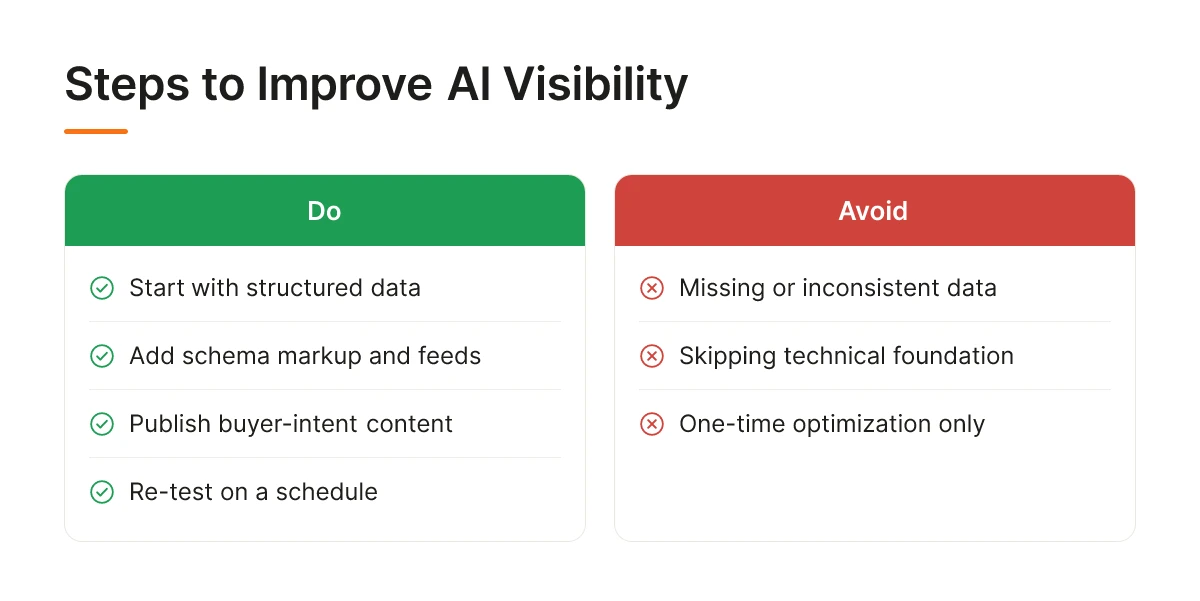
Fix your technical foundation first, then publish content that answers the exact prompts buyers type, build citations off-site, and re-test on a schedule.
What's the Step-by-Step Process for Optimizing Content and Technical Setup for AI Search?
Start with structured data. AI crawlers pull from schema markup, product feeds, and llms.txt files to figure out what a business actually sells, if that data is missing or inconsistent, the engine either skips the brand or gets the facts wrong [4]. For an e-commerce store, that means product schema with accurate pricing and availability; for a B2B SaaS company, it means clear organization and service schema describing what the software does and who it's for.
Second, publish content matched to the exact prompts showing up in your tracking data, not generic blog posts. If your tracked prompts show buyers asking "best inventory software for small retailers" or "hotel booking platform with no commission fees," write pages that answer that precise phrasing. Ahrefs notes that AI engines favor pages that directly address a query rather than pages that merely rank for a keyword [4]. This is where a tool that auto-publishes daily, matching content to the language buyers actually use, saves the manual research cycle most SMB owners don't have time for.
Third, build citations outside your own site. AI engines weight independent mentions, review sites, directories, press coverage, comparison articles, more heavily than anything a business says about itself [2][4]. A hotel with strong third-party review coverage on travel sites will often outrank a competitor with a nicer website but no outside mentions.
How Do You Track Progress and Adjust Strategy Based on AI Visibility Data?
Re-run the same tracked prompts on a fixed cadence, weekly or biweekly, and compare mention frequency, ranking position, and sentiment against your baseline [2][5]. An ai visibility tracker that logs these results over time turns the exercise from guesswork into a before-and-after comparison: did the new schema markup move the needle, or did the citation push matter more? Once you see which changes correlate with gains, double down. If a round of third-party citations lifted mentions in Perplexity but a batch of blog posts did nothing for ChatGPT, redirect effort toward citations and cut the underperforming content type. This loop, fix, publish, cite, measure, adjust, is the same cycle Moonrank runs automatically for its customers, pairing daily content publishing and technical optimization with ongoing visibility tracking so the adjustment happens without the owner managing spreadsheets by hand.
Frequently Asked Questions
What is a good AI visibility score for a small business?
There's no universal benchmark, a good score means you appear in answers for the specific prompts your actual customers use, consistently, and ahead of at least one direct competitor. For a small e-commerce or SaaS brand, a realistic early goal is showing up in 3-5 of your top 10 target prompts across ChatGPT, Gemini, and Perplexity within a few months, then expanding from there.
Can you track visibility for specific prompts or just broad brand mentions?
Most useful tools track both, but prompt-level tracking matters more for action. Broad brand mentions tell you AI engines know you exist; prompt-level tracking shows whether you appear for the exact questions, "best CRM for small teams," "boutique hotel in Austin", that drive actual buying decisions, which is what determines real traffic and leads.
How often should you check your AI visibility?
Weekly checks are enough for most SMBs, since AI model outputs shift gradually rather than daily. Check more often right after publishing new content or making technical changes like schema updates, so you can see whether the change actually moved the needle.
Does improving AI visibility also help traditional Google rankings?
Often yes, because the two overlap more than they differ. AI engines like Perplexity and Google's AI Overviews pull heavily from indexed, well-structured, citation-worthy web content [1], so fixing schema markup, structured data, and content depth tends to improve both AI citations and conventional search rankings at the same time, though neither is guaranteed to move in lockstep.
Do you need a separate AI visibility tracker for each AI engine you want to monitor?
No, most modern tools are built to cover several engines at once. A single ai visibility tracker typically monitors ChatGPT, Gemini, Perplexity, and sometimes Claude from one dashboard, so you're comparing the same prompt set across platforms instead of juggling separate logins and spreadsheets for each one.
Conclusion
AI visibility isn't a vanity metric, it's a direct signal of whether ChatGPT, Gemini, or Perplexity will recommend you over a competitor the next time a customer asks. Three things matter most: track specific prompts, not just brand mentions; fix the technical signals (schema, structured data, llms.txt) that let AI engines trust your content; and publish consistently, since stale sites fall out of citations fast.
You don't need to manage all three manually. Start a free trial at moonrank.ai and see where your business currently stands across ChatGPT, Gemini, Claude, and Perplexity before your next competitor gets there first.
Sources & References
- The 9 best AI visibility tools in 2026 | Zapier
- AI Search Visibility Tool: Optimize for AI Search
- Get Your Free AI Visibility Report
- Free AI Visibility Checker by Ahrefs: Track Your Brand in AI search
- 22 Best AI Search Rank Tracking & Visibility Tools for 2026 | Rankability Blog
Recommended Articles
Explore more from our content library: