A Complete Guide to Building Citation Authority in AI Search
Citation authority AI search determines if ChatGPT, Perplexity, and Claude name your business in answers. Learn how to build it and get cited more often.
Understanding citation authority AI search is essential. Citation authority in AI search is how likely ChatGPT, Perplexity, and Claude are to name and link to your business when answering a relevant question. It matters because these platforms increasingly replace traditional search clicks, if an AI engine cites a competitor instead of you, that customer never reaches your website. Building citation authority means structuring your content and site so AI models can easily extract, trust, and quote your business as the answer.
What Is Citation Authority in AI Search, and Why Does It Matter for Your Business?
Citation authority is the measure of how likely an AI engine is to name your business, your product, or your article as the actual source behind its answer. When a shopper asks Perplexity for the best running shoe for flat feet, or a B2B buyer asks ChatGPT to compare project management tools, the platform picks specific sources to cite by name. Your brand either shows up in that list or it doesn't, there is no middle ground. This is particularly relevant for citation authority AI search.
This is a different game from ranking on page one of Google. A high search position used to guarantee some volume of clicks. Now, an AI engine can read your page, extract the answer, and hand it to the user without ever sending them your way. Citation authority AI search is a question of whether your business enters the conversation at all, not where it lands in a results list.
How Do AI Citations Differ From Traditional Backlinks in SEO Value and Traffic?
Backlinks accumulate authority slowly, other sites link to you, Google's crawlers revisit and revalue those links over months, and your domain authority compounds over time. AI citations work on a completely different clock. A model selects sources per-query, judging in real time which page most directly and clearly answers the specific question being asked [1].
That means a page with zero backlinks can get cited today if it answers the question better than a competitor's page with a thousand backlinks. Earned authority, entity clarity, and citation architecture now function as separate evaluation criteria from the backlink-and-keyword signals that traditional SEO ranking relies on [3]. A brand can hold top-five Google rankings for every target keyword and still be invisible in AI-generated answers [3].
What Is the ROI of AI Citations Versus Traditional Search Optimization?
Traditional SEO pays off through a predictable, if slow, curve: better rankings lead to more impressions, which lead to more clicks. AI citation ROI doesn't follow that curve. It behaves more like earning a direct recommendation from a trusted source, the payoff shows up as brand mentions, referral trust, and inclusion in the buyer's consideration set, not as a steady stream of trackable clicks.
The stakes are immediate, not cumulative. AI citations are becoming the deciding factor in which sources get featured in an answer at all, shifting the entire model from ranking pages to selecting them [1]. If a user gets a full answer from ChatGPT and never clicks through, a missed citation means that customer never reaches your website, the touchpoint is lost before it starts, regardless of how well-optimized your site is for Google. That is the core reason SMBs without dedicated SEO resources need a strategy built specifically for how AI models choose citations, not a repurposed Google playbook. Moonrank builds this into its technical audit, schema markup, llms.txt configuration, and structured data, so the content a business already has becomes something an AI model can actually parse and trust enough to cite.
Why Citation Authority Is Becoming a Business Risk, Not Just a Marketing Metric
For most SMBs, visibility has historically been treated as a marketing line item, something to invest in when budget allows, but rarely framed as an operational risk. AI citation authority changes that framing. When a buyer's entire research journey happens inside a chat window, and the business isn't part of the answer, that isn't a missed marketing opportunity, it's a missed sale that never shows up in any funnel report because the prospect never reached the funnel at all. Leadership teams that still think of this as "extra SEO work" are underestimating how directly it now touches revenue.
How Do ChatGPT, Perplexity, and Claude Decide Which Sources to Cite?
AI models retrieve pages that answer a question directly, then select the ones offering the clearest, most attributable passage to quote, a two-stage process of retrieval and selection [5]. Retrieval finds content relevant to the query; selection picks which of those pages actually gets named in the answer. That second step is where citation authority AI search strategy is won or lost.
Retrieval mechanics are less mysterious than they sound. Models scan indexed web content and favor pages that state an answer concisely near the top, define entities clearly (what your business is, what it does, who it serves), and avoid burying the useful sentence under three paragraphs of preamble. Rankings can help a page get discovered, but they do not guarantee it gets cited, 88% of Google AI Mode citations come from pages outside the organic top 10, and 90% of ChatGPT citations come from pages ranked 21st or lower, or unranked entirely, in Google [3]. A page a model can't parse cleanly is a page it skips, no matter how well that page ranks elsewhere. When considering citation authority AI search, this point stands out.
What Factors Influence Whether an AI Model Cites Your Content?
Trust signals matter as much as topical relevance. Models weigh whether facts about your business stay consistent across every page they can find, your pricing, your service area, your hours, your claims, and whether authorship and expertise are clear rather than anonymous [2]. Page structure also decides outcomes: if a model can isolate one clean paragraph that answers the question without editing, that paragraph is the one that gets quoted.
Concrete factors that raise citation odds include direct-answer formatting placed near the top of a page, headings phrased as real questions your customers actually ask, current information, and claims stated without hedging. Specialist pages that answer one question precisely often outperform broad brand pages, in one measurement, specialist sites outside any named publisher or platform captured roughly half of top-ten citation slots across measured buyer questions [5]. Precision beats breadth.
What Are the Negative Citation Authority Factors, and How Do You Recover?
Citation standing erodes for predictable reasons: contradictory facts across your own site, thin or stale pages, vague marketing copy with nothing a model can extract as fact, and technical blockers like crawl restrictions or missing structured data. Any one of these gives the model a reason to cite a competitor instead.
Recovery starts with an audit, find where your own pages disagree with each other, then rewrite vague sections into direct, quotable answers. Republish the corrected version so models have a fresher, cleaner source to retrieve next time they crawl. Moonrank builds this into its technical audit process, fixing schema markup, llms.txt configuration, and structural clarity so AI engines have a consistent, citable version of a business to work from.
Common Mistakes That Quietly Undermine Citation Authority
Several patterns show up repeatedly in businesses that struggle to get cited, even when their content looks reasonable on the surface. One is writing for persuasion instead of clarity, pages full of adjectives and brand voice but light on the plain, factual sentence a model could lift and quote directly. Another is duplicating near-identical pages across locations or services without differentiating the actual facts each page contains, which confuses retrieval rather than helping it. A third is treating a one-time content refresh as a permanent fix, when in practice citation authority behaves more like a subscription, it has to be maintained, not just built once and left alone.
How Does Citation Authority Differ Across AI Platforms?
Each AI platform sources, weighs, and displays citations differently, so citation authority AI search work has to account for platform-specific behavior rather than one universal playbook.
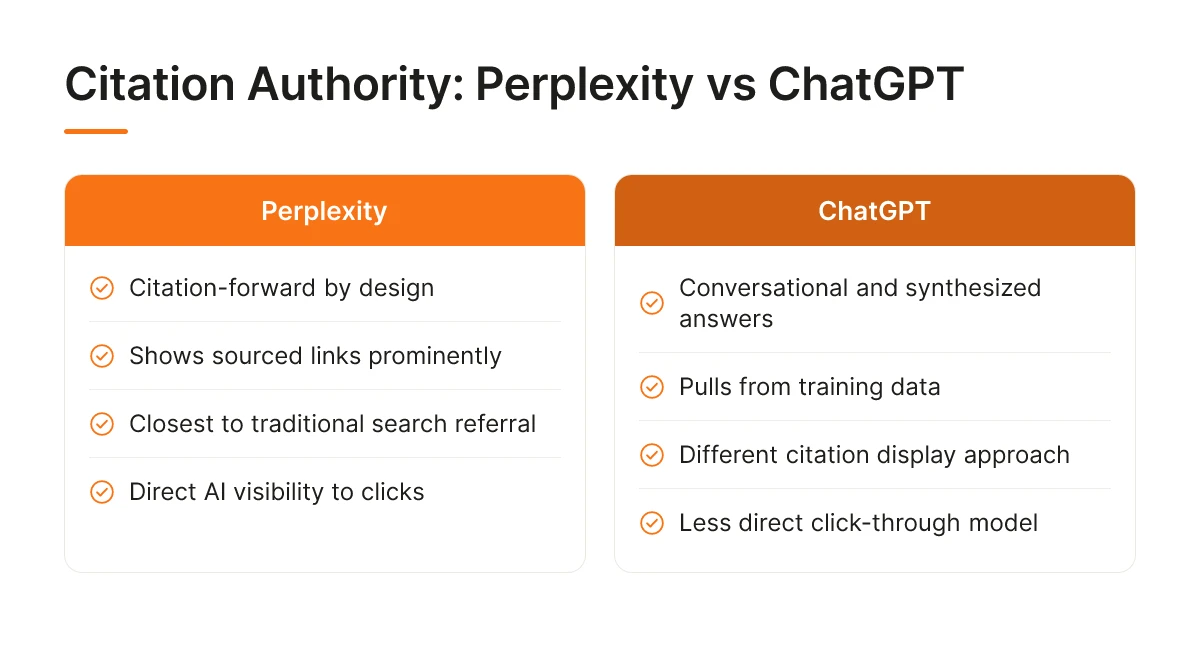
Perplexity is citation-forward by design. It shows sourced links prominently alongside its answers, which makes it the closest analog to traditional search referral traffic among the major AI platforms [1]. If a business wants a direct line between AI visibility and click-through, Perplexity is the platform most likely to deliver it. For those exploring citation authority AI search, this matters.
ChatGPT behaves differently. Its default answers are conversational and synthesized, pulling from training data and offering fewer explicit source links unless browsing mode is active. That makes citation behavior more selective, ChatGPT decides when a citation adds value to the conversation rather than surfacing links by default. Research analyzing citation patterns has found that a large share of ChatGPT citations come from pages that don't even rank in Google's top results [3], which confirms that visibility here depends on separate signals from classic SEO.
Claude follows a similar conversational pattern to ChatGPT but leans further toward well-structured, explanatory content over promotional copy. Sources that clearly explain a concept in plain language tend to outperform sources written like sales pages, regardless of how much backlink authority those sales pages carry [5].
Google AI Overviews sits in the middle. It blends traditional ranking signals with a separate citation-selection layer, so existing SEO fundamentals, page structure, backlinks, keyword relevance, still shape whether a business appears, even though ranking alone doesn't guarantee inclusion [3][5].
How Should You Adjust Strategy Based on Which AI Platforms Your Audience Uses?
Match effort to how your customers actually research. If they tend to ask conversational questions and expect a synthesized answer, prioritize ChatGPT and Claude, that means investing in clear explanations and entity clarity over link-building. If they expect to see sourced links they can click through and verify, prioritize Perplexity and Google AI Overviews, where citation-forward display still resembles familiar search behavior.
Most SMBs can't specialize by platform manually, which is part of why Moonrank tracks visibility across ChatGPT, Gemini, Claude, and Perplexity simultaneously, showing where a business is already getting cited and where its content still needs work.
Why Cross-Platform Consistency Beats Chasing a Single Algorithm
It's tempting to optimize heavily for whichever platform currently sends the most visible traffic, but that approach ages poorly. Platform behavior shifts as these products evolve, a model that rarely cited sources a year ago may add browsing and citation features tomorrow. Businesses that build a strong, consistent entity, clear facts, clean structure, dated updates, tend to perform reasonably well everywhere, rather than excelling on one platform and disappearing from the others the moment usage patterns shift. This directly impacts citation authority AI search outcomes.
Key Strategies to Build Citation Authority in AI Search
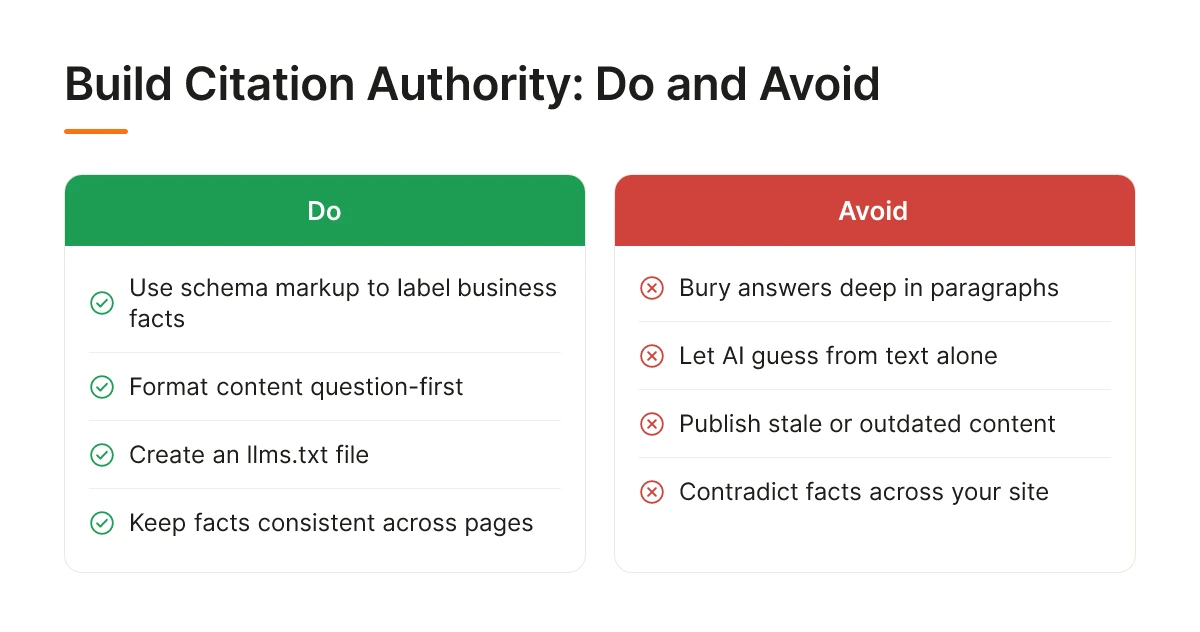
Building citation authority AI search engines respect comes down to five concrete moves: schema markup, question-first formatting, an llms.txt file, consistent facts, and fresh content.
What Structured Data and Formatting Improve AI Citation Likelihood?
Structured data markup, known as schema, works like a set of labels on your web pages that tell AI engines exactly what your business does, where it operates, and who it serves. Instead of guessing from paragraphs of text, an AI crawler reads a label that says "restaurant, Italian cuisine, Austin, Texas, open until 10pm" and can cite that fact with confidence. Without schema, a model has to infer these details from unstructured prose, which raises the odds it gets something wrong or skips you for a competitor with cleaner markup.
Formatting matters just as much as markup. Answer the core question in the first sentence of every section, AI systems extract passages, not whole pages, so a section that buries its point three sentences in often gets passed over. Phrase subheadings as real questions a customer would type or speak, since this mirrors how models decompose a query during retrieval [5]. Keep factual claims consistent across every page; a model that finds your hours listed as "9-5" on one page and "9-6" on another has reason to trust neither.
An llms.txt file adds one more layer of clarity. It's a plain-text file placed at your site's root that acts like a signpost, pointing AI crawlers to your most citation-worthy pages, your services page, your location and hours, your pricing tier, instead of leaving the crawler to guess which pages matter most. It won't guarantee a citation, but it removes friction for the systems doing the retrieving.
None of this replaces the need for a single consistent source of truth. Hours, services, pricing tier, and location should read identically whether the visitor is a customer on your homepage or a crawler indexing your footer. Conflicting versions across pages, or across your site and your Google Business Profile, create the kind of ambiguity that pushes models toward a cleaner competitor [3].
Finally, publish specific, dated content on a regular cadence. Research on citation behavior shows retrieval and selection happen in two stages, and freshness plus clarity influence which passages get chosen in the second stage [5]. A business that updates its site weekly with concrete, current information has a better shot at being the source a model pulls from than one whose last substantive update was a year ago. Moonrank automates this cadence, daily content publishing paired with schema and llms.txt configuration, so SMBs build citation authority without hand-coding markup or tracking freshness manually.
How Content Depth and Topical Coverage Affect Citation Odds
Beyond individual page formatting, the overall shape of a site's content matters. A business that covers its core topic from multiple angles, common questions, edge cases, comparisons, process explanations, gives an AI model more entry points to retrieve from and more opportunities to be the cited source across a range of related queries. A single well-optimized page can win one specific question, but a cluster of interlinked, clearly structured pages tends to build a more durable footprint across the many ways customers phrase similar needs.
How Do You Measure and Track Citation Authority Across AI Search Engines?
You measure citation authority AI search performance by tracking three things on a schedule: how often you're mentioned, how accurately you're described, and who shows up next to you. Without that baseline, you're guessing whether last month's content push actually changed anything.
What Metrics Show Your Brand's Citation Authority Across AI Platforms?
Three metrics matter most, and none of them require guesswork if you track them consistently. First, mention frequency, how often your brand name, domain, or founder shows up when someone asks ChatGPT, Perplexity, or Claude a question in your category. Second, description accuracy, whether the AI states your pricing, location, or services correctly, or repeats outdated information from a stale directory listing. Third, competitive co-occurrence, which competitor names appear alongside yours, and whether they're replacing you outright in certain query types. This is particularly relevant for citation authority AI search.
A restaurant owner might find ChatGPT recommends three competitors before mentioning them at all, or a Shopify store might discover Perplexity cites an old product line that no longer exists. Both are fixable, but only once you can see them.
The practical method is running the same set of queries across ChatGPT, Perplexity, and Claude on a fixed schedule, weekly, at minimum, and logging what changes. AI engines pull from different indexes and update at different speeds, so a citation that appears in Perplexity this week might not reach ChatGPT for another month. Comparing outputs side by side reveals where you're gaining ground and where a competitor just took a slot you held before.
Manual spot-checking works for exactly one query, one time. It doesn't scale for a business owner who already handles inventory, customer service, and marketing alone. Running the same prompts across three platforms every week, by hand, eats hours that don't exist in most SMB schedules, and a single missed cycle means weeks pass before a description error or a lost citation gets noticed.
Building a Simple Internal Tracking Routine Before Automating
Even before adopting a dedicated tool, a business can start with a lightweight internal habit: a shared spreadsheet listing the five to ten questions customers most commonly ask, run through each major AI platform once a week, with a short note on whether the business was mentioned, mentioned accurately, and where it ranked relative to competitors. This won't scale indefinitely, but it builds the baseline understanding needed to judge whether later investments, schema fixes, new pages, an llms.txt file, are actually moving the needle before committing to a larger, ongoing strategy.
This is the gap Moonrank was built to close. Moonrank tracks how your business appears across ChatGPT, Gemini, Claude, and Perplexity automatically, surfacing mention frequency, accuracy issues, and competitor shifts without you running a single manual query. It pairs that tracking with daily content publishing and technical fixes, schema markup, llms.txt, structured data, so the signals driving citation authority AI search visibility keep improving instead of stalling out. Visit www.moonrank.ai to see where your business stands today.
Frequently Asked Questions
Do AI citations replace the need for traditional SEO?
No, AI citations work alongside traditional SEO rather than replacing it. Ranking well in Google still helps AI engines discover your content, but citation depends more on entity clarity and earned authority than keyword rankings alone [3]. Treat AI citation building as an added layer, not a swap.
Can a small business realistically compete with larger brands for AI citations?
Yes, AI citation selection favors clear, credible content over brand size. Roughly half of top citation slots go to specialist sites outside major named publishers and platforms [5], meaning a focused SMB with structured, well-sourced content can out-cite a bigger competitor with thinner or less specific pages. When considering citation authority AI search, this point stands out.
How long does it take to see a change in AI citation frequency after updating content?
Most businesses notice shifts within a few weeks, though timelines vary by platform and topic. AI engines re-crawl and re-rank sources on different schedules, and citation patterns can drift even without content changes [3], so ongoing monitoring matters more than a single update.
Does having a Google Business Profile help with AI citation authority?
It can help, mainly by reinforcing entity clarity and local relevance signals AI engines check. A complete, consistent profile supports the broader "entity footprint" that citation authority depends on [2], but it works best combined with structured content and technical optimization, not alone.
Should a business prioritize new content or fixing existing pages first?
Fixing existing pages usually comes first. A site with contradictory facts, thin pages, or missing structured data gives AI models reasons to skip it regardless of how much new content gets added on top. Once the existing footprint is consistent and clearly structured, new content compounds that foundation instead of adding more inconsistency for a model to sort through.
Conclusion
Citation authority in AI search comes down to three things: clear entity signals, content structured for machine legibility, and consistent technical setup, schema markup, structured data, and llms.txt files that tell AI engines exactly what your business does. Ranking well in Google no longer guarantees a citation in ChatGPT or Perplexity [3], so SMBs need a dedicated strategy rather than a bolted-on afterthought.
Because citation patterns drift and require ongoing monitoring [3], the most practical next step is auditing your current AI visibility before writing a single new page. Moonrank runs that audit automatically, then handles the daily content and technical fixes that follow, start a 3-day free trial at moonrank.ai.
Sources & References
- AI Citations Explained: How they work and how cited by AI models • Yoast
- AI Citation Authority: How to Get Cited by ChatGPT, Perplexity, and Google AI | MarGen
- AI’s Brand Citation Algorithm: How AI Search Engines Select, Rank, and Recommend Brands | ziptie.ai Blog
- How AI Search Engines Decide What to Cite
Recommended Articles
Explore more from our content library: