Full Comparison of Best SEO Tools for Google Ranking
A full comparison of best SEO tools for tracking AI search visibility on ChatGPT, Gemini, Claude, and Perplexity, not just traditional Google rankings.
Understanding full comparison of best SEO tools is essential. SMBs need SEO tools that track and optimize for AI search engines like ChatGPT, Gemini, Claude, and Perplexity, not just Google rankings, because these tools evaluate brand mentions, structured data, and content differently than traditional search crawlers. The best options combine AI visibility tracking, content publishing, and technical optimization in one budget-friendly platform, letting a small business compete without hiring an agency or stitching together several separate subscriptions.
Why Do SMBs Need Different SEO Tools Now That AI Search Engines Exist?
A Google rank tracker tells you where you sit on a results page; it tells you nothing about whether ChatGPT just recommended your competitor instead of you. That gap is why a full comparison of best SEO tools now has to include AI visibility platforms alongside traditional rank trackers, not treat them as the same category.
Traditional SEO tools measure keyword position, where a page sits for a given search term on a given day. AI engines don't return a ranked list of ten blue links. They synthesize an answer and either mention your brand or they don't. Tracking that requires querying the engines directly and logging whether your business shows up as a citation or recommendation, which is a fundamentally different mechanic than crawling SERPs.
Is Traditional Google SEO Enough, or Do You Need Separate Tools for AI Search Engines?
Traditional Google SEO alone leaves a real visibility gap because AI engines weigh structured data, entity recognition, and third-party mentions more heavily than backlinks and on-page keywords [1]. Google's ranking algorithm still rewards keyword optimization and link authority. ChatGPT, Gemini, Claude, and Perplexity work differently: they pull from content they can parse cleanly (schema markup, well-structured data) and from sources that mention a business consistently across the web, not just from the business's own site [2]. A tool built only for backlink analysis and keyword tracking has no mechanism for measuring or improving any of that. It's optimizing for a search behavior fewer customers use every year.
What's the Real ROI Difference Between Agency Services and Self-Serve SEO Tools for AI Visibility?
Agencies bundle strategy calls and manual reporting into a premium retainer, while self-serve tools automate the same tracking and publishing work at a much lower ongoing cost. An agency team researching AI search presence manually, then compiling a report, is paying for labor hours on top of the work itself [1]. A platform that runs the tracking and content publishing on autopilot removes that labor cost entirely, which is the gap Moonrank was built to close: automated daily content, technical optimization, and AI visibility tracking bundled into one budget-friendly subscription instead of a premium retainer.
Picture a boutique hotel that ranks on page one of Google for "hotels in [city]." A guest instead asks ChatGPT for a recommendation, and the hotel never comes up, because ChatGPT is pulling from review sites, structured business data, and mentions elsewhere, not from the hotel's own keyword-optimized page. That's the visibility gap no rank tracker will ever show you.
What Should You Look for in an SEO Tool Built for AI Search Visibility?
A tool built for AI search visibility should track brand citations across ChatGPT, Gemini, Claude, and Perplexity, support schema markup, connect to your CMS, and require minimal setup.
Most SEO software still measures the wrong scoreboard. Any full comparison of best SEO tools has to start by separating platforms that report on Google rankings from those that actually measure whether an AI engine mentions your business by name. The gap between the two is the entire point of this evaluation.
How Do You Evaluate an SEO Tool's Ability to Optimize for AI Search vs. Traditional Search?
Ask a vendor one direct question: does the tool show you, by name, which AI engines mention your brand and in what context? Platforms built around AI visibility monitor brand mentions and citations across generative engines and identify which sources are shaping those mentions [2]. That is a fundamentally different job than rank tracking, which only tells you where a URL sits on a results page.
Schema markup and structured data belong on the same checklist. In plain terms, schema is the code that tells an AI engine exactly what your business sells, where it operates, and who it serves, without it, an AI system has to guess, and guessing usually means it picks a competitor instead. Tools with technical execution features, such as schema optimizers and structured data support, exist precisely to close that gap [3]. Moonrank builds this in as part of its technical audit, handling schema markup, llms.txt configuration, and citation building automatically so a business owner never has to touch a config file.
What Integration Capabilities Matter Most When Managing Both Google and AI Search Visibility?
Two integrations matter more than any dashboard feature: a direct CMS connection for automatic publishing, and an analytics pull that ties AI visibility to real traffic and conversions. Some platforms already integrate site analytics with AI search tracking so teams can connect brand mentions to actual site performance rather than treating them as separate reports [3]. Without that link, you're left guessing whether AI visibility translates into customers.
Setup simplicity matters as much as feature depth. A solo Shopify owner or a two-person SaaS team has no dedicated SEO hire to configure crawlers or interpret rank-tracking exports. Moonrank runs on autopilot after onboarding: daily content generation, publishing, and technical fixes happen automatically, with no manual input required from the business owner.
- A direct CMS connection that allows automatic publishing without manual export/import steps
- An analytics integration that ties AI citations and rankings to actual traffic and conversions
- Schema markup and structured data support built in, not sold as a separate add-on
- AI visibility tracking across ChatGPT, Gemini, Claude, and Perplexity in one dashboard
- Minimal setup that a non-technical owner can configure without a developer
A Full Comparison of Best SEO Tools for AI Search vs. Traditional SEO
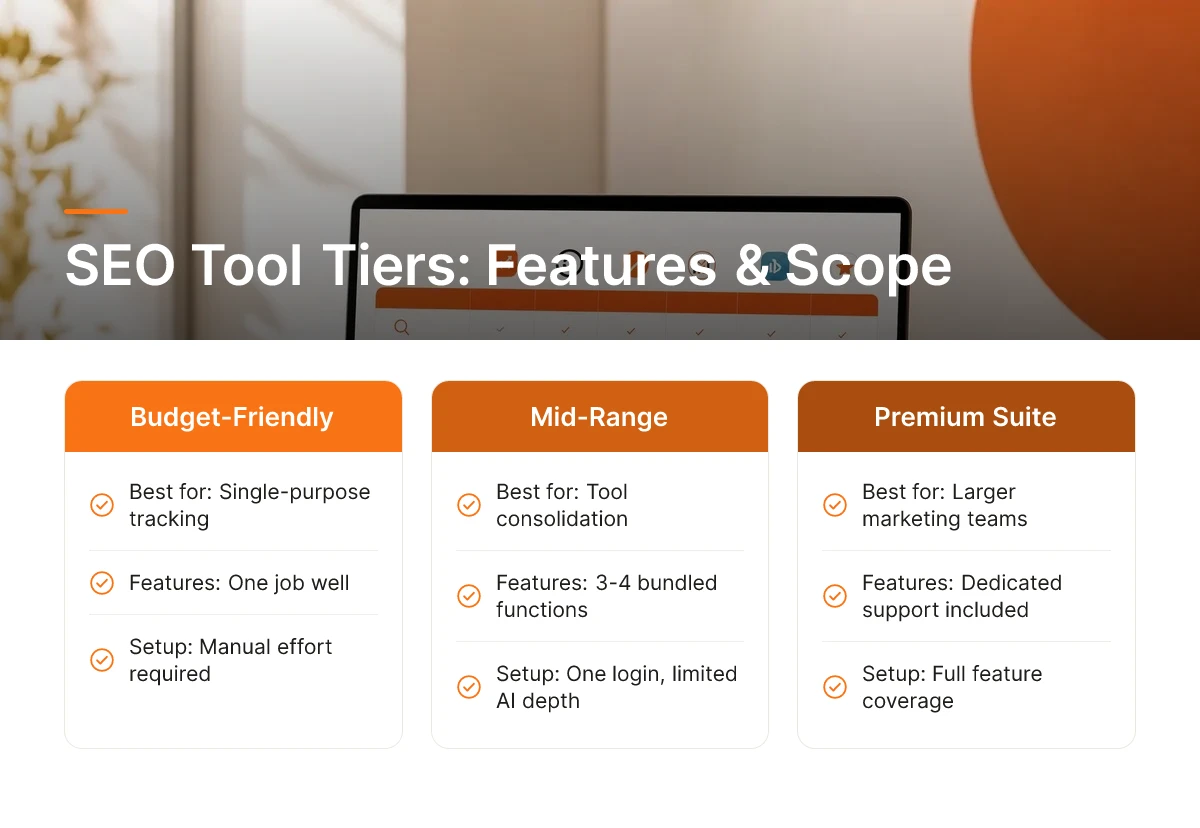
A full comparison of best SEO tools breaks into three qualitative tiers: budget-friendly single-purpose trackers, mid-range platforms that bundle a few overlapping features, and premium suites with dedicated support built for larger marketing teams.
- Budget-friendly tools: tend to do one job well, rank tracking, backlink monitoring, or basic keyword research, and leave everything else to spreadsheets and manual effort.
- Mid-range platforms: combine three or four functions (content briefs, site audits, competitor tracking) under one login, which cuts down on tool-switching but rarely covers AI search visibility with any depth [3].
- Premium suites: add account management, custom reporting, and broader technical crawling, but they're priced for agencies and enterprise marketing departments, not a solo Shopify owner running a five-person team.
The real decision isn't which tier sounds most complete, it's whether you piece together separate point solutions or run one platform that covers tracking, content, and technical optimization together. A rank tracker, a content generator, and a technical audit tool from three different vendors can technically do the same jobs a bundled platform does. But every point solution adds a login, a billing cycle, and a report format that doesn't talk to the others.
What's the Cost-Per-Feature Breakdown When You Compare Tools Designed for AI Search Optimization?
Comparing tools by cost-per-feature misleads SMBs because two platforms claiming "AI visibility tracking" often measure completely different things, one might check citation frequency across ChatGPT and Perplexity, another might just flag brand mentions in a single AI Overview snapshot [2]. Overlapping feature names hide very different depth underneath, so a lower sticker price doesn't necessarily mean less capability, and a higher one doesn't guarantee more.
A more honest evaluation looks at outcome per dollar: how much measurable visibility improvement, more AI citations, more organic sessions, more assisted conversions, a tool produces relative to what it costs, not how many checkboxes it has on a features page [1]. This is where a platform like Moonrank frames itself deliberately: it bundles AI search visibility tracking across ChatGPT, Gemini, Claude, and Perplexity, daily automated content publishing, and technical optimization (schema markup, llms.txt, structured data) into one budget-friendly subscription, which is the kind of bundled outcome-per-dollar comparison that's hard to make against three separate point tools with three separate invoices.
How Long Does It Take to Implement and See Results with Each Type of SEO Tool?
Single-purpose trackers are the fastest to start, often live within an hour, but they require you to manually stitch together reports from separate tools as your stack grows, which adds hours of admin work every month. Bundled platforms take longer to configure initially, since they're connecting more systems at once, but they cut the ongoing manual reconciliation that point solutions demand over time.
For a founder without a dedicated marketer, ease of use matters as much as raw feature count. A platform with fewer bells and whistles that a non-technical owner can actually run alone beats a feature-rich suite that sits half-configured because nobody on the team has time to learn it.
Which SEO Tool Features Actually Move the Needle for ChatGPT, Gemini, Claude, and Perplexity Visibility?
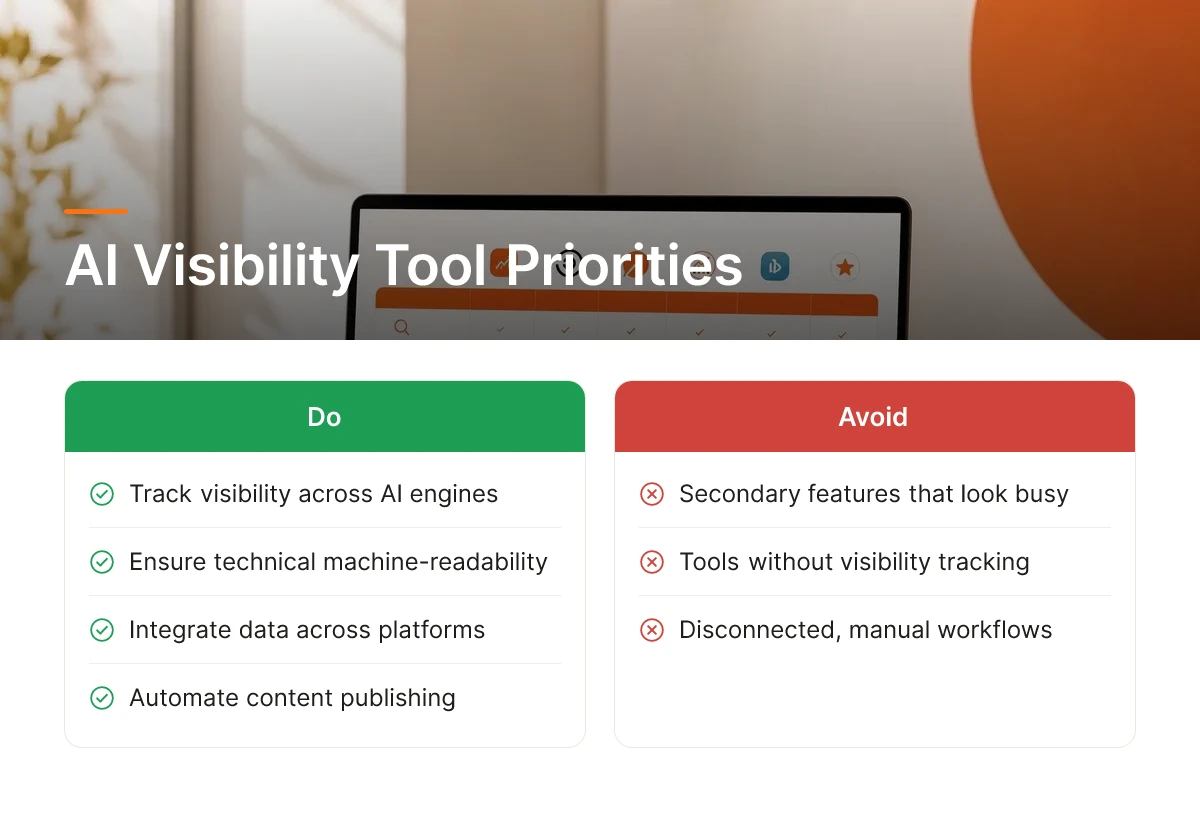
Four capabilities separate tools that move AI visibility from tools that just look busy: visibility tracking, automated publishing, technical machine-readability, and integrated data. Everything else is secondary.
AI Visibility Tracking Is the Foundation Everything Else Supports
You cannot fix what you cannot see, and most SMB owners have no idea whether ChatGPT, Gemini, Claude, or Perplexity even mentions their business. AI visibility tracking monitors whether a brand shows up in AI-generated answers, which competitors get cited instead, and which sources the AI pulled from to make that decision [2]. Without this layer, every other feature, content, schema, backlinks, is a guess. A platform that tracks citations across generative engines turns invisible mentions into a measurable baseline, which is exactly the shift a full comparison of best SEO tools needs to account for, since traditional rank trackers were never built to watch answer boxes instead of blue links.
Automated Content Publishing Increases the Surface Area AI Engines Can Cite
AI engines don't invent facts, they pull from content that already exists and reads as authoritative [4]. That means consistent, structured publishing matters more than a handful of polished posts once a year. Moonrank runs daily automated content generation and auto-publishing so a business's site keeps producing fresh, citable material without the owner writing a word, which is the mechanism behind its positioning as a budget-friendly alternative to agency retainers.
Technical Optimization: Structured Data and llms.txt in Plain Terms
Schema markup and llms.txt are machine-readable signals, structured data tells AI engines exactly what a business sells, where it operates, and who it serves, while llms.txt gives language models a direct map of what content to trust. Moonrank builds this technical layer in automatically, including citation building, so a business doesn't need a developer to make its site legible to AI crawlers.
Do You Need Separate Tools for Rank Tracking, Content Optimization, and Technical SEO, or Can One Tool Handle All Three?
One integrated tool can handle all three, but most platforms on the market still force SMBs to stitch together separate systems for tracking, content, and technical fixes. Enterprise suites offer breadth across rank intelligence, content briefs, and technical audits [3], but that breadth assumes a team to operate each module. When tracking data lives in one dashboard, content lives in a CMS plugin, and schema lives in a developer's backlog, insights arrive too late to act on, a competitor gets cited while the fix sits in a ticket queue.
How Do Customer Support and Learning Resources Differ Across Tools Built for AI Search Visibility?
For an SMB owner with no marketing team, a responsive support channel and a clear knowledge base matter more than a dedicated account manager. Agencies sell hands-on service models [1], but that model assumes budget for ongoing consultation. Self-serve documentation paired with fast support response lets a solo founder resolve a schema question in minutes rather than waiting on a scheduled call.
Can You Get AI Search Visibility Without Hiring an Agency or Buying Multiple Tools?
Yes, a single platform can now track your AI visibility, publish optimized content, and fix technical issues, replacing both agency retainers and separate SEO tools.
That's a real shift from how most SMBs approached search visibility even two years ago. A full comparison of best SEO tools built for the AI search era shows the same pattern repeating: the businesses making progress aren't necessarily spending more, they're spending on fewer, better-connected systems.
What Does an All-in-One SEO Solution for AI Search Look Like Compared to Piecing Together Multiple Tools?
An all-in-one setup puts visibility tracking, content publishing, and technical optimization under one dashboard instead of three separate logins. You see how your brand shows up across ChatGPT, Gemini, Claude, and Perplexity, and the same system acts on what it finds, publishing new content and adjusting schema markup or llms.txt files without you exporting a spreadsheet from one tool to brief another.
Piecing together a stack does the opposite. A rank tracker tells you where you stand, a content tool drafts articles, a separate technical auditor flags structured data gaps, and a person has to sit in the middle, moving data between them and deciding what to prioritize [3]. That coordination overhead is where SMB owners lose the most time, because none of these tools talk to each other automatically, and the research on comparing SEO software consistently frames evaluation around exactly this kind of feature fragmentation [3][4].
Agencies solve the coordination problem by putting a team in the middle instead of software, but that team bills premium retainers for work that's largely repeatable: keyword research, content calendars, technical fixes, and reporting [1]. Once that work is automatable and consistent, the retainer stops buying strategy and starts buying labor you could get from a system running daily.
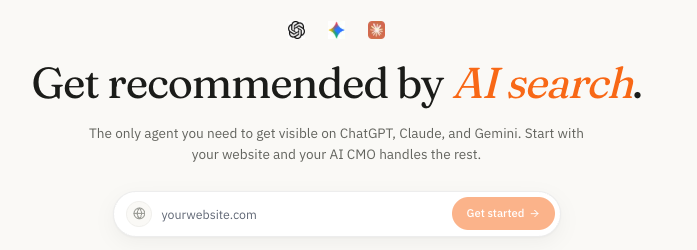
Moonrank is built as that consolidated option. It runs personalized keyword research, publishes SEO content automatically every day, applies the technical fixes AI engines need to parse and trust your site, and tracks your visibility across ChatGPT, Gemini, Claude, and Perplexity, all on one budget-friendly subscription, with no marketing team required to run it.
If you're not sure where your business currently stands with AI engines, that's the starting point worth checking before anything else. See your current AI visibility at www.moonrank.ai and decide from there whether automation, a tool stack, or an agency fits your business.

Frequently Asked Questions
Do small businesses show up differently in ChatGPT and Perplexity than in Google?
Yes, AI engines pull from a narrower set of sources and favor structured, well-cited content over raw keyword rankings. A business ranking on page one of Google can still be invisible in ChatGPT if its site lacks schema markup, clear entity signals, or third-party mentions the model trusts. This gap is becoming increasingly costly to ignore as more users turn to AI-generated answers instead of traditional search results [1].
What is the biggest mistake SMBs make when choosing an SEO tool for AI visibility?
Assuming a traditional keyword-ranking tool automatically covers AI search, it usually doesn't. Most established platforms bolt AI tracking onto a system still built around backlinks and SERP position, leaving the technical groundwork AI engines actually need, structured data, llms.txt, citation-worthy content, unaddressed.
Can you use your existing Google-focused SEO tool for AI search visibility instead of switching?
Partially, but plan to supplement it, not rely on it alone. Traditional tools still help with keyword research and content structure, since LLMs pull from well-optimized, authoritative pages rather than inventing facts [4]. What they typically miss is AI-specific tracking, technical readability fixes, and automated daily publishing.
How quickly can a small business expect to see AI search visibility improve after adopting a new tool?
Most SMBs see initial movement within four to eight weeks, with steadier gains building over two to three months. Technical fixes like schema markup and llms.txt tend to show effects faster than content-driven citation growth, since AI engines need repeated crawling and re-indexing to register new signals.
Should a small business switch SEO tools entirely, or add an AI visibility layer to what it already uses?
It depends on how much overlap exists already. If your current tool only tracks Google rankings and backlinks, adding a dedicated AI visibility layer usually makes more sense than a full switch, at least initially. But if you're managing several disconnected tools already, consolidating into one platform that covers tracking, content, and technical optimization together tends to reduce both cost and coordination overhead over time.
Conclusion
Choosing among the best SEO tools now means asking a narrower question: does this tool track and fix AI search visibility, or just Google rankings with AI features bolted on? Most platforms in this comparison still lean toward the latter. For SMBs without a marketing team, the practical path is a tool that handles technical AI-readability, daily content, and cross-engine tracking without manual upkeep.
Moonrank was built for exactly this gap, automated daily publishing, schema and llms.txt optimization, and visibility tracking across ChatGPT, Gemini, Claude, and Perplexity on one budget-friendly subscription. Start the free trial at moonrank.ai and check where your business currently stands in AI search before your competitors get there first.
Sources & References
- Best AI SEO tools for improving organic search rankings in 2026 | Omni Eclipse
- How do you rank in AI? Top AI Visibility Tools Overview
- SEO Tools Comparison: Side-by-Side SEO Software Evaluations
- 15 Best SEO Tools for Content, Rankings, and AI Visibility
Recommended Articles
Explore more from our content library: