How to Use SEO Writing AI to Get Recommended by ChatGPT
AI writing tools help you rank in AI search only when paired with real optimization: entity clarity, schema markup, structured data, and answer-first content.

Understanding seo writing ai is essential. AI writing tools can help you rank in AI search engines only when the output is built around real optimization signals, clear entity definitions, structured data, and answer-first formatting, not just fast content generation. Raw ChatGPT output rarely gets cited by Perplexity or recommended by ChatGPT itself because it lacks the structured, fact-dense signals these engines look for. SMBs get better results pairing AI drafting with dedicated optimization steps: schema markup, clear sourcing, and consistent publishing, rather than relying on generation speed alone.
Can SEO Writing AI Actually Get You Recommended by ChatGPT and Perplexity?
Yes, but only when the output gives AI search engines something specific to cite, a named entity, a clear fact, a structured answer, not generic paragraphs about a topic.
ChatGPT, Perplexity, and Gemini don't rank pages the way Google does. They retrieve chunks of text that answer a question directly, then decide whether that chunk is trustworthy enough to quote or recommend. A paragraph that defines what a business does, lists its services, and states facts in plain sentences gets pulled into an answer. A paragraph full of vague marketing language does not. This is why seo writing ai only works commercially when the content is structured for extraction, not just readability.
What Happens to AI-Generated Content in AI Search Recommendations
Most AI-generated drafts never get cited because they read like summaries instead of sources. Link Assistant's review of nine AI writing tools found that outputs from ChatGPT, Gemini, and similar tools still need manual editing to add real keyword targeting, outlines, and factual specificity before they're usable for search [3]. That gap matters more in AI search than in Google search, since these engines actively check whether a claim is sourced and specific before surfacing it. A page that says "we offer quality service" gives an AI engine nothing to quote. A page that names a specific fact or figure gives it something concrete to work with.
Do Real Businesses See Visibility Gains From AI-Assisted Content?
Businesses that pair AI drafting with real optimization work see gains; those that publish raw AI output at high volume generally don't. Publishing faster doesn't move the needle on its own, SEOWriting AI's own positioning leans on SERP-competitor analysis and content structured for both traditional and AI engines, not sheer output speed [1]. The tools reviewed by Originality.AI are judged less on how fast they generate drafts and more on whether the resulting content holds up structurally for ranking and citation [2]. Moonrank builds on this by pairing daily content generation with schema markup, llms.txt configuration, and citation building, the technical layer that tells ChatGPT and Perplexity a page is trustworthy enough to quote.
Set expectations accordingly: one well-optimized article won't move visibility. Consistent publishing combined with technical signals, sustained over weeks, is what shows up in AI recommendations.
How to Use AI to Write Content That AI Search Engines Recommend
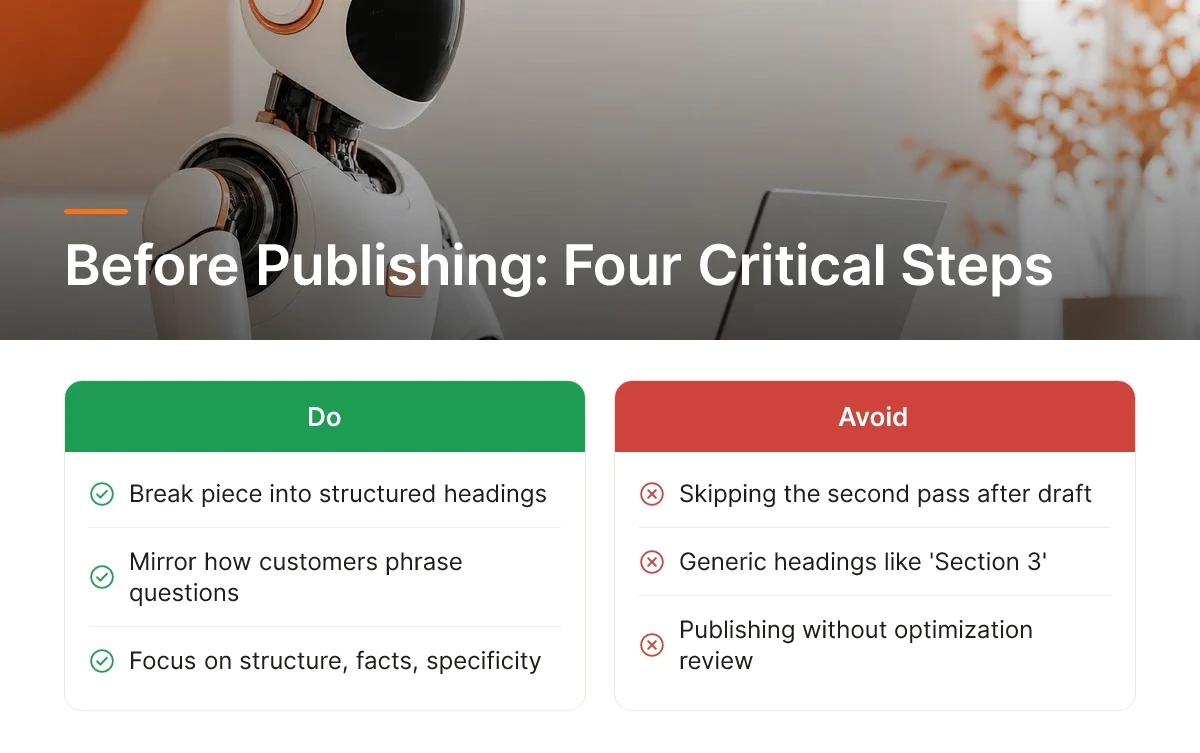
A draft from any writing tool is a starting point, not a finished asset, getting recommended by ChatGPT or Perplexity requires a second pass focused on structure, facts, and specificity. Skipping that pass is the most common reason seo writing ai output never gets cited anywhere.
SEO Steps That Matter Beyond Generating the Draft
Once the draft exists, four things need to happen before it's publish-ready:
- Structure headings around real questions. Break the piece into headings that mirror how a customer would actually phrase a question, "best running shoes for flat feet" reads better to an AI engine than "Section 3: Product Considerations."
- Write direct-answer paragraphs. State the answer in the first sentence under each heading, then support it with detail.
- Add schema markup. Structured data tells AI engines exactly what your page covers and what kind of business published it.
- Name the business throughout. Mention business name, location, and category throughout the piece, not just in a byline. AI engines pull entity signals from context, and a page that never names the business it's about gives them nothing to attach a recommendation to.
This is the layer most generic AI writing tools skip. They generate a draft optimized for keyword coverage, not for the extraction logic AI search engines run to pull a clean answer out of a page.
How to Avoid AI Detection Penalties While Staying Recommendable
Content that reads as templated gets filtered before it ever gets cited, because AI search engines are built to surface useful answers, not generic filler. The fix isn't hiding that AI helped write something, it's editing until the content says something a competitor's page doesn't. Vary sentence length and structure so paragraphs don't all follow the same subject-verb-object rhythm. Add details AI can't invent on its own: your actual return policy, a specific ingredient sourcing note, a real staff name tied to a service. Then fact-check every claim, because a single wrong number undermines trust in the whole page.
Specificity, not keyword density, is what keeps content out of the low-value bucket AI engines are trained to discount. A page packed with the target keyword but thin on real detail reads as filler; a page with fewer keyword mentions but concrete, verifiable facts reads as a source worth citing. This is the exact gap Moonrank's daily publishing closes automatically, every article ships with schema, entity mentions, and structured answers already built in, and Moonrank's technical audit layer checks citation-worthiness before anything goes live, so business owners aren't manually auditing drafts for factual gaps or template patterns.
ChatGPT vs. a Dedicated SEO Writing AI Tool: What's the Real Difference?
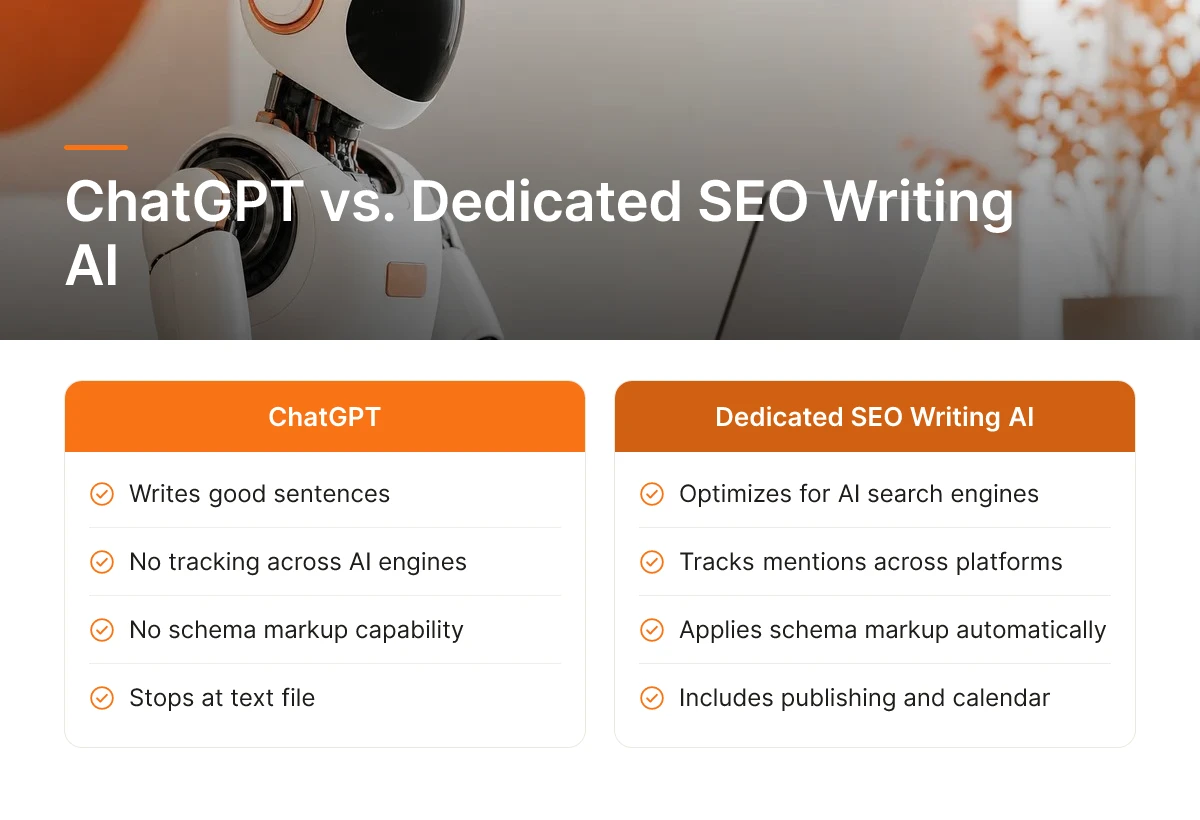
ChatGPT writes good sentences; it has no idea whether those sentences show up when someone asks Perplexity for a recommendation. That gap is the entire reason a dedicated seo writing ai tool exists as a separate category.
Can ChatGPT Optimize Content for AI Search on Its Own?
ChatGPT can draft a blog post, rewrite a product page, or brainstorm headlines, but it stops at the text file. It has no mechanism to track whether your business gets mentioned across ChatGPT, Gemini, Claude, or Perplexity, no way to apply schema markup that tells those systems what your business actually sells, and no publishing calendar to keep content flowing on a schedule.
A Shopify owner who pastes a ChatGPT draft into their store gets a page. They don't get citations, structured data, or any signal that the page is being seen by AI systems at all. That's a manual, one-off task repeated indefinitely, every draft still needs formatting, publishing, internal linking, and a person checking whether any of it moved the needle.
What Actually Matters When Comparing Tools for SMB Budgets
A purpose-built tool typically adds three things ChatGPT can't:
- Automated structured data — schema markup and llms.txt configuration so AI engines can parse and trust the content.
- On-page optimization checks — validated against real keyword and competitor data.
- Visibility tracking — reporting on whether your brand actually appears in AI-generated answers.
Moonrank, for example, runs this as one system, daily content generation, technical AI audits, and cross-engine visibility monitoring, rather than three separate subscriptions bolted together.
Neither ChatGPT nor a dedicated tool replaces a content strategy. Feeding a tool a vague niche with no keyword targeting or competitive read just produces faster generic drafts, the volume goes up, the relevance doesn't.
The decision comes down to frequency and effort tolerance. A B2B SaaS founder who needs one landing page rewritten this quarter can reasonably use ChatGPT directly and edit by hand. A business that needs daily publishing, ongoing technical fixes, and a standing answer to "are we visible in AI search this month" needs automation built for that cadence, because doing it manually every day isn't a task most owner-operators have time for.
Set against agency retainers, which tend to sit in the premium tier for ongoing monthly work, a budget-friendly automated platform changes that calculus for most SMBs weighing effort against cost.
What Does AI-Optimized Content Cost Without an Agency?
Costs fall into three general tiers: free tools handle basic drafting, budget-friendly SaaS platforms add optimization and publishing, and premium or agency-level plans layer on tracking and strategy support.
Free AI writers, the kind built into many word processors or offered as trial plans, generate readable drafts fast. That's their ceiling. They don't research keywords specific to your niche, they don't add schema markup, and they don't tell you whether ChatGPT or Perplexity ever mention your business. You still have to publish, format, and optimize everything by hand, which erases most of the time savings that made a free tool tempting in the first place.
Where the Free Tier Breaks Down
Structured data and visibility tracking are the two features free tools almost never include, and both matter more than the writing itself for AI search recommendation. AI engines rely on schema markup and llms.txt files to parse what a business actually does, without that, even well-written content can go unread by the systems deciding who gets recommended. A free tool can produce a blog post; it can't tell you whether that post changed your standing in Gemini or Claude's answers.
Budget-friendly paid plans close that gap. This is the tier where seo writing ai tools start doing the technical work, auto-publishing, structured data, citation building, that free drafting tools skip entirely. Moonrank sits in this budget-friendly tier, bundling daily content generation with technical optimization and AI search visibility tracking across ChatGPT, Gemini, Claude, and Perplexity, instead of requiring three separate subscriptions.
Agency Retainers vs. Self-Serve Tools
Agency retainers run as recurring monthly fees plus per-project charges for technical fixes, strategy calls, and revisions, costs that scale with how much attention your account gets, not with results. Self-serve platforms replace that variable overhead with a flat, predictable subscription. That predictability matters most for owner-operators who need to budget marketing spend months in advance, not renegotiate scope every quarter.
The real comparison isn't subscription price against subscription price. It's writing time saved, multiplied by how accurately the content gets optimized for AI recommendation, against what an agency would typically charge at premium/enterprise rates for comparable coverage.
What to Look for in an SEO Writing AI Tool for AI Search Visibility
The right seo writing ai tool publishes to your actual platform, outputs structured data AI engines can parse, and proves, with tracking, not promises, that your content gets surfaced.
Integrations and CMS Compatibility That Matter Most
Check publishing support before anything else. A tool that generates good copy but dumps it into a CSV file you have to manually paste into WordPress defeats the purpose of automation.
For an e-commerce store on Shopify, confirm the tool publishes directly to product pages, collection pages, and the blog, not just a generic blog feed. For a B2B SaaS site on Webflow or a custom CMS, ask whether the tool supports API-based publishing or only has a plugin for the two or three most common platforms. Many AI writing tools are built WordPress-first [1], which leaves Shopify and Webflow users stuck exporting content by hand. Moonrank auto-publishes daily content directly to the business's site regardless of platform, which matters for owners who signed up specifically to avoid touching a CMS at all.
How to Judge If a Tool's Content Will Get Recommended
Readable prose is not enough, AI search engines like ChatGPT and Perplexity rely on structured signals to understand what a page is about and whether to trust it. Ask any vendor whether the tool outputs schema markup automatically, and whether it configures an llms.txt file that tells AI crawlers what your business does and which pages matter. If a sales page never mentions schema or structured data, assume the content is optimized for human readers only, not for machine parsing.
Before committing to any tool, run a small test:
- Publish a handful of articles using the tool.
- Ask ChatGPT or Perplexity a question your target customer would ask, "best boutique hotel in [city]" or "top project management software for small teams".
- Check whether your business shows up or gets cited as a source.
- Repeat the same check again in four to six weeks.
If nothing changes, the tool's output isn't being surfaced, regardless of how polished the writing reads.
Finally, treat visibility tracking as a core feature, not an afterthought. Generation without measurement leaves you guessing. Moonrank's AI search visibility tracking monitors how a business appears across ChatGPT, Claude, Gemini, and Perplexity over time, which turns "we published content" into "here's what changed in your AI recommendations this month", the actual outcome an SMB owner is paying for.
Frequently Asked Questions
Do free AI writing tools work for SEO, or do you need a paid plan?
Free tools can draft basic copy, but they rarely handle the technical side AI search engines actually check, schema markup, structured data, and citation building. Most free plans also cap word counts or publishing frequency, which matters if you're trying to build the kind of content history ChatGPT and Perplexity reward. For a Shopify store or B2B SaaS site trying to compete daily, a paid plan usually pays for itself in saved hours alone.
What's the price difference between free tools, paid plans, and hiring an agency?
Free tools cost nothing but limit output; paid AI writing platforms typically sit in the budget-friendly to mid-range tier; agencies typically charge premium/enterprise-level monthly retainers for comparable work. Moonrank sits in the budget-friendly tier and bundles content generation, technical optimization, and AI visibility tracking, work an agency would split across multiple retainers.
Which AI writing approach is best for SMBs trying to compete without agency costs?
The best approach combines automated daily publishing with technical AI-readability fixes, not just content generation alone. A restaurant owner or solo SaaS founder doesn't have time to write, optimize, and track visibility separately. Moonrank handles all three, personalized keyword research, daily auto-published content, and schema/llms.txt setup, so the business owner never touches a technical file or writes a draft themselves.
How do you avoid AI content detection issues while still ranking in AI search?
Focus on accuracy and specificity rather than trying to disguise AI-generated text. AI search engines like ChatGPT and Perplexity prioritize content that answers questions clearly and cites real information over content that merely sounds human. Detection tools matter less than whether your content gets pulled into an AI answer, that depends on structured data, clear facts, and consistent publishing, which is why technical optimization matters as much as the writing itself.
What integrations should an AI SEO writing tool support beyond WordPress?
Look for direct publishing to Shopify, Webflow, and headless CMS setups, plus schema and llms.txt support that doesn't require manual coding. E-commerce stores need product-page integration; B2B SaaS sites need blog and docs coverage. A tool limited to WordPress leaves a gap for the growing number of SMBs running on other platforms.

Conclusion
Writing content with AI is no longer the hard part, getting that content recognized by ChatGPT, Gemini, and Perplexity is. That takes daily publishing consistency, technical signals like schema markup and llms.txt, and visibility tracking most SMB owners never set up on their own. Skipping any one of those three leaves you writing into a void.
If you're a Shopify owner or solo SaaS founder without time to manage all three, start by checking how your business currently shows up when someone asks an AI engine for a recommendation in your category. Run that visibility check at www.moonrank.ai.
Sources & References
- SEO WRITING - AI Writing Tool for 1-Click SEO Articles
- SEOWriting AI Review - Build Optimized Content in Minutes, Originality.AI
- AI Content for SEO: Nine Popular Writing Tools Tested
Recommended Articles
Explore more from our content library: