How AI SEO Services Help Small Businesses Get Found by AI
Discover how AI SEO services help SMBs get recommended by ChatGPT, Gemini, and Perplexity through structured data, consistent listings, and daily content.

AI search engines like ChatGPT, Gemini, and Perplexity recommend businesses whose information is structured, consistent, and easy to verify across the web, not businesses that simply rank well on Google. SMBs can improve their odds using AI SEO services: automated tools that publish structured content, monitor how AI engines describe your business, and fix gaps in your online presence without the cost of a full agency retainer. The core shift is from chasing keyword rankings to feeding AI models clear, trustworthy signals about who you are and what you offer.
How AI SEO Services Help Your Business Get Recommended by ChatGPT and Perplexity
AI engines recommend businesses based on structured data, consistent listings, and clear third-party validation, not the backlink counts that drive traditional Google rankings. This is the foundation that most AI SEO services are built around.
What Factors Do AI Search Engines Use to Pick Which Businesses to Recommend?
ChatGPT, Gemini, Perplexity, and Claude don't crawl the web the way Google's algorithm does. They pull from structured data (schema markup that defines what your business is and does), how consistently your business name, address, and offerings appear across directories and review sites, and how often independent sources, review platforms, local publications, industry roundups, mention you. A restaurant with matching hours on Google, Yelp, and its own website reads as trustworthy. One with conflicting information across those three sources reads as unreliable, and AI models tend to skip unreliable sources rather than guess.
This is also why AI SEO services focus on entity clarity, making sure an AI model can state in one sentence what your business sells, who it serves, and where, rather than stuffing pages with keywords. That clarity is what gets quoted back to a user asking for a recommendation.
Can Small Businesses Compete With Larger Companies for AI Search Visibility?
Yes, consistency and clear structured data often matter more to AI models than domain authority or ad spend.
A national chain with a bloated, inconsistent web presence across hundreds of locations can actually lose to a single-location shop with clean, verified information. AI models reward clarity they can trust, not size. This is the opening automated tools are built for: Moonrank runs a technical AI audit that implements schema markup, llms.txt configuration, and citation building, then publishes structured content daily so a small e-commerce store or B2B SaaS company can maintain the same signal quality a large enterprise team would produce manually, without hiring one.
Handling this at scale means more than publishing. It means monitoring how ChatGPT and Perplexity currently describe your business, catching outdated or wrong details before they spread, and flagging inconsistencies across the web, the kind of ongoing work no owner-operator has time to do by hand every week. This is where the case for using dedicated AI SEO services becomes clearest, since manual monitoring rarely keeps pace with how often AI engines refresh their answers.
Each engine also pulls from different sources: Perplexity leans on live web citations, Gemini draws on Google's index and knowledge graph, and ChatGPT and Claude weight training data alongside retrieved content. Optimizing for one engine and ignoring the others leaves visibility gaps. Coverage across all four matters more than perfecting your presence on a single platform. For a broader look at how these platforms are evaluated, see this overview of top AI visibility tools.
AI Search Optimization vs. Traditional Google SEO: What Actually Changes
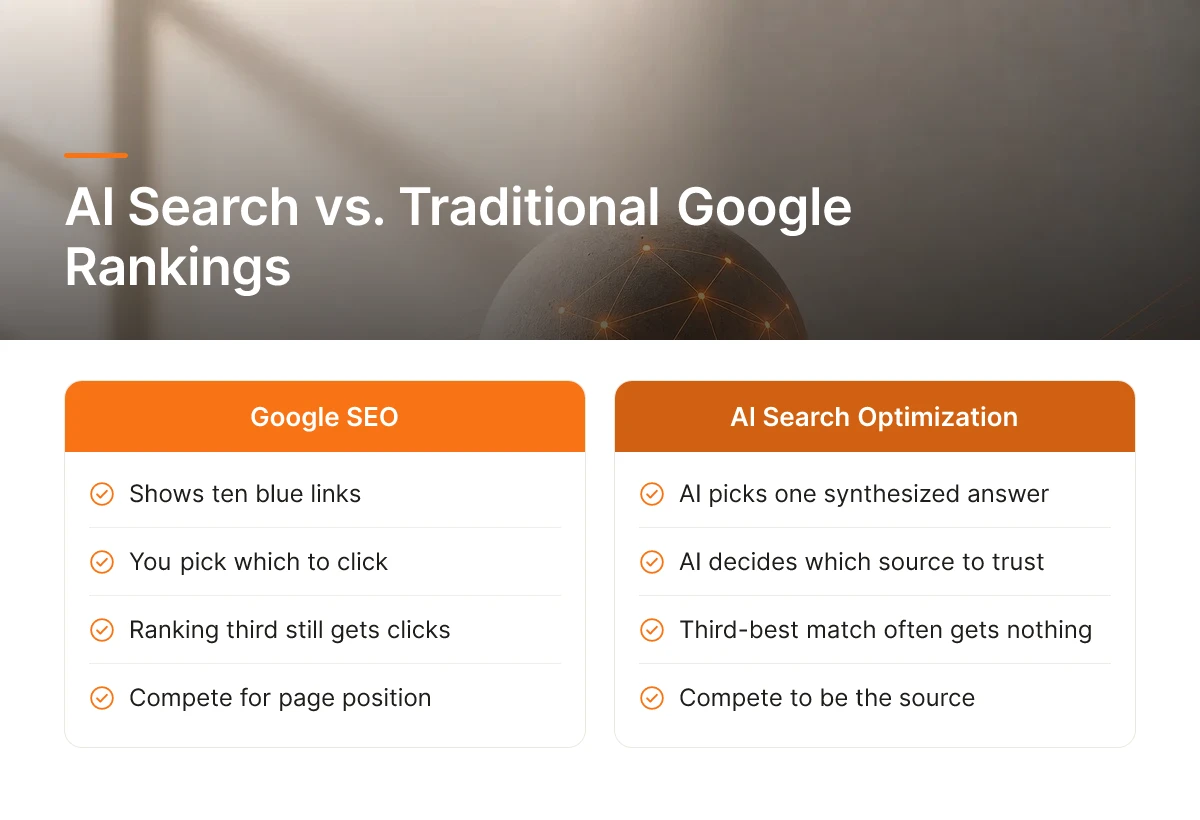
Google shows you ten blue links and lets you pick one; ChatGPT, Gemini, and Perplexity pick for you and hand you a single synthesized answer. That shift changes what "winning" visibility even means, you're no longer competing for a spot on a page, you're competing to be the source an AI model decides to trust and repeat.
Ranking third on Google still gets you a click. Being the third-best match for an AI answer often gets you nothing, because most AI engines mention only one to three sources by name in a given response. Visibility becomes binary more often than it used to: you're in the answer, or you're invisible to that customer entirely.
Do the Same SEO Tactics That Work for Google Work for ChatGPT and Perplexity?
Some fundamentals carry over, clear, well-organized content and genuine third-party mentions still help AI engines understand and trust your business. But tactics built purely to game rankings don't translate, and treating ai seo services as just SEO with extra steps is where most SMBs go wrong.
Exact-match keyword stuffing does little for a system that's synthesizing meaning across a response, not matching query strings. Link-building volume alone, hundreds of low-quality backlinks, carries less weight than a handful of citations from sources an AI model already considers credible. What matters more is structured data, consistent facts about your business across the web, and content phrased the way people actually ask questions in a chat box.
- Structured data: schema markup that clearly labels what your business is and does.
- Consistent facts: matching name, address, hours, and offerings across every listing.
- Conversational content: pages phrased the way people actually ask questions in a chat box.
- Credible citations: a handful of mentions from sources AI models already trust, rather than bulk backlinks.
Why Is AI Search Visibility Becoming Important for SMBs Right Now?
Purchase research is moving from search bars into chat interfaces faster than most SMB owners have adjusted for. Hibu reports that around 43% of consumers now use AI search tools like ChatGPT or Gemini daily, and 75% say they're using them more than they did a year ago [2]. Google still holds close to 90% share of traditional, non-AI searches [2], which is exactly why this looks optional until a competitor starts showing up in the answers you don't.
None of this replaces the need for a solid website. AI engines still pull from and cross-check your existing content, so a thin or outdated site undermines both your Google rankings and your odds of being cited in an AI answer. Moonrank builds on that baseline rather than around it, publishing daily content and fixing technical AI-readability gaps like schema markup and llms.txt so the same site works harder in both worlds.
What It Actually Costs to Get Visibility in AI Search Engines
The real cost of ai seo services comes down to two models: paying for human hours through an agency, or paying for software that runs daily on its own. Both can work, the right choice depends on your budget and how competitive your niche is.
What's the Real Cost Difference Between Hiring an Agency and Using an Automated Platform?
Agencies price around billable hours and account management, which pushes their retainers into premium territory. You're paying for a strategist to research your market, a writer to draft content, and an account manager to report back to you, three or more people touching your account every month.
Automated platforms price around software delivery instead of headcount, which is why they land in budget-friendly tiers. A platform like Moonrank runs keyword research, content generation, publishing, and technical optimization, schema markup, llms.txt configuration, citation building, as one automated system rather than a team of billable specialists. You lose some of the bespoke strategy sessions an agency offers, but you gain a recurring cost that a solo founder or independent shop owner can justify without a marketing budget.
The tradeoff is customization versus consistency. Agencies can pivot strategy in a meeting. Automated tools execute the same disciplined process, daily content, ongoing technical fixes, without needing you to schedule a call. Choosing between the two models is really a choice about how you want your AI SEO services delivered, hands-on and custom, or automated and consistent.
What ROI Can You Expect From Investing in AI Search Visibility?
Skip the fixed-percentage-return math and track three concrete signals instead: whether your brand gets mentioned when someone asks ChatGPT, Gemini, or Perplexity a question in your category, whether you see referral traffic showing up from those engines in your analytics, and whether you appear when someone asks a comparison-style question like "best [your category] for [use case]."
None of these show up in a traditional Google Analytics dashboard by default, which is part of why SMB owners underestimate how much business AI search already influences. Consumer behavior is shifting fast enough that around 43% of consumers now use AI search tools like ChatGPT or Gemini daily, and 75% say they use them more than they did a year ago [2]. If you're not tracking mentions and referrals from those engines, you have no way to know whether your visibility is improving or disappearing.
The decision rule is simple. If your niche is straightforward and your main goal is ongoing maintenance, steady content, clean technical signals, consistent tracking, a budget-friendly automated platform covers it. If you're in a highly competitive or complex niche where nuanced positioning matters, premium agency support with dedicated strategy may justify the higher recurring cost.
What You Need to Do to Appear in AI-Generated Answers
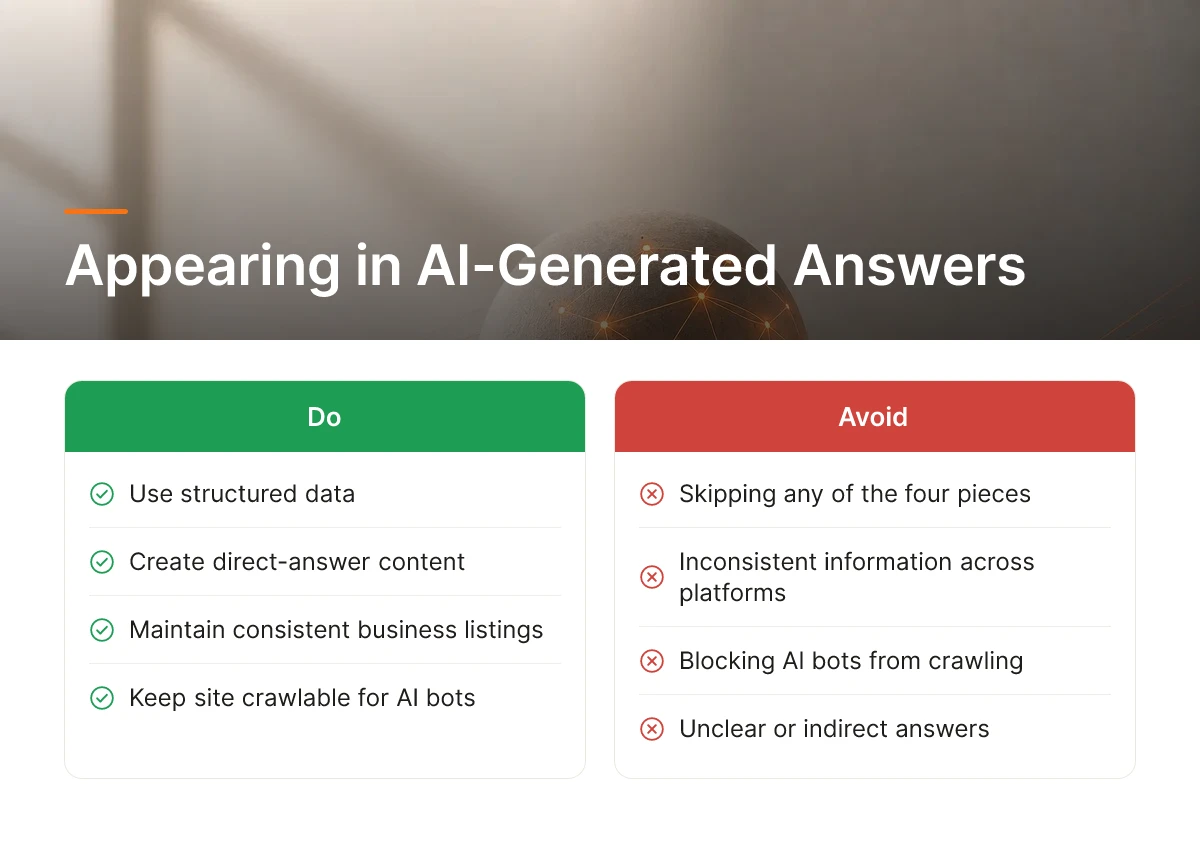
Appearing in AI-generated answers takes four things: structured data, direct-answer content, consistent business listings, and a crawlable site AI bots can actually read.
None of this requires a developer on staff. But it does require doing all four consistently, which is exactly where most SMB owners run out of time, and exactly why ai seo services exist as a category in the first place. Skipping one piece usually means an AI engine has the information but doesn't trust it enough to recommend you.
How Does Technical Optimization Differ When Targeting AI Search Engines?
Google ranks pages; AI engines extract facts from them, so the technical work shifts from "get indexed" to "get understood."
Schema markup is the plain-text labeling system that does this, small tags in your site's code that say, in a format machines read instantly, "this is a restaurant," "this is a plumbing service," "this location serves Austin, TX." Without it, an AI model has to guess what your page means from surrounding text, and guessing is where you drop out of consideration. With it, ChatGPT or Perplexity can lift the exact detail it needs, your hours, your service area, your price tier, without misreading the page.
Crawlability matters too. If an AI crawler can't access your pages, it can't cite them, full stop. That's where llms.txt comes in: a simple file placed on your site that tells AI crawlers which pages to read and how to interpret your content, similar in spirit to a robots.txt file but written for language models instead of search bots. Moonrank builds this file automatically as part of its technical audit, alongside schema markup and citation building, so the site is legible to AI systems without the owner touching a line of code.
What Type of Content Do AI Search Engines Prefer to Recommend?
AI engines pull content that answers a question directly, in the first sentence, under a clear heading, not content buried in narrative buildup.
FAQ-style sections perform well because they mirror how people phrase questions to ChatGPT or Gemini. A heading like "What does a boutique hotel in Savannah charge for a weekend stay?" followed immediately by a direct answer is easier for a model to extract and quote than three paragraphs of brand story. Short paragraphs, numbered steps, and specific numbers all help the same way.
Consistency across the web matters just as much as the content itself. If your business name, address, and services differ across your website, Google Business Profile, and review sites like Yelp or TripAdvisor, AI models treat that as a trust problem and often default to a competitor with cleaner data instead.
Given how much of this is ongoing, daily publishing, schema upkeep, listing consistency, most owners eventually automate it rather than doing it by hand each week. As detailed in this piece on keeping small businesses visible in AI search, staying consistent across platforms is quickly becoming a baseline requirement rather than a nice-to-have.
Moonrank handles all four pieces on autopilot for $99/month: daily content generation, technical schema and llms.txt setup, citation building, and visibility tracking across ChatGPT, Gemini, Claude, and Perplexity.
How Long AI Search Visibility Takes and How to Track Progress
Most SMBs see technical fixes reflected within weeks and content-driven mentions build over the following months, faster than typical Google ranking timelines. That speed comes from how large language models retrieve and rank information, there's no equivalent of the months- or years-long backlink accumulation curve that drives traditional SEO. Instead, freshness, clarity, and structured data carry more weight, which is why ai seo services built around daily publishing and technical cleanup tend to show movement sooner than a link-building campaign ever could.
What's a Realistic Timeline for Appearing in ChatGPT, Gemini, and Perplexity Recommendations?
Expect visibility to arrive in two waves, not one big jump. The first wave is technical: once schema markup, llms.txt, and structured data are in place, AI crawlers can parse and trust a site's content much faster than Google's crawler needs to build authority signals. That often changes how a business gets described or cited within a matter of weeks.
The second wave is content-driven and slower. New pages need time to get indexed, cited by other sources, and picked up across the different data feeds each AI engine draws from. This is where daily, niche-specific content, the kind Moonrank publishes automatically for its $99/month subscribers, compounds over a few months rather than producing instant results. Businesses that expect Google-style timelines of six months to a year are often surprised at how much sooner the technical layer pays off, even while content-driven gains keep building.
How Do You Track Whether Your AI Search Visibility Efforts Are Working?
Track progress with three concrete checks run on a regular cadence, not a one-time audit:
- Manual queries: ask ChatGPT, Gemini, and Perplexity buyer-intent questions like "best [category] in [city]" and note whether the business appears and how it's described.
- Referral traffic: watch analytics for a rising trickle of sessions from perplexity.ai or chat.openai.com, a real signal even before it becomes significant volume.
- Brand mention consistency: check whether the business name, description, and offering are represented the same way across all three engines, or whether one has outdated information.
Consistency in that tracking matters more than any single query result, since one-off checks can mislead. AI engines update their underlying models and refresh their data sources on different, often undisclosed cycles, so a business can see visibility dip or spike with zero changes on its end. That's normal churn, not a sign the work isn't working, which is exactly why Moonrank's ongoing AI search visibility monitoring exists as a continuous layer rather than a one-time report.

Frequently Asked Questions
Can I do AI search optimization myself without any outside help?
Yes, but expect a real time cost: daily content writing, schema markup, and llms.txt setup all take ongoing technical work. A solo founder without SEO experience usually spends several hours a week on tasks a tool like Moonrank runs automatically for $99/month. The DIY route works if you have the time; most SMB owners don't.
Will optimizing for AI search hurt my traditional Google rankings?
No, the two goals reinforce each other rather than compete. AI engines and Google both reward clear structure, credible citations, and fresh content, so improvements made for one typically help the other. Structured data and consistent publishing benefit both channels at once.
Do I need separate strategies for ChatGPT, Gemini, and Perplexity?
Not entirely separate, but each engine pulls from different sources and weighs signals differently. Perplexity leans heavily on live web citations, while ChatGPT and Gemini draw more on training data and connected search plugins. A single foundation, structured data, consistent content, strong citations, covers most of the work, with monitoring across all four engines showing you where gaps remain.
How do I know if my business is already being mentioned by AI engines?
Ask ChatGPT, Gemini, Claude, and Perplexity directly with queries a customer would use, like "best [your category] in [your city]." Track results over a few weeks since AI answers shift as models retrain and pull new sources. Tools built for AI visibility tracking automate this instead of manual, repeated checking.
How do I choose between different AI SEO services if I've never used one before?
Compare what each option actually automates versus what still requires your time: daily content publishing, schema and llms.txt setup, citation building, and cross-engine monitoring are the core pieces to look for. Also check whether the service tracks results across ChatGPT, Gemini, Claude, and Perplexity, not just one engine, since coverage gaps are where visibility quietly disappears.
Conclusion
AI search visibility comes down to three things: structured data AI engines can parse, fresh content published consistently, and citations that build trust across sources. Skipping any one leaves gaps competitors will fill first. Agencies charge thousands to manage this manually; automated platforms now handle the same technical audit, daily publishing, and cross-engine tracking without the retainer.
Start today by asking ChatGPT and Perplexity how they'd describe your business in your category, the gaps in their answers show you exactly where to focus. Then try Moonrank's 3-day free trial to see your current AI visibility score and fix those gaps on autopilot.
Sources & References
Recommended Articles
Explore more from our content library: