Compare SMB GEO Tools on Pricing, Features and AI Coverage
The best GEO tool for your SMB depends on which AI engines your customers actually use and how much hands-on management you want to do. Look for a tool that...

Understanding compare geo optimization tools for smbs pricing features and ai search coverage is essential. The best GEO tool for your SMB depends on which AI engines your customers actually use and how much hands-on management you want to do. Look for a tool that tracks and optimizes visibility across ChatGPT, Gemini, Claude, and Perplexity at a budget-friendly price point, rather than an enterprise platform built for agencies. Prioritize tools that combine citation tracking with automated content publishing, not just monitoring dashboards that tell you a problem exists without fixing it. For most small businesses, an all-in-one tool costs far less than hiring a specialist and gets you visible faster.
How Do You Compare GEO Optimization Tools for SMBs on Pricing, Features, and AI Search Coverage?
You compare them across three axes: what they cost, what they actually do beyond monitoring, and which AI engines they cover, ChatGPT, Gemini, Claude, and Perplexity.
Generative Engine Optimization, or GEO, means optimizing your business so AI engines mention it directly in the answer they generate, not just so your website ranks on a results page. When someone asks ChatGPT "best hotel in Savannah" or Perplexity "top project management software for small teams," GEO determines whether your business gets named in that response. If you're trying to compare GEO optimization tools for SMBs on pricing, features, and AI search coverage, you first need to understand that this is a different game than classic search ranking.
Is AI SEO the Same as GEO, or Are They Different Strategies?
"AI SEO" and GEO get used interchangeably in vendor marketing, but the practical distinction matters for what you're buying. AI SEO often refers narrowly to technical fixes, schema markup, llms.txt files, structured data that helps AI crawlers parse your site. GEO, in the fuller sense, includes that technical layer plus the ongoing work of building citations and fresh content that AI engines pull from when generating answers. A tool that only handles one half leaves you with a partial solution: technically readable but rarely mentioned, or frequently mentioned in low-authority contexts because nobody's building the structured data underneath.
Why Should SMBs Care About GEO When They're Already Doing SEO?
Traditional SEO targets a position on a results page; GEO targets a mention inside a generated answer, and those two outcomes depend on different signals. Google rankings weigh backlinks, keyword placement, and page authority. AI engines weigh structured data, third-party mentions across the web, and how clearly your content answers a specific question [4]. A business with a strong Google ranking can still be invisible to ChatGPT if its site lacks the technical signals AI systems rely on, or if nobody else online mentions it in a citable way. That gap is why SMB owners who've invested in SEO for years are now finding competitors get recommended by AI search engines while they don't show up at all.
The rest of this comparison uses three consistent axes: pricing tier (budget-friendly versus enterprise-scale), feature depth (monitoring alone versus monitoring plus automated fixes), and AI engine coverage (how many of the major assistants a tool actually tracks and optimizes for, not just claims to support).
Which AI Search Engines Should SMBs Prioritize, and Where Do Tools Fall Short on Coverage?
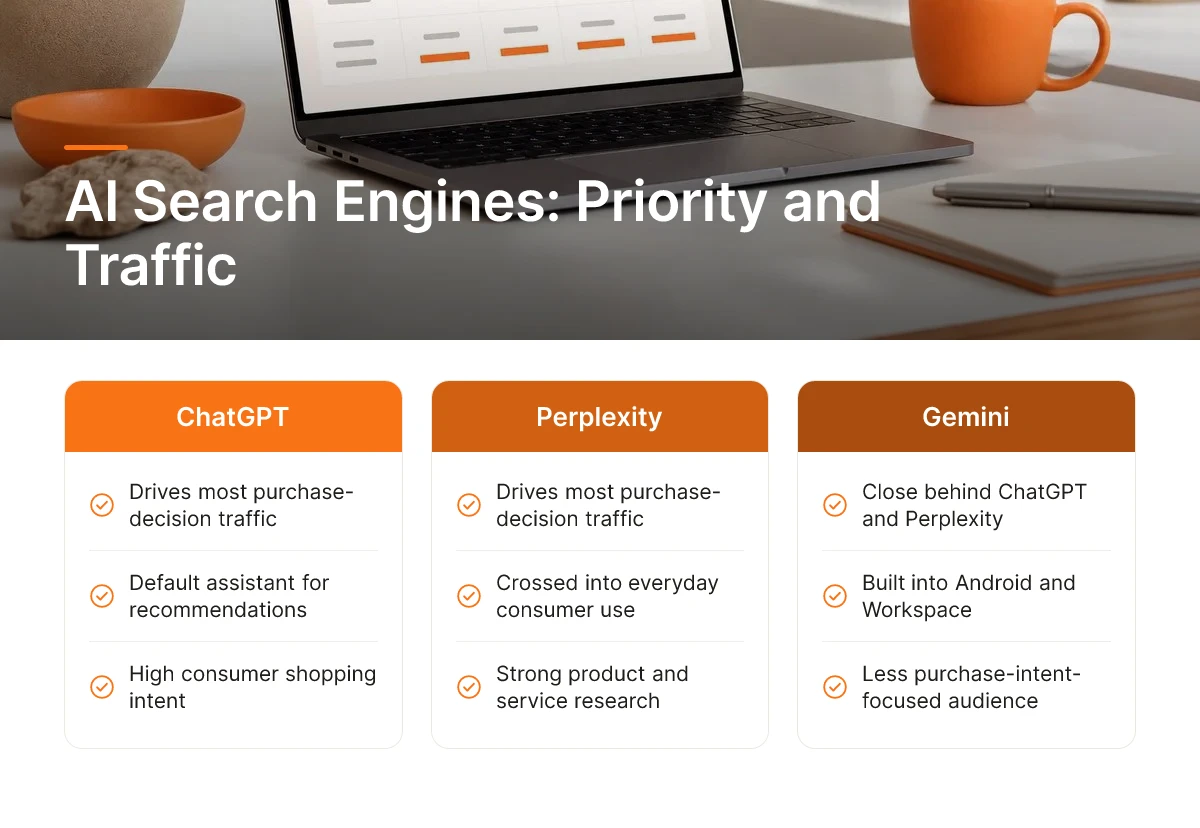
ChatGPT and Perplexity drive the most purchase-decision traffic for SMBs today, with Gemini close behind and Claude trailing for consumer-facing queries.
Perplexity has already crossed into everyday consumer use for product and service research, and ChatGPT remains the default assistant most shoppers open first when they ask for a recommendation. Gemini matters where it's built into Android phones and Google Workspace, which puts it in front of a large but less purchase-intent-focused audience. Claude sees far less consumer shopping traffic, it's used more for work tasks than "best restaurant near me" or "top project management tool for a 10-person team" queries. That ranking should guide where an SMB spends its limited attention, not a blanket assumption that every engine deserves equal weight.
What Emerging AI Systems Are GEO Tools Missing?
Most GEO tools track the four major engines well but miss Grok, DeepSeek, and regional assistants that are gaining ground with younger and international audiences.
Coverage gaps exist because many tools are built on scraping or direct API access to a specific engine, and each new engine requires its own separate integration, infrastructure that takes real engineering time to build and maintain. That's why a tool might track ChatGPT and Gemini well but leave Grok or DeepSeek out entirely, or why some platforms only add newer engines as paid add-ons rather than baseline coverage [1]. One tool built for the SMB budget tier tracks 12 providers including Yandex and GigaChat, systems no Western-built platform covers, a reminder that "AI search" isn't just the four big US names, especially for a business selling to customers outside the US [5]. An e-commerce brand with a large TikTok-driven, Gen Z customer base or a SaaS company selling into Asia-Pacific markets can't assume the tools built around ChatGPT and Gemini have them covered.
Which GEO Tools Offer the Broadest Coverage Across ChatGPT, Gemini, Claude, and Perplexity?
Broad coverage means running the same prompts across multiple engines simultaneously, not showing a single-engine dashboard with a wider label.
Some platforms track as many as 11 engines including ChatGPT, Gemini, Claude, Perplexity, Grok, Copilot, and DeepSeek [1], while budget tools often cap coverage at three or four engines and charge extra for the rest [3]. When you compare GEO optimization tools for SMBs on pricing, features, and AI search coverage, check whether "coverage" means real multi-engine prompt testing or just a marketing claim layered over single-engine tracking. Moonrank tracks visibility across ChatGPT, Gemini, Claude, and Perplexity as part of its automated monitoring, aligned with where SMB customers actually search rather than chasing every emerging engine at once. Before paying more for broader coverage, check server logs or ask customers directly which AI tools they use, coverage of an engine your audience never touches is coverage you're paying for and never using.
How Do GEO Tool Pricing Models Compare, and Which Deliver the Best ROI for Small Businesses?
Most GEO tools fall into three pricing patterns: flat monthly subscriptions, per-prompt or per-query pricing, and tiered plans that lock more AI engines behind higher-priced tiers. When you compare GEO optimization tools for SMBs pricing features and AI search coverage side by side, the tier structure matters as much as the sticker price, a budget-friendly plan that only tracks three engines isn't the same deal as one that covers seven.
Tiered plans are the trickiest to evaluate because the advertised entry price often excludes the engines you actually care about. One vendor comparison shows a tool with a base plan covering four AI engines, with three more available only as paid add-ons [1]. Another shows pricing jumping from a startup-friendly tier to a mid-range tier as soon as a business wants more than a capped number of tracked prompts per platform [1]. Read the fine print on which engines, ChatGPT, Gemini, Claude, Perplexity, are actually included before comparing headline prices.
Which GEO Tools Are Cheapest for Startups, and When Does Hiring a Consultant Make More Sense?
Budget-friendly GEO tools beat consultants on repeatable, ongoing work, tracking mentions daily and publishing optimized content on a set schedule, because that work doesn't require fresh strategy each month.
A consultant or agency is expensive largely because every task scales with billable hours: manual prompt research, manual content drafting, manual reporting. None of that gets cheaper as the engagement continues. A tool automates the repeatable 80% of the job, daily tracking, daily publishing, standard technical fixes, at a fixed cost regardless of how much output it produces in a given month.
Hiring a consultant still makes sense in specific situations: a business running multiple brands with different positioning needs, or a company facing a genuinely novel competitive problem that requires custom strategy rather than execution. If the work is bespoke and infrequent, hourly expertise beats a subscription. If the work is ongoing and repeatable, automation wins on cost every time.
What's the Real Cost-Benefit of a GEO Tool vs. Agency Costs?
Judge payback by comparing two things: the hours a manual approach would take you each month, and how often the tool actually acts versus just reports. A tracking-only tool tells you that you're invisible to ChatGPT; it doesn't fix it. Moonrank's approach bundles daily content publishing and technical optimization, schema markup, llms.txt, citation building, with visibility tracking, so the $99/month subscription covers both diagnosis and the fix, rather than leaving the business owner to hire a second vendor for execution.
Omniscient Digital's buyer's guide notes that GEO tools before a demo typically range widely in cost depending on whether they measure or act [4], the same distinction that separates a $29/month monitor from a platform that publishes on your behalf.
What Features Matter Most in a GEO Tool for SMBs, and How Do Leading Platforms Stack Up?
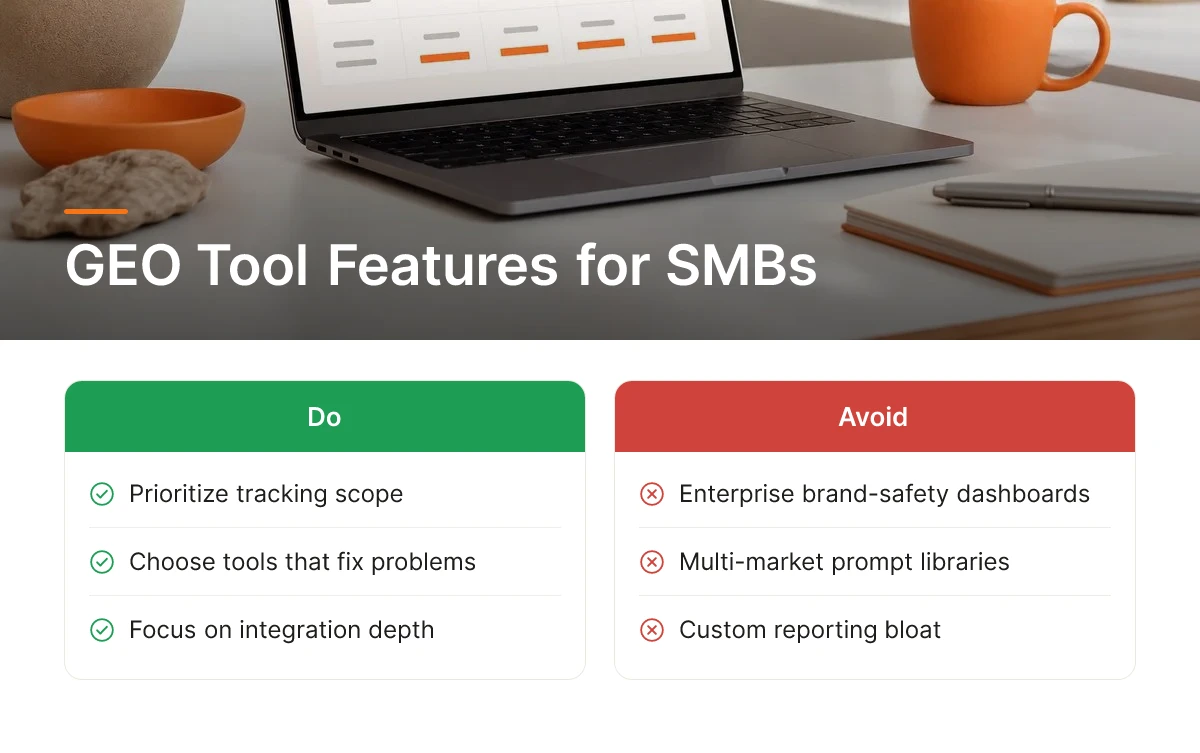
The features that matter most are tracking scope, integration depth, and whether the tool fixes problems or just reports them, bloat elsewhere is noise for an SMB.
Enterprise GEO platforms pile on brand-safety dashboards, multi-market prompt libraries, and custom reporting built for teams with a dedicated analyst. An SMB owner running a Shopify store or a five-person SaaS company does not need that depth, they need to know if ChatGPT recommends them and, if not, what to change. When you compare geo optimization tools for SMBs pricing features and ai search coverage side by side, the winners are the ones that match your actual team size, not the ones with the longest feature list.
What's the Difference Between Prompt Tracking, Analytics Tools, and Content-Native Platforms?
GEO tools split into three functional categories, and knowing which one you're buying prevents a mismatched purchase. Prompt-specific tracking tools monitor a fixed set of queries, like Otterly.ai, which tracks daily movement across ChatGPT, Perplexity, Copilot, and AI Overviews on its lower tiers [3]. Analytics-focused tools go further with dashboards, competitor benchmarking, and citation-source reporting, but stop short of touching your website, Semrush and Ahrefs Brand Radar fall into this bucket, layering AI visibility onto existing SEO reporting [1][2].
Content-native platforms close the loop: they track visibility and then publish the content and structured data needed to fix gaps automatically. This distinction matters because a dashboard telling you that a competitor gets cited for "best [niche] near me" is only useful if you can act on it fast. Moonrank falls into this third category, it runs daily automated content generation and technical optimization alongside its AI search visibility tracking, so a gap identified on Monday can be addressed without the owner writing a brief or hiring a freelancer.
How Do GEO Tools Integrate With Existing SMB Stacks Like HubSpot, WordPress, or Shopify?
Integration is where many otherwise-capable tools fail SMBs. A restaurant owner running WordPress, a boutique retailer on Shopify, or a B2B SaaS company syncing content through HubSpot all need the same thing: a tool that plugs into what they already run, not one that requires migrating platforms. Look for direct WordPress publishing, native Shopify app support, and CRM sync with tools like HubSpot so structured data and blog content update without manual export-import work.
Two technical features are worth understanding in plain terms. Structured data is code embedded in your site that tells AI engines exactly what your business sells, where it operates, and what makes it distinct. An llms.txt file works similarly, it's a plain-text signal file that tells AI crawlers how to read and trust your site's content. Tools that configure both automatically save SMB owners from editing code themselves.
Because most SMBs have no in-house developer, weight ease-of-setup as heavily as feature count. A platform that takes two weeks of technical configuration erases the time savings it promised in the first place.
How Do You Measure GEO Performance and Confirm a Tool Is Getting You Cited by AI?
Track three numbers, citation frequency, share of voice against named competitors, and referral traffic from AI engines, and check them against a recorded baseline, not a vendor's dashboard score.
What Metrics Show Real Citation Lift or Traffic Impact From GEO Optimization?
Citation frequency counts how often your brand gets named when you (or a tool) ask AI engines the questions your customers actually ask, "best running shoe store in Denver," "top project management software for a 10-person team." Share of voice takes that same prompt set and asks who else gets mentioned alongside you, and how often they beat you to it. Referral traffic from ChatGPT, Perplexity, and Gemini shows up in Google Analytics as its own channel and tells you whether citations convert into visits.
None of these numbers means much in isolation. A tool that reports "40% visibility" without showing which prompts it tested, which engine answered, or what the AI actually said is asking you to trust a black box. Several GEO platforms differ on exactly this point, some track a handful of fixed prompts, others expand into hundreds, and coverage of engines varies widely, from three tracked systems up to eleven or more depending on the vendor [1]. When you compare geo optimization tools for SMBs pricing features and AI search coverage, the prompt-level detail behind the score matters more than the score itself.
How Should SMBs Set Up Tracking Before They Start Optimizing?
Before changing anything, write down 15 to 20 prompts a real customer would type into an AI assistant, run them across ChatGPT, Gemini, Claude, and Perplexity, and log whether your brand appears, in what position, and alongside which competitors. That log is your baseline. Without it, you can't tell whether a jump in mentions next month came from your optimization work or from noise. Traffic alone won't catch this. Many AI answers fully satisfy the user's question with no click required, so a citation can build trust and awareness even when it never shows up in your analytics as a session. Treat citation presence as the leading indicator and referral traffic as a lagging one that confirms the trend later.
For ongoing tracking, an SMB without dedicated staff can manage a lightweight cadence: re-run the same prompt set every two to four weeks, and set up alerts or manual spot-checks for new citations as fresh content gets published. Moonrank builds this into its process directly, it monitors visibility across ChatGPT, Claude, Perplexity, and Gemini alongside its daily content publishing, so citation tracking and optimization run on the same loop instead of living in separate tools.

Frequently Asked Questions
Do small businesses need a dedicated GEO tool, or is regular SEO enough?
Regular SEO alone won't show you how AI engines summarize or cite your business, because that requires visibility tracking across ChatGPT, Gemini, Claude, and Perplexity specifically. Traditional SEO tools were built for Google's crawler and ranking logic, not for how large language models select and cite sources. A dedicated GEO tool fills that gap without replacing the fundamentals SEO already handles.
Can a GEO tool guarantee my business gets mentioned by ChatGPT or Perplexity?
No tool can guarantee placement, because AI engines control their own retrieval and citation logic. What a GEO tool can do is improve the odds, through technical fixes like schema markup and structured data, plus consistent content, and track whether those changes move the needle over time.
How long does it typically take to see AI citation improvements after starting GEO optimization?
Most businesses see early signals within four to eight weeks, though full citation gains often take longer. Technical fixes like structured data and llms.txt configuration tend to get indexed faster than new content earns citations, since AI engines need repeated exposure to a source before trusting and referencing it consistently.
Should an SMB use a GEO tool alongside its existing SEO tools, or replace them?
Most SMBs should run GEO alongside SEO rather than replace it, since Google organic traffic still matters even as AI search grows. The two disciplines overlap, clean structured data and quality content help both, but AI visibility tracking and llms.txt optimization are jobs traditional SEO platforms don't fully cover.
What's the biggest mistake small businesses make when choosing a GEO tool?
The most common mistake is picking a tool based on engine count alone, without checking whether it also fixes the underlying problem. Tracking that your brand is invisible across five AI engines is only useful if the tool also helps you publish content and structure data to change that.
Conclusion
Picking a GEO tool comes down to three questions: which AI engines does it actually track, does it fix problems or just report them, and can your budget sustain it past the first quarter. Monitoring-only tools tell you where you stand; platforms that combine tracking with automated content and technical fixes tell you what to do about it. For SMBs without a marketing team, that second category matters more than engine count alone. Moonrank bundles AI visibility tracking, daily content publishing, and technical optimization, schema markup, llms.txt, structured data, for $99/month. Start the 3-day free trial at moonrank.ai and check where your business currently stands with ChatGPT, Gemini, Claude, and Perplexity.
Sources & References
- Best GEO Tools in 2026: Free, Paid & Enterprise | Goodie
- The 9 Best Generative Engine Optimization (GEO) Tools of 2026
- GEO for Small Businesses: Affordable Tools Compared
- Top 10 Generative Engine Optimization Tools: A Buyer's Guide - Omniscient Digital
- Best GEO Tools for Small Businesses: What to Choose Without an Enterprise Budget
Recommended Articles
Explore more from our content library: