A Complete Guide to Finding the Best SEO Software for SMBs
Discover how the best SEO software combines content, technical fixes, and AI visibility tracking to help SMBs compete without hiring an agency.
The best SEO software for SMBs in 2026 combines automated content creation, technical optimization, and visibility tracking into one system, so a small team can compete with agencies without hiring one. As AI engines like ChatGPT and Gemini increasingly answer questions directly, the right software needs to do more than chase Google rankings: it must monitor whether your brand gets mentioned in AI-generated answers, keep technical signals (schema, site structure) clean, and publish optimized content consistently. For SMBs, the priority is a platform that automates these three jobs together rather than requiring separate tools and manual stitching.
Why SMBs Need the Best SEO Software as AI Search Grows
Search results now get answered directly by AI engines instead of listing ten blue links, so ranking means getting cited in an answer, not just landing on page one.
Perplexity alone reported more than 100 million weekly queries by late 2024 [1], and a large share of Google searches now end without a click as users read AI-generated summaries instead of visiting a site [1]. That shift changes what "visibility" means for a small business. A restaurant or Shopify store no longer just competes for a spot in Google's results, it competes to be the source ChatGPT or Perplexity pulls from when someone asks for a recommendation.
Is SEO Still Worth It in 2026 With AI Search Engines?
Yes, SEO is not being replaced, it's being read by a different audience.
AI engines still depend on the same raw material search engines always used: structured content, clear technical signals, and pages that plainly state what a business does and where. Schema markup, clean site structure, and well-organized content are exactly what AI systems parse to decide who to cite [2]. The mechanism hasn't changed. What changed is who's reading the output, a language model summarizing an answer instead of a human scanning search results.
Can AI Search Engines Replace the Need for SEO Optimization?
No, AI search engines still need optimized, trustworthy content to draw from, so the underlying SEO work remains necessary, just aimed at a new reader.
This is where manual effort breaks down for small teams. Keeping content fresh, fixing technical issues, and tracking how a brand shows up across Google and AI engines each demand ongoing attention [3]. A solo founder or a two-person marketing team can manage one of those jobs for a while. Sustaining all three, every week, without a break, isn't realistic alongside running the business itself.
Agencies solve that by bundling strategy, writing, and reporting into one retainer, but that bundling is exactly what prices out most SMBs, with typical agency retainers running well beyond what a small e-commerce store or B2B SaaS startup can justify. That cost gap is the real argument for the best SEO software: a system that automates content, technical fixes, and tracking together, so a small team gets agency-level coverage without agency-level spend.
What the Best SEO Software Does to Get You Recommended by AI
The best SEO software builds clear entity signals into your site's structure, then tracks whether ChatGPT, Gemini, Claude, and Perplexity actually cite your business in response.
That's two jobs, not one. First, the software has to make your business legible to a machine that's reading your site to answer a question, not to rank a page. Second, it has to tell you whether that effort worked, because unlike a Google ranking, you can't just check position #3 for your target keyword.
How Does SEO Software Optimize Content for AI Search Recommendations?
AI engines pull answers from structured data and clearly labeled entities, not from guessing at page intent the way a keyword-matching crawler might. Software built for this adds schema markup, structured data tags that tell an AI system exactly what your business sells, where it operates, and who it serves, along with an llms.txt file, a plain-text guide that tells AI crawlers which parts of your site to trust and prioritize. Moonrank handles this layer automatically: it runs a technical audit, applies schema markup and llms.txt configuration, and builds citations that give AI systems reason to trust your content, without you touching a line of code.
Content freshness matters here too. AI systems favor sources that get updated regularly over static pages that haven't changed in years, which is part of why daily publishing, not a blog post every few weeks, has become a meaningful lever for AI visibility.
How Do Traditional SEO Tools Differ From AI Visibility Software?
Traditional SEO platforms are built around keyword rank tracking and backlink counts, metrics that assume a human is scanning a list of blue links. Tools like Semrush and Ahrefs remain strong for that kind of keyword research and competitive link analysis [2], but that data doesn't tell you whether an AI engine mentioned your brand by name in an answer.
AI visibility tracking is a distinct discipline: it monitors where a brand gets cited across AI models, which sources shape those citations, and how often competitors appear in the same generated answers [1]. Some tools in this newer category, like AirOps, now connect AEO and AI search visibility insights directly to content production instead of treating them as an afterthought [2]. That shift, from "where do I rank" to "did the AI mention me", is the real dividing line separating legacy SEO tooling from AI-era platforms.
Building SEO Automation In-House vs. Using an All-in-One Platform
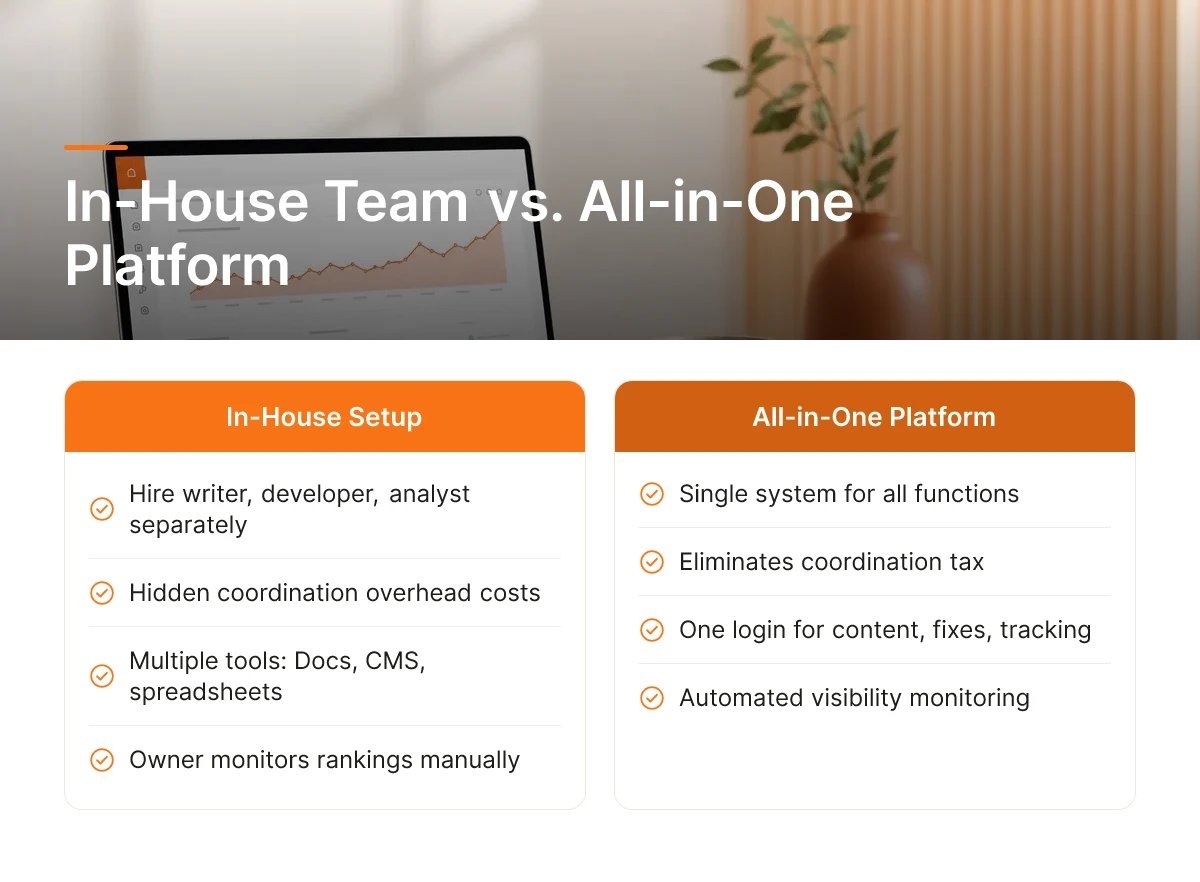
An in-house setup costs more than payroll alone, coordinating writers, a developer, and a rankings analyst adds hidden overhead that a single platform avoids. That coordination tax is the real reason many SMB owners end up evaluating the best SEO software instead of building a team from scratch.
Assembling an in-house workflow typically means bringing together several roles, each with its own tools and handoffs:
- A writer who drafts content in a separate document editor, disconnected from technical or performance data.
- A developer who fixes schema markup and site structure, usually queued behind other work.
- Someone to monitor rankings, often the owner, tracking performance across spreadsheets and disconnected dashboards.
Every handoff between them is a place where deadlines slip and priorities get lost, and none of that friction shows up on an invoice.
An all-in-one platform collapses those three functions, content, technical optimization, and tracking, into one workflow. Instead of routing a schema markup fix through a developer's ticket queue, the platform applies it automatically. Instead of a writer producing one post a week, content publishes daily without anyone drafting a brief. Moonrank, for example, runs keyword research, daily content generation, technical fixes like llms.txt configuration, and AI visibility tracking across ChatGPT, Gemini, Claude, and Perplexity from a single dashboard, at a cost far below what three separate contractors or a full agency retainer would run.
What Integration Capabilities Matter When Adding SEO Software to Your Stack?
The software should connect to your CMS, analytics platform, and existing marketing tools without requiring a developer to configure it. For a Shopify store or a SaaS company running a marketing stack on Google Analytics and Mailchimp, that means the platform publishes directly to the existing site and reads traffic data without custom API work. If a tool needs a developer just to get set up, it has already reproduced the coordination problem it was supposed to solve.
How Long Does It Take to See Results, and What ROI Metrics Should You Track?
Meaningful SEO and AI visibility movement typically takes weeks to a few months, not days, because search engines and AI models need repeated signals before they trust a source. Track organic traffic trend lines over time, the number of indexed pages, and, for AI search specifically, how often your brand gets mentioned in ChatGPT, Gemini, or Perplexity responses for relevant queries. Rankings for obscure keywords or raw content volume are vanity metrics; traffic trend and AI mention frequency are what indicate a business is actually gaining ground.
Key Features to Look for in SEO Software Without an Agency
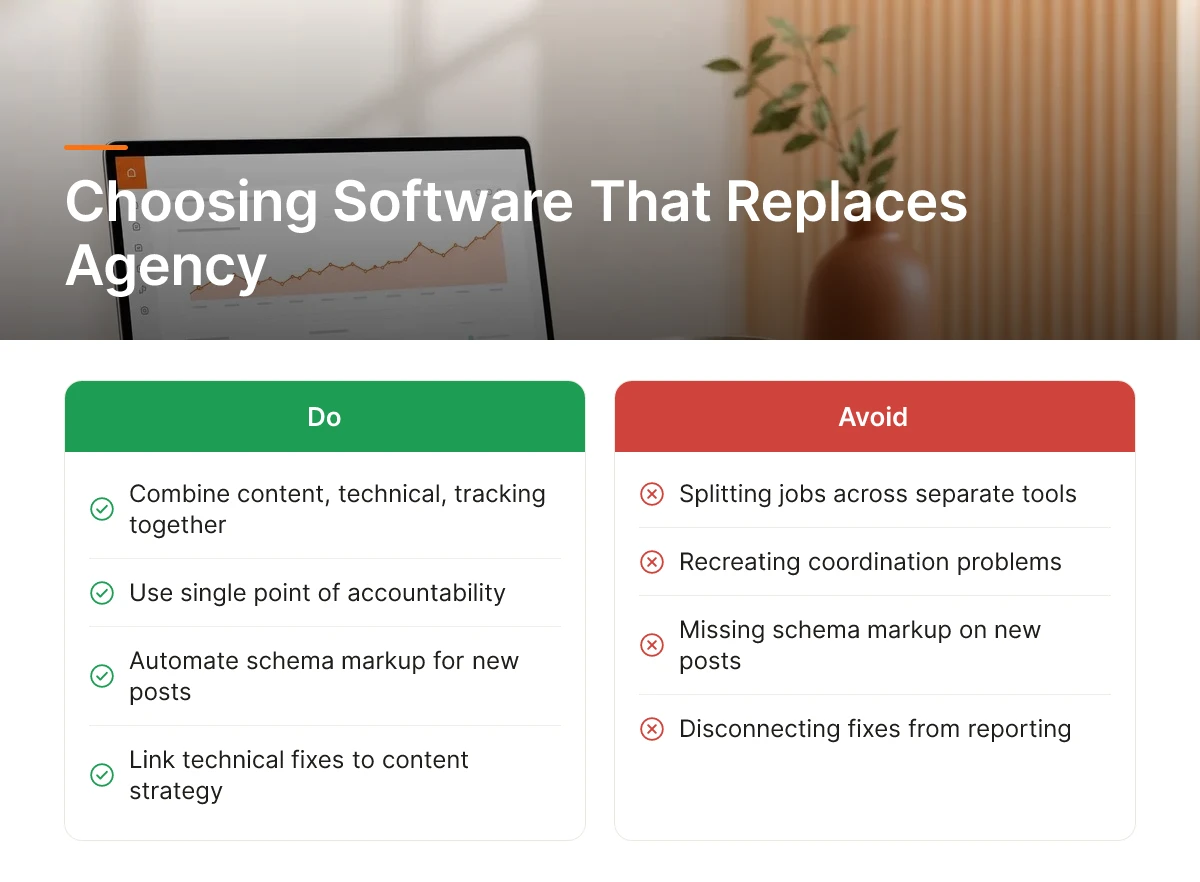
The best SEO software for a business replacing an agency needs to combine content publishing, technical fixes, and visibility tracking in one system, not three separate logins.
Which Features Handle Content, Technical Optimization, and Tracking Together?
Agencies work because one team handles strategy, writing, technical fixes, and reporting under a single point of accountability. Software that splits those jobs across separate tools recreates the coordination problem an agency was solving in the first place, someone still has to notice that a new blog post needs schema markup, or that a technical fix should change what gets written next month. AirOps' own breakdown of the category notes that the split between research-and-monitoring tools and end-to-end execution platforms is real, and that stronger teams tend to use both rather than pick one [2].
For an owner without a marketing team, that split isn't practical. The useful bar is whether a platform connects content generation, technical signals, schema markup, llms.txt, structured data, and AI visibility tracking so each part informs the others automatically. Moonrank builds this connection directly: daily content publishing, technical AI audits, and visibility tracking across ChatGPT, Gemini, Claude, and Perplexity run as one process, not three subscriptions.
How Does Onboarding and Support Differ Between SEO Platforms?
"Automated" should mean the software publishes on a set cadence, applies technical fixes itself, and sends visibility reports on schedule, not a dashboard that still expects someone to log in and act on recommendations. Several platform reviews for 2026 highlight this same execution gap: many tools surface what to fix but leave the fixing to the user [3].
Onboarding speed matters just as much. A restaurant owner or Shopify founder without technical staff can't spend weeks configuring keyword sets or editing structured data by hand. The gap between platforms that need a specialist to set up and ones that run after a short onboarding form is often the real difference between replacing an agency and just adding another tool to manage.
Reporting should read like a plain update, not an SEO briefing. An owner should see which pages are driving AI mentions and what changed this week, without translating metrics like "crawl frequency" or "entity citations" first, that's the level of clarity a budget-friendly system needs to earn its keep.
The Best SEO Software Options for SMBs on a Tight Budget
For budget-conscious SMBs, the best SEO software choice comes down to matching what you're paying for against what your business actually needs, not the longest feature list.
What Can You Do With Free SEO Tools Before Upgrading?
Free SEO tools cover the basics: keyword lookup, a quick site audit, maybe a backlink snapshot. Google Search Console and similar free tools tell you what's already ranking and flag obvious technical errors like broken links or missing meta tags.
The limits show up fast. Usage caps cut you off after a handful of keyword checks per day, there's no automation to act on what the audit finds, and none of these tools track whether ChatGPT, Gemini, Perplexity, or Claude ever mention your business at all [4]. That gap is the mechanism that forces an upgrade decision, you hit a wall on volume or visibility and have to pay for something that closes it.
Budget Automation vs. Premium Enterprise Suites
Enterprise suites like the ones built for agency workflows offer deep keyword research, competitive intelligence, and rank tracking across dozens of clients [3]. That breadth is valuable if you're managing multiple accounts. It's overkill if you're one shop owner trying to get found.
The more useful question for an SMB isn't "which tool has the most features", it's "which parts of that feature set will I actually use every week." A budget-friendly automation platform that handles publishing and monitoring on its own often delivers more usable output than a premium suite that requires a dedicated person to run it.
Automation Software vs. Agency Retainers
The real cost comparison isn't tool versus tool, it's automation software versus an agency retainer. Agencies bundle content writing, technical fixes, and reporting into one ongoing service, billed monthly regardless of output. An automation platform bundles the same work, daily content, technical optimization, visibility monitoring, into one system that runs without a person on the other end billing hours.
Moonrank was built for exactly this comparison. It's designed for SMBs that want content creation, technical optimization (schema markup, llms.txt, structured data), and AI visibility tracking across ChatGPT, Gemini, Claude, and Perplexity handled automatically, without hiring an agency or learning to edit structured data by hand. If you're weighing free tools against paid platforms and agency retainers, start a trial at www.moonrank.ai and see what shows up in your first AI visibility report.
Frequently Asked Questions
Do I still need SEO software if I'm only trying to show up in ChatGPT and Gemini, not Google?
Yes, the technical groundwork that gets you cited by ChatGPT or Gemini overlaps heavily with SEO fundamentals. AI engines still crawl your site, read your schema markup, and weigh your structured data and citations when deciding what to recommend. A tool built for AI visibility, like Moonrank, handles that groundwork automatically instead of asking you to reverse-engineer it yourself.
Can one platform replace hiring an SEO agency for a small business?
For most SMBs, yes, especially when the agency's main job was publishing content and fixing technical issues. Automated platforms handle daily content generation, schema markup, and visibility tracking without a retainer. Moonrank, for example, runs this at a budget-friendly monthly cost versus agencies that typically charge premium rates for similar scope.
What's the difference between rank tracking and AI visibility tracking?
Rank tracking shows where your site lands in Google's search results; AI visibility tracking shows whether AI engines mention or recommend your brand at all. The two measure different outcomes, a page can rank on page one in Google yet never get cited in a ChatGPT or Perplexity answer. AI visibility tools monitor citations, sentiment, and competitive mentions across ChatGPT, Gemini, Claude, and Perplexity specifically [1].
How much technical SEO knowledge do I need to use automated SEO software?
Little to none, that's the point of automation-first tools built for owner-operators, not SEO specialists. You won't need to edit schema markup or configure an llms.txt file by hand. Platforms like Moonrank implement those technical elements on autopilot after onboarding, so you never touch code.
What should I check before switching from an agency to a software platform?
Before switching, confirm the platform actually covers what your agency currently handles: content publishing cadence, technical fixes like schema and llms.txt, and visibility reporting across both Google and AI engines. Look for a short onboarding process, clear weekly reporting, and evidence the tool acts on issues automatically rather than just flagging them for you to fix yourself.
Conclusion
Picking the best SEO software now means asking a different question than it did three years ago: does this tool get you found by AI engines, not just Google? Prioritize platforms that combine daily content publishing, technical fixes like schema markup and llms.txt, and visibility tracking across ChatGPT, Gemini, Claude, and Perplexity, doing all three separately gets expensive and slow. If you're an SMB owner without time to manage another tool, start by checking where you currently stand: run a free AI visibility scan at moonrank.ai and see whether AI engines recommend you or your competitors.
Sources & References
- How do you rank in AI? Top AI Visibility Tools Overview
- Best SEO Automation Tools for Content Teams in 2026
- The Best Free & Paid SEO Software Tools For Agencies in 2026 | SEOTesting
- 12 Best SEO Tools for 2026 (Used by Our Team Daily)
Recommended Articles
Explore more from our content library: