Tools Helping Local Businesses Show Up in AI Search Answers
Local businesses appear in AI search answers through technical SEO fixes, structured data, consistent citations, and dedicated AI-visibility tracking tools...

Understanding what tools help local businesses show up in AI search engine answers is essential. Local businesses show up in AI search answers through a mix of technical SEO fixes, structured data, consistent citations, and dedicated AI-visibility tracking tools, not through paid ads or manual submission. Platforms like Moonrank track how ChatGPT, Gemini, and Perplexity mention your business, flag gaps in your schema markup and citations, and automatically publish optimized content so AI engines have fresh, structured information to pull from. The core mechanism: AI engines recommend businesses whose online presence is clear, consistent, and well-structured across your website, Google Business Profile, and directory listings.
How Do AI Search Engines Like ChatGPT and Perplexity Decide Which Local Businesses to Recommend?
AI engines pull answers from indexed web content, structured data, and live web retrieval at once, weighing consistency across all three rather than running one ranking formula. This is particularly relevant for what tools help local businesses show up in ai search engine answers.
Unlike a traditional search engine that returns a ranked list of links, tools like ChatGPT, Perplexity, and Google's AI Overviews generate a single answer by synthesizing what they find across your website, your Google Business Profile, review platforms, and directory listings. When someone asks "who does emergency plumbing near me?" the AI is not scanning a keyword database, it is cross-referencing multiple sources to decide which business it can recommend with confidence [1]. That confidence is the entire game. If the signals conflict or are thin, the AI either skips your business or hedges with a vague answer.
What Role Do Google Business Profile, Citations, and Local Signals Play in AI Recommendation Decisions?
Google Business Profile completeness, review volume, and citation consistency function as trust signals that AI systems check against each other before naming a business. AI search still runs on the same foundation as local SEO, a complete profile, fast and well-structured site, and consistent listings across the web [2]. Semrush notes that local queries in AI tools tend to carry higher purchase intent than typical searches, because they combine a specific need with a specific location, which raises the stakes for getting these signals right [3]. Local signals and consistent citations still matter because AI systems use them to verify that a business is real, active, and trustworthy before recommending it [1].
This is where the question becomes practical rather than theoretical. An incomplete Google Business Profile, a stale review count, or a directory listing that hasn't been touched in two years all read as weak signals to an AI system trying to make a confident recommendation.
How Do AI Model Training Data Cutoff Dates Affect Which New Local Businesses Can Appear in Answers?
Training data cutoffs mean some AI tools work from older snapshots of the web, so a business that opened or updated recently may be invisible unless the tool uses real-time retrieval. Large language models are trained on data up to a certain date, and anything that changed after that point, a new location, a rebrand, a fresh set of reviews, will not exist in the model's internal knowledge until it retrieves live web data instead of relying purely on memory. This is why real-time retrieval features, structured data, and fresh content matter as much as historical reputation: they give the AI something current to pull from between training cycles.
Why Inconsistent Business Information Undermines AI Confidence
Mismatched name, address, or phone details across the web create ambiguity that makes an AI system less willing to recommend a business at all. If your website lists one phone number, your Google Business Profile lists another, and a directory listing has an outdated address, the AI has no reliable way to confirm you are the business a customer is asking about, so it often recommends a competitor with cleaner data instead.
What Website Changes Actually Get Local Businesses Noticed by AI Search Engines?
AI engines favor pages with direct, quotable answers to specific customer questions over pages written like marketing brochures. Before comparing available tools, it helps to fix the website itself, since no tool can optimize content that isn't structured to be quoted in the first place.
AI tools like ChatGPT and Perplexity build answers by pulling short, self-contained statements out of web pages, not by summarizing an entire "About Us" paragraph. A sentence like "We offer emergency AC repair in Reading, PA, with same-day service" is far easier for a model to lift and cite than "We pride ourselves on decades of trusted service to the community." Semrush notes that AI search platforms are specifically trying to answer service-and-location questions such as "who does emergency AC repair near me" [3], which means the businesses that phrase their content as literal answers to those questions win the citation.
How Should Local Businesses Structure Content, FAQs, and Schema Markup to Get Quoted by AI Tools?
FAQ sections written in plain question-and-answer format tend to get pulled into AI answers because they already match the shape of a user's query [1]. Pairing that structure with schema markup gives AI crawlers a machine-readable confirmation of what the page is saying in prose.
Three schema types matter most for local businesses:
- LocalBusiness schema tells AI crawlers your business name, address, phone number, hours, and service category in a structured format, removing any guesswork about who you are and where you operate.
- FAQPage schema marks up your question-and-answer content so engines can identify it as directly quotable, rather than buried inside a longer paragraph.
- Review schema surfaces customer ratings and testimonials in a format AI tools can reference as third-party trust signals, not just self-reported claims.
Well Dressed Walrus points out that structured data and FAQs are central to what generative engine optimization looks like in practice for a real business [1].
What Does a Before-and-After Schema Markup Implementation Look Like for a Real Local Business?
Picture a plumbing company's service page before any changes: a vague paragraph claiming "quality service you can trust," no FAQ section, and a phone number that only appears inside a contact form. AI tools have almost nothing to quote and no confirmed location data to trust.
Now picture the same page after rework: an FAQ block answering "Do you offer emergency plumbing in Denver?" directly, LocalBusiness schema listing the exact service area, and Review schema pulling in verified ratings. The name, address, and phone number appear as plain text in the page footer, not just inside an image or a form field, since AI crawlers cannot reliably extract contact details from images [4].
Moonrank handles this technical layer automatically for subscribers, implementing schema markup, llms.txt configuration, and structured data alongside its daily content publishing, so business owners don't need to learn markup syntax to benefit from it.

What Tools Help Local Businesses Show Up in AI Search Engine Answers?
Three categories of software answer this question: visibility trackers, automated content publishers, and technical/schema auditors. Most owners eventually need all three, whether from one platform or several.
AI-visibility tracking tools monitor how often, and how favorably, a business gets mentioned when someone asks ChatGPT, Gemini, or Perplexity a question in its category. This is the AI-search equivalent of rank tracking, except instead of a position on a results page, the output is a yes-or-no on whether your name showed up at all, and in what context.
Automated content publishing tools handle the ongoing work of feeding AI engines fresh, citable material, new pages, updated service descriptions, answer-formatted blog posts, without the owner writing anything themselves.
Technical and schema auditing tools find the structural gaps that keep AI crawlers from parsing a site correctly: missing schema markup, absent llms.txt files, thin or duplicated content that undermines trust signals [1].
Moonrank is built to cover all three from one dashboard. It tracks brand mentions across ChatGPT, Gemini, and Perplexity, audits a site for schema markup and structured data gaps, and then automatically publishes optimized content daily so those AI engines have fresh material to cite, closing the loop between finding a problem and fixing it, rather than just reporting one.
What Features Should a Local Business Look for in an AI Visibility Tool?
Prioritize multi-engine tracking, automated fixes, and plain-English guidance over dashboards that just look impressive.
- Multi-engine tracking: A tool that only checks one AI engine misses the point, since customers ask ChatGPT, Perplexity, and Gemini differently and get different answers [2].
- Automated fixes, not just reports: A report that says "your schema is missing" is less useful than a tool that writes and implements the fix.
- Plain-English recommendations: Most local owners are not going to edit an llms.txt file by hand, so the tool needs to translate technical findings into steps a non-technical person can approve or automate.
Some owners try to skip the tooling question entirely and just check by hand, typing a few questions into ChatGPT or Perplexity every week and seeing what comes back. That works as a spot check, but it does not scale. New AI engines keep launching, each with its own retrieval logic, and manually querying four or five tools across dozens of relevant search phrases quickly becomes a part-time job rather than a five-minute task [3]. When considering what tools help local businesses show up in ai search engine answers, this point stands out.
Budget is a real constraint for this audience. Self-serve software sits at the budget-friendly end, agency retainers sit at the premium end, and most independent shop and restaurant owners are choosing based on that gap rather than feature checklists alone. A tool priced for solo founders, not enterprise marketing teams, tends to win here, which is the gap Moonrank was built to fill.
How Long Does It Take for a Local Business to Start Appearing in AI Search Answers?
Most local businesses see early movement within a few weeks and clearer gains over two to three months, but the starting point determines almost everything. A business with a complete Google Business Profile, existing schema markup, and consistent citations across directories moves faster than one building that foundation from nothing.
That variance is the honest answer to why one shop owner sees results in three weeks and another waits three months. If your website has no structured data, thin location pages, and a half-filled Google Business Profile, the technical work alone, adding schema, cleaning up NAP consistency, writing pages that actually answer local questions, can take several weeks before there's anything new for an AI engine to find [3]. A business that already has the basics in place is just waiting on the next layer: fresh content and stronger citations.
What Are Realistic Timelines for Seeing Traffic and Lead Lift from AI Visibility Improvements?
Expect narrow, long-tail questions to surface your business before broad category questions do. A business optimizing for "who fixes garage doors near Reading, PA" tends to appear there sooner than for "best garage door company" because the narrower query has less competition and matches specific page content more directly [4]. That's a useful early signal, if you're showing up for detailed, location-specific questions but not yet for broad ones, the strategy is working; it just needs time to compound.
Part of the delay is mechanical, not strategic. Some AI engines pull from real-time web retrieval, so a schema update or new page can show up in answers within days. Others depend on periodic crawls or model training snapshots, meaning changes take longer to register no matter how well-optimized the site is [2]. This is one reason answers vary across ChatGPT, Gemini, Perplexity, and Claude for the same query, each pulls from a different mix of live and cached data.
This is also why choosing the right software should prioritize tools built for steady, compounding technical work over one-time fixes. Moonrank runs daily automated content publishing and technical optimization, schema, citations, structured data, precisely because visibility here rewards consistency, not a single overhaul.
What's the Difference Between Traditional SEO and Optimizing for AI Search Engine Visibility?
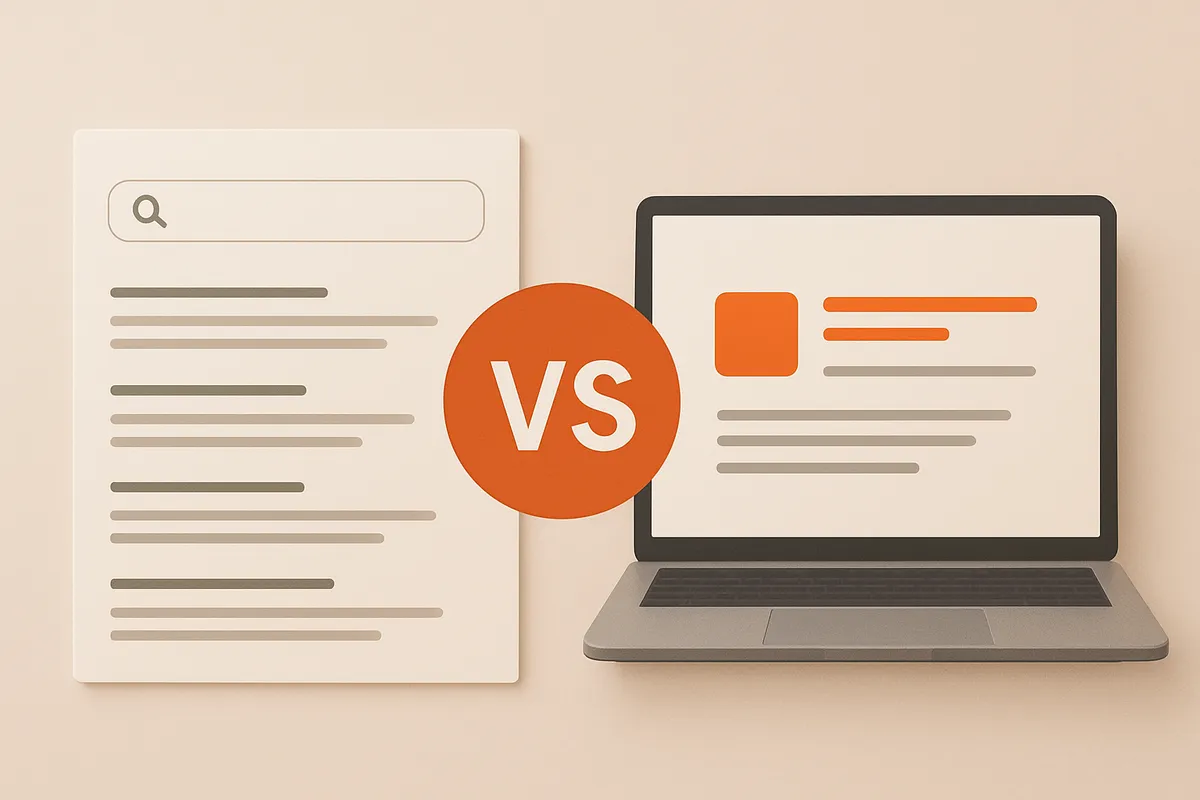
Traditional SEO ranks a page in a list of ten blue links; AI search visibility gets a business named inside a single, already-written answer with no links to compete against.
That difference changes what "winning" even means. On Google, a business can rank third or fifth and still get clicked. In an AI-generated answer, the model usually names two or three businesses total, sometimes just one [3]. There is no page two to fall back on, which is exactly why so many owners start researching this topic once they notice a competitor getting named and they aren't.
Why Do Local Businesses Need a Separate Strategy for AI Search Engines Versus Google Organic Search?
Local businesses need a separate strategy because the two systems reward different things: Google ranks pages, while AI models synthesize an answer from whichever sources they trust most.
A page stuffed with the keyword "best plumber in Austin" repeated a dozen times might still rank on Google through sheer relevance signals. AI models work differently, they favor content that reads like a clear, direct answer to a specific question, not content written to please a ranking algorithm [1]. A page that plainly states what a business does, who it serves, and where, in plain sentences, gets quoted more often than a page optimized purely for search engine crawlers. Citations and structured data also carry more weight for AI visibility than they do for classic rankings. AI platforms lean on consistent business information across the web, directories, review sites, a complete Google Business Profile, and on structured data like schema markup that spells out exactly what a business is and does [2] [4]. Backlink volume, long a cornerstone of traditional SEO, matters less here than being cited accurately and consistently in places AI systems already trust [3]. None of this replaces classic SEO, it runs alongside it. A local business still needs a fast, well-structured website and a strong Google Business Profile to compete on Google [2], while also building the citations, structured data, and direct-answer content that get it named in ChatGPT, Gemini, or Perplexity responses. Moonrank handles both tracks by combining daily content generation with technical fixes like schema markup and llms.txt configuration, so a business builds AI visibility without abandoning the search rankings it already depends on.
Frequently Asked Questions
Can a local business appear in AI search answers without a website?
It's unlikely, though not technically impossible. AI search platforms rely heavily on structured, crawlable content to verify what a business does and where it operates [3]. A Google Business Profile, review platforms, and directory listings can generate some visibility, but without a website carrying schema markup and detailed service pages, most businesses give AI systems too little to work with.
Do AI search engines favor businesses with more online reviews?
Yes, review volume and consistency are strong trust signals for AI search platforms, similar to their role in traditional local search [3]. AI tools also look for review content that mentions specific services, locations, or outcomes, since that detail helps confirm relevance to a given customer question, not just overall star rating.
How can a local business tell if it's already being mentioned by AI tools?
The simplest check is asking ChatGPT, Perplexity, or Gemini directly, using the phrasing a real customer would type, like "best plumber near me" [4]. This manual spot-check only shows one moment in time, though, which is why tools built for ongoing AI search visibility tracking exist, they monitor mentions across multiple engines continuously instead of relying on a single query.
Is optimizing for AI search answers worth it for a small, single-location business?
Yes, because local queries in AI tools tend to carry high purchase intent, pairing a specific need with a specific location [3]. A single-location business competing for "near me" recommendations has a realistic shot at appearing in AI answers, often with less competition than broader, non-local search terms.
Should a local business fix its website first or start with AI visibility tracking?
Fixing the fundamentals comes first. Tracking tells you whether a business is being mentioned, but that data means little if the website lacks schema markup, direct-answer content, and consistent citations to build on. Most owners get more value starting with the technical foundation, then layering in ongoing tracking to measure whether those changes are actually moving the needle over time.
Conclusion
Showing up in AI search answers comes down to three things: a website AI tools can actually parse, consistent local signals across your Google Business Profile and directories, and ongoing visibility tracking so you know whether any of it is working [1][3]. Most local business owners don't have time to manage schema markup, daily content, and citation building on top of running their business.
That's the gap Moonrank fills, automated daily content, technical AI optimization, and visibility tracking across ChatGPT, Gemini, Claude, and Perplexity, running without manual input after setup. Start a free trial at moonrank.ai and see where your business currently stands in AI search results.
Sources & References
- How to Get Your Business Mentioned by AI Tools | Well Dressed Walrus
- AI Search for Local Businesses: How It Works
- How to do AI search optimization for local businesses
- 7 Ways to Help Your Business Show Up in AI Search
Recommended Articles
Explore more from our content library: