A Complete Guide to How AI Search Intent Recognition Works
Learn how AI search intent recognition helps ChatGPT and Perplexity match content to real customer needs instead of exact keywords.

AI search engines like ChatGPT and Perplexity recommend content by matching a user's underlying intent, not just their exact words, to pages that clearly answer that specific need. For SMBs, this means AI search intent recognition comes down to structuring your content so it directly answers real questions, states what your business does in plain language, and signals topical authority through clear formatting. Unlike Google, which ranks a list of links, AI engines synthesize one answer and pick a small number of sources to cite, so being recognized as the clearest match for intent matters more than keyword density.
How AI Search Intent Recognition Works in ChatGPT and Perplexity
ChatGPT and Perplexity break a query into meaning and context first, then search for pages that resolve that meaning, not pages that repeat the same words back. That process is the mechanical core of AI search intent recognition, and it works differently depending on whether the engine has one question to answer or a whole conversation to track.
What Role Does Natural Language Processing Play in Understanding Intent?
Natural language processing lets these engines read phrasing, synonyms, and sentence structure instead of matching exact keyword strings. Rather than scanning for "best running shoes," the system interprets what "something comfortable for long runs" actually means, then looks for content that addresses that need directly [3]. Bloomreach describes this as a shift away from keyword-first matching toward systems that interpret user intent, behavior, and context together [3], which is also why a page written to satisfy a search query one way (dense keyword repetition) often reads as generic to an engine parsing for meaning. Content that states plainly what a product does or who a service is for tends to parse more cleanly than copy optimized purely for ranking signals. As Insightland's research on intent-based search explains, AI systems are built specifically to understand customers on a deeper level than keyword matching alone ever could.
How Do AI Search Engines Use Context and Conversation History?
Conversation history changes what the engine assumes a user wants, often without the user restating anything. A shopper who asks "what's a good gift for a home cook" and then follows up with "under $50 and easy to ship" hasn't repeated the original intent, the engine carries it forward and narrows the field using the new constraints. Wellows frames this as the reason traditional intent categories (navigational, informational, transactional) fall short in generative engines: real sessions blend multiple intents and shift as new context arrives [4]. For a business, that means content answering the broad question and the narrowing follow-up both need to exist somewhere the engine can find them.
This is also where AI search departs from traditional search mechanically. Google returns a ranked list of links for a user to sort through; ChatGPT and Perplexity synthesize a single answer and choose a small number of sources to cite within it [2]. Recognition, in that model, isn't about ranking position, it's about being the clearest, most directly citable answer to the specific intent the engine has inferred. Getfluence notes that this citation-based structure is what's driving the shift toward what's called GEO, or Generative Engine Optimization [2], and it's the reason SMBs need content built to answer questions outright rather than content built to rank.
The Main Types of Search Intent AI Engines Detect and Prioritize
AI search engines sort queries into four intent categories, informational, navigational, transactional, and commercial investigation, then decide whether to answer directly or point to a source. That decision is the core mechanic behind AI search intent recognition, and it determines whether your business gets named in the answer or left out entirely.
How Do Informational, Navigational, and Transactional Intent Differ in AI Recommendations?
- Informational intent: a question with no purchase attached yet, "how often should I reseal a hardwood floor", and AI engines usually answer it inline, citing a source rather than sending the user anywhere.
- Navigational intent: a user looking for a specific business by name, like "Riverside Hardware hours," where the engine's job is confirmation, not discovery.
- Transactional intent: ready-to-buy language, "book a flooring contractor in Denver", and this is where AI engines start naming specific businesses instead of just explaining concepts.
- Commercial investigation: "best flooring contractors in Denver" signals comparison shopping, sitting between informational and transactional intent.
Commercial investigation is the category where Moonrank's competitive landscape analysis matters most, because it shows exactly how competitors are positioned when an AI engine builds that comparison. Google historically treated these four categories as ranking signals across many result slots. AI engines instead compress the decision into a single answer, so they weigh trust and completeness more heavily than raw keyword match [3]. A page that conversationally interprets what the shopper actually wants, not just the words they typed, tends to get pulled into that answer [3].
How Can the Same Query Be Interpreted Differently Based on User Context?
"Best plumber near me" can be informational or transactional depending entirely on phrasing and history. A user asking "best plumber near me" cold is often still comparing; a user who follows up with "can they come today" has shifted into transactional territory, and the engine needs to recognize that shift mid-conversation. Traditional keyword matching can't make that distinction reliably, which is why typo-prone or unconventional phrasing frequently produced irrelevant results in older systems [3].
AI engines also favor pages that resolve intent completely in one place, pricing, service area, availability, and reviews on a single page, over content scattered across five thin pages, because generative engines synthesize one answer rather than listing links for the user to sort through themselves [2].

How SMBs Can Optimize Content for AI Search Intent Recognition
AI search intent recognition improves when a business writes in plain, direct language that names what it does, who it serves, and what question each page answers. The work splits into four habits: structure, keyword strategy, explicit naming, and clean data markup.
What Content Structure and Formatting Signals Help AI Engines Match Intent?
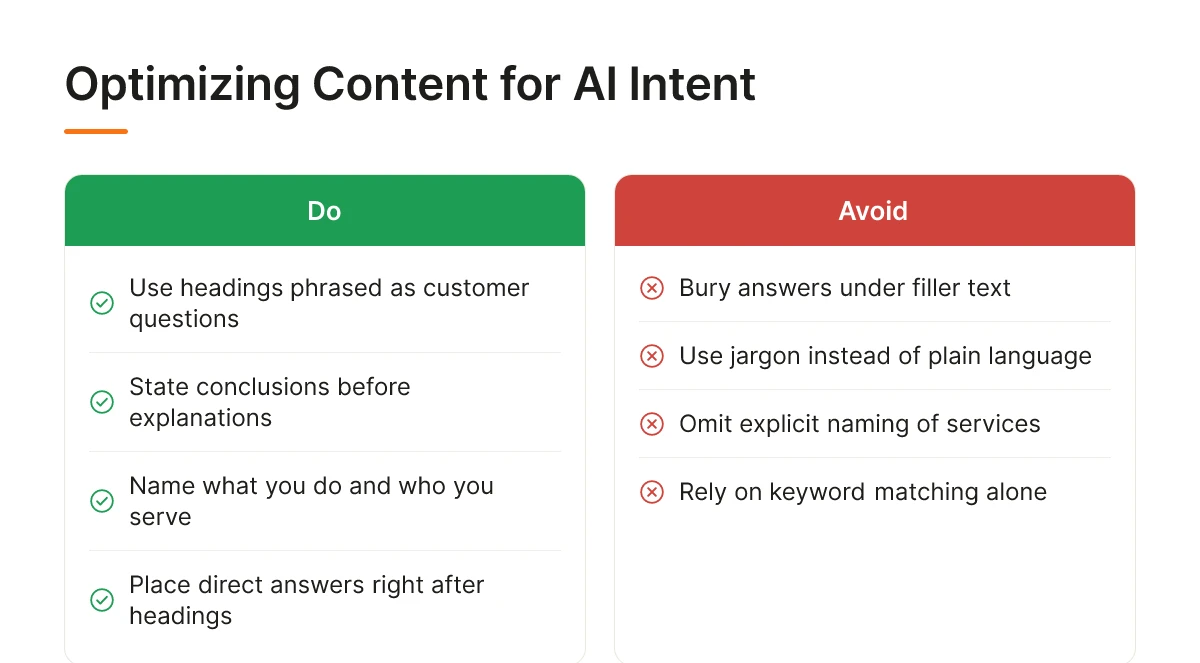
AI engines scan for headings phrased the way customers actually ask questions, then look for a direct answer in the sentence right after. Generative engines synthesize an answer and cite sources rather than returning a list of links, so a page needs to state its conclusion before it explains the reasoning [2]. This is a reversal of the old blog habit of building up to a point over three paragraphs.
Scannable formatting matters as much as the writing itself. Short paragraphs, numbered steps, and comparison tables give AI crawlers discrete chunks of text they can lift and cite without misreading context. A page that buries its best answer under a wall of text gets skipped in favor of a competitor's cleaner structure.
How Should SMBs Align Keyword Strategy with Intent Patterns?
Keyword strategy for AI search means writing to resolve a need, not chasing search volume for its own sake. Traditional keyword-first approaches break down when a shopper's query doesn't match the exact terms a business optimized for, and AI systems are built specifically to interpret the intent behind irregular phrasing rather than the phrasing itself [3]. An ecommerce store ranking for "best waterproof hiking boots" gains little if the page never actually helps someone decide which boots to buy for wet trail conditions.
Intent-based content also means covering the full range of intent types, informational, comparison, transactional, local, instead of writing only for the highest-volume term [5]. A B2B SaaS company targeting "expense tracking software" should also address "expense tracking software for remote teams," because that's the version a real buyer types into a chat interface.
Naming your business, services, and location in plain language is what lets an AI engine match you to a specific query instead of a generic category. A page that says "Moonrank helps Shopify store owners get recommended by ChatGPT and Perplexity" gives a model a concrete entity to cite; vague phrases like "we help brands grow" give it nothing to attach.
Structured data and a single clear topic per page reduce the ambiguity that causes AI systems to skip a source entirely. Schema markup, consistent headings, and one page-one-topic discipline all narrow what a page is "about" in machine-readable terms, this is core to the technical optimization Moonrank automates for SMBs, alongside the daily content publishing that keeps those signals fresh.
A practical workflow: pull the three questions customers ask most often in email or chat support, write one page per question that fully resolves it in the opening lines, then format the rest with subheadings and lists so an AI engine can extract the answer cleanly.
AI Search Engines vs Traditional Search: How Intent Interpretation Differs
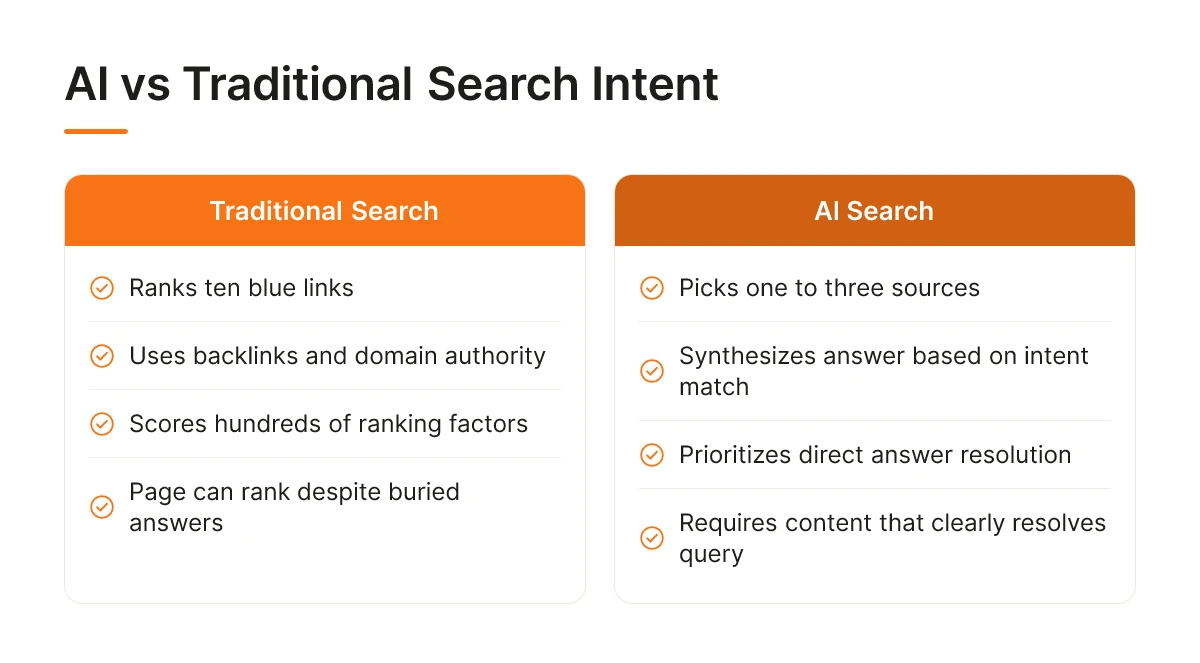
Google ranks a list of ten blue links using backlinks, keyword relevance, and page authority; AI engines pick one to three sources and synthesize an answer based on how directly they resolve intent. That difference explains why a business can dominate page one of Google and still go unmentioned in a ChatGPT answer for the same topic.
Traditional search works like a popularity contest scored across hundreds of ranking factors, with backlink volume and domain authority carrying heavy weight [1]. A page can rank well because other sites link to it, even if the content itself buries the answer under filler. AI search engines run a different calculation entirely, they generate a synthesized response and cite the sources that state the answer with the least friction [2]. Authority still matters, but it's no longer the deciding factor when a smaller, clearer source resolves the query faster.
Why Do AI Search Engines Sometimes Recommend Different Sources Than Google?
AI engines favor topical completeness and directness over the accumulated authority signals that dominate classic ranking. A page that fully answers a narrow question in plain language often gets cited over a bigger site that covers the topic broadly but never states the specific answer outright [4].
Consider a boutique hotel competing against a national chain. The chain's site ranks first on Google for "pet-friendly hotel in Austin" because of domain authority and backlink count. But the boutique hotel's page states plainly: "Yes, we allow up to two dogs under 50 lbs, no extra fee." Perplexity or ChatGPT synthesizing an answer to "which Austin hotels allow dogs" pulls the boutique's page because it resolves the intent in one sentence, while the chain's page requires the AI to infer the answer from a generic amenities list.
This is the practical upside of AI search intent recognition for SMBs: budget size stops being the deciding factor. A five-person retail shop with a direct, well-structured answer can out-cite a competitor spending far more on link building, because AI engines reward clarity over spend [3][5]. That's a different competitive game than traditional SEO, and it's one smaller businesses can actually win.
Tools and Metrics to Track AI Search Visibility and Intent Match
Tracking AI search intent recognition means watching whether your brand shows up in AI answers, how often, and in what context, not just where you rank on a results page. That requires a different measurement habit than traditional SEO, and most SMBs haven't built it yet.
How Can SMBs Monitor Visibility Across ChatGPT, Perplexity, Claude, and Gemini?
Visibility tracking starts with a simple question: does your brand get mentioned when someone asks an AI engine a question your business should answer? That means running the queries your customers actually type, "best hiking boots for wide feet," "top project management tool for small teams", across ChatGPT, Perplexity, Claude, and Gemini on a regular schedule, then logging whether your brand appears, how often, and in what position within the answer.
The qualitative read matters as much as the count. Watch for three outcomes:
- The AI cites your content directly with a link or attribution, signaling strong trust in your content's structure and authority.
- It paraphrases your information without credit, which often means your information reached the model's training or retrieval layer but your source wasn't distinct or authoritative enough to name.
- It ignores your business entirely and recommends a competitor instead, the clearest sign of a gap in AI search intent recognition [4].
Getting ignored means the engine either never found relevant content on your site or found a competitor's answer that matched intent more precisely [3].
This is a different metric category than keyword rank tracking. A page-one Google ranking measures position in a list; AI recommendation tracking measures whether you were chosen as the answer at all, and generative engines synthesize a single response rather than presenting ten blue links [2]. A business can rank well in classic SEO reports and still be invisible in AI-generated answers.
Monitoring approaches range from manual query logging, a budget-friendly starting point for a solo founder, to premium platforms that automate tracking across engines and flag citation changes over time. Moonrank's AI search visibility tracking sits in that automated tier: it monitors how often ChatGPT, Gemini, Claude, and Perplexity mention or recommend your business, then pairs that data with the daily content and technical fixes needed to close the gap.

Frequently Asked Questions
Can the same search query mean different things depending on who is asking?
Yes, the same words can signal different goals depending on context, location, and history. AI search engines weigh signals like past queries, session behavior, and phrasing to interpret what a specific person likely wants, rather than treating a query as a fixed string of keywords [3]. That's why two shoppers typing "best running shoes" can land on different recommendations.
Do AI search engines use the same ranking signals as Google?
No, AI search engines synthesize answers and cite sources directly instead of returning a ranked list of links [2]. Domain authority and backlinks still matter, but they're weighed alongside editorial structure, trusted citations, and how clearly content answers a specific question [2]. Treat it as a related but distinct discipline from classic SEO.
How often should SMBs update content to stay matched to changing search intent?
Update or publish new content at least weekly, since intent shifts as customer language, seasons, and competitor positioning change. Static pages built once and left alone tend to lose relevance as AI engines favor fresher, more specific answers over time. Consistency matters more than occasional large rewrites.
Is it worth optimizing separately for each AI engine, or is one approach enough?
A single strong content and technical foundation covers most of the work, but each engine still has quirks worth tracking separately. ChatGPT Search leans heavily on domain authority and trusted citations [2], while other engines weigh sentiment and structure differently [4]. Monitoring visibility across ChatGPT, Gemini, Claude, and Perplexity individually, rather than assuming uniform treatment, catches gaps a single-engine view misses.
What's the biggest mistake SMBs make when trying to improve AI search intent recognition?
The most common mistake is writing content optimized for keyword density rather than for directly resolving a customer's question. Pages stuffed with repeated phrases but no clear, plainly stated answer tend to get skipped by AI engines in favor of competitors who state their answer in the first sentence. Clarity and directness consistently outperform keyword volume.
Conclusion
AI search intent recognition rewards businesses that answer specific questions clearly, back claims with trustworthy sources, and update content often enough to track shifting customer language. Waiting for quarterly blog posts or one-time schema fixes won't keep pace with how ChatGPT, Gemini, Claude, and Perplexity re-evaluate content daily. The businesses winning recommendations right now are the ones publishing consistently and fixing technical readability gaps, like schema markup and llms.txt, in the background, without manual effort.
Start by checking whether your business currently appears when you ask ChatGPT or Perplexity for a recommendation in your own category. If it doesn't, moonrank.ai runs that visibility check and starts fixing the gaps automatically.
Sources & References
- How to Optimize Your Content Strategy for AI Search Success
- Best Content Strategy for Visibility in ChatGPT Search
- Understanding Customer Intent With AI Search
- User Intent in Generative Engines: Guide to AI Search Optimization
- Intent-based search: why AI understands customers better than keywords - Insightland
Recommended Articles
Explore more from our content library: