How SEO for Wix Helps AI Engines Find You
Learn how SEO for Wix works differently for AI search engines like ChatGPT and Gemini, plus practical steps to get your Wix site cited and recommended.

Understanding seo for wix is essential. Wix websites can absolutely get recommended by ChatGPT, Gemini, and Perplexity, but ranking on Google alone won't get you there, AI search engines read your site differently, pulling from crawlable text, structured data, and clear factual statements rather than backlinks and keyword density. To improve your odds, make sure Wix's SEO settings expose clean HTML content (not just JavaScript-rendered visuals), write pages that directly answer specific customer questions, and add structured data that states what your business does in plain terms. Platform choice matters less than how clearly your content communicates facts an AI can quote. Good seo for wix practice starts with this shift in mindset before any technical setting gets touched.
SEO for Wix vs Google SEO: What Actually Changes for AI Search
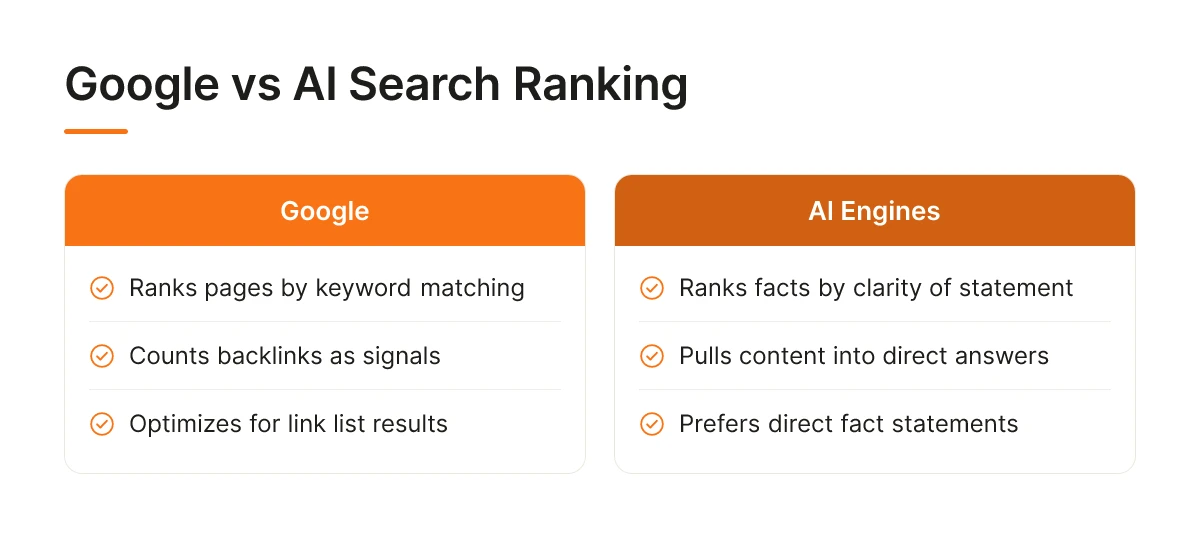
Google ranks pages by matching keywords and counting backlinks; AI engines rank facts by how clearly they're stated and how easily they can be pulled into an answer. That distinction is the entire reason seo for wix now means something different than it did two years ago.
Why Do AI Search Engines Treat Wix Sites Differently Than Google Does?
Google's algorithm was built to rank a list of links. ChatGPT, Gemini, and Perplexity are built to generate an answer, so they look for content that reads like a direct statement of fact rather than a page optimized to rank for a phrase [1]. A Wix page stuffed with the keyword "best hiking boots Denver" might still rank on Google, but an AI engine cares more about whether the page clearly states which boots you sell, for what terrain, and at what price.
This also changes what happens after the search. Google sends a click. AI engines often summarize your content directly in the chat window and never send the visitor to your site at all [2]. That means the goal shifts from earning a click to earning a quote, your product description, your FAQ answer, your return policy needs to be extractable as a clean, standalone fact an AI can lift and cite without distortion.
Which Google SEO Habits Don't Help With AI Search Visibility?
Some Wix SEO fundamentals still carry weight for both systems. Clean metadata, an accurate sitemap, and descriptive alt text help Google crawl your site and help AI systems understand what each page contains [4]. Squarespace's own guidance on AI-powered search makes a similar point: well-structured, clearly organized, concisely written pages perform better across both traditional and AI-driven results [2].
Other habits matter far less. Backlink volume, a cornerstone of Google ranking, carries little weight in how an LLM decides what to cite, these models weigh trust signals like clear entity definitions and structured data over link counts [1]. Exact-match keyword density, another Google-era habit, can actually work against you if it makes a sentence harder to quote cleanly. AI engines also tend to work from a page's underlying HTML rather than its visual layout, so a beautifully designed Wix page with content buried inside JavaScript-rendered elements may be invisible to a model that never renders the design at all.
- Backlink volume: a heavy Google ranking factor, but a weak signal for AI citation decisions
- Exact-match keyword density: can make sentences harder to quote cleanly if overused
- Visual design polish: irrelevant if the underlying HTML doesn't expose the same content
- Clean metadata and sitemaps: still useful for both Google and AI crawlers
- Descriptive alt text: still helps both systems understand page content
Technical and Content Factors That Get Wix Sites Recommended by AI
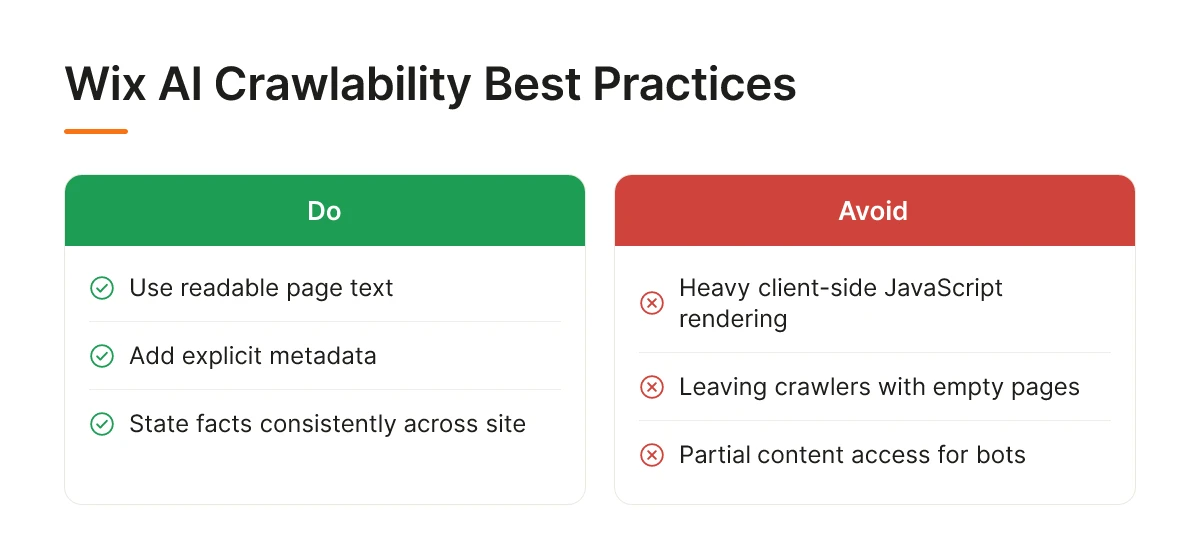
AI engines cite sites they can parse cleanly and quote confidently, that means readable page text, explicit metadata, and facts stated the same way everywhere on your site. Get these details right and seo for wix starts working in your favor instead of against it.
Does Wix's JavaScript Rendering Help or Hurt AI Crawlability?
Wix pages that rely heavily on client-side JavaScript can leave AI crawlers with an empty or partial page if the bot doesn't execute scripts before reading content. Squarespace's own guidance on AI-powered search makes the same point for site builders generally: crawlers need to access your content directly, and sites that are well-structured and clearly organized get read more easily than ones that require heavy rendering to reveal text [2]. Wix has moved toward server-side rendering for many templates, which pre-builds the HTML before it reaches the browser, this is the safer setup because an AI crawler gets full text on the first request, no script execution required.
Check this by viewing your page's source HTML directly, not just what renders in a browser. If your services, location, and key descriptions only appear after JavaScript runs, an AI crawler may skip past the substance and cite a competitor with a simpler, pre-rendered page instead.
What Content Structure and Metadata Do AI Engines Look For?
AI systems favor pages built around a clear question in the heading followed immediately by a direct answer, then supporting detail in lists or defined terms. Gravitate's research on AI search SEO frames this as the core mechanic: content needs clarity, structure, and entity-rich information so tools like ChatGPT, Gemini, and Claude can find, understand, and summarize it accurately [1]. A page titled "What are your delivery times?" that opens with a one-sentence answer will get quoted more often than a paragraph that buries the answer in the third sentence.
Metadata still matters. Page titles, meta descriptions, and schema markup, the structured data that tells AI engines exactly what your business does, should state your services and location in plain terms, not marketing language. Wix's SEO settings panel lets you edit these fields per page and configure structured data markup directly [4], and Wix's own SEO hub has started publishing guidance specifically on what gets cited in AI search results, a signal that this is becoming a standard part of on-page setup [3].
Consistency across the site reinforces all of it. If your homepage, About page, and contact page each describe your business name, services, and city the same way, AI engines have less reason to doubt or hedge when citing you, inconsistent facts are one of the fastest ways to get left out of a recommendation entirely.
Can a Wix Website Actually Rank in AI Search Results?
Yes, a Wix site can show up in ChatGPT, Gemini, and Perplexity recommendations, provided the content is clear and the technical basics are in place. Platform migration is not a prerequisite for AI search visibility.
AI search engines summarize information from sites that are well-structured, clearly written, and trustworthy [2]. That standard applies whether the underlying site runs on Wix, a custom stack, or anything in between. What matters most is whether crawlers can access the content and whether that content answers a real question clearly and completely [2].
Are There Wix Limitations That Make AI Optimization Harder?
Wix does introduce some friction compared to fully custom-coded sites, mainly around markup control. Wix's SEO settings panel lets site owners edit meta tags, URL structures, and structured data markup through a managed interface rather than raw code access [4]. That's fine for standard schema types, articles, products, local business, but it means less flexibility for advanced or custom schema than a hand-coded site allows.
Template-generated HTML can also carry extra div nesting and boilerplate that a custom build wouldn't include, which occasionally makes content structure less clean for AI parsing. None of this blocks visibility outright, it just means seo for wix sites benefits from deliberate cleanup: clear heading hierarchy, accurate structured data, and an accessible sitemap, since Wix already exposes controls for most of this [4].
Do Wix Sites Have the Same Visibility Potential as Custom-Built Sites?
For the vast majority of SMB use cases, a Shopify alternative retailer, a boutique hotel, a regional B2B SaaS tool, content clarity and factual completeness outweigh platform choice. AI search tools favor content that's concisely written, well-organized, and free of keyword stuffing [2], none of which depends on the CMS underneath.
Where it gets harder is in competitive, high-volume categories with many well-optimized competitors chasing the same query. In those cases, depth and specificity of content, not the platform, decide who gets cited. A local bakery or a niche B2B tool competing on a narrow, well-covered topic needs the same thing regardless of host: complete, accurate, entity-rich pages [1] that answer the exact question a buyer would ask an AI assistant. Moonrank's technical audit layer handles the schema markup and llms.txt configuration that Wix's interface doesn't expose directly, closing that gap without requiring a rebuild.
How to Set Up AI Search Optimization on Wix Without an Agency
You can handle most of the technical setup yourself using Wix's native tools, then spend your remaining effort on content AI engines can actually quote. No agency required for the first pass. This is the practical core of seo for wix for most small business owners.
Which Wix SEO Features Matter Most for AI Search?
Four built-in Wix features do the heavy lifting for AI visibility, and all four are accessible from your dashboard without a developer:
- SEO panel: set page titles and meta descriptions that summarize what a page is about in plain language, the same clarity that helps an AI system decide whether to cite you [4]
- Structured data markup settings: tell search engines and AI crawlers exactly what your business is, a restaurant, a product page, a service area, an FAQ [4]
- Sitemap settings: make sure new and updated pages get discovered promptly rather than sitting unindexed for weeks
- Alt text on images: a small field that gives AI crawlers another data point about what your page covers, reinforcing the same facts stated in your copy [4]
That structured data matters more for AI search than it did for classic Google SEO, since language models rely on clearly labeled entities to summarize a page accurately [2]. Together, these four settings form the technical foundation of seo for wix that everything else builds on.
Can You Automate AI Search Optimization on Wix?
Partially. Wix's free SEO tools cover the technical basics, meta tags, sitemaps, basic structured data, while premium tiers mostly add convenience features like bulk editing and advanced customization, not fundamentally different capability [4]. What no Wix plan automates is the content itself: writing pages that answer real customer questions directly, keeping your hours, pricing, and service details consistent across every page, and structuring FAQ sections so an AI engine can lift a clean answer. That's manual work, and it's the work that actually decides whether ChatGPT or Perplexity mentions you.
A realistic order of operations: fix the technical basics first, meta tags, structured data, sitemap, alt text. Then rewrite your five or six most important pages so they open with a direct answer to the question a customer would type, not marketing copy. Finally, monitor how often you show up in AI answers and adjust. This is exactly where Moonrank fits for SMBs who'd rather not do that content cycle by hand, it runs the daily content publishing, technical schema fixes, and visibility tracking automatically, as a budget-friendly alternative to hiring for that work directly.
How to Measure Whether Your Wix Site Gets Recommended by AI Search
Measuring AI search visibility means running direct prompts across chatbots, watching referral data in Wix Analytics, and tracking mention consistency over time rather than a single rank. This measurement layer is often the missing half of seo for wix efforts, since most site owners fix the technical settings and then never check whether it worked.
Start with the manual check anyone can run today, no tools required. Open ChatGPT, Gemini, and Perplexity and ask the questions a real customer would ask, "best boutique hotel in [city]," "top running shoe brands for wide feet," "which project management SaaS is best for five-person teams." Note whether your business appears, how it's described, and which competitors show up instead. Repeat the same prompts weekly and keep a simple log; a single check tells you nothing, but four or five checks over a month start showing a pattern.
What Metrics Should You Track for AI Search Visibility?
Track three things: mention frequency, referral traffic, and branded search volume. Wix Analytics and Google Analytics won't label traffic as "from ChatGPT" explicitly in most setups, but referral sources like chat.openai.com, perplexity.ai, or gemini.google.com showing up in your traffic sources report is a direct signal that an AI engine sent someone your way [4]. Watch for upticks in direct traffic and branded search ("[your business name] reviews" or "[your business name] pricing") right after you publish new content or update your Wix SEO settings, that pattern often means an AI answer surfaced your brand name even without a clickable link [2]. Squarespace's own guidance on AI-powered search makes the same point: build trust signals and structure content clearly, then watch how traffic composition shifts afterward [2].
How Do You Compare AI Search Performance Across Sites?
This is where AI visibility tracking breaks from familiar Google rank tracking, and it's worth understanding before you judge your own numbers too harshly. Google SEO gives you a position, page 1, spot 3. AI search doesn't work that way; there's no fixed slot, and the same prompt can return different answers minutes apart depending on model updates and context [1]. Consistency of mention across repeated prompts and across engines matters more than chasing a number that doesn't exist. That's precisely why seo for wix needs its own measurement approach separate from traditional keyword rank tracking, and why manual spot-checks eventually become too slow to catch changes across ChatGPT, Gemini, Claude, and Perplexity at once.
This is the gap dedicated AI visibility tracking tools are built to close. Moonrank monitors how a business appears in recommendations across all four major engines on an ongoing basis, then pairs that tracking with daily content publishing and technical fixes, schema markup, llms.txt, structured data, so mention frequency has a reason to improve instead of just being observed.

Frequently Asked Questions
Will improving my Wix site's Google SEO also help it show up in AI search results?
Partly, good Google SEO builds the foundation, but AI search engines weigh different signals. Clear structure, fast load times, and quality content help both [1]. However, AI engines also prioritize structured data, clear entity information, and citation-worthy content in ways standard Google SEO checklists don't fully cover [2].
Does Wix's SEO Setup Checklist cover what AI search engines need?
It covers the basics, meta tags, sitemaps, structured data settings, but not everything AI engines look for [4]. Wix's checklist targets Google ranking factors; you'll still need to address llms.txt configuration and citation building separately as part of a fuller seo for wix strategy.
Is Wix's mobile-friendliness a factor in AI search recommendations?
Mobile-friendliness matters indirectly, it affects crawlability and user trust signals AI engines reference [2]. AI search engines look for well-structured, clearly organized sites when generating responses, and mobile usability is part of that overall quality signal [2].
How long does it take for AI search engines to start citing a Wix site after changes?
There's no fixed timeline, and no research source confirms a specific window. AI engines need to recrawl your site, reprocess your content, and build enough trust signals, like citations and structured data, before referencing you [2]. Consistent publishing and technical fixes tend to matter more than any single update, since visibility builds gradually rather than overnight.
Do I need to hire a specialist to handle seo for wix, or can I do it myself?
Most of the technical groundwork, meta tags, sitemaps, structured data, alt text, is manageable yourself using Wix's built-in SEO panel [4]. Where owners typically run out of time is the ongoing content work: writing citation-ready pages and tracking mentions across engines. That's the part tools like Moonrank are built to take off your plate.
Conclusion
Wix gives you the settings, meta tags, structured data, sitemaps, but AI search engines reward what you do with them: clear entity signals, consistent publishing, and content built for citation, not just keywords [4]. Start by auditing your structured data and llms.txt setup, then commit to a regular publishing cadence instead of one-time fixes.
If you'd rather not manage that manually, Moonrank handles daily content publishing, schema markup, and AI visibility tracking across ChatGPT, Gemini, Claude, and Perplexity for your Wix store or service site, automatically. Check your site's AI search readiness at www.moonrank.ai.
Sources & References
- AI Search SEO: How to Rank on ChatGPT, Perplexity, & Gemini
- Optimize your site for AI-powered search engines, Squarespace Help Center
- Learn SEO | Wix SEO Hub
- Customizing Your SEO Settings | Help Center | Wix.com
Recommended Articles
Explore more from our content library: