The Best SEO SaaS Platforms for Automated AI Visibility
Discover why the best SEO SaaS automates Google rankings and AI search citations together, replacing costly agency retainers with daily automation.
The best SEO SaaS for SMBs is a platform that automates both traditional search optimization and visibility across AI search engines like ChatGPT and Perplexity, without requiring an agency retainer. This matters because ranking in Google alone no longer captures how people find businesses; AI engines now summarize and recommend brands directly, and that requires structured data, fast content publishing, and citation tracking working together on autopilot. Look for a platform that publishes optimized content automatically, monitors your brand's presence in AI answers, and handles the technical signals AI engines read, all at a fraction of agency cost.
Why SMBs Need a Best SEO SaaS Approach Instead of an Agency
SMBs need a best SEO SaaS platform because agencies work in slow, manual cycles while visibility across Google and AI search engines now demands constant, automated upkeep.
A typical agency retainer runs on a monthly rhythm: a strategy call, a content calendar, a handful of articles drafted over two or three weeks, then a report. That cadence made sense when Google was the only system to satisfy. It breaks down now that ChatGPT, Perplexity, and Gemini pull from freshly published, well-structured content and update their citations continuously. SaaS automation replaces the monthly cycle with daily publishing and always-on monitoring, so a business's content footprint grows every day instead of in scheduled bursts.
Is SEO Still Worth It When AI Search Engines Are Changing How People Find Information?
Yes, SEO is still worth it because AI engines still need sourced answers, and businesses that don't rank or get cited anywhere simply don't get mentioned. AI Overviews and chat-based assistants have to synthesize their answers from somewhere, and that somewhere is still indexed, structured, well-linked content [3]. A shop owner who assumes AI search replaces the need for search optimization has the relationship backwards: AI search depends on the same underlying content signals, plus a few new ones like structured data and citation-worthy authority [1]. Losing a mention in a Perplexity comparison or an AI Overview costs a business a buyer it never even sees leave [3].
What's the Mistake Most SMBs Make Optimizing for Both Google and AI Search Engines?
The core mistake is treating Google rankings and AI search visibility as one task, when they're two connected but distinct signals that need separate tracking and separate technical work. Ranking on page one of Google doesn't guarantee a mention in a ChatGPT answer or a Perplexity source list, those systems weigh citation quality, structured data, and topical consistency differently [2]. B2B SaaS teams especially fall into this trap, assuming a strong domain rating covers both bases, then discovering a competitor gets named in AI comparisons while they don't [4].
Understaffed SMBs rarely have a marketer, let alone two specialists tracking Google rankings and AI citations in parallel. That's why automation isn't a convenience here, it's the only realistic way a solo founder or shop owner keeps up with both systems at once, and it's precisely the gap the best SEO SaaS platforms are designed to close.
How SEO SaaS Gets You Recommended by ChatGPT, Perplexity, and Other AI Search Engines
SEO SaaS platforms earn AI citations by structuring your business facts so language models can extract and quote them accurately, not by chasing keyword density.
ChatGPT, Perplexity, and Gemini don't crawl your site the way Googlebot does. They retrieve fragments of content, check whether those fragments answer a specific question clearly, and decide whether your business is a trustworthy source to cite. A page full of vague marketing language gives an AI model nothing solid to quote. A page with a clearly labeled fact, your hours, your service area, your product specs, gives it something to work with.
How Is Optimizing for AI Search Engines Different From Traditional Google SEO?
Traditional Google SEO rewards backlinks, keyword density, and accumulated domain authority built over years. AI search visibility runs on a different set of signals: how often your business gets cited across AI conversations, how clearly your facts are stated, and how recently that content was published or updated [3].
Onely's research on AI search visibility points out that a competitor named in a single Perplexity comparison can win a buyer's consideration even though that buyer never clicked through to a website an analytics tool would register [3]. That's the core shift: rankings measure position on a results page, while AI visibility measures whether you get mentioned at all inside a generated answer. A site can rank on page one of Google and still be invisible in ChatGPT's response if its facts aren't structured for extraction.
What Technical and Content Changes Does SEO SaaS Automate for AI Visibility?
The best SEO SaaS platforms automate two things a business owner would otherwise need a developer for: technical markup and content velocity. On the technical side, that means schema markup, structured data embedded in your site's code that tells AI engines exactly what your business does, where it operates, and what it sells, plus a properly configured llms.txt file, which acts like a directory that points AI crawlers to your most important pages and facts. Moonrank builds this technical layer automatically during onboarding, handling schema, llms.txt configuration, and citation building without requiring the business owner to touch a line of code.
On the content side, publishing daily rather than monthly matters because each new page is another surface an AI model can pull from when it generates an answer. AI visibility platforms track this kind of citation frequency directly, measuring where a brand gets mentioned across models and how often competitors appear in the same context [1]. More clearly labeled, current content simply gives AI engines more chances to find and quote your business first.
What to Look for When Choosing an SEO SaaS Platform for AI Search Visibility
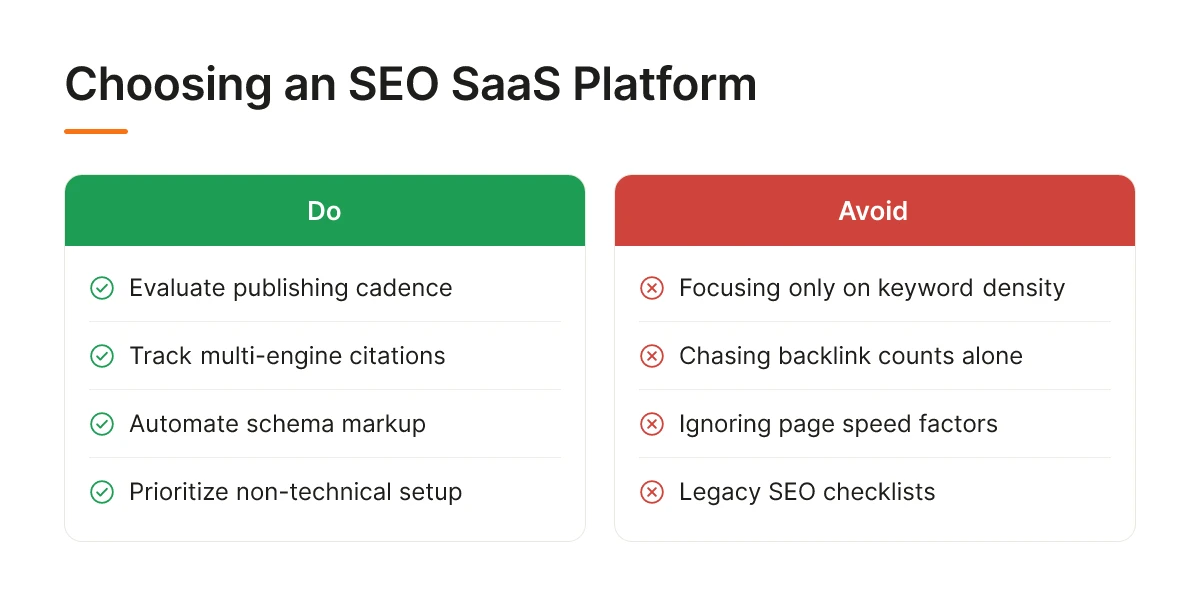
The best SEO SaaS platform for AI search visibility scores on four things: publishing cadence, multi-engine citation tracking, schema automation, and setup speed for non-technical owners.
Legacy SEO checklists focus on keyword density, backlink counts, and page speed. Those still matter for Google, but they say nothing about whether ChatGPT or Perplexity will actually mention your business when a customer asks for a recommendation. Evaluate platforms against criteria built for that specific job:
- Automated publishing cadence, Does the tool publish new content daily, or does it require you to approve, edit, and schedule each piece? A platform that needs weekly manual intervention is not automated.
- AI citation tracking across multiple engines, Does it monitor ChatGPT, Gemini, Claude, and Perplexity by name, or just one?
- Technical schema automation, Does it handle schema markup, llms.txt configuration, and structured data without you touching code?
- Ease of setup, Can a restaurant owner or Shopify merchant get running in an afternoon, or does it demand a developer?
Which SEO SaaS Tools Have AI Search Engine Optimization Capabilities Built In?
Most SEO tools still treat AI search as an add-on feature bolted onto a Google-first product, rather than the core design goal. Industry coverage of the AI visibility category backs this up: platforms built specifically to quantify brand citations inside generative engines are a distinct and newer product class from traditional rank trackers [1]. B2B SaaS-focused roundups of AI SEO tools make a similar distinction, separating platforms that offer real AI search tracking and content generation from those that only claim AI compatibility [2]. That distinction matters when you compare vendors. A tool built for Google SEO with an "AI visibility" tab added later usually can't tell you why a competitor gets recommended and you don't. A category-specific answer engine optimization tool, by contrast, is built around tracking and influencing exactly that. Moonrank falls into the second group, it runs daily automated content generation, technical AI audits, and competitive analysis across AI engines as its core process, not a bolted-on feature, which is part of why it's positioned as a best SEO SaaS candidate for smaller teams.
How Do You Compare SEO SaaS Platforms on Features, Pricing, and AI Search Tracking?
Compare platforms on feature depth relative to your setup time and budget tier, not on sticker price alone. A budget-friendly tool that only tracks one AI engine or requires manual publishing will cost you more in owner hours than a mid-range platform that runs on autopilot. Premium agency-style services bring strategy depth but often charge for hours you don't need as a small operation [3][4]. Weigh three things together: how many AI engines the platform actually tracks by name (since a recommendation on ChatGPT doesn't guarantee one on Gemini or Claude), how much of the technical work is automated versus manual, and whether the pricing tier matches the size of your business. A single-location retailer rarely needs an enterprise engagement built for complex, multi-product SaaS companies [3].
How to Integrate SEO SaaS Into Your Workflow to Drive Pipeline and Revenue
Connect your SEO SaaS platform to analytics and CRM tools so visibility gains show up as tracked pipeline, not just a bump in unattributed traffic. Without that connection, a visitor who found you through a ChatGPT citation lands on your site, converts, and gets logged as "direct", invisible to whoever approves next quarter's budget.
How Should SEO SaaS Connect to Your CRM and Analytics Tools to Measure Business Impact?
Start with attribution. AI-referred visitors often arrive with no referrer string, which is why most analytics setups bucket them under "direct" or "unknown" by default. Tag landing pages tied to your AI-visibility content and pass that data into your CRM so a conversion, a demo request, a Shopify checkout, a form fill, can be traced back to the content that earned the citation in the first place.
The practical handoff looks like this: the SEO SaaS platform surfaces where your business gets cited or recommended across ChatGPT, Gemini, Claude, and Perplexity, and identifies which pages are driving that visibility. Your CRM then picks up from the moment a visitor converts, tracking deal stage, close rate, and revenue. One tool proves you're getting found; the other proves what happens after. Neither does the whole job alone, and agencies rarely wire the two together as part of a standard retainer [3].
What Metrics Should You Track to Prove SEO SaaS Is Driving Pipeline?
Rankings alone don't justify a subscription to a finance lead. Track share of AI citations relative to competitors in your category, assisted conversions from AI-referred sessions, and content velocity against lead velocity, are you publishing faster than you're generating qualified pipeline, or is the gap widening? Onely's research on SaaS buyer behavior notes that a competitor named in an AI comparison can win consideration before a prospect ever clicks through to a site, meaning some of the most valuable visibility never appears in a standard traffic report [3].
This is the case for tying reporting to revenue, not impressions. Moonrank's AI search visibility tracking exists specifically to surface these citation-level signals, where and how often your business gets recommended, so that data can feed into the CRM conversations that matter to a founder deciding whether the best SEO SaaS for their business is worth the monthly line item. A tool that reports rankings but not revenue is asking to be cut in the next budget review.
SEO SaaS vs Agency Services: The Real Cost Difference
Agencies bill for hours and headcount; a SaaS platform bills for software, and that structural difference is what separates ongoing agency retainers from a flat SaaS subscription.
How Much Does an SEO Agency Cost Compared to an Automated SEO SaaS Platform?
An agency retainer covers people, not just output. You're paying for a strategist's hours, an account manager who joins your calls, and often a separate line item for content production, since writing, editing, and publishing get billed as a distinct service from strategy [4]. Contracts frequently lock in for six or twelve months, which makes sense from the agency's side, SaaS SEO agency evaluators note that consistent output requires ongoing staffing commitments [3], but it leaves an SMB owner paying premium rates whether or not that month's output moved the needle.
An automated SEO SaaS platform strips out the labor layer. There's no strategist hourly rate embedded in the invoice because no strategist is manually researching your keywords or writing your posts every week. The cost structure is a flat, recurring subscription, and that's the core reason SaaS pricing sits in a budget-friendly tier while agency retainers climb into premium territory reserved for larger marketing budgets.
What's Typically Included in a Budget-Friendly SEO SaaS Plan Compared to an Agency?
A well-built SaaS plan bundles what an agency would otherwise itemize: content publishing, AI visibility tracking, and technical optimization under one subscription. Moonrank, for example, runs daily content generation, schema markup, llms.txt configuration, and citation building as part of a single subscription plan, the kind of stack an agency would typically quote as three separate services with three separate invoices.
Automation is what makes that bundling possible. Once publishing and technical fixes run on a system instead of a person's calendar, output no longer scales with billable hours, which is exactly the bottleneck that pushes agency pricing higher as demand for content grows. The honest tradeoff: agencies still offer bespoke strategy and human judgment for complex, high-stakes positioning calls [3][5]. For most SMBs without in-house SEO staff, though, the best SEO SaaS options trade that bespoke layer for speed, consistency, and a cost structure that doesn't creep up every quarter.
Frequently Asked Questions
Can a small business replace an SEO agency with a SaaS platform?
Yes, for most SMBs a well-built SEO SaaS platform covers what an agency retainer used to handle. The gap that used to require a human strategist, daily content, technical audits, schema markup, is now something software can run on autopilot, which is exactly the wedge Moonrank is built around as a best SEO SaaS alternative to traditional retainers.
Do AI search engines like ChatGPT actually send traffic to small business websites?
Yes, but the bigger shift is referral, not clicks, buyers now ask ChatGPT or Perplexity for a recommendation before ever visiting a website [3]. If your business isn't cited in that answer, you lose the customer silently, with no analytics trail showing what happened [3].
How long does it take to see AI search visibility results after switching to an SEO SaaS platform?
Most businesses start seeing measurable citation and visibility changes within four to eight weeks of consistent daily publishing and technical fixes. Full topical authority, where AI engines reliably recommend you across multiple query variations, typically builds over two to three months.
Does SEO SaaS work for local, service-based businesses or just software companies?
It works for both, restaurants, boutique hotels, and retail shops benefit the same way B2B SaaS teams do. The mechanics are identical: AI engines need structured, current, well-cited content to recommend any business, regardless of industry.
What should a growing team look for once basic SEO SaaS automation is in place?
Once daily publishing and schema automation are running smoothly, look for deeper competitive benchmarking, multi-language content support, and API access to feed citation data into other reporting tools. A best SEO SaaS platform built for scale should let you layer in more AI engines and markets without switching systems or re-onboarding your technical setup from scratch.
Conclusion
Choosing the best SEO SaaS platform comes down to three things: does it publish consistently, does it fix the technical signals AI engines actually read, and does it track whether ChatGPT, Gemini, and Perplexity mention you at all. Agencies charge a premium for parts of this; most standalone tools cover only one piece of it. Moonrank bundles all three, daily content, schema and llms.txt optimization, and cross-engine visibility tracking, into one subscription. Start with a free trial at moonrank.ai and check where your business currently stands before a competitor claims the recommendation instead.
Sources & References
- How do you rank in AI? Top AI Visibility Tools Overview
- 11 Best AI SEO Tools for B2B SaaS Growth Teams
- Best SaaS SEO Agencies in 2026: A Criteria-Based Evaluation for AI Search Visibility - Onely
- 12 Best SaaS SEO Agencies for 2026 | SeoProfy
- SaaS SEO Agency for B2B SaaS Companies | TripleDart
Recommended Articles
Explore more from our content library: