How Traditional SEO Tools Differ From AI Search Optimization
Traditional SEO tools (like rank trackers and keyword research platforms) help you climb Google's search results, while AI search optimization platforms...
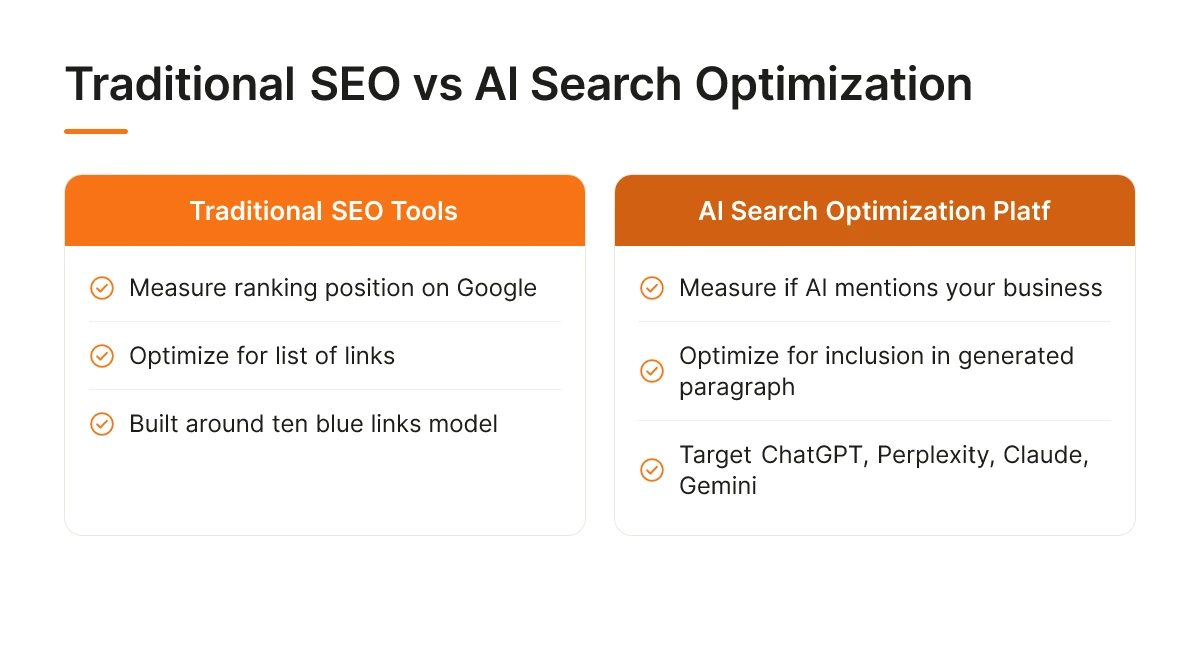
Understanding what is the difference between traditional seo tools and ai search optimization platforms is essential. Understanding what is the difference between traditional seo tools and ai search optimization platforms is essential. Traditional SEO tools (like rank trackers and keyword research platforms) help you climb Google's search results, while AI search optimization platforms help your business get mentioned and recommended inside AI answers from ChatGPT, Perplexity, and similar tools. The two track different outcomes, rankings versus citations, and use different mechanics to get there, so most businesses end up needing both rather than picking one over the other. Traditional tools won't tell you if ChatGPT recommends you; AI search optimization platforms won't tell you if you rank on page one of Google.
What Is the Difference Between Traditional SEO Tools and AI Search Optimization Platforms?
Traditional SEO tools measure where you rank on Google; AI search optimization platforms measure whether ChatGPT, Perplexity, Claude, or Gemini mention your business at all.
That's the real answer to what is the difference between traditional SEO tools and AI search optimization platforms, one category optimizes for position in a list of links, the other optimizes for inclusion in a generated paragraph. Semrush, Ahrefs, and similar platforms were built around a search model that no longer covers the whole picture: a page of ten blue links, ranked by relevance and authority signals [1]. AI search optimization platforms exist because that model doesn't explain how answer engines work. When someone asks Perplexity "best project management software for a 10-person team," there's no ranked list to climb, there's a short answer with two or three sources cited, and you're either one of them or you're invisible.
What Metrics Do Traditional SEO Tools Track That AI Search Optimization Platforms Don't?
Traditional tools track keyword position, domain authority, and backlink count, numbers built around how Google's crawler evaluates a page over time [2]. These metrics answer questions like "did we move from position 14 to position 6" or "how many referring domains point to this URL." None of them tell you whether an AI model ever reads that page, let alone quotes it.
AI search optimization platforms track a different set entirely: citation frequency (how often your brand gets named in AI-generated answers), share of voice against competitors inside those answers, and which specific pages get quoted or paraphrased. A business can hold a strong domain authority score and still show up zero times when a buyer asks ChatGPT for a recommendation, the two scoreboards don't talk to each other [3].
How Does Optimizing for AI Model Citations Differ From Optimizing for Google Rankings?
Google ranking depends on link signals, crawl health, and keyword relevance accumulated over months. AI citation depends on how clearly a piece of content answers a specific question, structured enough for a language model to extract, quote, and attribute without ambiguity [4].
That difference means a page can rank poorly in Google's results yet still get surfaced by Perplexity or Claude, simply because it states an answer in direct, well-structured language a model can lift cleanly. Conversely, a page with a strong backlink profile can be ignored entirely by AI answer engines if it buries its point under thin, unstructured copy. This is the gap Moonrank is built to close: it handles the technical side, schema markup, llms.txt configuration, structured data, that makes content legible to AI systems, while publishing new content daily so there's something fresh for those models to find and cite.
Why Should SMBs Care About AI Search Optimization If They're Already Investing in Traditional SEO?
Because a growing share of your buyers now get a single AI-generated answer instead of a page of links, and if your business isn't the one named, you lose the sale before you ever see a search query land on your site.
Is AI Search Optimization Replacing Traditional SEO, or Is It a Separate Channel?
AI search optimization doesn't replace traditional SEO, it runs alongside it as a separate discovery channel with its own rules. Traditional SEO is still what gets you crawled, indexed, and ranked on Google and Bing [4]. AI search optimization is the work of making sure ChatGPT, Perplexity, and similar tools can find, trust, and cite your content when they generate an answer [4].
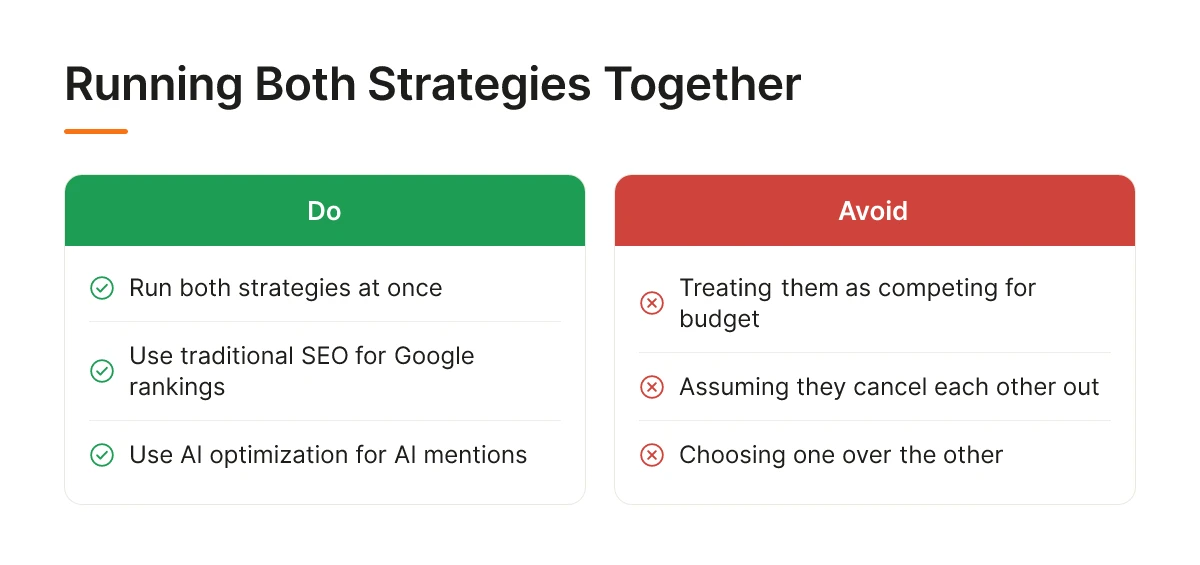
Understanding what is the difference between traditional seo tools and ai search optimization platforms matters here because the two aren't competing budgets, they're complementary ones. Keyword rankings and AI citations are tracked differently, built differently, and increasingly need to be managed side by side rather than swapped out for one another [1].
What's the Business Impact of Getting Recommended by AI Search Engines Versus Ranking on Google?
A Google ranking gets you a click competing against nine other blue links on the page. An AI recommendation often arrives as one named answer with no visible competitors, the user asks, the tool picks a winner, and that's the end of the comparison shopping.
That shift raises the stakes for specific audiences. Ecommerce brands depend on being the product an AI tool names when a shopper asks for the "best" option in a category. B2B SaaS buyers increasingly use AI tools to build vendor shortlists before a human sales rep ever enters the conversation. Cybersecurity firms need to be named as trusted, credible options in a field where buyers are risk-averse and rarely click past the first recommendation. Hotels need to show up when travelers ask an AI assistant to plan a trip, since that query often replaces the old habit of scrolling a booking site.
Many SMB owners worry that adding AI search optimization means spreading an already tight budget thinner. The more useful framing: this is a new, comparatively low-competition channel, not a reallocation away from SEO that's already working. Moonrank is built to run both at once, handling the technical AI-readability work (schema markup, llms.txt, structured data) and daily content publishing for under what a single agency invoice typically costs, without asking you to cut your existing SEO spend.
How Do You Actually Optimize Content to Get Recommended by AI Search Engines?
You rewrite pages so machines can lift a fact cleanly, add structured data that states what your business sells, and publish often enough that AI engines keep finding fresh material to cite.
This is the practical answer to this method: traditional tools optimize a page to rank in a list, while AI search optimization optimizes a sentence to be extracted and repeated. The mechanics below show what actually changes.
What Technical and Content Changes Do You Need to Make for AI Search Optimization?
Start with structured data, schema markup is the code on your site that tells AI engines exactly what your business does, where it operates, and what it offers, in a format machines parse without guessing. A hotel adds schema for room types, pricing tiers, and amenities; a SaaS company adds schema for product category, features, and pricing model. Without it, an AI engine has to infer your business from prose, and inference introduces errors it won't risk repeating to a user. Content needs the same directness. Put the answer to the obvious question in the first two sentences of the page, not buried after three paragraphs of brand story. Write headings that match how people actually ask, "What does [product] cost?" instead of "Our Pricing Philosophy", because AI engines pattern-match questions to headings when selecting what to cite [4]. State facts as self-contained sentences: a line like "Moonrank costs $99/month and includes daily automated content publishing" can be lifted whole, while a sentence that depends on three prior paragraphs of context cannot [4]. One more emerging piece: llms.txt is a simple text file that tells AI crawlers which content on your site is meant to be read and cited, similar to how robots.txt long told search engines what to crawl [4]. It's not a ranking guarantee, but it removes ambiguity about what you want surfaced.
How Do You Track Whether Your AI Search Optimization Efforts Are Actually Working?
Traditional rank trackers show position on a results page, they have no concept of whether ChatGPT mentioned your brand yesterday [3]. You have to query the AI engines directly, or use a monitoring layer that does it for you, tracking brand mentions and citations across ChatGPT, Gemini, Claude, and Perplexity on a recurring basis. Technical setup, schema, llms.txt, is largely one-time work. Staying visible is not: AI engines continuously refresh which sources they trust, so content has to keep publishing to stay in rotation [1]. This is the gap Moonrank is built around, it handles the daily publishing and the visibility tracking together, so you're not manually checking four AI engines or guessing whether last month's schema fix still matters.
What's the Real Cost Difference Between Traditional SEO Tools and AI Search Optimization Platforms?
Traditional SEO tools generally sit in the mid-range to premium subscription tier, while AI search optimization platforms tend to cost less because the category is newer and less crowded. That cost gap is one of the clearest ways to answer this strategy for a business deciding where to put its next marketing dollar.
Platforms like the established SEO suites mentioned in industry comparisons are built for agencies and in-house teams tracking hundreds of keywords, running backlink audits, and monitoring dozens of competitors at once [2]. That breadth justifies a higher price, but it also means an SMB owner is often paying for reporting modules and competitor-tracking depth they'll never fully use. AI search optimization platforms, by contrast, tend to land in the budget-friendly tier because the discipline, tracking and improving visibility in ChatGPT, Gemini, Claude, and Perplexity, is still forming, with far fewer vendors competing for the same customer [3].
How Should SMBs Allocate Budget Between Traditional SEO Tools and AI Search Optimization Platforms?
Keep existing SEO spend in place and treat AI search optimization as a smaller, additional line item rather than money pulled from your SEO budget. Google still handles a significant share of commercial search volume, so dropping traditional SEO to fund AI visibility work would trade one gap for another [1]. A practical starting point: fund your current SEO tools and agency relationships as-is, then add a modest, separate line for an AI-focused platform, treating it the way you'd treat a new channel test rather than a replacement budget.
What's the ROI Difference Between Investing in Traditional SEO Versus AI Search Optimization?
Traditional SEO ROI shows up gradually, ranking improvements and organic traffic gains typically build over months as authority and backlinks accumulate [4]. AI search optimization ROI often looks different: because fewer businesses are actively optimizing for AI answer engines right now, a well-optimized site can start appearing in ChatGPT or Perplexity recommendations faster than it would climb Google's rankings for a competitive term [3].
This is the gap Moonrank is built for. At $99 a month, it bundles technical AI optimization, daily content publishing, and visibility tracking across all four major AI engines, work that would otherwise need a separate writer, developer, and monitoring tool, priced well under what agencies charge for comparable traditional SEO retainers.
Should You Choose One or Use Both Traditional SEO Tools and AI Search Optimization Together?
Most businesses should run both at once: traditional SEO tools and AI search optimization platforms target different surfaces, so they don't compete for the same budget logic or cancel each other out.
Can You Run Traditional SEO and AI Search Optimization Strategies at the Same Time?
Yes, traditional SEO governs how your site ranks on Google's results page, while AI search optimization governs whether ChatGPT, Gemini, Claude, or Perplexity mention your business in a generated answer [1]. Those are two separate systems with separate inputs: one depends on backlinks, crawlability, and keyword rankings; the other depends on structured data, citations, and how clearly your content answers a question in plain language [5]. Running an SEO platform for rankings and an AI visibility tool for answer inclusion is not duplication, it's coverage of two discovery channels your buyers already use interchangeably.
This is the practical answer to this approach: one audits and improves ranking signals, the other audits and improves answer-eligibility signals. A site can rank on page one of Google and still never get mentioned by an AI engine, because the two systems evaluate different things [3]. Treating them as a single workstream, rather than a choice between them, is what closes that gap.
Which Approach Makes More Sense for Different Business Sizes and Industries?
Industry shapes where you'll see results first. Ecommerce stores and hotels tend to get faster AI visibility wins, since shoppers and travelers frequently ask AI tools for direct recommendations, "best hiking boots under $150" or "boutique hotels in Charleston" are exactly the prompts these engines are built to answer. B2B SaaS and cybersecurity companies see a different pattern: buyers research vendors conversationally, comparing options with an AI assistant before a sales rep, or the company's own website, ever enters the picture.
Team size matters too. A solo founder or small team with no dedicated marketing staff benefits from starting with AI search optimization first, since it's a less crowded channel with less competition for visibility right now. Larger teams with existing SEO infrastructure already in place should add AI optimization as a parallel workstream rather than replacing anything.
If you're an ecommerce brand, SaaS company, or hotel wondering whether you show up when someone asks an AI engine for a recommendation, that's exactly what Moonrank tracks and improves. Moonrank runs daily automated content publishing, technical optimization like schema markup and llms.txt, and AI visibility monitoring across ChatGPT, Gemini, Claude, and Perplexity, for $99 a month, next to your existing SEO stack. Visit www.moonrank.ai to see where your business currently stands.
Frequently Asked Questions
Do AI search optimization platforms replace the need for traditional SEO tools?
No, most businesses still need both, since Google and Bing continue to drive measurable traffic alongside AI answer engines [1]. Traditional SEO tools track rankings and backlinks; AI search optimization platforms track whether ChatGPT, Gemini, or Perplexity cite and recommend your business. Running only one leaves a visibility gap the other can't see [3].
Can a page rank low on Google but still get cited by ChatGPT or Perplexity?
Yes, AI answer engines weigh semantic relevance, entity consistency, and content structure more heavily than backlink-driven ranking position [5]. A page with thin backlinks but clear, well-structured answers to specific questions can get cited even if it sits on page two of Google. That's why schema markup and structured data matter so much for AI visibility [4].
How long does it take to see results from AI search optimization compared to traditional SEO?
AI search optimization can show visibility changes within weeks, while traditional SEO typically takes months to move rankings. Because AI engines re-crawl and re-synthesize answers more frequently than Google re-ranks pages, fresh, well-structured content can get picked up faster [4]. Traditional SEO's link-building and domain authority gains still build gradually over a longer period, often three to six months before meaningful movement.
What industries benefit most from investing early in AI search optimization?
B2B SaaS, e-commerce, cybersecurity, and hospitality brands benefit most, since their buyers increasingly research options by asking AI tools directly instead of searching. B2B SaaS buyers often ask ChatGPT or Perplexity to compare platforms before opening Google at all [3]. Hotels and e-commerce stores lose bookings and sales when competitors get recommended instead.
Conclusion
Traditional SEO tools and AI search optimization platforms measure different things: one tracks Google rankings and backlinks, the other tracks whether AI engines actually cite and recommend you. Skipping either leaves money on the table, especially for B2B SaaS and e-commerce brands whose buyers now ask ChatGPT or Perplexity before opening a browser tab. If you're an SMB without a dedicated SEO team, start by auditing your current AI visibility rather than guessing. Moonrank runs that audit automatically, then publishes daily content and fixes technical gaps like schema markup and llms.txt on autopilot, try it at moonrank.ai.
Sources & References
- Traditional SEO vs. AI SEO: What You Actually Need to Know
- AI Tools for SEO: The Good, The Bad, The Pointless
- AI Search Optimization vs Traditional SEO Tools (2026) | Iriscale
- AI SEO Does Not Replace Traditional SEO, Squarewebsites Plugins
- AI Search vs. Traditional Search: Ranking, Optimization & Future Trends | Search Atlas
Recommended Articles
Explore more from our content library: