Why Perplexity Cites Some Ecommerce Stores, Not Others
Perplexity cites ecommerce stores whose product data it can clearly read, trust, and match to a shopper's question — not necessarily the biggest retailers....

Understanding Perplexity ecommerce citations is essential. Perplexity cites ecommerce stores whose product data it can clearly read, trust, and match to a shopper's question, not necessarily the biggest retailers. It pulls from product feeds, structured markup, retailer reputation signals, and real-time crawling, then favors pages with clean schema, accurate pricing, and clear availability. Stores get ignored when their product data is thin, outdated, blocked from crawlers, or buried behind JavaScript Perplexity can't render. Visibility depends more on data clarity than brand size, which gives smaller ecommerce brands a real chance to compete.
How Does Perplexity Decide Which Ecommerce Products to Cite?
Perplexity blends live web crawling with structured product feeds, then matches both against the shopper's exact question before choosing what to cite. Unlike a traditional search index that ranks pre-crawled pages, Perplexity Shopping draws on real-time data to answer a specific query, comparing options rather than returning a static list of links [2]. That means a product page can be re-evaluated every time someone asks a related question, not just ranked once and left alone.
Freshness and clarity carry more weight here than raw domain authority. Perplexity's model rewards sources that get cited in a generated answer, not sources that simply rank well on Google [5]. A page with an accurate price, current stock status, and complete specs is easier for Perplexity to trust than a page from a high-authority domain with outdated or vague product information. This is the core mechanic behind Perplexity ecommerce citations: the engine is grading your data, not just your domain.
Does Perplexity Favor Large Retailers Over Smaller Brands?
Large retailers tend to get cited more often, but that's a byproduct of cleaner feeds, not company size. Big chains typically run structured, well-maintained product feeds with consistent pricing and availability data, which makes their listings easier for Perplexity to parse and trust [1]. A smaller store with the same level of data hygiene stands on equal footing for a given query.
The practical path for a niche or small ecommerce brand runs through specifics: tighter data hygiene, long-tail product descriptions that match how shoppers actually phrase questions, and differentiation signals a generic retailer won't have, material, origin, sizing nuance, or a use case a mass retailer doesn't call out. A boutique store that answers a narrow question precisely can out-cite a retailer whose listing is broad but thin on detail.
What Ranking Factors Determine Whether Your Product Gets Cited Over a Competitor's?
Four factors consistently separate a cited product from a competitor's: structured data completeness, crawlability, review signals, and content that directly answers the shopper's query.
- Structured data completeness: full schema markup covering price, availability, and specs, rather than partial or missing fields.
- Crawlability: product data Perplexity can render and read, not content locked behind JavaScript or blocked by crawler rules [5].
- Review signals: visible, legitimate customer feedback that supports trust in the listing.
- Query-matching content: product copy that answers the specific comparison or question a shopper is likely to ask, not generic category text.
What Data and Structured Markup Does Perplexity Need to Index Your Products?
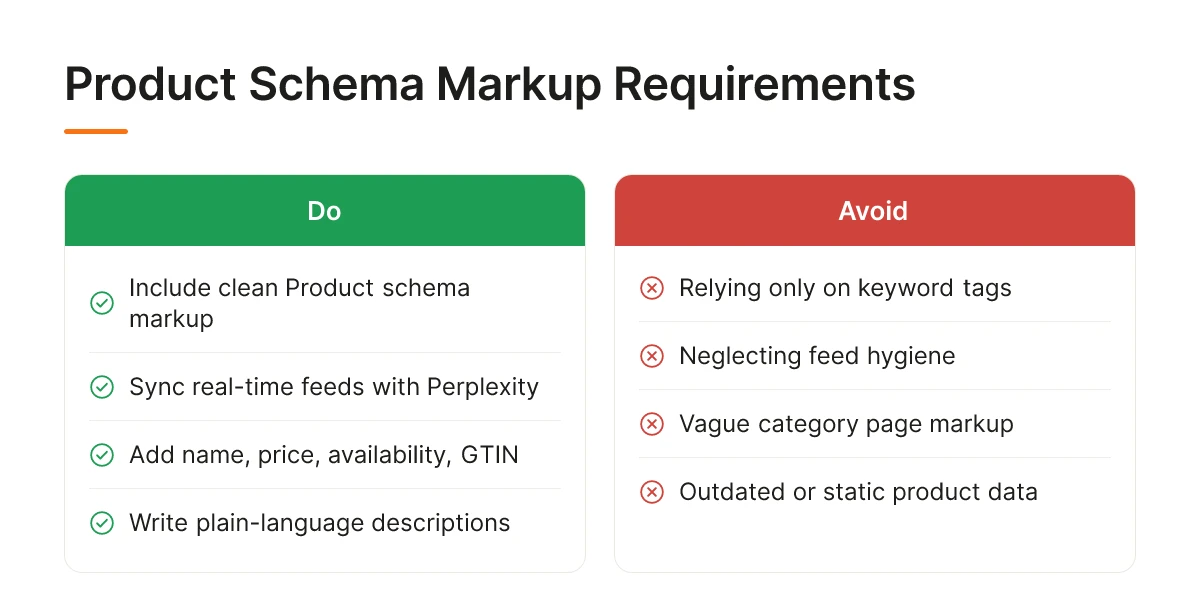
Perplexity needs clean Product schema markup, synced real-time feeds, and plain-language descriptions, not just the keyword tags that satisfy a traditional search crawler.
What Feed Format and Schema Markup Does Perplexity Require?
Product schema markup is the structured data that tells AI engines exactly what you're selling, name, price, availability, GTIN, and review data, formatted so a machine can parse it without guessing. Perplexity's retrieval model depends on this structure to match a shopper's question to a specific item rather than a vague category page.
Feed hygiene matters just as much as the markup itself. Product titles need to stay consistent between your feed and your live page, attributes like size, material, and color should sit in structured fields rather than buried in a paragraph, and pricing or stock status has to update in both places at the same time. A feed that says "in stock" while the product page says "sold out" breaks the trust Perplexity's answer engine depends on, and inconsistent SKUs across the two are one of the fastest ways to get dropped from consideration entirely.
How Should Product Data Differ for Perplexity Versus Traditional Search Engines?
Google rewards pages that rank for a keyword; Perplexity rewards sources it can confidently cite in a generated answer, which means it leans harder on real-time retrievability and descriptions that read like natural answers to a question [5]. A listing built purely around keyword density can still rank on Google while never surfacing in a Perplexity response, because Perplexity's citation selection has more to do with whether a source clearly answers a specific query than whether it's optimized for search volume [4]. This is where Perplexity ecommerce citations diverge sharply from classic SEO practice. Instead of writing "best waterproof hiking boots men," a product description that answers "which hiking boots stay dry in heavy rain and fit wide feet" gives Perplexity a direct, intent-matchable passage to cite.
Common technical blockers quietly break this chain. Product pages rendered entirely through JavaScript can leave bots unable to retrieve price or availability data, missing alt text strips out a signal Perplexity uses to confirm what's pictured, and SKU mismatches between your feed and your site create the same kind of inconsistency that undermines trust in a citation. Teams chasing durable Perplexity ecommerce citations should treat feed accuracy, schema completeness, and natural-language product copy as one connected system, not three separate to-do lists, fixing one while ignoring the others still leaves gaps an AI shopping engine can't parse around. Moonrank's technical audit addresses this directly, implementing schema markup and structured data so AI engines can parse and trust a store's product catalog without manual cleanup from the owner.
How Do Perplexity's Citation Mechanics Compare to ChatGPT Shopping and Google AI Overview?
Perplexity blends live web crawling with merchant product feeds, ChatGPT Shopping leans on direct merchant partnerships, and Google AI Overview mostly repackages existing Shopping feed data, three different pipelines with three different use points.
Each platform sources products through a distinct mechanism, and that mechanism determines what work actually moves the needle. Perplexity's answer engine draws from indexed pages and structured feeds together, generating a single conversational answer built from whatever sources it judges most relevant to the query [5]. ChatGPT Shopping works more like a curated marketplace, relying on merchants who've set up direct data partnerships or product feeds recognized by OpenAI. Google AI Overview, by contrast, draws heavily on Google Shopping feeds and Merchant Center data that stores have likely maintained for years, meaning a merchant's existing Google investment carries over directly.
Which AI Shopping Platform Drives the Most Qualified Traffic Right Now?
The platform most likely to send ready-to-buy visitors is the one that matches purchase-intent queries to specific, well-documented products rather than general category terms. Perplexity's citation model rewards pages that answer a specific comparison or recommendation question directly, so a shopper asking for a shortlist of products arrives already primed to choose rather than browse. Adobe Analytics data cited by Shopify found that AI-referred shoppers converted 31% more than visitors from other sources and were 33% less likely to bounce [1], evidence that when an AI platform does cite a store, the resulting visit tends to be a qualified one, even if citation volume itself stays uneven across platforms.
Citation freshness is where the platforms diverge most. Perplexity updates more dynamically, pulling from live pages at query time, while Google AI Overview tends to lean on previously indexed Shopping data that refreshes on its own schedule [1]. That gap matters for merchants running flash sales or frequent price changes, a store's Perplexity ecommerce citations can reflect today's inventory, while a Google Overview citation might show yesterday's.
None of this means picking one platform and ignoring the others. Clean schema markup, accurate product attributes, and clear pricing data improve visibility across all three systems simultaneously, since each one ultimately needs the same structured signals to trust a product listing [1][2]. Optimization work built for Perplexity ecommerce citations rarely gets wasted, it compounds across every AI shopping surface a store wants to appear on.
What's the Real ROI of Getting Cited by Perplexity?
Perplexity citations rarely produce a traffic spike, the real return shows up as a smaller number of visitors who convert at a noticeably higher rate because they arrive already comparing specific products.
What Conversion Rates and Traffic Patterns Are Ecommerce Stores Seeing From Perplexity Citations?
A shopper who asks Perplexity to compare three hiking boots has already done the research most browsers skip. By the time Perplexity cites your product page, that visitor isn't window-shopping, they're deciding between you and two named competitors. Adobe Analytics data shows AI-referred shoppers convert 31% more than visitors from other sources and are 33% less likely to bounce [1], which lines up with how this traffic behaves: fewer sessions, more intent per session.
That tradeoff matters for how you measure Perplexity ecommerce citations. Don't assume a fixed conversion lift and extrapolate from it. Instead, segment Perplexity as a distinct referral source in Google Analytics or your attribution tool, separate from generic "AI traffic" or dark social, and track its conversion rate against your site average over a full quarter. The volume will look small next to organic search. The behavior underneath it, add-to-cart rate, average order value, time to purchase, is what tells you whether the channel is working.
Why ROI Builds Gradually, Not Overnight
Citation frequency grows as Perplexity's crawlers revisit your product feed, structured data, and third-party mentions over repeated cycles, not in a single pass [5]. Expect weeks of incremental movement before citations become consistent across related queries, not a single update that flips visibility on.
There's also a timing advantage worth naming. Traffic to US retail sites from AI sources grew 693% during the 2025 holiday season [1], and most store owners in a given category still haven't touched their product data for AI retrieval. Being cited now, while competitors haven't optimized, can produce outsized visibility that gets harder to win once the category catches up.
Treating this as ongoing, incremental work, rather than a one-time project billed at agency rates, keeps the cost proportional to the gradual way the payoff actually arrives.
What Tools Help Ecommerce Stores Scale Perplexity Ecommerce Citations?
A category of AI visibility software now tracks whether a store gets cited across Perplexity, ChatGPT, Gemini, and Claude, then flags the technical gaps blocking better coverage.
These tools do three concrete jobs. First, they monitor citation frequency, running the kinds of product and comparison questions shoppers actually ask, then recording whether your store shows up in the answer and how often. Second, they audit structured data: missing schema markup, thin product descriptions, or absent review markup are common reasons a store with strong Google rankings still gets skipped when Perplexity assembles a cited answer [5]. Third, they surface competitor citation patterns, showing which rival stores get pulled into answers for the same queries and why their product pages might be easier for Perplexity's retrieval system to parse and trust. Manual versions of this work exist, a technical SEO consultant can run prompt tests by hand and audit schema line by line. But that approach doesn't scale for a store with a few hundred SKUs, and it needs repeating every time a product catalog changes or Perplexity adjusts how it selects sources [4].
How Can SMBs Automate Perplexity Optimization Without Hiring an Expensive AI SEO Agency?
Automated platforms replace hourly consulting work with scheduled audits, continuous visibility tracking, and content publishing that runs without a business owner lifting a finger.
For a store owner without a dedicated technical SEO hire, this matters because the alternative is choosing between two costly paths: paying an agency retainer for ongoing optimization, or letting Perplexity ecommerce citations happen by accident. A budget-friendly, self-serve platform sits between those options, it handles the schema fixes, the llms.txt configuration, and the daily content output that signals freshness to AI crawlers, at a fraction of agency cost. Agencies typically charge premium monthly retainers for this kind of ongoing technical work; a self-serve SaaS tool compresses that into a single affordable subscription.
Moonrank was built for exactly this gap. It runs daily automated content publishing, fixes structured data and schema issues, and tracks how often your store gets recommended across ChatGPT, Gemini, Claude, and Perplexity, all without requiring a store owner to write a line of code or a single blog post. For ecommerce brands trying to earn consistent Perplexity ecommerce citations without hiring a $3,000-a-month agency, www.moonrank.ai is a practical place to start tracking and improving that visibility today.
Frequently Asked Questions
Can small or niche ecommerce stores realistically compete with major retailers for Perplexity citations?
Yes, Perplexity weighs source relevance and clear product data over brand size, so a well-structured niche store can out-cite a major retailer on specific queries. Perplexity's model rewards sources that get cited in generated answers, not domains with the biggest ad budgets [5]. A small store with accurate feeds, clean schema, and detailed specs often beats a generic big-box listing for narrow searches.
Does Perplexity use Google Shopping feeds or require its own separate feed?
Perplexity doesn't require a separate proprietary feed, but it draws on structured product data similar to what powers Google Shopping. Merchants should keep product feeds, schema markup, and merchant data accurate and current, since Perplexity blends conversational search with real-time product data rather than a single dedicated feed format [2].
How often does Perplexity re-crawl product pages to update prices and availability?
Perplexity hasn't published a fixed re-crawl schedule for product pages. Because its citation behavior favors sources with current, verifiable information, stores that update prices, stock status, and availability promptly on-page are more likely to stay accurately represented between crawls [4].
Do customer reviews affect whether Perplexity cites a product?
Reviews likely play a supporting role rather than a direct ranking factor, since Perplexity prioritizes relevance and transparent product information over promotional signals [2]. Detailed reviews that add context, sizing, use cases, comparisons, can still strengthen the underlying page content Perplexity draws from when generating an answer.

Conclusion
Getting cited by Perplexity comes down to three things: structured, current product data; content that directly answers comparison and recommendation questions; and technical signals, schema markup, clean feeds, verifiable specs, that let Perplexity's model trust what it's reading. Store size matters less than data clarity. A niche retailer with precise product pages can out-cite a household name with messy markup.
Start by auditing one high-traffic product page this week: check its schema, confirm pricing and stock are current, and see whether the copy actually answers "what is this best for." For stores that want this handled automatically across every page, Moonrank builds the schema, llms.txt setup, and daily content Perplexity and other AI engines look for, visit moonrank.ai to get started.
Sources & References
- Perplexity Shopping: How to Optimize Your Store for AI (2026) - Shopify
- Perplexity Shopping Is Changing the Way We Shop Online
- How Perplexity Decides Which Sources to Cite: 4 Stages
- Perplexity Ecommerce: Why Your Store Doesn't Appear and How to Check, Arbling
Recommended Articles
Explore more from our content library: