A Complete Answer Engine Optimization Guide for Modern SMBs
Answer engine optimization helps SMBs get cited by ChatGPT, Gemini, Claude, and Perplexity through structured data and extractable content. Learn how.
Answer engine optimization (AEO) is the practice of structuring your content and technical SEO so that AI search tools like ChatGPT, Gemini, Claude, and Perplexity recommend and cite your business directly in their answers. Unlike traditional SEO, which competes for blue links on a results page, this discipline focuses on becoming the source an AI model quotes or links to when a user asks a question. For SMBs, this means clear structured data, direct answers near the top of pages, and consistent factual signals across the web, not just keyword-targeted pages built to rank.
What Is Answer Engine Optimization and How Does It Differ from Traditional SEO?
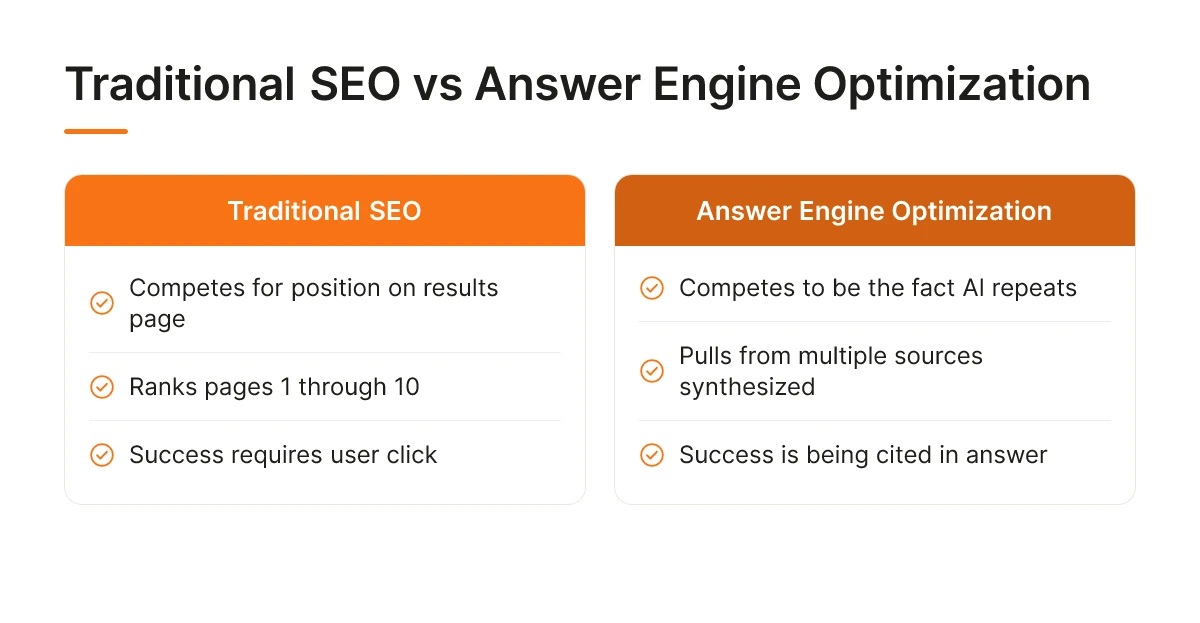
Traditional SEO competes for position on a results page; this approach competes to be the fact an AI model repeats back to the person asking.
That's a different contest. Google SEO has spent two decades training businesses to chase rank 1 through 10, because a click only happens if a page shows up on that page. AI engines like ChatGPT, Gemini, Claude, and Perplexity skip the list entirely, they pull from several sources, synthesize them into one answer, and hand the user a conclusion instead of ten blue links [1]. Winning no longer means outranking nine competitors. It means being one of the two or three sources the model trusts enough to cite.
For an e-commerce brand or a B2B SaaS company, that shift changes what "good content" even means. A product page built to rank for "best inventory management software" needs keyword density and backlinks. A page built for this purpose needs a direct, extractable answer near the top, clean structured data, and facts that stay consistent across the web, because the model is cross-checking, not just crawling.
Why Is Answer Engine Optimization Becoming Critical for SMBs Right Now?
Buyers are skipping the search results page altogether and asking AI tools for a direct recommendation, which shrinks the window where an SMB can win a click through ranking alone.
Coursera's overview of this practice cites Semrush data showing visitors who arrive through AI search convert at 4.4 times the rate of traditional organic traffic in 2025 [2]. That means the leads showing up through AI engines aren't just extra traffic, they're better qualified, because the AI already did the filtering before sending the user anywhere. An SMB that isn't cited in that answer doesn't lose a ranking spot; it loses the conversation entirely.
What Are the Risks of Relying Solely on Answer Engine Optimization?
AEO citations often inform a buyer's decision without generating a click, so a business that drops traditional SEO entirely can lose measurable traffic.
Being quoted inside an AI answer builds trust and awareness, but it doesn't always put a visitor on your site the way a search result does. Siteimprove notes that brands earning citations inside AI responses see meaningfully higher organic and paid click-through rates than brands that aren't cited [4], but that lift compounds on top of existing SEO work, not instead of it. This is an additional layer built on solid technical SEO, not a replacement for it. Moonrank treats both as one system: daily content publishing and technical fixes like schema markup and llms.txt configuration feed the same foundation that ranking and citation both depend on.
How Do AI Search Engines Decide Which Sources to Recommend and Cite?
AI engines pull content through retrieval-augmented generation, then rank it by how clearly it answers a question and how much they trust the source. This is the mechanical core of the practice, understanding it tells you exactly what to fix on your site.
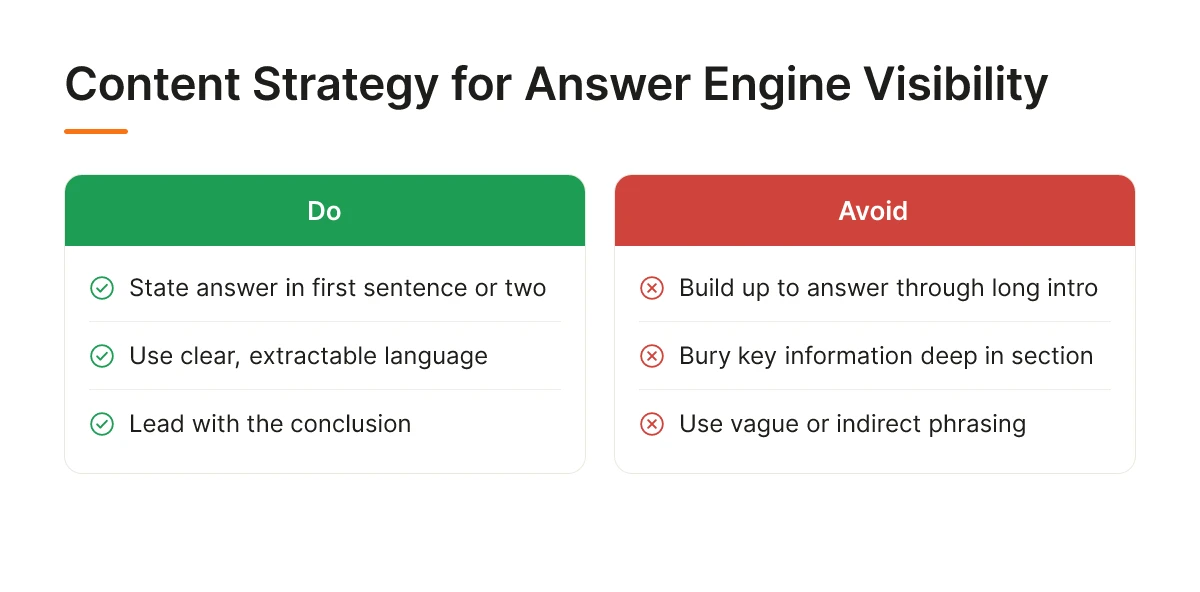
Retrieval-augmented generation, or RAG, works by searching an index of web content for passages that match a user's query, then feeding those passages to the language model as grounding material before it writes a response. The model favors pages that state an answer in the first sentence or two of a section rather than building up to it through a long introduction. If your product page buries the answer to "does this integrate with Shopify" three paragraphs deep, the engine has to work harder to extract it, and it often skips you for a competitor who states it upfront.
Do Different AI Engines Rank and Cite Sources Differently?
Yes, Perplexity leans heavily on live web retrieval and shows visible citations for nearly every claim, while ChatGPT and Claude often blend training data with occasional browsing, making them less transparent about sourcing [1]. Perplexity's model is closer to a live search engine: it fetches current pages at query time and links directly to them, which is why single-page optimization can move the needle faster there. ChatGPT and Claude, by contrast, draw on a mix of pre-trained knowledge and plugin-based browsing, so a single well-optimized page matters less than whether your brand shows up consistently across many pages, reviews, and third-party mentions over time. HubSpot frames this discipline as improving how often and how accurately a business appears across this mix of engines [1], which is a different job than ranking for a single Google query.
What Trust Signals and Content Structures Do Answer Engines Prioritize?
Answer engines weigh clear authorship, factual consistency across multiple pages on the web, and recent publish or edit dates as proxies for trustworthiness. If three different pages, your site, a review platform, and a directory listing, state three different founding years or price points for your business, that inconsistency makes every one of those sources less citable. Content written as direct question-and-answer blocks with scannable headers gets extracted more easily than long narrative paragraphs, because the model can lift a clean answer without having to summarize or interpret it [2] [3].
This is also where enterprise research backs up the stakes: brands cited inside AI answers earn meaningfully more organic and paid clicks than brands that are technically visible but never cited [4]. Moonrank builds this structure in automatically, daily content generation, schema markup, and llms.txt configuration, so a business doesn't need to manually audit every page for Q&A formatting and date consistency.
The core trust signals worth tracking include:
- Consistent facts across sources: your site, directories, and review platforms should state the same founding year, location, and pricing tier.
- Clear authorship: pages with a named author or identifiable organization behind them read as more credible to extraction models.
- Recent publish or edit dates: content refreshed regularly signals that the information is still accurate.
- Scannable Q&A formatting: direct questions paired with concise answers are easier for a model to lift cleanly.
- Third-party corroboration: mentions on review sites, directories, and press coverage reinforce what your own site claims.
What Technical and Content Strategies Improve Answer Engine Visibility?
This work comes down to three things: structured data that tells AI engines what your business does, content written to be extracted in one or two sentences, and a site that crawlers can actually read. Get those right and citation becomes a technical outcome, not a guessing game.
How Should You Implement Structured Data for AI Parsing?
Schema markup is structured data added to your site's code that tells AI engines exactly what your business does, instead of making them guess from paragraphs of text. Three types matter most for citation: For more information, see Answer.
- FAQ schema marks up question-and-answer pairs so engines can lift them directly into a response.
- Organization schema defines who you are, business name, location, contact details, social profiles, which helps AI engines verify you're a real, trustworthy entity.
- Product schema structures price, availability, and specifications so an engine can cite exact details rather than paraphrase them wrong.
Content structure matters as much as the markup. Write answer-first: open the page or section with a direct one- or two-sentence answer to the question it targets, then follow with supporting detail. This mirrors how answer engines extract snippets, they favor the first clear statement over content buried three paragraphs down [1].
None of this works if the crawler can't read the page. AI crawlers need HTML they can parse directly, not content that only renders after JavaScript executes. Pair that with fast load times and a clean sitemap so every page gets discovered and indexed in the first place. Siteimprove's research frames this as the core gap enterprise teams miss, content can be technically live and still invisible to answer engines if it's not structured for extraction [4]. For a broader primer on the fundamentals, Coursera's guide walks through how these signals fit together.
What AEO Strategies Work Best for Niche Industries?
Generic advice only goes so far, the highest-use tactic changes by vertical. Ecommerce stores get the most lift from structured product data and review schema, since AI engines lean on verified ratings and specs when recommending "best" products in a category. B2B SaaS companies benefit from clear feature-comparison pages that state plainly what the product does and doesn't do, giving engines an unambiguous basis for recommendation. Cybersecurity firms gain citation weight by publishing and linking their own documented methodologies, since answer engines favor sources that show their work. Hotels and hospitality brands should prioritize structured local and amenity data, address, room types, amenities, proximity to landmarks, formatted so engines can match them to "near me" and comparison queries.
One emerging file worth watching: llms.txt, a simple instruction file placed at the root of a site that tells AI bots which content to prioritize when crawling, similar in spirit to a robots.txt file but aimed at language models rather than search spiders. It's not yet universally adopted, but it's a low-effort way to signal priority content.
This is exactly the stack Moonrank automates: schema markup, llms.txt configuration, and structured data get implemented as part of its technical AI audit, so SMBs don't need to hand-code any of it.
How Can You Measure and Track Answer Engine Optimization Success?
Track success by counting citations, not clicks, measure how often AI tools mention your brand by name when answering questions in your category, then log it monthly.
Traditional SEO trains you to watch rankings and click-through rate. This practice asks a different question: did ChatGPT, Gemini, Claude, or Perplexity mention your business at all, and did they get the details right? A citation inside an AI answer often never produces a click, but it still shapes the buyer's shortlist before they ever visit a website.
What ROI Metrics and KPIs Should SMBs Track?
Two KPIs matter most: citation frequency and referral traffic. Citation frequency means picking 10-20 questions your customers actually ask, "best project management tool for a 10-person team," "hotel near the convention center with late checkout", and checking, by hand or with a tracking tool, whether your brand shows up in the answer.
Referral traffic is the second signal, and it's one most analytics setups already capture without you realizing it. When someone clicks through from a Perplexity answer or a ChatGPT response with browsing enabled, that session lands in your analytics as its own referral source, separate from organic Google traffic. Treat it as a distinct line item, mixing it into "organic search" hides the one number that proves the work is paying off. Industry data already shows this traffic converts well: Semrush found AI-referred visitors convert at 4.4 times the rate of traditional organic search visitors in 2025 [2], and Siteimprove reports brands cited in AI answers see 35% more organic clicks and 91% more paid clicks than brands left out [4].
How Do You Benchmark Visibility Against Competitors?
Run the identical set of target questions across all four AI platforms and record which competitor gets cited, how often, and in what position. If a competitor shows up consistently and you don't, pull up their site and check what you're missing, structured FAQ pages, schema markup, comparison content, third-party reviews the AI model trusts as a source.
This is manual, repeatable work: same questions, same platforms, logged on a spreadsheet every few weeks. Moonrank's visibility tracking layer automates this comparison across ChatGPT, Gemini, Claude, and Perplexity so you're not running the same ten prompts by hand each month.
Expect slow, compounding movement rather than daily swings, check monthly, not daily, since AI models update their indexes and trust signals on their own schedule, not yours.
What Tools Can Help SMBs Automate Answer Engine Optimization?
A growing category of software tracks brand visibility across AI engines, flags technical gaps, and publishes content automatically, so SMBs don't need to hire an in-house SEO team to compete in this space.
These tools generally handle three jobs at once: monitoring whether a business gets mentioned when someone asks ChatGPT, Gemini, Claude, or Perplexity for a recommendation; auditing the technical signals, schema markup, llms.txt files, structured data, that determine whether AI engines can parse and trust a site; and publishing fresh, optimized content on a regular schedule to close whatever gaps the monitoring turns up. Before this category existed, SMB owners had two options, and neither fit well. Enterprise platforms built for traditional keyword ranking and backlink analysis bolt on AI visibility as an afterthought, built for teams with dedicated analysts, not a restaurant owner managing marketing between shifts.
That leaves two real paths. Hiring an agency means premium monthly retainers for strategy calls, slow content cycles, and reporting that may or may not connect to actual AI citations. Automated platforms flip that: lower, predictable cost, and content that publishes daily instead of monthly, with no agency account manager in between.
How Does Moonrank Help SMBs Get Recommended Without Expensive Agency Fees?
Moonrank runs both halves of the job on autopilot. It tracks whether your business shows up in recommendations across ChatGPT, Gemini, Claude, and Perplexity, then automatically publishes SEO content daily and applies the technical fixes, schema markup, llms.txt configuration, citation building, needed to close the gaps it finds. The keyword research and competitive analysis behind that content is specific to your niche, not a generic template pulled from a broader industry list.
The product exists for one reason: SMBs can't justify a premium monthly agency retainer, but they also can't ignore AI search traffic without losing customers to competitors who do show up. Moonrank is built, with a short free trial, so a Shopify store owner, a B2B SaaS founder, or a boutique hotel manager can get the tracking and publishing an agency would otherwise provide, without the retainer or the learning curve. For a closer look at how the tracking and automation work together, visit www.moonrank.ai.
Frequently Asked Questions
Is answer engine optimization replacing traditional SEO?
No, it's working alongside SEO rather than replacing it entirely. Google still drives meaningful traffic, so technical SEO fundamentals like site speed and crawlability still matter. But this practice addresses a separate channel, ChatGPT, Gemini, Claude, and Perplexity, where ranking signals and citation logic differ enough that treating them as one strategy leaves visibility gaps [1].
Can small businesses realistically compete for AI citations against larger brands?
Yes, AI engines cite based on content clarity and structured trust signals, not domain authority or ad budget alone. A well-organized local business page with clean schema markup and specific answers can get cited over a larger competitor with bloated, unstructured content. The playing field is more level than in traditional Google rankings, at least for now.
How long does it take to see results from answer engine optimization?
Most businesses start seeing early citation changes within 4 to 8 weeks of consistent technical and content work. Full visibility gains typically build over several months, since AI engines need repeated signals, fresh content, consistent schema, growing citations, before trusting a brand enough to recommend it regularly.
Does answer engine optimization work the same way for ecommerce and B2B SaaS businesses?
No, the mechanics shift based on what buyers ask AI engines in each category. Ecommerce brands need product-level citations, reviews, comparisons, "best X for Y" answers, while B2B SaaS companies need AI engines to cite feature comparisons, integration details, and use-case fit. Both rely on structured data and clear, extractable content, but the keyword targeting and content format differ significantly.
Do you need separate content for each AI platform?
No, a single well-structured page can serve all four major platforms at once, since RAG-based engines pull from the same underlying web content regardless of which model is generating the final answer. What changes is emphasis, Perplexity rewards single-page clarity more directly, while ChatGPT and Claude weigh consistency across many pages over time.
Conclusion
This practice comes down to three things: structured data AI engines can parse, content that answers specific questions clearly, and consistent publishing that builds trust over time. Ecommerce brands need product-level citations; B2B SaaS companies need feature and use-case clarity. Neither happens from a one-time audit, it requires daily attention most owners don't have time for.
That's the gap Moonrank was built to close. Start a free trial at www.moonrank.ai and see how your business currently shows up, or doesn't, across ChatGPT, Gemini, Claude, and Perplexity.
Sources & References
- Show Up in AI Search with Answer Engine Optimization (AEO) | HubSpot
- What Is Answer Engine Optimization? | Coursera
- Introduction to Answer Engine Optimization - Webflow University
- What is Answer Engine Optimization, and Why Should Enterprise Marketers Care?
Recommended Articles
Explore more from our content library: