AI Model Training Data Search: How It Shapes Search Results
Learn how AI model training data search works—find, evaluate, and source datasets from public repos, licensed vendors, and synthetic generators compliantly.
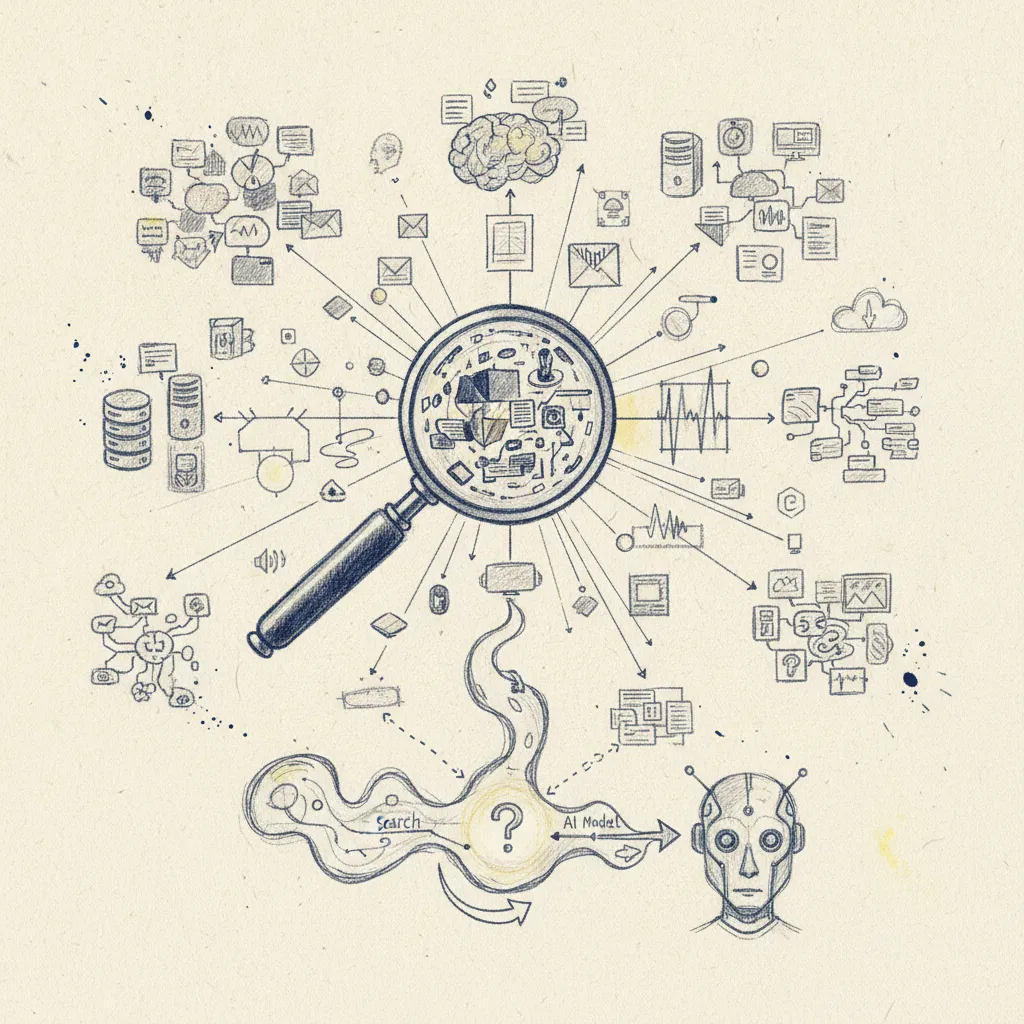
AI model training data search means finding, evaluating, and sourcing the datasets used to teach machine learning models how to perform tasks. You can pull data from public repositories like Hugging Face and Kaggle, licensed data vendors, web scraping pipelines, crowdsourcing platforms, or synthetic data generators. The right source depends on your use case, budget, and legal constraints, quality, diversity, and compliance matter as much as volume.
Where to Find Data for AI Model Training: A Source-by-Source Search Guide: AI model training data search
The five most reliable starting points for AI model training data search are public repositories, licensed vendors, web scraping, crowdsourcing platforms, and domain-specific archives.
Public Repositories and Domain-Specific Sources
Hugging Face Datasets hosts over 100,000 community-contributed datasets and is best for NLP, text classification, and generative AI tasks. Kaggle suits structured and tabular data challenges, with active community benchmarks. Google Dataset Search indexes datasets from across the web and works well for broad discovery. UCI ML Repository is the go-to for classical machine learning benchmarks, while Common Crawl provides petabyte-scale raw web text for pre-training large language models.
General repositories don't always fit specialized applications. For medical data, NIH's National Center for Biotechnology Information and PhysioNet offer clinical and physiological datasets with strict access controls. Legal practitioners use PACER and CourtListener for case law corpora. Multilingual training benefits from OPUS and CCAligned, which cover parallel text across dozens of language pairs. According to the National Institute of Standards and Technology (NIST), data quality and provenance are foundational to building trustworthy AI systems.
What Metrics Should You Use to Evaluate Training Data Quality?
Target a label accuracy rate of 95% or higher, anything below that threshold introduces systematic errors that compound during training. Inter-annotator agreement, measured with Cohen's kappa, should exceed 0.80 to confirm that labelers are applying consistent judgment rather than guessing.
Also check class balance ratios: a dataset where one category represents 90% of samples will produce a model that ignores minority classes. Coverage breadth, the range of linguistic styles, demographics, or edge cases represented, determines whether the model generalizes beyond its training distribution.
How Do Different Data Sources Compare in Terms of Cost and Reliability?
Public datasets are free but carry real trade-offs: Common Crawl data, for example, contains significant noise, outdated content, and potential copyright issues that require downstream filtering. Licensed vendors such as Scale AI, Appen, and RWS TrainAI [1] charge between $0.05 and $1.00 per labeled item but provide quality guarantees, defined turnaround times, and human-in-the-loop validation.
The volume-quality trade-off is direct: open-source sources can deliver millions of samples quickly, while a licensed vendor producing domain-specific annotated medical records may cap throughput at thousands per week. Budget and deadline together determine which option fits, not quality alone.
How to Gather and Prepare Training Data for AI
Gathering AI model training data follows a seven-stage workflow: define requirements, source data, collect it, clean it, annotate it, validate it, then version and store it.
Each stage builds on the last. Skipping data cleaning before annotation, for example, forces annotators to label malformed or duplicate records, wasted effort that degrades final model quality.
What are the step-by-step validation techniques for training data?
Validation is where raw inputs become trustworthy model-ready data. Four techniques cover the most critical failure modes:
- Holdout set testing: Reserve 10–20% of your dataset before any model training begins. This set never touches training runs and gives an unbiased accuracy benchmark.
- Cross-validation splits: Divide the remaining data into k folds (typically 5 or 10) and rotate which fold acts as the validation set. This catches variance that a single holdout split can miss.
- Adversarial testing: Deliberately inject edge cases, rare language patterns, unusual image angles, low-signal audio, to expose brittleness before deployment.
- Automated schema checks: Run rule-based checks that flag malformed records (missing fields, out-of-range values, encoding errors) before a single training epoch runs.
Data augmentation reduces how much raw data you need to collect in the first place. For images, horizontal flipping and random cropping multiply labeled examples at near-zero cost. For NLP tasks, synonym replacement preserves label meaning while diversifying phrasing. For audio models, noise injection improves robustness to real-world recording conditions.
Annotation quality depends on who does the labeling. In a human-in-the-loop model, crowdsourced labelers produce first-pass labels at scale, domain experts review ambiguous or edge-case records, and a quality audit layer samples 5–10% of final annotations to catch systematic errors before they enter training.
"The quality of training data is the single most important factor in determining AI model performance — more impactful than model architecture or compute budget in the majority of real-world deployments." — Andrew Ng, Founder of DeepLearning.AI and Adjunct Professor at Stanford University
What tools and frameworks can you use to implement data collection and annotation?
Matching the right tool to each stage of an AI model training data search workflow prevents both under-engineering and over-engineering:
- Collection: Beautiful Soup parses static HTML pages; Scrapy handles large-scale crawls with built-in request throttling and pipelines.
- Annotation: Label Studio is an open-source option that supports text, image, audio, and video labeling in one interface. Scale AI provides managed human annotation at enterprise volume.
- Validation: Great Expectations lets teams define data contracts in Python and run automated suite tests against incoming batches. Pandera integrates directly with pandas DataFrames for lightweight schema enforcement.
- Versioning: DVC (Data Version Control) tracks dataset versions alongside Git commits, so every model run is reproducible and every data change is auditable.
No single tool covers the full pipeline. Teams that treat these stages as separate engineering concerns, with dedicated tooling and ownership at each step, consistently produce cleaner datasets than those that handle everything in ad-hoc scripts.
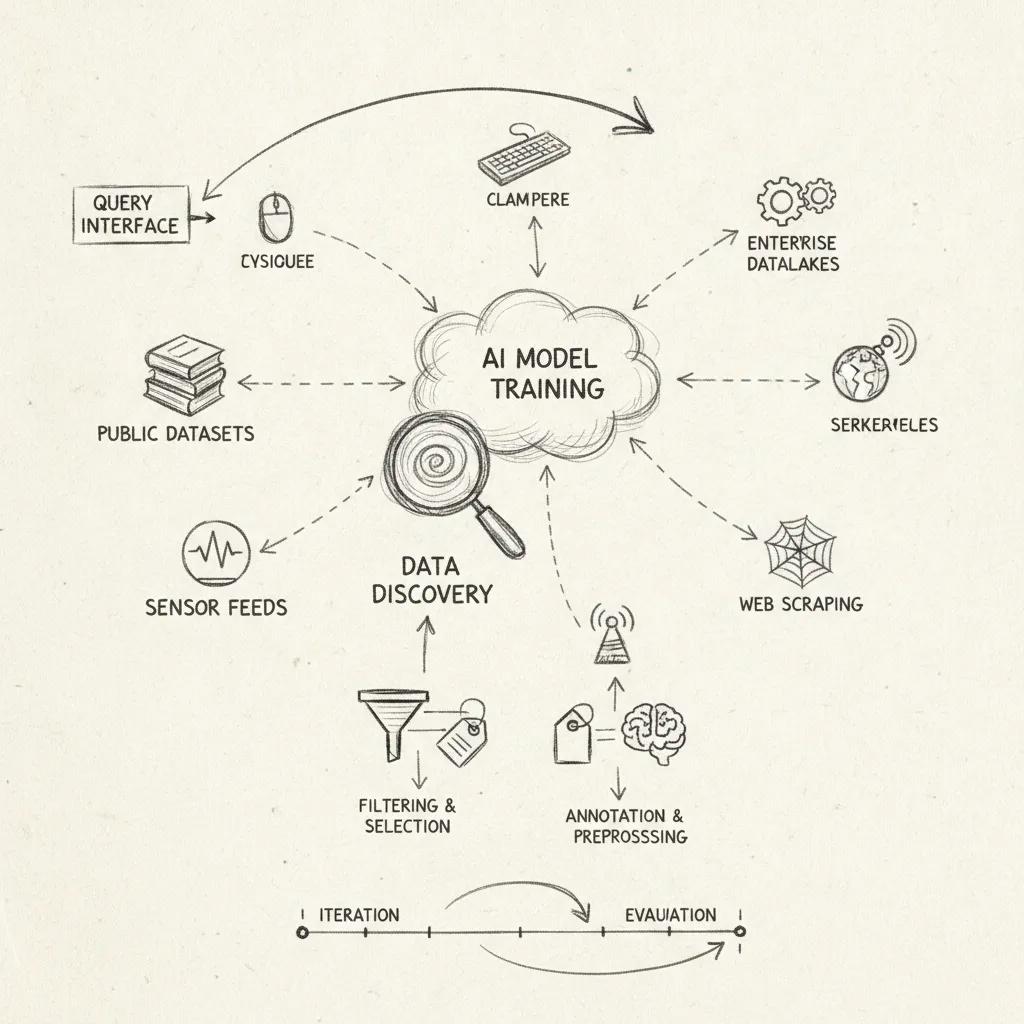
Synthetic, Real-World, and Crowdsourced Training Data: Key Differences
The three main AI model training data types each offer distinct trade-offs in cost, quality, and legal risk, and most production teams use all three together.
What Are the Pros and Cons of Each Training Data Source Type?
Synthetic data is algorithmically generated using tools like GANs (generative adversarial networks) or simulation engines such as NVIDIA Omniverse. It carries no privacy risk and scales without limit, but it risks a "sim-to-real gap," where a model trained on simulated data underperforms against real-world inputs.
Real-world data is captured from live environments: sensor feeds, user interactions, medical records, and web text. It delivers high fidelity to actual conditions, but collecting and labeling it is expensive, and it frequently raises privacy and consent concerns.
Crowdsourced data is human-labeled through platforms like Amazon Mechanical Turk or Toloka. It scales cost-effectively, but annotator bias and inconsistent quality are persistent problems that require quality-control layers to manage.
Cost benchmarks clarify the gap between methods. Synthetic generation via a cloud simulation platform can cost under $0.001 per sample. Crowdsourced annotation on Mechanical Turk averages $0.01–$0.05 per task. Proprietary real-world dataset licensing, by contrast, can run $10,000–$500,000+ depending on the domain.
How Do You Choose the Right Data Collection Method for Your Use Case?
Match the method to the scarcity and sensitivity of real data. Synthetic data suits autonomous vehicle training and medical imaging, where live examples are rare or legally restricted. Real-world data is essential for NLP models that must reflect natural language drift, slang, regional variation, and evolving usage patterns that simulations cannot replicate.
Crowdsourcing works well for image classification and sentiment labeling at volume, where speed and scale matter more than specialist knowledge.
When conducting an AI model training data search for a production system, most teams adopt a hybrid strategy: real-world data forms the core training set, synthetic data fills edge-case gaps, and crowdsourcing handles annotation at scale. This combination typically delivers the best quality-to-cost ratio across the full pipeline.
Legal and Compliance Issues to Consider When Sourcing AI Training Data
Sourcing AI training data carries real legal risk, GDPR, copyright law, and emerging AI-specific regulations can all expose your organization to fines, litigation, or forced data deletion.
How do data privacy, licensing, and copyright laws affect AI training data?
GDPR allows fines of up to 4% of global annual revenue for scraping or processing personal data without a lawful basis, and AI model training data search activities that pull identifiable individuals' information from public websites are not automatically exempt. Always verify whether a dataset contains personal data before ingestion, and run PII scrubbing as a standard pre-processing step. According to the Federal Trade Commission (FTC), organizations using AI systems must ensure data collection practices comply with consumer protection and privacy laws.
Copyright law adds a second layer of risk. The 2023 Getty Images v. Stability AI lawsuit and the ongoing NYT v. OpenAI case both center on whether using copyrighted content for model training constitutes infringement. Neither case has produced a final ruling, but both signal that "publicly available" does not mean "freely usable for commercial AI training."
License type determines what you can actually do with a dataset. Permissive licenses, CC0, MIT, Apache 2.0, generally allow commercial use. Restrictive licenses, CC-BY-NC or proprietary agreements, do not. Always read the license before you build on a dataset, not after.
Practical compliance checklist:
- Document data provenance for every source in your pipeline.
- Obtain written licenses for any commercial dataset.
- Run automated PII scrubbing before data ingestion.
- Maintain an audit trail of all data sources for regulatory review.
What does 'duty of care' mean in the context of AI training data?
A "duty of care" means organizations are responsible for ensuring their training data does not embed harmful biases, hate speech, or illegal content, regardless of where that data originated [2]. The Transparency Coalition has built a framework around this principle, and the EU AI Act formalizes it: enforcement obligations for high-risk AI systems begin in August 2026.
In practice, duty of care requires active data auditing, not passive sourcing. Pulling a dataset from a public repository and assuming it is clean is no longer a defensible position under emerging regulatory standards.
How to Build an AI Training Data Pipeline That Performs
A high-performing AI training data pipeline runs six sequential layers: ingestion, preprocessing, annotation, quality assurance, storage and versioning, and model feeding.
Each layer requires specific tooling. Use Apache Airflow or Prefect for orchestration across the full pipeline. Store raw and processed datasets in Amazon S3 or Google Cloud Storage. Version datasets and experiments with MLflow or DVC, this lets teams roll back to a prior data state when model performance degrades unexpectedly.
A concrete example shows how this works end-to-end: a computer vision team building a defect-detection model collects 50,000 real production images, applies synthetic transforms to expand the set to 200,000 samples, annotates in Label Studio, validates data contracts with Great Expectations, versions every dataset snapshot with DVC, and retrains the model weekly on new production data. That cycle, collect, augment, annotate, validate, version, retrain, is the repeatable structure any team can follow when conducting an AI model training data search for a new domain.
What is the cost-benefit analysis for different data collection methods?
In-house data collection specialists offer the tightest control over quality and domain coverage, but cost $80,000–$150,000 per year per specialist. Outsourced annotation vendors cut that cost by 40–60%, though coordination overhead and quality variance increase. Synthetic data pipelines carry high upfront setup costs but approach near-zero marginal cost per additional sample once the generation infrastructure is in place.
For most teams, a hybrid model performs best: use in-house staff to define labeling guidelines and audit edge cases, outsource volume annotation, and fill coverage gaps with synthetic generation.
How do you optimize ML pipeline performance with quality training data?
A Stanford study found that improving data quality by 10% outperformed model architecture changes in 7 out of 10 benchmark tasks, making data investment more ROI-positive than additional compute in many scenarios.
Three tactics drive continuous improvement. First, build feedback loops where model errors automatically flag the underlying training samples for re-annotation. Second, apply active learning to prioritize labeling the unlabeled examples the model is most uncertain about, this reduces annotation volume by up to 50% while preserving accuracy gains. Third, schedule quarterly data audits to remove stale or distribution-drifted records that silently degrade model performance over time.

Frequently Asked Questions
How much training data does an AI model actually need?
The amount depends entirely on the task: a narrow image classifier may need thousands of labeled examples, while a large language model like GPT-4 was trained on hundreds of billions of tokens. As a rough benchmark, simple classification models can perform well with 1,000–10,000 labeled samples per class, but models handling open-ended language generation require orders of magnitude more. Data quality consistently matters more than raw volume, a smaller, clean, well-annotated dataset outperforms a large noisy one for most supervised learning tasks.
Can you use data scraped from the web to train a commercial AI model?
Legally, it is contested, and the risk is real. Multiple ongoing copyright lawsuits center on exactly this question, including cases involving books scraped into the Books3 dataset [2] used to train models from Meta and Bloomberg without author permission [2]. Practically, web-scraped data also carries quality risks: noise, bias, and outdated information degrade model performance. Most enterprise AI teams now combine licensed data, synthetic data, and carefully vetted public datasets to reduce both legal exposure and data quality problems.
What is the difference between data annotation and data labeling?
Data labeling assigns a category tag to a piece of data, for example, marking an image as "cat" or "dog." Data annotation is broader: it adds richer metadata such as bounding boxes, sentiment scores, entity tags, or transcription text to help a model understand context, not just classification. In practice, many vendors use the terms interchangeably, but annotation typically implies more granular, structured markup that supports complex model architectures like object detection or named-entity recognition.
How do you handle class imbalance in AI training datasets?
Class imbalance, where one category has far more examples than another, causes models to favor the majority class and perform poorly on rare cases. The three standard fixes are oversampling the minority class (e.g., using SMOTE to generate synthetic examples), undersampling the majority class, and adjusting class weights in the loss function so the model penalizes errors on rare classes more heavily. Combining all three approaches, then validating with precision-recall metrics rather than raw accuracy, produces the most reliable results.
How can I check whether my data was used to train an AI model?
Several tools now exist to help creators and organizations investigate whether their content was included in AI training datasets. The Transparency Coalition's guide to AI training data search tools provides a curated overview of available resources, including dataset lookup tools and membership inference methods. These tools vary in accuracy and coverage, but they represent the most accessible starting point for anyone conducting an AI model training data search to audit their own content's inclusion.
Conclusion
Finding and preparing the right AI model training data is not a one-time task, it is an ongoing discipline that shapes every downstream decision, from model accuracy to legal exposure. Three things matter most: source your data from licensed or ethically collected channels to avoid the copyright liability now playing out in court [2]; prioritize annotation quality over dataset size; and build validation into the pipeline from day one rather than treating it as a final step.
If your business goal is to appear in AI-generated recommendations, not just train models, the same principle applies: the structured, well-organized content that AI engines like ChatGPT, Gemini, and Perplexity surface comes from sites that have done the technical groundwork. Start by auditing whether your site has schema markup and an llms.txt file in place, two signals that tell AI systems exactly what your business does. Moonrank runs that audit automatically and fixes the gaps for $99/month, without requiring any technical input from you.
Sources & References
- AI Training Data for ML Models and AI Applications, TrainAI, RWS
- TCAI Guide to Search Tools: Was Your Data Used to Train an AI Model?, Transparency Coalition. Legislation for Transparency in AI Now.
Recommended Articles
Explore more from our content library: